-
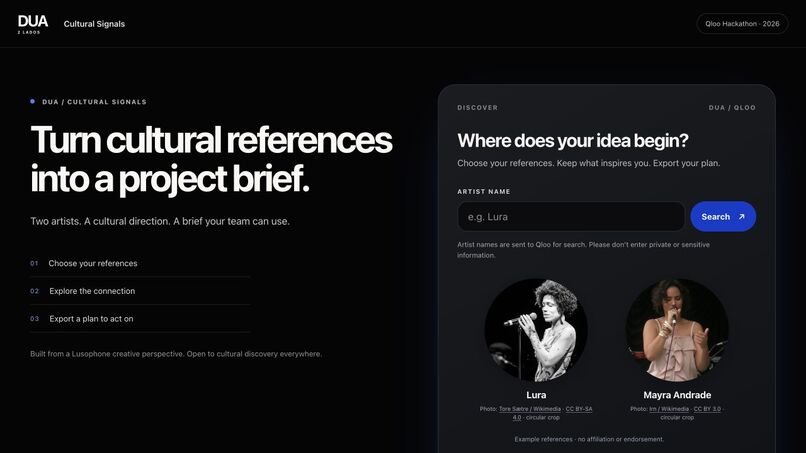
Start with Lura and Mayra Andrade, then explore real Qloo cultural references.
-
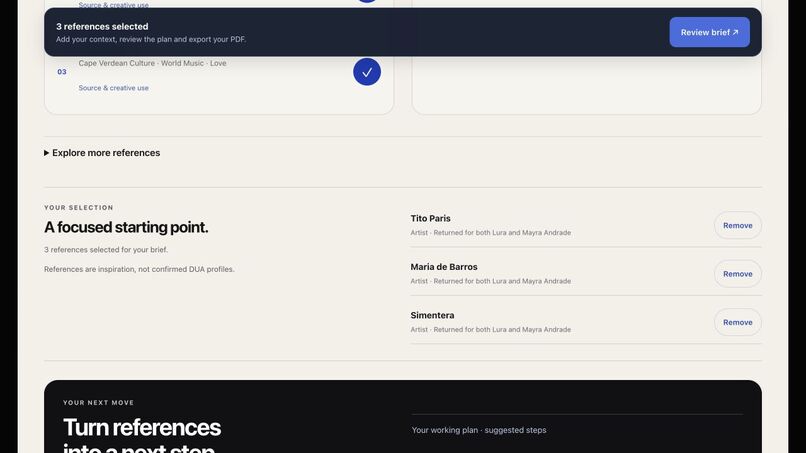
A curated selection with clear provenance, ready to become a creative brief.
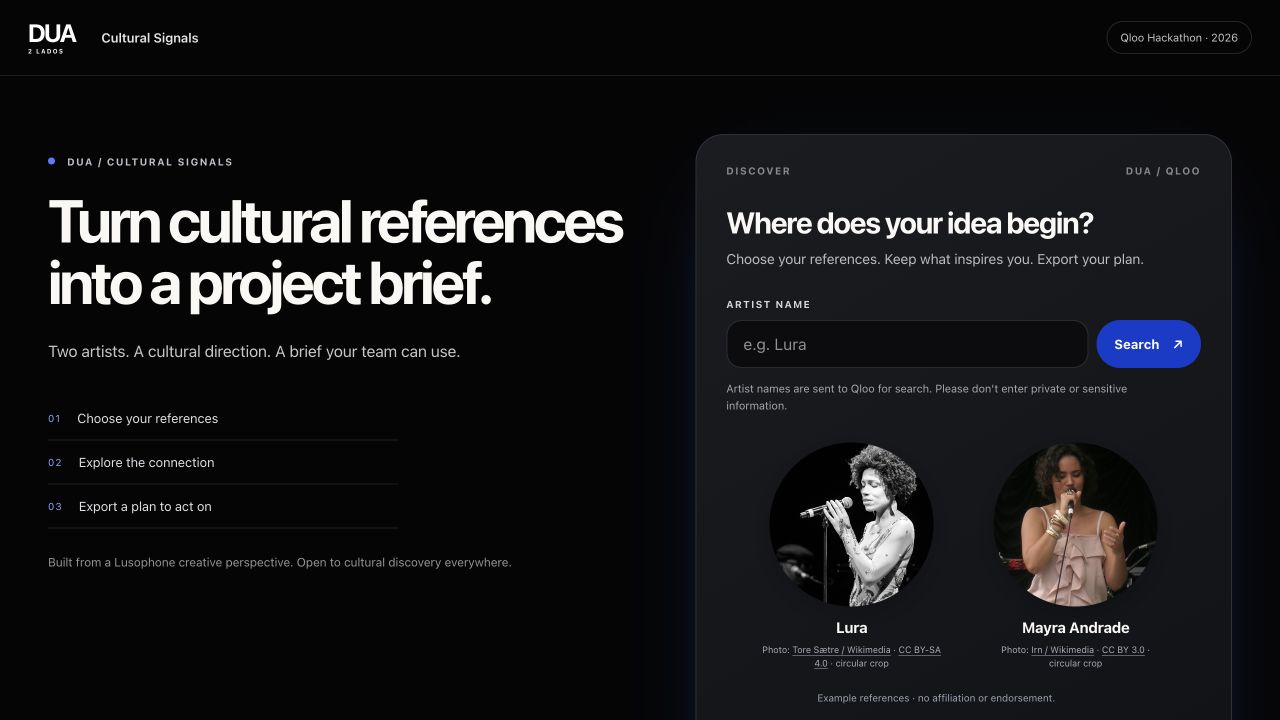
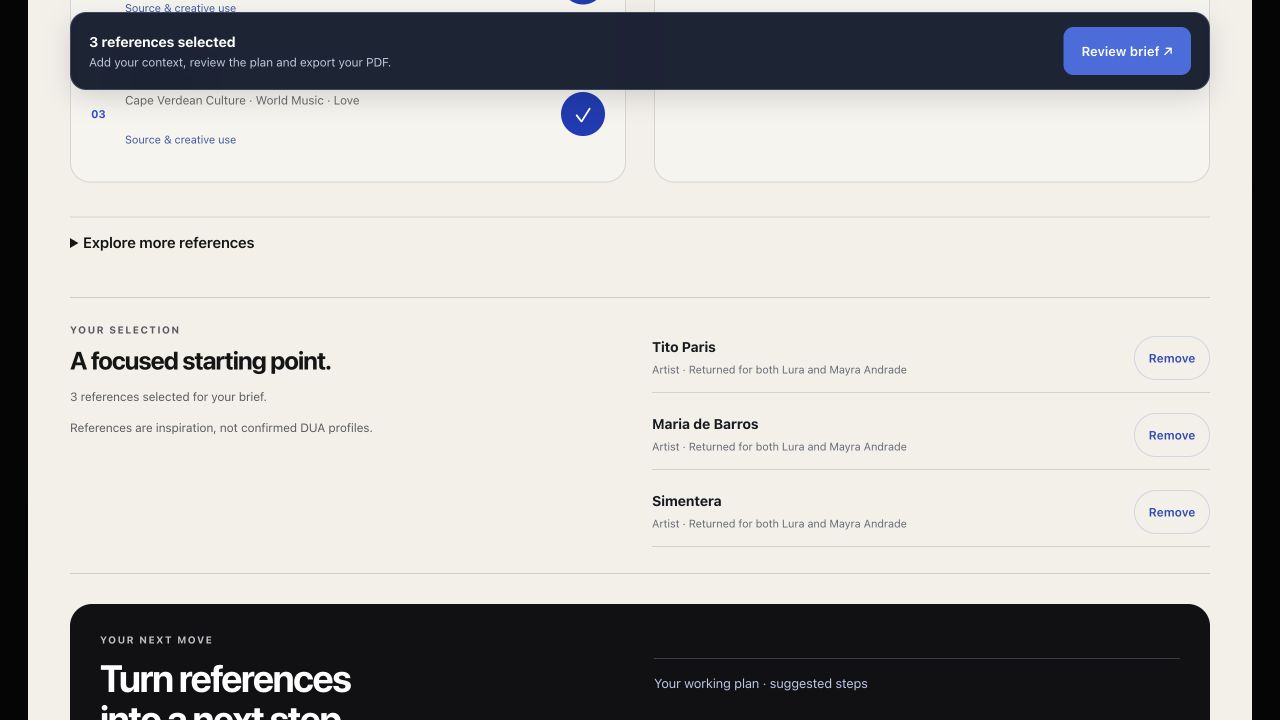
DUA Cultural Signals — Cultural Bridge
The idea
What if a cultural programmer could start with two artistic references and discover a research path between them, while seeing exactly where the evidence comes from?
DUA Cultural Signals helps creators prepare an event, collaboration or campaign by comparing music and film references returned by Qloo. It presents shared entities and direct connections in the returned samples, keeps the two individual perspectives visible, and lets the creator assemble an editorial PDF brief with a personal project note and sample-based charts.
Why I built this
I am Carlos Guedes, a musician and the founder behind 2 LADOS/DUA. I grew up in a social housing neighbourhood on the outskirts of Lisbon. Music and human connection shaped my path, including international music and human-rights projects and co-founding a community studio. That experience informs what I build: tools that help creators turn an intention into something they can discuss and develop with others.
DUA already brings together creative tools, Community, Radar and Market for Lusophone creators. Cultural Signals addresses a specific step: organising cultural references into a usable project brief. Qloo supports discovery; the creator chooses the direction. The result can become the starting point for a real conversation with a team.
The prototype works independently so judges can try it without a DUA account. Links to explore DUA Community and Radar separately are available today. Saving the brief into a DUA project, attaching it to a collaboration request and carrying an agreed scope into Market are proposed next integrations, not existing connections. No private DUA profiles, messages or account data are accessed.
How it works
- Search for each artist and confirm the correct Qloo identity.
- Choose a goal: a live showcase, a collaboration or a cultural campaign.
- The server re-verifies both identities and queries Qloo separately for artist and film insights. It compares up to six entities in each returned sample by Qloo entity ID.
- See whether one input artist appears in the other artist's music results, which entities are returned for both and which appear in only one of the limited samples. When the first artist and film samples have no shared entity, the tool automatically explores up to two additional artists, stops when it finds a path or a provider call fails, and reports each step or an honest no-match / unavailable outcome.
- Expand the research trace to see the verified identities, the size of the returned samples and why the workflow did or did not make further searches. Curate a shortlist, add project context, and download a PDF with sample-based charts, provenance and human review steps. Preview a collaboration note based on the selected references and the creator’s own context; copy and edit it for a later conversation. The prototype does not send messages automatically. Creators can open DUA Community separately; selected references are not assumed to have profiles there.
The default example uses Lura and Mayra Andrade. Known historical names encountered during development are editorially excluded. This is not an exhaustive life-status check: Qloo results are cultural references, not verified hiring candidates. A pair may have no common entities in the limited sample; the tool reports that honestly.
A tool agents can use
The bounded research workflow chooses whether to perform additional Qloo searches based on the initial results and explains each path. It is available through structured search and comparison endpoints with an OpenAPI 3.1 description. A read-only MCP stdio adapter exposes these as two discoverable tools for compatible agent clients: search for an artist, then compare two verified identities. The adapter calls the public demo without exposing the Qloo key. Its protocol and live calls have been tested; connection to a particular agent application has not been verified. This is a deterministic, human-guided tool, not an autonomous LLM agent or a finished DUA Chat integration.
Qloo is essential: there is no replacement recommendation dataset or invented fallback. If a Qloo request fails, the comparison does not pretend to be complete. The key stays on the server, and the live app uses public artist names only.
Human context matters
Matching entities in two returned lists is not proof of shared audiences, personal relationships, artist availability, rights or consent. Some returned artists may have died. These are cultural research references, not a list of people available to hire. Users are prompted to check representation and context with relevant communities and verify all rights and arrangements independently.
What we tested
The real Qloo search and comparison flow was exercised locally and on the public demo. Thirty-five isolated automated tests cover identity validation, matching, adaptive research, PDF chart data and pagination, brief content, MCP protocol, failure handling and single-reference workflows. A separate live MCP session returned real search and comparison results from Qloo. The live interface and curation were exercised, with responsive checks at 320 and 390 pixels. A generated PDF was opened and inspected, and its text and charts were checked against real Qloo results.
Try it
Select “Try a live example” to verify and compare Lura and Mayra Andrade in one step, or search and select both artists manually. Open the research trace, select references, add your project context and rationale, and preview your own collaboration note or download the PDF. An example entered by a user is a working proposal, not a confirmed event or booking. Turn off comparison to use a single reference.
Demo: https://dua-cultural-signals-qloo.vercel.app
Source and MIT license: https://github.com/duaia-cyber/dua-cultural-signals-qloo
OpenAPI: https://dua-cultural-signals-qloo.vercel.app/openapi.json
The existing DUA ecosystem: https://dua.2lados.pt/
DUA Community: https://dua.2lados.pt/feed
Practical value and proposed DUA integration
DUA Cultural Signals turns cultural references into a project brief a creator can use in a real team discussion. Choose a live showcase, collaboration or campaign; curate references returned by Qloo; add the intended audience, place and a practical constraint; export the resulting working plan and evidence charts as a PDF. The goal-specific plan proposes a format, people to find and a first deliverable. These transparent templates support human decisions; they are not claims generated by Qloo about performers or demand.
The next product step is to integrate this research stage into the existing DUA ecosystem: a saved project brief could become a Community collaboration request, with an agreed scope later taken to Market. Today the prototype provides links to explore Community and Radar separately, without account connection or automatic transfer. This distinction is visible in the demo.
Built With
- mcp
- node.js
- qloo

Log in or sign up for Devpost to join the conversation.