
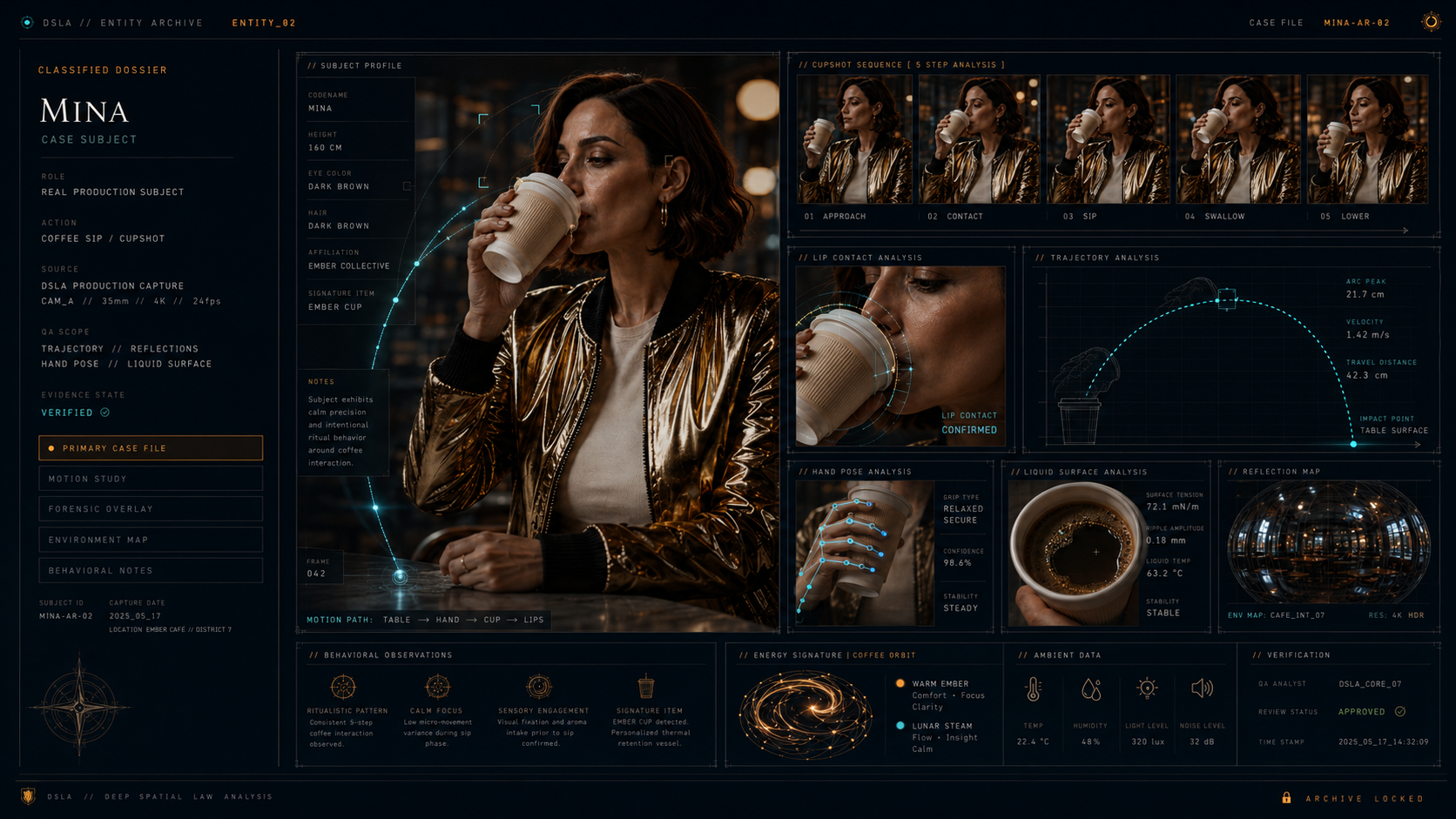

Inspiration
DSLA started with a simple question:
What if AI could help create animation without making the process impossible to understand?
Generative tools can produce impressive results, but when something goes wrong, it is often difficult to understand why. A movement may look incorrect, but the problem can be hidden somewhere between the original idea, the generated plan, the implementation, and the final output.
I wanted to build something that makes this process more visible, traceable, testable, and repairable.
That idea became DSLA — the Declarative Semantic Layer for Animation.
What I Built
DSLA treats generative animation more like software development.
Instead of asking an AI system to improvise an animation from start to finish, the process is structured around a source of truth, a storyboard, compiler-like transformations, production tasks, rendering, and quality checks.
The goal is to preserve the meaning of the original creative intention throughout the pipeline.
DSLA can represent animation ideas as structured semantic data, transform those ideas into production-oriented tasks, and expose the intermediate steps that lead to the final result. When a result fails, the system should make it possible to inspect what happened instead of simply generating another attempt and hoping for the best.
This is important to me because creative work should not become less understandable just because AI is involved.
How I Worked
My workflow has three distinct roles:
I think with GPT.
I build with Codex.
And I decide as a human.
When I have an idea, I first discuss it with GPT-5.6. We examine the intention, possible risks, alternative approaches, technical constraints, and the result I am actually trying to achieve.
Only after that does Codex enter the repository. Codex inspects the existing system, implements the required changes, runs tests, and reports what happened.
Then comes the most important part:
Did Codex cook?
Working code is not automatically a successful result. I review whether the implementation actually serves the original vision. I inspect the visual result, examine the tests, and decide whether the project feels closer to what it should become.
When it does not, I return to the planning stage, explain what went wrong, refine the direction, and begin another iteration.
Challenges
One of the biggest challenges was resisting the temptation to treat AI output as automatically correct.
At one point, I experimented with allowing Codex to work autonomously overnight through a loop that repeatedly examined a problem and attempted to discover a solution. It did not work as intended.
However, the failure taught me something more valuable than a successful automated run would have taught me.
The objective should not necessarily be to remove the human from the process. AI can explore, implement, test, and propose. But the human still determines meaning, direction, values, and purpose.
The strongest result comes from collaboration rather than replacement.
What I Learned
My biggest advantage is not that I always know the right answer.
It is that I can turn uncertainty into another useful iteration.
Working with AI has changed the way I approach development. I no longer see uncertainty as something that has to be eliminated before building can begin. Instead, uncertainty can become part of the process: something to examine, structure, test, and gradually clarify.
I also learned that good AI-assisted development requires active human judgment. The model can help expand possibilities, but the responsibility for choosing a direction remains with the person building the project.
Why It Matters
DSLA is not supposed to be only about me.
I had the idea, and I am doing everything I can to make it real. But the larger purpose is to create tools and processes that help other people make their own ideas visible and move closer to their dreams.
Brightfolio is the broader vision behind that goal: a creative space where technology, storytelling, and human intention can meet.
I believe artificial intelligence could become one of the best things that has ever happened to the world — provided that we use it to strengthen human creativity rather than abandon human responsibility.
Think with GPT.
Build with Codex.
Decide as a human.
Still standing. Still building.
Built With
- chatgpt
- codex
- css
- html
- javascript
- node.js
- python
- vscode

Log in or sign up for Devpost to join the conversation.