Inspiration
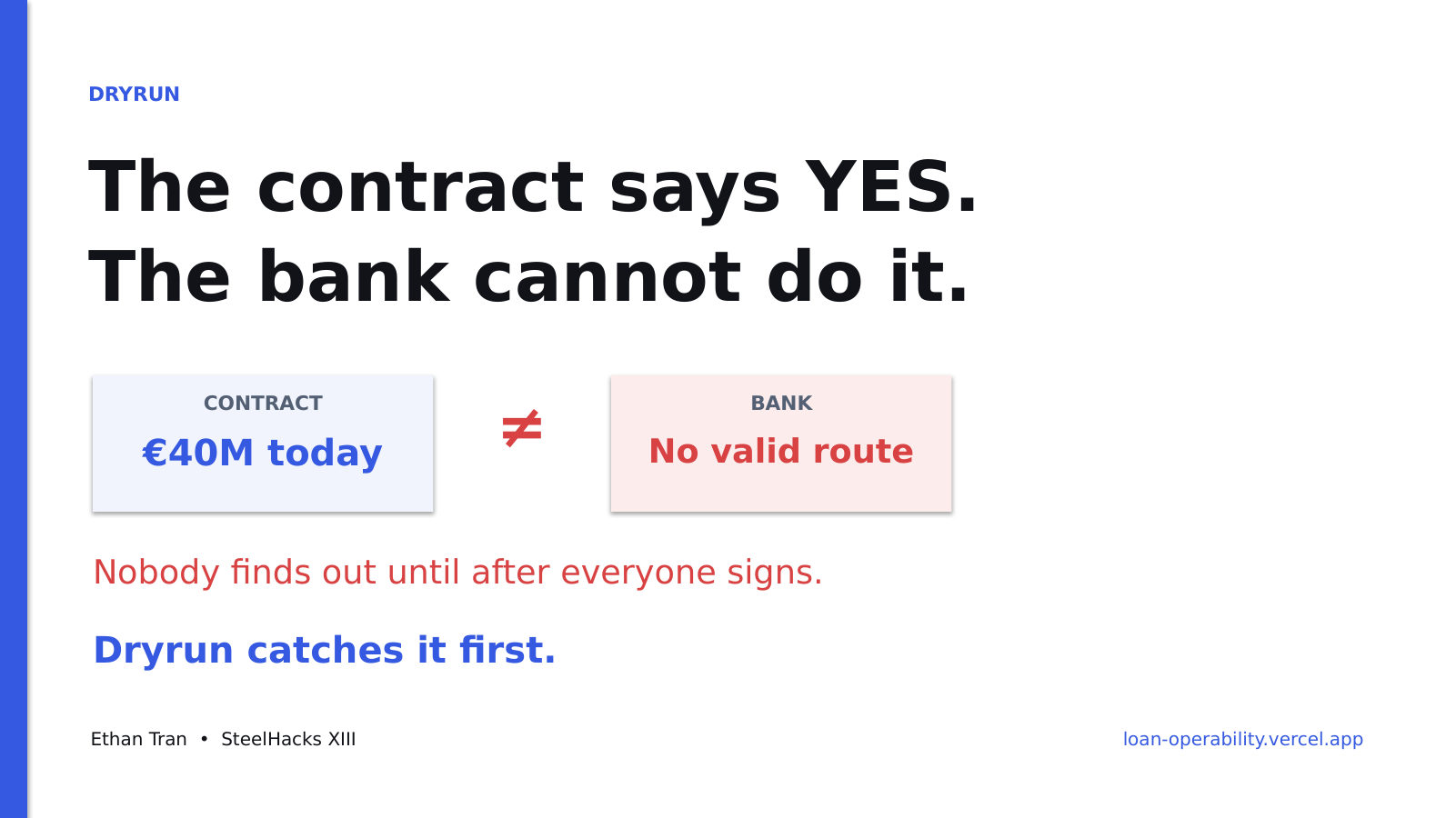
I worked at a wealth management firm this summer and saw how important decisions often depend on information spread across different documents and systems. A contract can promise one thing while the institution's actual limits, approval rules, or operating procedures say something different.
Usually, nobody catches that mismatch until someone tries to carry out the agreement. That inspired Dryrun.
What it does
Dryrun checks a draft loan agreement against what a bank can actually execute before anyone signs it.
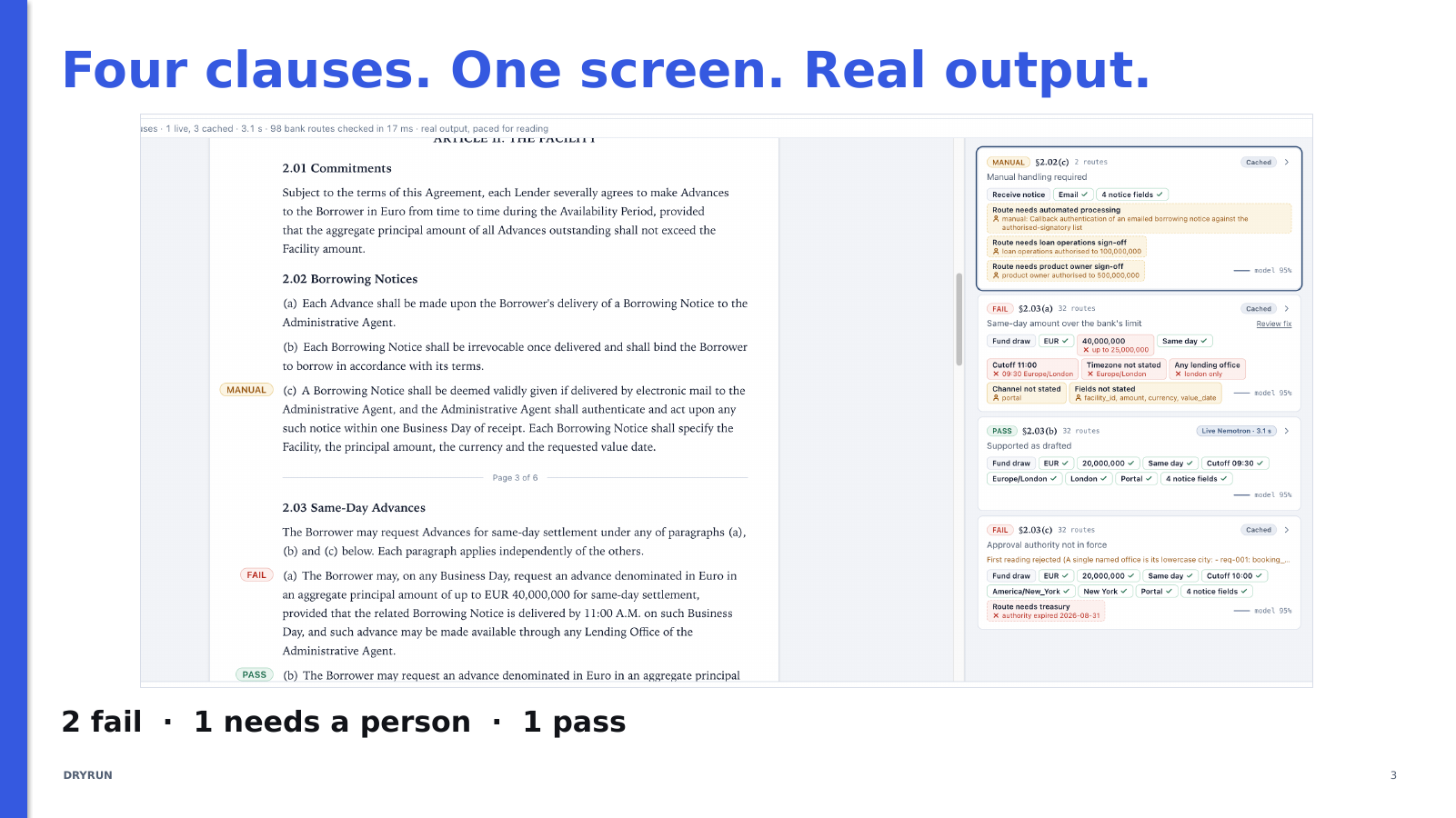
A user uploads an agreement, and Dryrun reviews each borrowing clause. It compares what the contract promises with the bank's limits, cutoff times, approved entities, and authorization records.
Each clause receives one of three results:
- PASS: The bank can execute it as written.
- MANUAL: A person needs to review or approve it.
- FAIL: The agreement conflicts with the bank's current operating rules.
Every result includes the exact language from the agreement and the policy evidence behind the decision. Dryrun can also suggest corrected terms and test them again.
How we built it
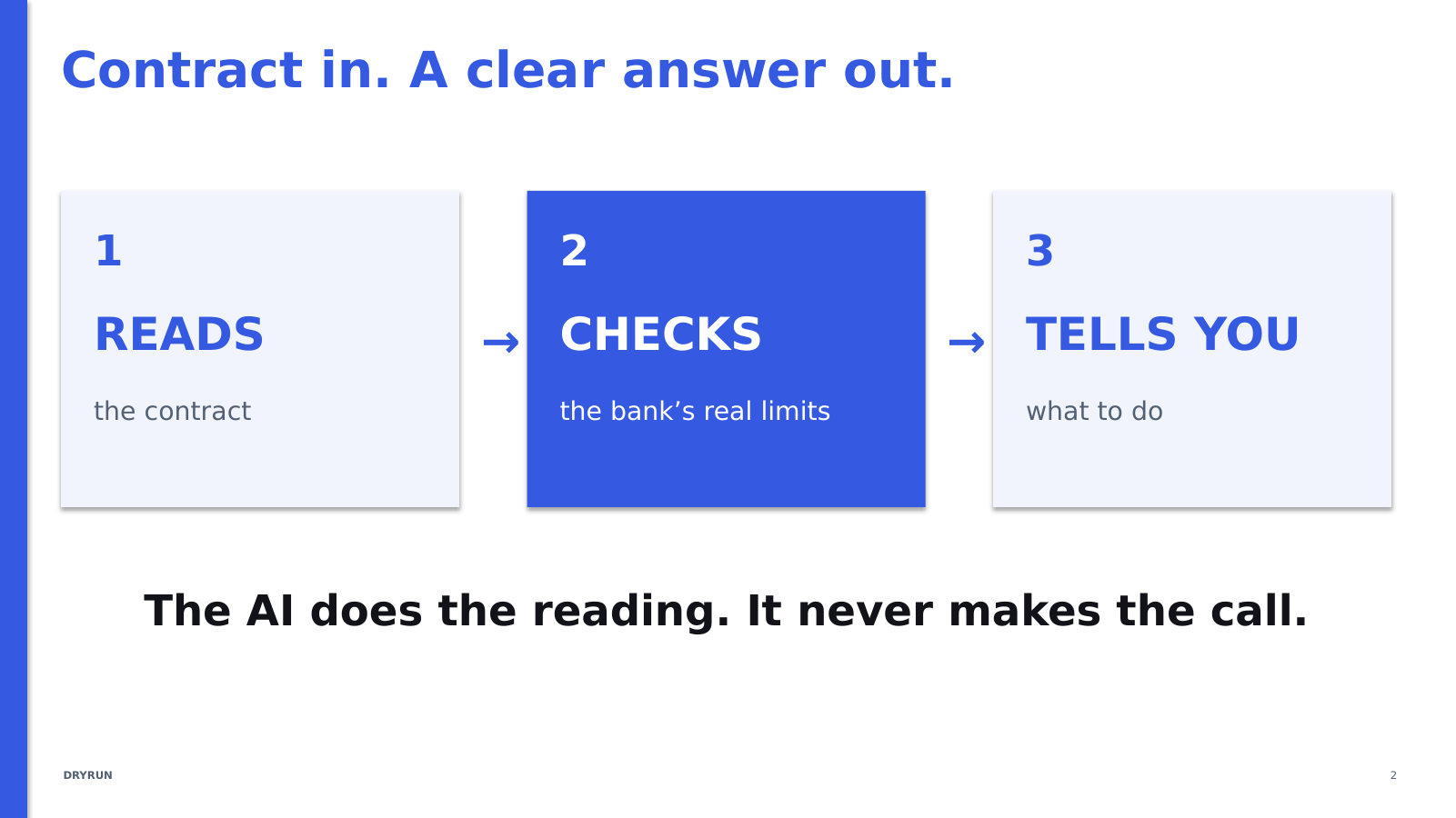
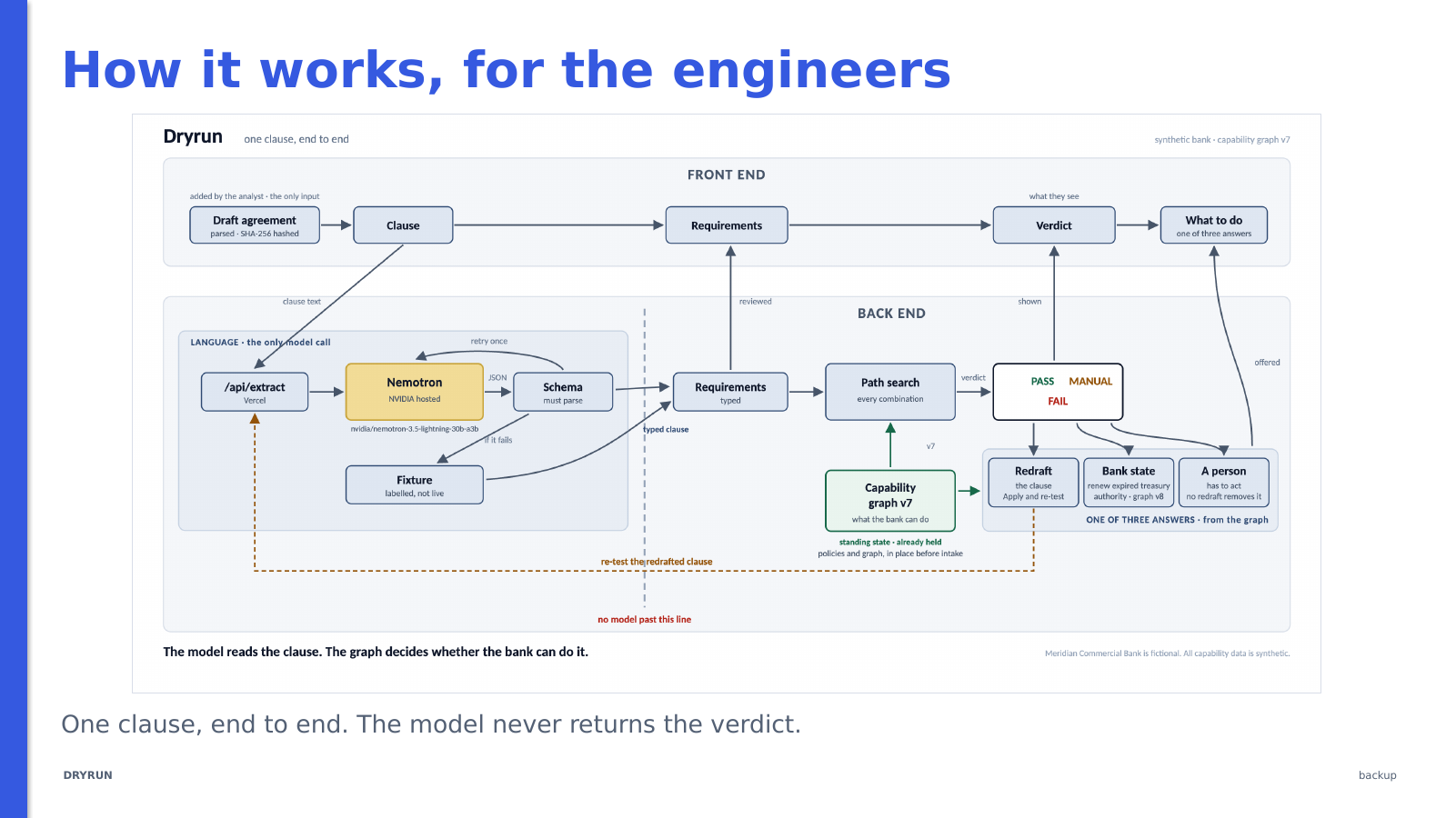
Nemotron reads the contract language and converts each clause into structured requirements, such as the amount, currency, deadline, and required approvals.
Nemotron does not decide whether a clause passes or fails. A deterministic evaluation engine compares those requirements against the bank's capability data. The engine tests 32 possible execution routes using 14 checks per route.
The frontend was built with React and TypeScript. Zod validates the extracted data, Vitest tests the evaluation engine, and Vercel hosts the application and server-side extraction function.
Challenges
The biggest challenge was making the results trustworthy. A language model can understand complicated contract wording, but it should not make the final operational decision.
We separated those responsibilities. Nemotron handles language extraction, while regular code owns the PASS, MANUAL, and FAIL verdicts. We also show the supporting language from both documents so users can verify every result themselves.
Another challenge was keeping the demo honest when free model access becomes rate-limited. If Nemotron is unavailable, Dryrun uses a clearly labeled cached extraction for the sample agreement instead of pretending a live model call succeeded.
What we learned
We learned that AI is more useful here when it has a limited, clearly defined role. Nemotron is good at understanding the contract, but deterministic code is better for proving whether the bank has a valid execution path.
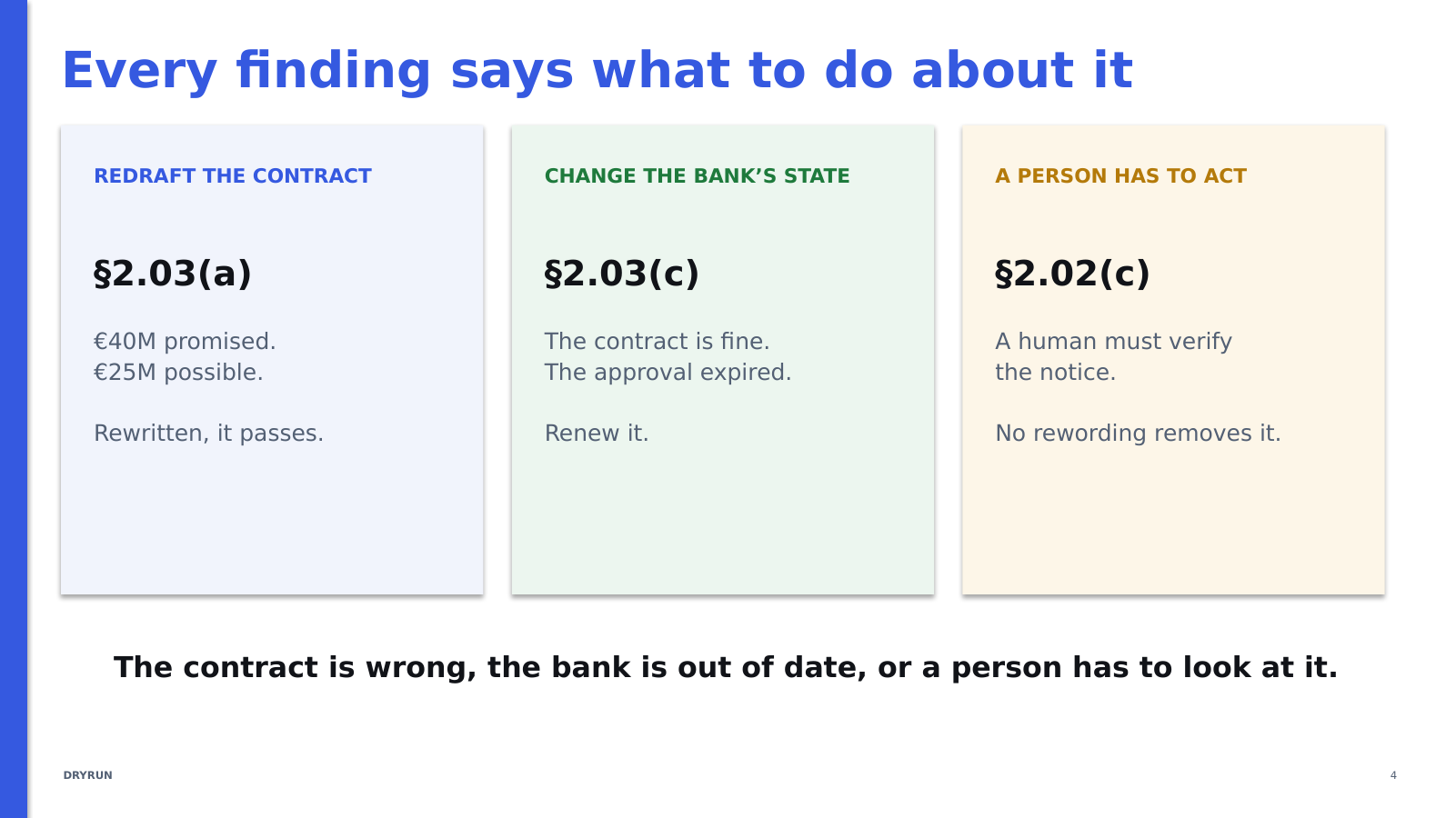
We also learned that not every problem should be fixed by rewriting the contract. Sometimes the contract is wrong, sometimes the bank's internal information is outdated, and sometimes a person needs to take action.
What's next
The current version uses synthetic data and supports one structured Markdown agreement format. Next, we would add PDF and Word document support, automatically identify relevant clauses, and test the system with people who work directly with lending operations and legal agreements.
Tools and AI disclosure
NVIDIA Nemotron 3.5 Lightning 30B A3B performs runtime clause extraction. OpenAI Codex and Anthropic Claude were used as development assistants for implementation, debugging, testing, documentation, and review. The deterministic engine, not an AI assistant, produces the final PASS, MANUAL, and FAIL verdicts.
Built With
- node.js
- nvidia-nemotron-3.5-lightning-30b-a3b
- react
- tailwind-css
- typescript
- vercel
- vite
- vitest
- zod
