Inspiration
I was mainly inspired by the video game released for the Nintendo 3DS named "Tomodachi Life," with a similar premise of simulating the daily interactions of custom made avatars and allowing the player to observe the ensuing dramatic histories.
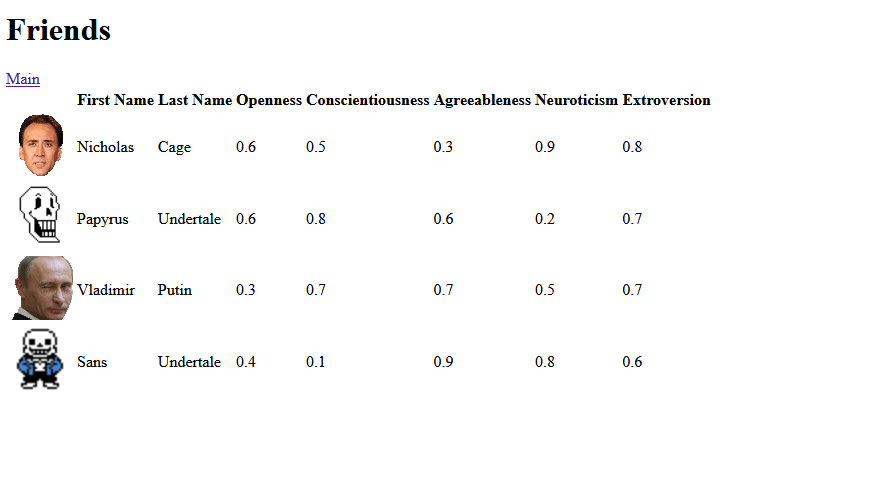
For this simulation game, I employed a model for personality that has recently become prominent in psychological research known as "the big 5." It involves 5 numerical scales that represents the range of human temperaments: Openness to experience (adventurousness), Conscientiousness (orderliness, pragmatism), Neuroticism (sensitivity to negative emotion, anxiety), Extroversion (affinity for public settings), and Agreeableness (politeness and obedience).
What it does
The current iteration of the application simply runs a custom built web server and displays an HTML page with the information of various "simulated friends," the data of whom are extracted from server-side JSON config files.
How we built it
I wrote the code myself using Rust, with guidance from the official Rust documentation, and using various packages like serde_json (for handling JSON files), and base64 (for displaying images).
Challenges we ran into
Rust is a very challenging language to learn; it has a strict typing system and will not allow the coder to write anything that might corrupt memory, and insists on handling every possible error case. Therefore, development was quite slow and not much was accomplished in terms of the overall vision of the game.
Accomplishments that we're proud of
The whole program was written in less than 200 lines of code and works perfectly.
What we learned
I learned more about how HTTP works, the way that server software interacts with it. I also learned about base64 encoding, for turning bytes into printable strings.
What's next for Druzya : Friend simulator
It'd be nice to have the actual simulation part working, but I likely won't get around to it for the next several years at least...


Log in or sign up for Devpost to join the conversation.