-
-
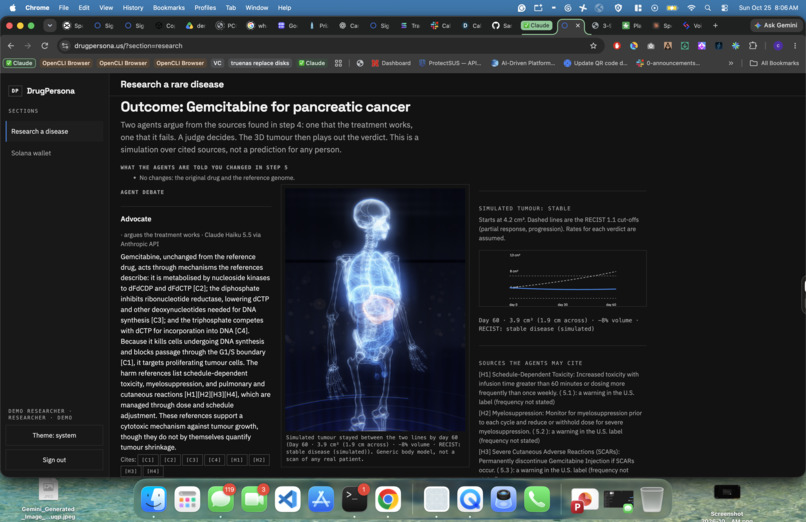
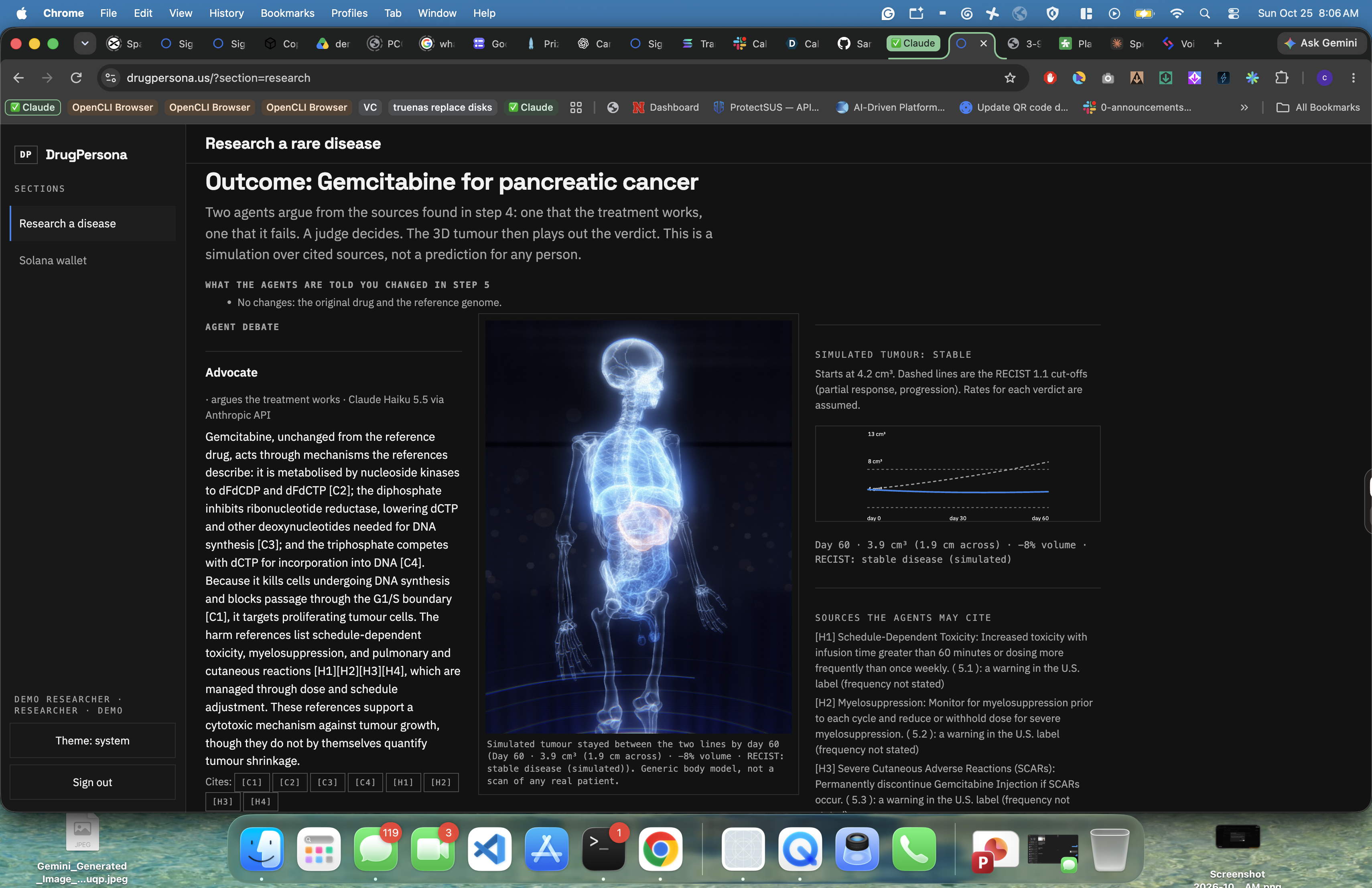
Outcome: Two agents argue for and against the drug from cited sources, a judge rules, and a 3D tumour simulation plays out the verdict.
-
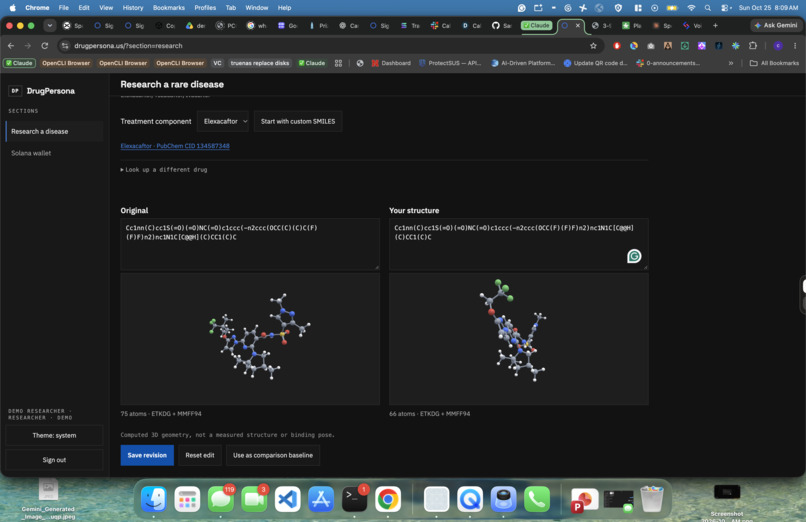
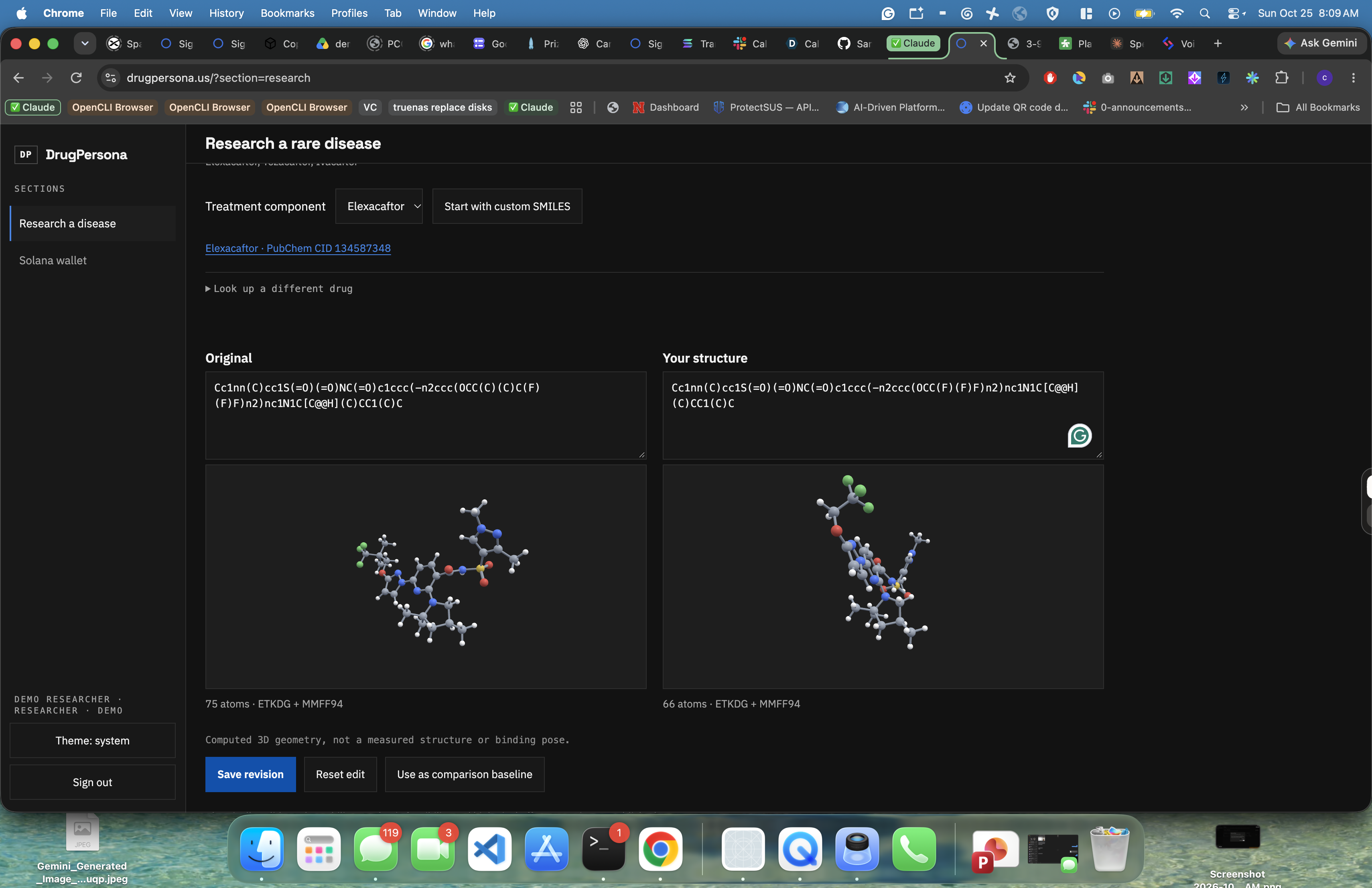
SMILES editor: Edit a drug’s structure and compare the original and modified molecule side by side in computed 3D.
-
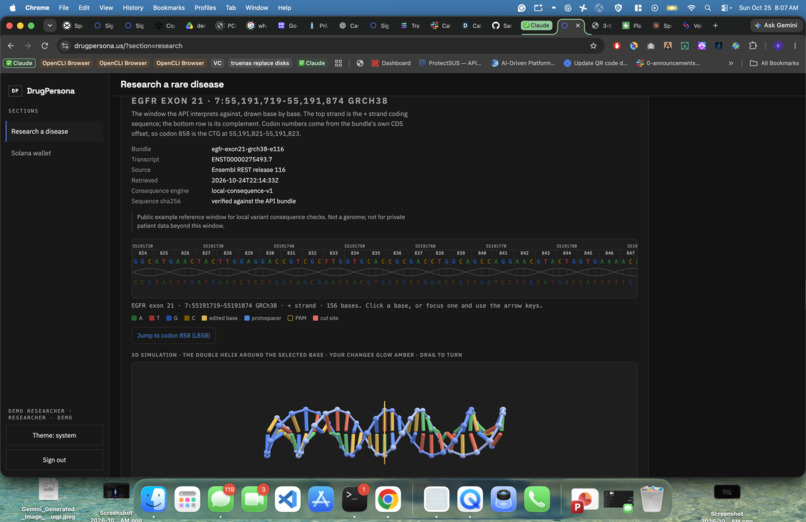
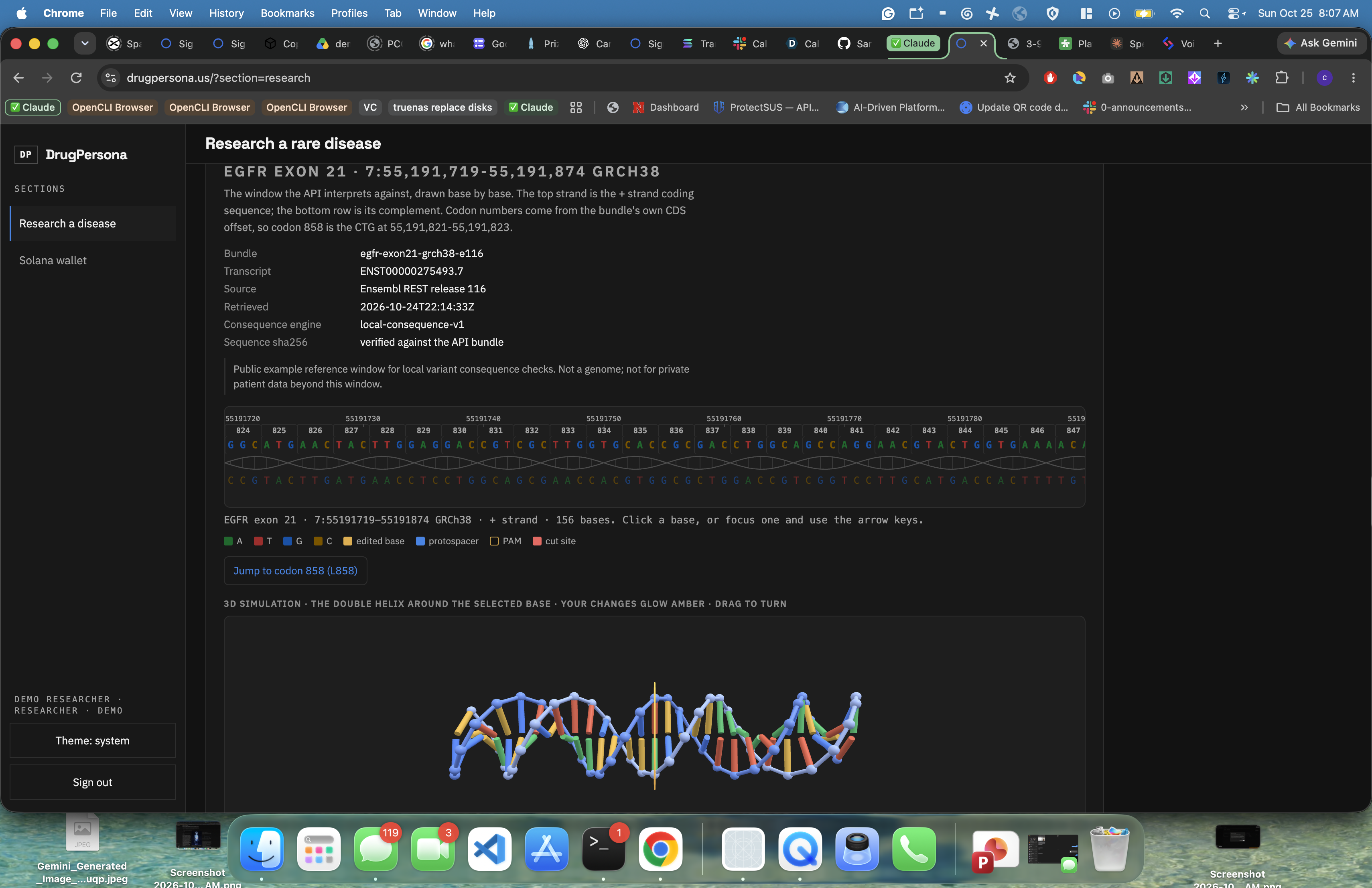
EGFR exon 21: Inspect and edit the sequence base by base, and watch the 3D double helix light up your changes
-
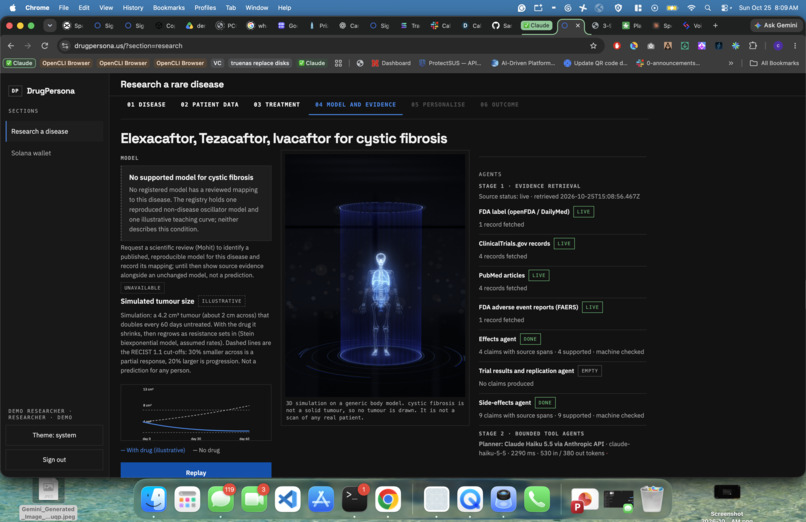
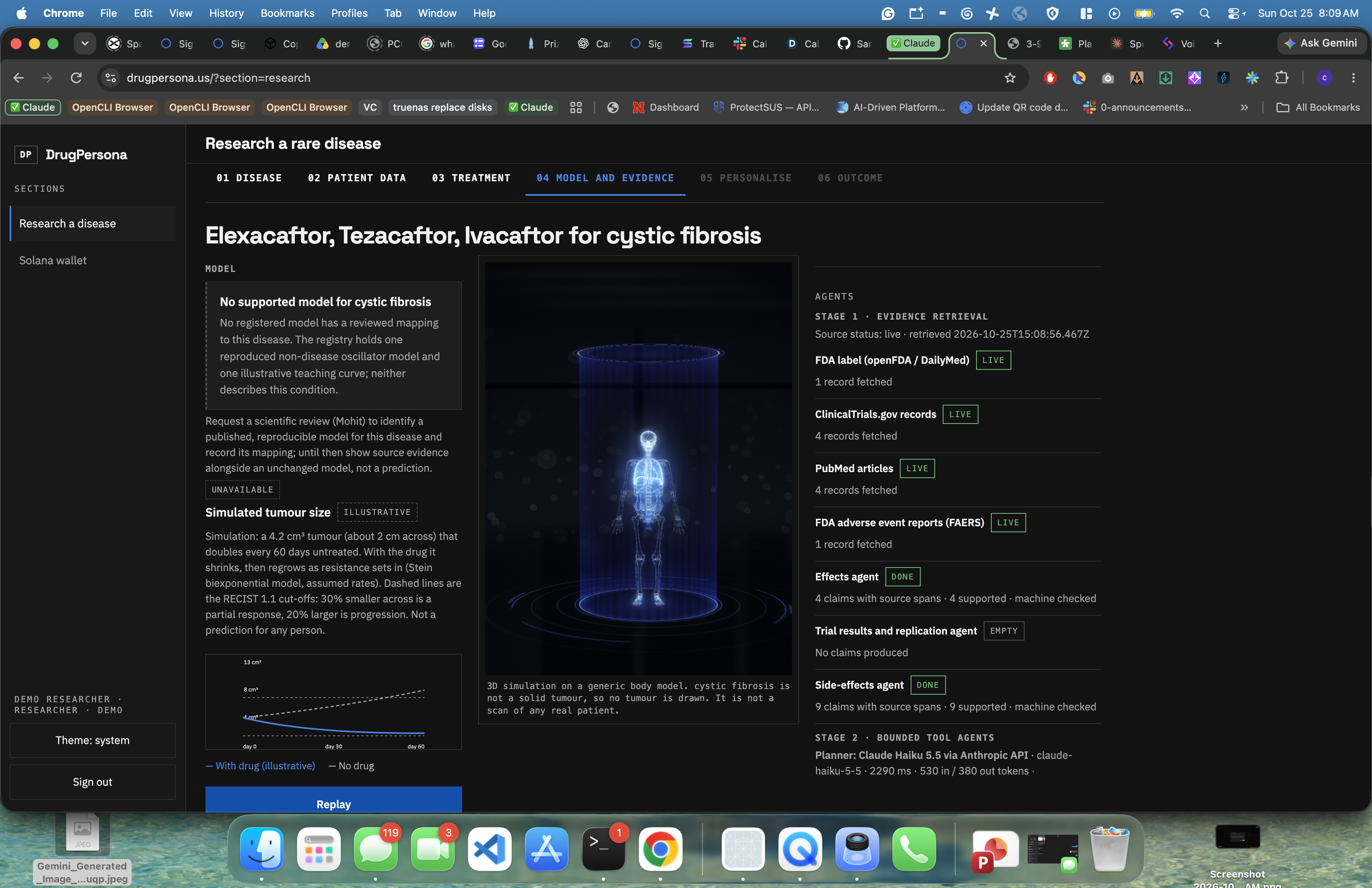
Model and evidence: Live FDA, ClinicalTrials.gov and PubMed evidence feeds source-checked agents, shown on a 3D body model.
-
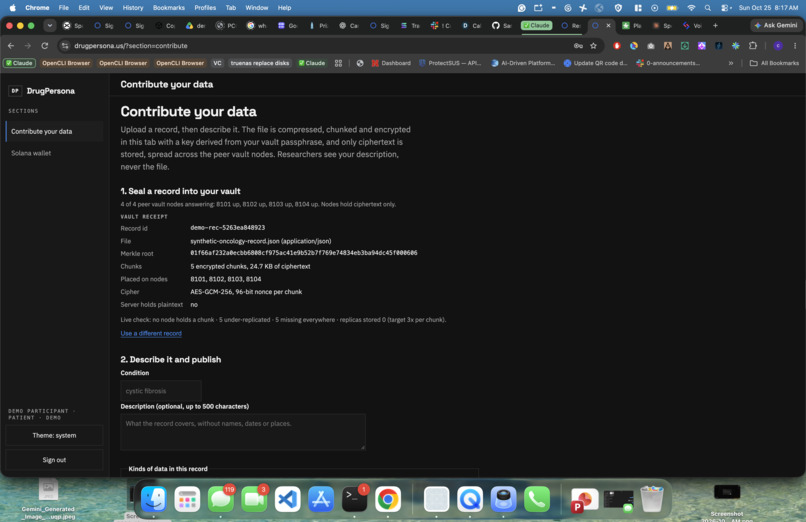
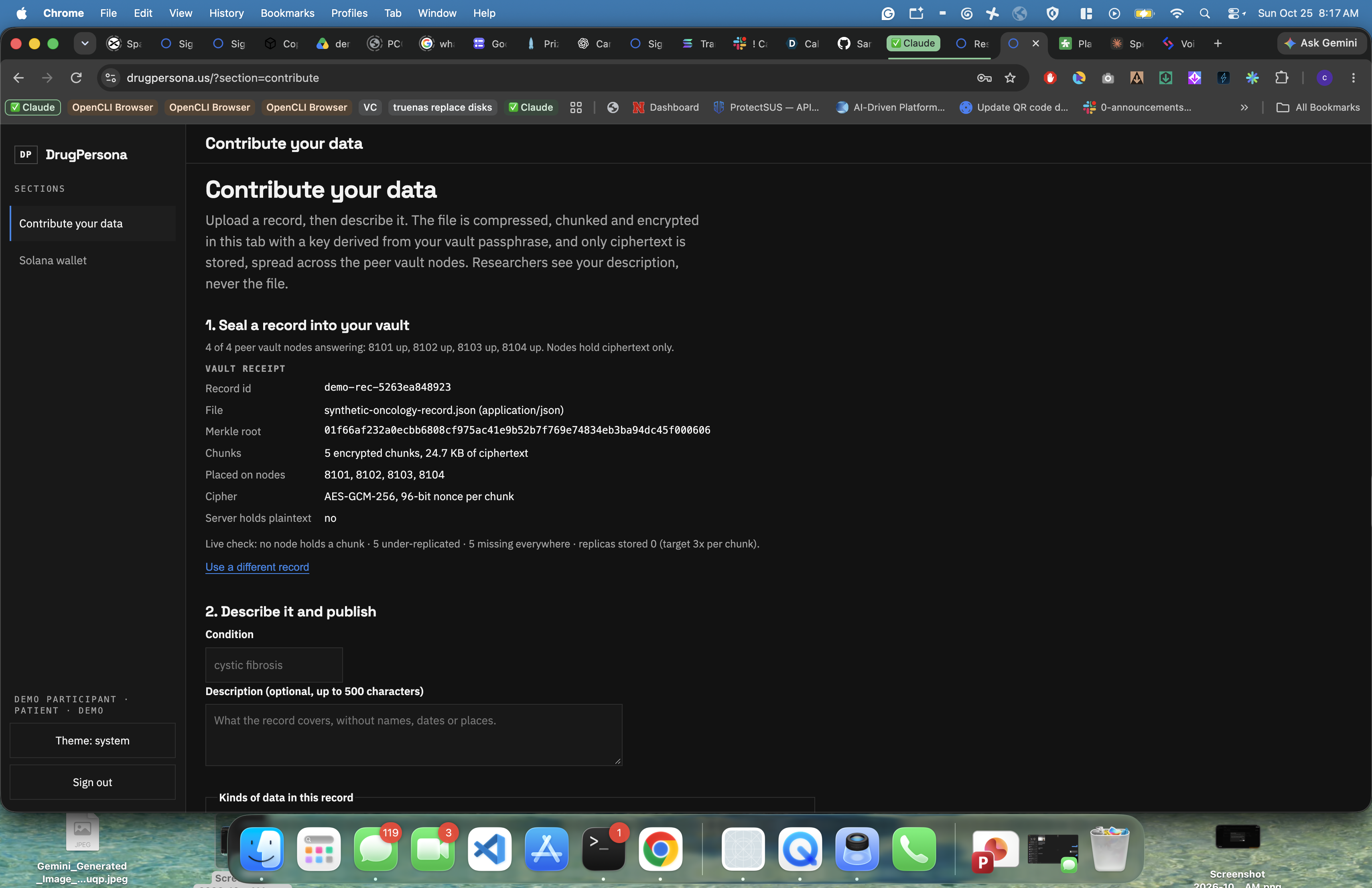
Vault upload: Records are encrypted in your browser and split across peer vault nodes. The server never sees plaintext.
-
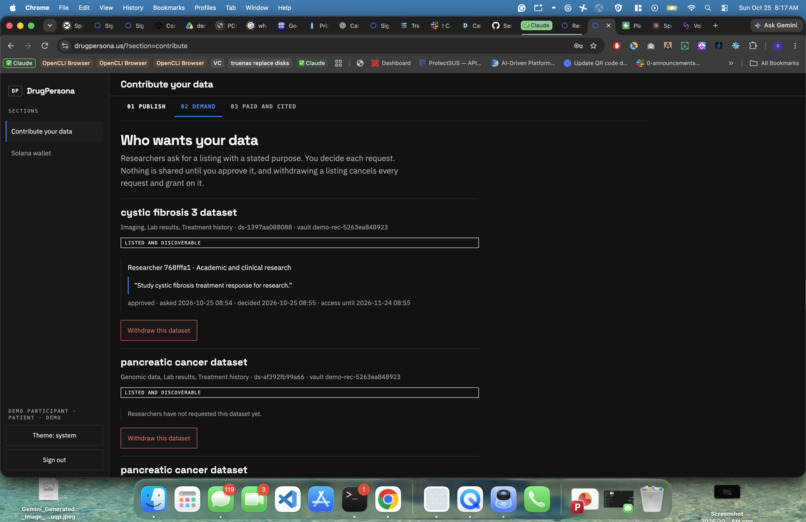
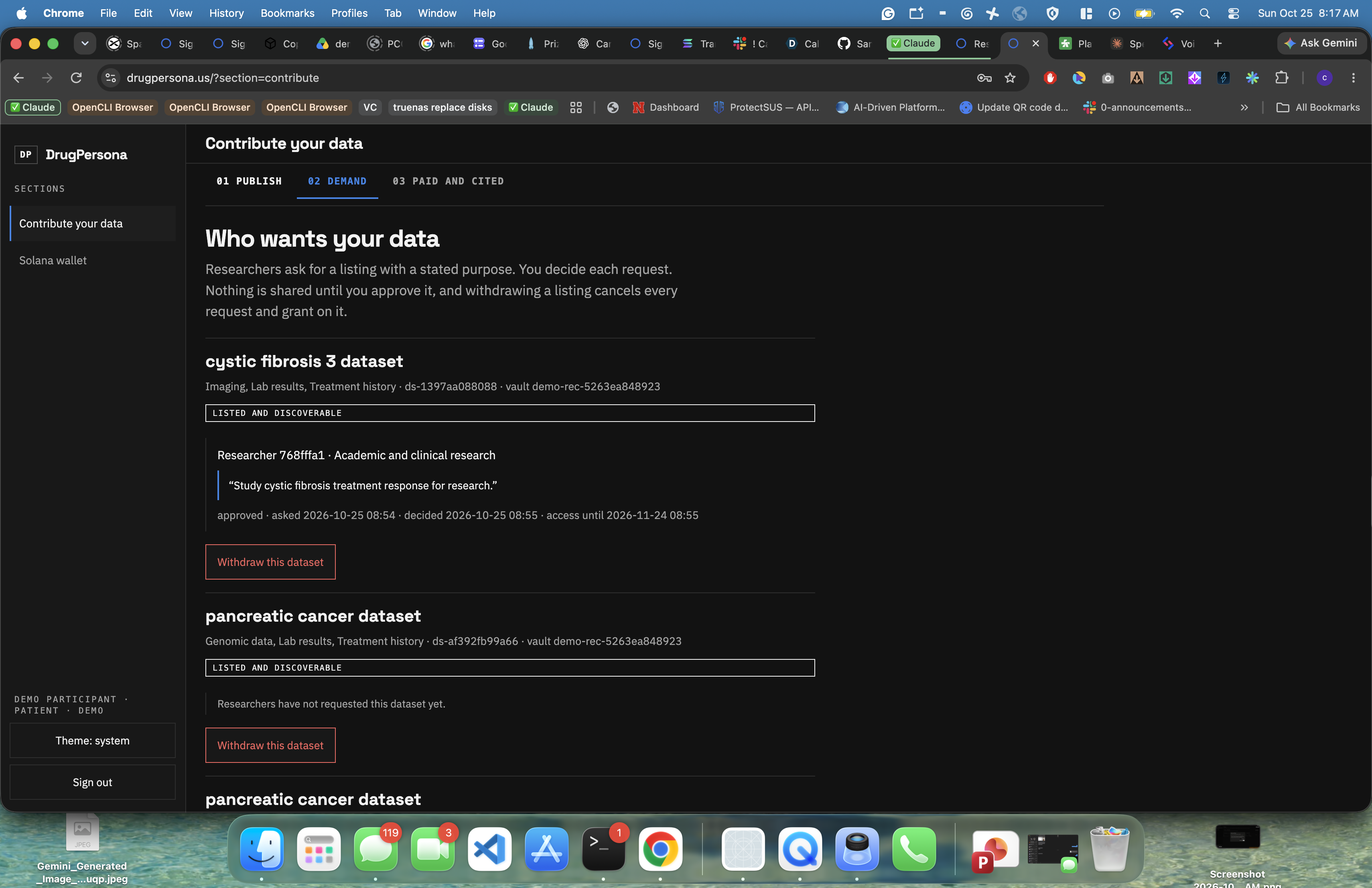
Demand tab: Contributors approve or withdraw every researcher request. Nothing is shared until you say yes.
-
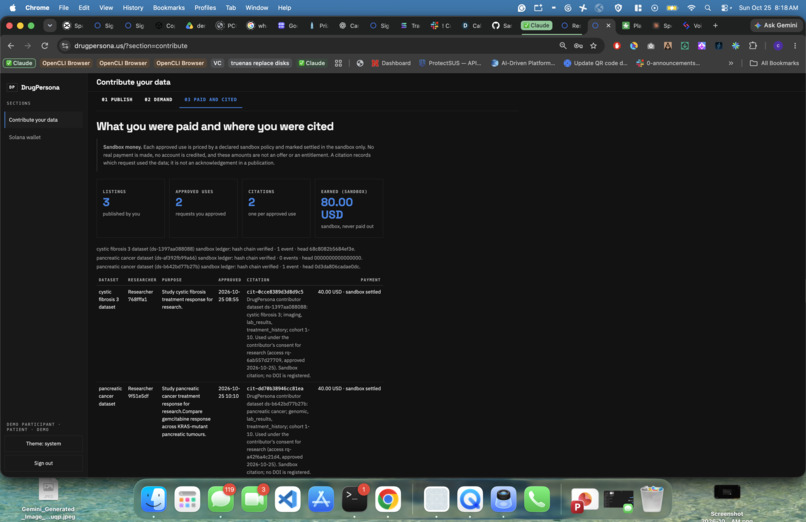
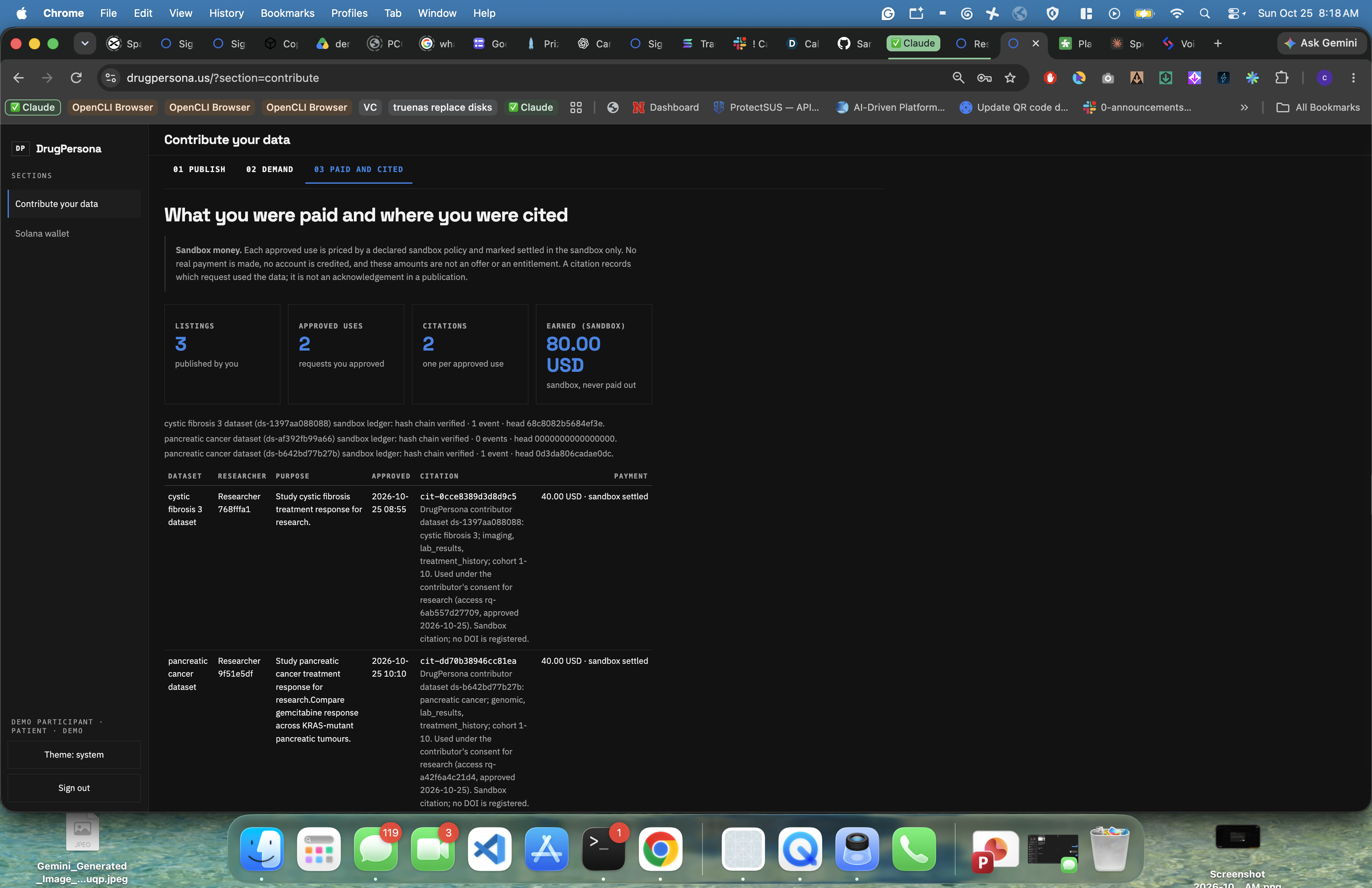
Paid and cited: Every approved use earns sandbox pay and a citation back to your dataset, logged on a hash-chained ledger.
DrugPersona
Rare disease research you can trust.
Inspiration
Great medical research starts with people, but the data they share is scattered and hard to reach. For rare diseases, where every patient and every record counts, that gap hurts the most.
- Researchers lose months to data fragmentation. Patient records sit in separate clinics, labs and registries, each with its own format and its own access rules. Even when the right data exists, it is hard to find, hard to request, and hard to trust.
- Patients rarely know who uses their data, and almost never get credit or a fair reward for it.
- Clinics are left out of the loop, so promising findings rarely reach real care.
We built DrugPersona to fix that. It is one network where patient data is easy for researchers to find and request, because the patient's consent is built into every step.
- Patients control how their data is used, credited, and paid for.
- Researchers can find consented data in one place and see exactly where every result came from.
- A finding is never presented as proven when it is only a guess.
What it does
DrugPersona is an interactive 3D biology lab and a consented data network. Researchers and patients meet in one place, with the patient's permission at the center. You can orbit a real anatomy atlas, switch to DNA and molecule views, and talk to the lab by voice.
For researchers: one network instead of scattered data
- Find consented patient data in one place. Search the dataset marketplace by coarse, privacy-safe facets such as data type and cohort size, instead of chasing records across clinics. Small cohorts are hidden, and no patient identity is shown.
- Request access in a single flow. State your purpose and the owner approves it. You get an access receipt, an invoice, and a citable record of what you used.
- Trust the data's origin. Access only works if the patient's consent still covers your purpose, and every access and denial goes to a tamper-evident audit trail.
- Start from any disease. Search a registry of 24,000+ conditions (16,000+ rare) and see the drugs under investigation for each, pulled from live clinical trial records.
- Get an evidence dossier where every claim carries the exact sentence from its source. A claim verifier marks each statement as supported, conflicted, or unsupported, and a reproducibility score lists what a paper never reported.
- Run experiments with a clear record. Watch an advocate, a skeptic, and a judge argue over the cited sources and play the verdict on a 3D tumor, clearly marked as illustrative.
- Send reviewed proposals to a connected clinic.
For patients: easy to share, always in control
- Hold your own records in an encrypted vault whose keys never leave your browser
- Grant access limited to a purpose, with an expiry, and revoke it at any time. Revoking unlists your data and cancels pending requests.
- See an audit trail of every access
- Hear a consent form in English, Spanish, Hindi, or Mandarin and answer by voice
- See your share of each invoice. Payments are simulated, with Solana devnet for testing.
For clinics
- Review consented referrals and get voice outreach. Cartesia outbound calls need a separate patient authorization and an opted-in clinic contact.
Every result is labeled by what it is:
- Source reported: from a label, trial or paper
- Computed property: a deterministic calculation from a chemical structure
- Model prediction: from a defined model, within its stated limits
- Experiment measured: observed by an instrument
- Illustrative: a teaching scenario with hypothetical inputs
- Unavailable: shown instead of a made-up number
The deepest worked example is osimertinib for EGFR lung cancer. Cancer Studio and General Explore share the same evidence, consent and finance services.
How we built it
DrugPersona is one website behind one FastAPI gateway. Everything runs behind one URL, so researchers don't hop between systems.
- What you see: a 3D lab with a sign-in for each kind of account, and menus that only show what your role can use
- One data network: a dataset marketplace and a consent network share one set of accounts and one audit trail. A dataset is discoverable only if it is listed, the owner attested to de-identification, and research consent is active.
- Consent on every access: grants are scoped to an audience and a purpose and expire. Access, invoices, and settlement each re-check that consent is still live.
- Evidence service: pulls the FDA label, ClinicalTrials.gov, and PubMed, then checks each claim against its source. A pinned MONDO registry handles disease search.
- Safety first: a policy gate runs before any model or tool. It denies treatment, dosing, and synthesis requests, and still stores the denial.
- Honest records: every consequential table is a SHA-256 hash chain, so ordinary edits are visible
- Vault: records are encrypted in the browser with AES-GCM and spread over four peer nodes. A node we killed on camera was repaired, and the record was recovered.
- Money and fraud checks: a payee identity check must clear before any settlement, and it fails closed. A finance controller catches duplicate payouts and holds them.
- Deterministic code decides; the model phrases. Where a model writes prose, it is checked against sources and dropped if it fails. Every answer names the model that actually produced it.
- Sponsor tools: Cartesia voice, Claude (direct and on Bedrock), Apify, Elastic and more. Missing credentials fail loudly instead of faking success.
Challenges we ran into
- Making scattered data findable without exposing people. Search had to be useful to researchers but coarse enough to protect patients: no free text, no owner identity, and small cohorts suppressed.
- Making consent work across the whole chain. Consent had to be checked on discovery, access, invoice, and payment, and it had to stop everything when a patient revoked it.
- Making science look exciting without hiding the details. Every scene had to stay tied to its source, method, and limits.
- Keeping different kinds of results separate. A number from a paper, a calculation, and a guess are not the same, and the screen has to say which one it is.
- Failing closed. If the identity check, the voice key, or the model is unavailable, the product holds or says so instead of guessing.
- Joining four people's work into one product. Evidence, consent, the marketplace, and the 3D lab had to share contracts, accounts, and a single URL.
- A demo that feels real without pretending to be. Patients, the clinic and the money are fictional, and we labeled them that way on purpose.
Accomplishments that we're proud of
- One network for consented data. A researcher can go from a disease to a consented dataset, to access, to an invoice, and a citable record, all in one product.
- 87 of 87 claims in the osimertinib dossier carry the exact source sentence, across 12 sources
- A claim verifier that scored 96.9% (62 of 64) on labeled claims, with its misses published, including the one prompt injection it still lets through
- 7 of 7 unauthorized access attempts denied, with a valid receipt chain
- A full journey from patient consent to dataset listing, researcher access, invoice, simulated settlement, revocation and audit
- A live identity check that blocked a synthetic identity before payout
- A vault that survived a killed storage node
What we learned
- Fragmentation is a trust problem as much as a search problem. Researchers don't just need to find data. They need to know it is allowed and where it came from.
- A good picture still needs a source. Visuals are only trustworthy when you can trace them back.
- Not all evidence is equal. Reported, computed, predicted, measured, and illustrative mean different things, and the app never blurs them.
- Consent is part of the science. Access depends on what a patient agreed to, and consent is checked on every access, not once.
- Showing the miss is more convincing than hiding it. Publishing our verifier's failure built more trust than a clean number would have.
- A working demo is not proof. It does not show that a treatment works, that clinics will adopt it, or that real payments work.
What's next for DrugPersona
- Connect real clinics and datasets to the network, so fragmented records become findable in one place, with ethics review and proper privacy agreements first
- Time real research coordinators to replace our estimate of time saved
- Close the known verifier gap by checking each sentence of a claim separately
- Move from demo logins and SQLite to real sign-in and a hosted database before any real records arrive
- Ship the patient consent wallet as a mobile app
- Partner with real researchers and clinics before calling this medical use
Rare disease research you can trust.
Built With
- 3dmol
- amazon-bedrock
- anthropic-claude
- apify
- cartesia
- clinicaltrials
- crs-credit-api
- fastapi
- godaddy
- javascript
- next
- notability
- openfda
- pubchem
- pubmed
- python
- rdkit
- react
- rust
- solana
- spacetimedb
- sqlite
- three
- twilio
- typescript

Log in or sign up for Devpost to join the conversation.