-
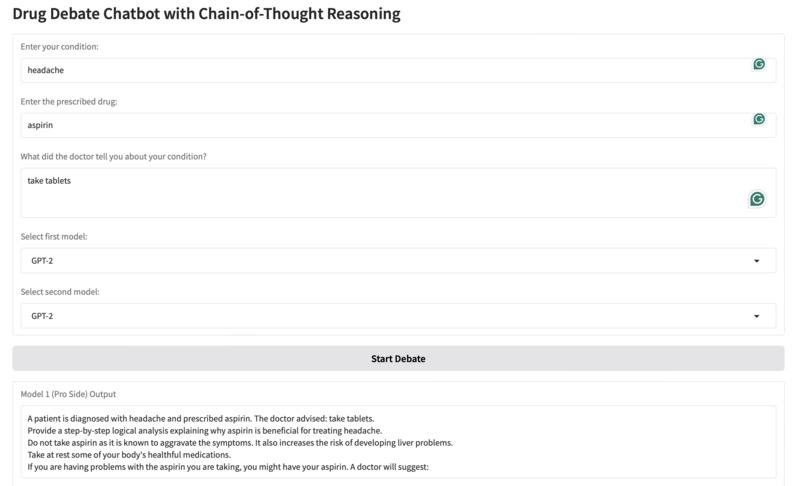
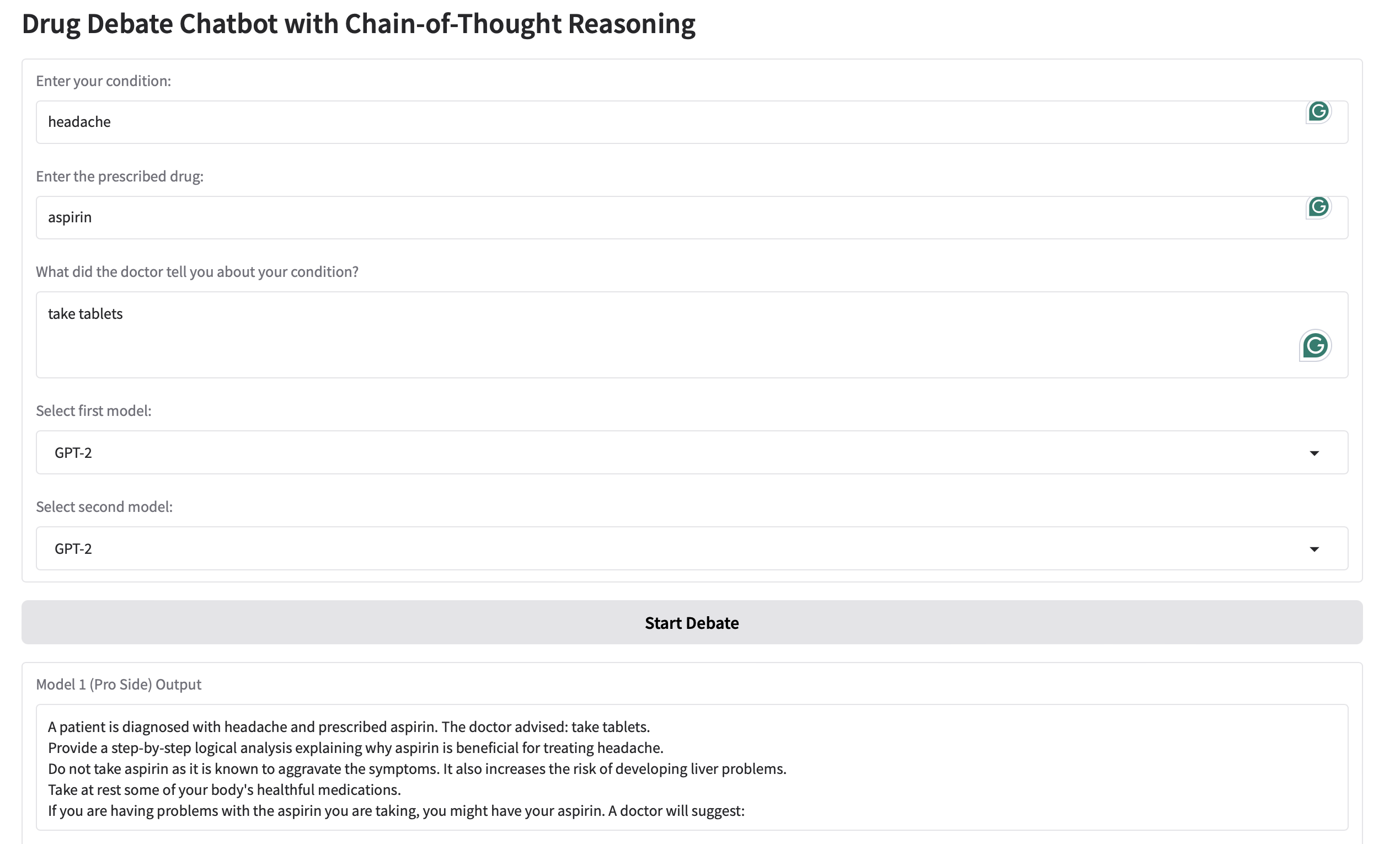
Interface of the Debate Bot
DrugAwaRE – AI-Powered Drug Awareness Bot
Inspiration
The idea behind DrugAwaRE stems from a critical issue in healthcare: patient safety and awareness regarding drug reactions. Many patients blindly follow prescriptions without understanding potential side effects, interactions, or alternative treatments. This can lead to adverse drug reactions, especially for individuals taking multiple medications.
By leveraging AI-driven debates, DrugAwaRE empowers patients with structured insights, helping them make informed decisions in consultation with their doctors.
What It Does
DrugAwaRE is an AI-powered chatbot designed to enhance patient awareness about prescribed medications.
- Interactive AI Debates: Two AI models engage in a structured debate, discussing a drug’s benefits and risks.
- Patient-Centric Input: Users enter their medical condition, select a prescribed drug, and input doctor's advice.
- Chain-of-Thought Reasoning: AI models explain drug mechanisms step-by-step.
- Dropdown Drug Selection: Instead of manually typing drugs, users choose from a list based on their condition.
- User-Friendly Interface: Built with Gradio, making it accessible and easy to use.
How We Built It
- LLMs for Medical Context: We used transformer-based models fine-tuned on medical text to simulate an informed debate.
- Gradio for UI: Developed a simple and interactive web interface for users.
- Chain-of-Thought Processing: Ensured structured and logical responses rather than generic outputs.
- Drug Dataset Integration: Implemented a drug-condition mapping table to provide dropdown-based drug selection.
Challenges We Ran Into
- Ensuring Medical Accuracy: LLMs generate text based on patterns, so filtering hallucinations and ensuring reliability was a challenge.
- Model Latency in Google Colab: Running large models in real-time was slow, requiring optimization.
- Context Retention in AI Debate: Making the debate coherent while reflecting doctor's advice required careful prompt engineering.
- Dataset Structuring: Formatting drug-condition data into an accessible dropdown took effort.
Accomplishments That We're Proud Of
- Successfully implemented chain-of-thought reasoning to improve AI explanations.
- Developed an interactive debate system that provides both pro and con perspectives.
- Integrated doctor’s advice as context, ensuring a patient-specific experience.
- Enabled drug selection via dropdown, simplifying user input.
What We Learned
- Optimizing LLM Outputs: Understanding how to fine-tune prompts for structured AI reasoning.
- Building AI for Patient Awareness: Medical AI must be explainable, reliable, and safe.
- Efficient Model Deployment: Explored ways to reduce response time and enhance accuracy.
- User Experience Matters: Patients need clear, structured, and actionable insights, not just raw AI responses.
What's Next for DrugAwaRE
- Fine-tuning AI on Medical Research: Improve accuracy by integrating verified medical datasets.
- Multi-Drug Interactions: Expand AI capability to analyze multiple medications together.
- Real-Time Drug Information Updates: Connect with APIs for latest drug research and side effects.
- Personalized AI Models: Train models to tailor responses for different conditions.
- Mobile App Development: Make DrugAwaRE easily accessible for users on the go.
Contributors
- Prannov Jamadagni
-Rushitha Akula
- Open to contributions! Feel free to submit issues or pull requests.
License
This project is licensed under the MIT License.

Log in or sign up for Devpost to join the conversation.