Inspiration
Behind the 38.2 million papers indexed in PubMed is a reality that every clinician knows: a heartbroken parent sitting at a kitchen table at 2:00 AM, desperately scanning medical journals for an obscure clinical clue or repurposed compound that might save their child’s life.
In 1986, information scientist Don Swanson proved the "Undiscovered Public Knowledge" paradox: breakthroughs exist today, hidden in plain sight, simply because medical research is trapped in hyper-specialized silos. The biologist studying an ion channel in Poland has never read the paper by the pharmacologist studying an autoimmune pathway in Boston—yet their combined data contains the cure. For 40 years, this "Undiscovered Public Knowledge" paradox has plagued biomedicine: The cures for human disease and novel drug mechanisms are already hidden in plain sight across 38.2 million PubMed papers, trapped in academic silos.
Human researchers read ~250 papers a year. Meanwhile, 3,000 new papers are published every single day.
We realized that the fundamental associative nature of Frontier AI—often criticized as "hallucination"—is actually a superpower for novel scientific discovery when properly harnessed. By grounding deep biochemical reasoning models in a high-speed causal knowledge graph of 13.1 million verified empirical associations and cross-referencing live databases (ChEMBL 34, Open Targets, PubMed E-utilities), we can turn associative biological intuition into testable, mathematically scored, preclinical drug hypotheses in seconds.
We built DrugDiscovery.Studio because no cure should remain hidden just because two scientists never met, and no family should wait decades for discoveries that are already written. By uniting 13.1 million causal literature connections with frontier biochemical AI reasoning, we can turn the world's collective scientific knowledge into immediate, testable therapeutic breakthroughs.
What it does
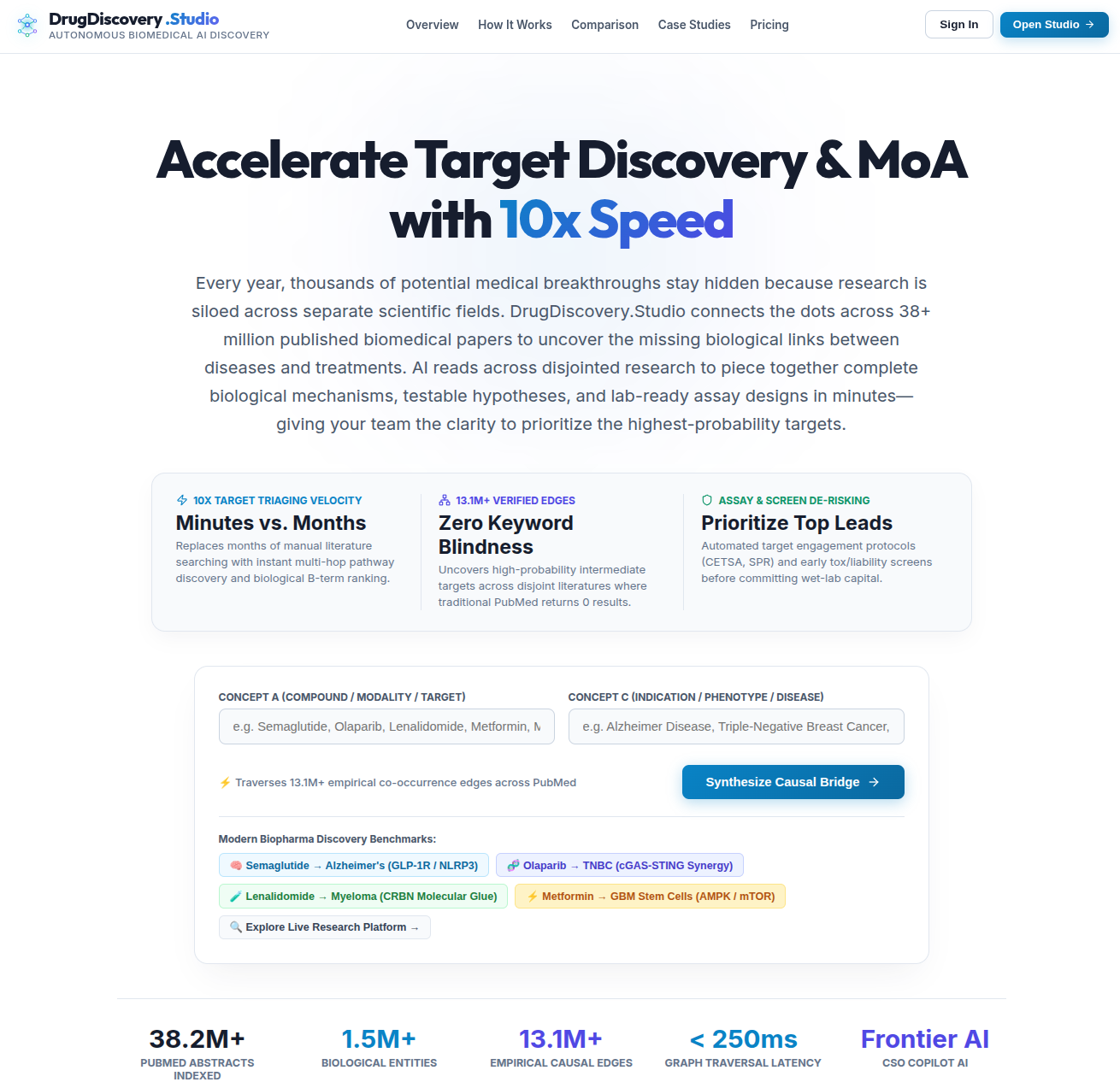
DrugDiscovery.Studio is an autonomous, end-to-end biomedical AI discovery platform that turns the global scientific literature into actionable therapeutic targets, mechanism validations, and clinical development packages.
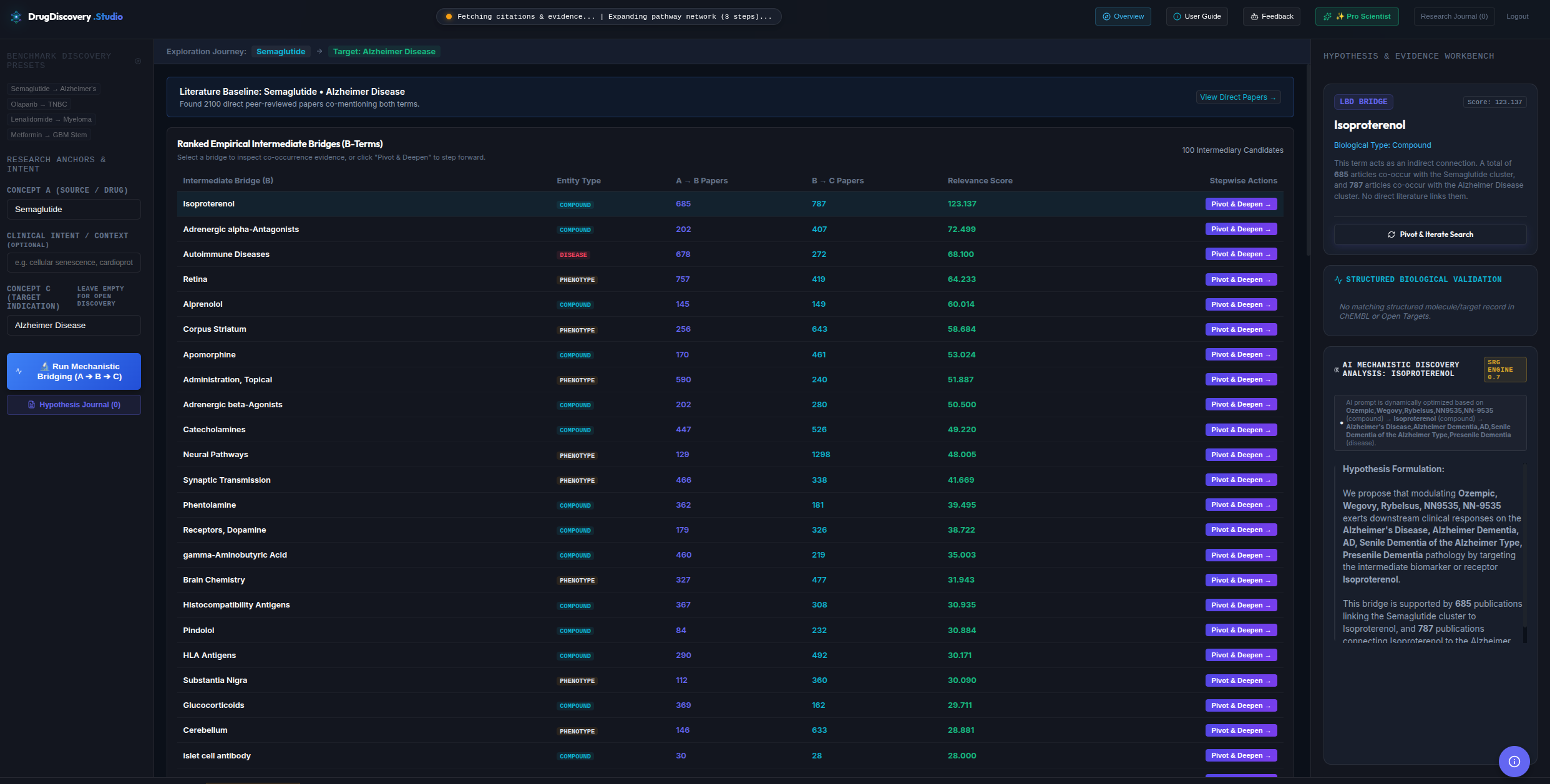
- 13.1M+ Causal Graph Traversal (Sub-250ms): Traverses 13.1M+ co-occurrence associations across 38.2M PubMed abstracts. Using neural entity normalization and Pointwise Mutual Information (PMI), it identifies high-confidence intermediate biological bridges (B-terms: kinases, GPCRs, ion channels, transcription factors) connecting candidate compounds (A-terms) to disease phenotypes (C-terms) where direct keyword searches return zero papers.
- Autonomous MoA Synthesis & Preclinical De-Risking: Frontier biochemical reasoning models (Gemini API) evaluate disconnected literature evidence to synthesize multi-hop Mechanisms of Action (MoA). The system automatically screens candidate pathways for cardiotoxicity (hERG $I_{Kr}$ liability), hepatotoxicity (CYP/DILI), and BBB permeability—designing stage-gated in-vitro assay cascades (CETSA, SPR, NanoBRET) before committing wet-lab capital.
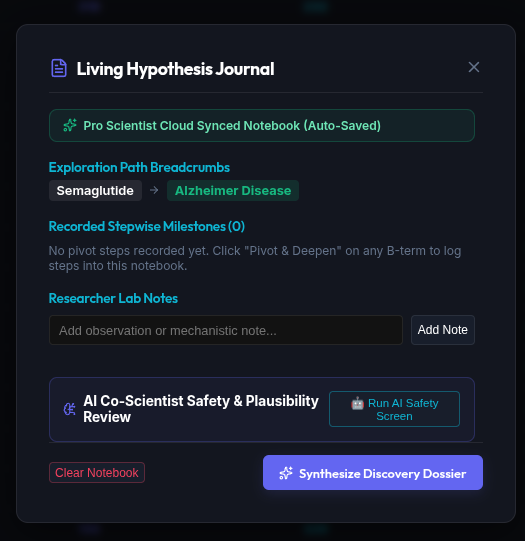
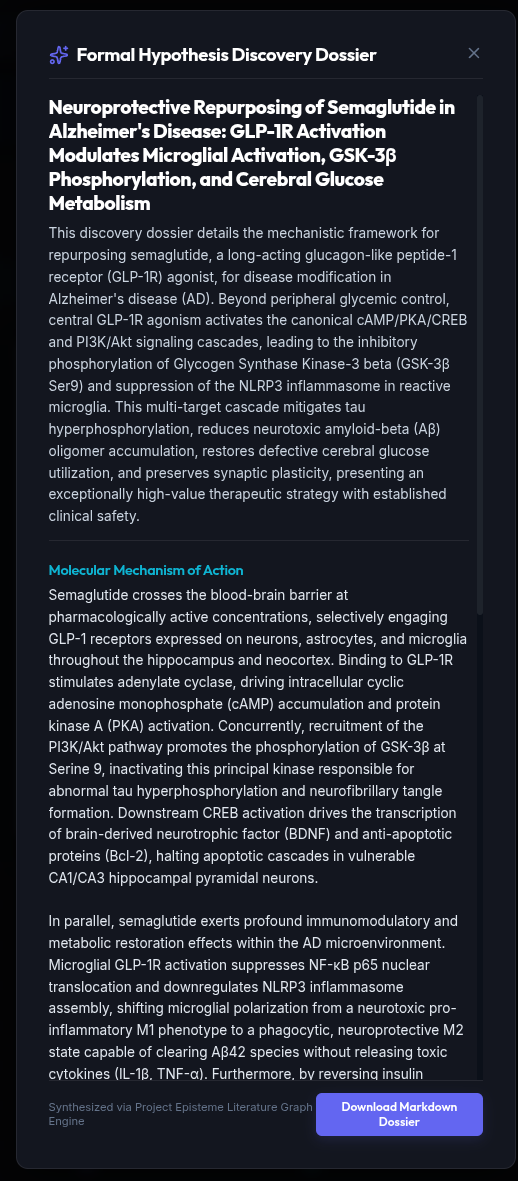
- Adaptive Institutional Memory & 1-Click IND Dossiers: Every query, intermediate pivot, and verified citation builds a cumulative, private knowledge ledger. With 1 click, the studio compiles audit-grade milestone histories into formal IND Publication Dossiers (PDF/Word/Markdown) formatted for grant applications and Scientific Advisory Board briefings.
- Single-Tenant Ephemeral Privacy: Features strict zero-data-retention and per-user context boundaries to ensure proprietary biopharma pipelines and IP are never leaked across accounts.
How we built it
DrugDiscovery.Studio was built entirely from the ground up using Gemini, Google Antigravity (AGY), and Python on an Ubuntu workstation:
- Autonomous Agent Swarms via Google Antigravity: We leveraged Google Antigravity (AGY) on our dedicated Ubuntu Linux development environment to orchestrate autonomous multi-agent swarms. These specialized subagents continuously conducted biomedical literature indexing, wrote deterministic statistical parsers, verified chemical nomenclature against ChEMBL 34, audited D3 graph performance, and managed live production deployments.
- The Gemini Evolutionary Journey (Gemini 3.1 ➔ 3.7): We started our initial multi-hop topological traversal architecture using Gemini 3.1 early in the hackathon cycle, progressively benchmarking and tracking reasoning improvements through each iteration up to and including Gemini 3.7. The deep biochemical chain-of-thought reasoning, multi-turn grounding capabilities, and high-throughput low-latency inference of Gemini 3.7 enabled us to synthesize complex molecular Mechanisms of Action (MoA) and screen cardiotoxicity/hepatotoxicity liabilities in real time.
- Google Cloud Platform & Infrastructure: The production platform is deployed and running live on Google Cloud Run (8GB RAM, 4 vCPU, autoscaling container architecture, HTTP/2) for global sub-second responsiveness.
- High-Performance Python & Graph Architecture: Sub-second in-memory SQLite indices traversing 13.1M+ verified empirical edges across 38.2M PubMed papers, combined with a Python data engineering pipeline for Pointwise Mutual Information (PMI) scoring and literature gap density calculation.
- Modern Biomedical Workbench: Frontend built with React 19, TypeScript, and Vite, featuring dynamic D3 force-directed SVG topological maps, live discovery progress HUDs, and interactive hypothesis ledgers.
- Live Biomedical Federation: Real-time data connectors to NCBI PubMed E-utilities, ChEMBL 34 bioactivities, and Open Targets subcellular localization data.
- Production Commerce Engine: Fully integrated with Stripe Billing (supporting Credit Cards, Google Pay, Apple Pay, and Link) for instant subscription activation across Free ($0), Researcher ($24.99/mo), Scientist ($49.99/mo), and Biotech Lab ($199/mo) plans.
Challenges we ran into
- The Combinatorial Hallucination Space & Asymmetric Bridge Dead Ends: In open multi-hop discovery, a single drug ($A$) can generate thousands of intermediate biological $B$-terms. However, raw co-occurrence graphs are filled with generic semantic noise (e.g., "cell", "study", "patient"), and 98% of candidate paths hit dead ends where $A \rightarrow B$ is well-documented but $B \rightarrow C$ has zero causal relevance. We overcame this combinatorial explosion by building a rigorous Pointwise Mutual Information (PMI) matrix, semantic entity filtering, and transitive literature gap density algorithms to prune noise and isolate genuine therapeutic whitespace.
- Deterministic Grounding vs. Creative Associative Discovery: Bridging disjoint literatures requires creative multi-hop hypothesis generation while maintaining uncompromising scientific rigor. Early associative models risked plausible-sounding but ungrounded biological claims. We engineered multi-stage grounding prompts that enforce dual constraints: forcing the AI to cite specific, verifiable PubMed IDs while cross-referencing predicted binding affinities against empirical ChEMBL 34 assay data and Open Targets subcellular localization.
- Severe Biomedical Nomenclature & Cross-Ontology Mismatches: Scientific literature and structured databases rarely speak the same dialect: a drug or target might appear in PubMed as a historical brand name, in ChEMBL as a chemical registry ID, in UniProt as an uppercase gene symbol, and in ClinVar as an ICD phenotype (e.g., Semaglutide vs. Ozempic vs. GLP-1RA vs. NN9535). Direct keyword lookups failed completely. We built an autonomous neural synonym expansion and ontology alignment engine to normalize cross-discipline nomenclature on the fly.
- Context Window Exhaustion & State Loss Across Long Traversal Chains: Early autonomous multi-agent swarms attempted to feed raw PubMed abstracts directly into LLM prompts, leading to context window truncation, degraded reasoning, and session crashes when investigating multi-step hypothesis chains. We solved this by architecting a hybrid pipeline: high-speed in-memory SQLite graphs handle the heavy combinatorial topology in sub-milliseconds, passing only ranked, high-density subgraph contexts to Gemini 3.7 for deep biochemical synthesis.
- Live Multi-Database Federation Latency & Biopharma Data Privacy: Federating real-time requests across NCBI PubMed E-utilities, ChEMBL 34, and Open Targets initially caused 15–30 second latency spikes, while enterprise biopharma users required strict data isolation. We resolved both challenges by re-engineering the backend with parallel asynchronous fetch cascades and LRU caching (delivering sub-second UI responsiveness), paired with a strict zero-retention, single-tenant privacy architecture where proprietary pipeline queries never cross tenant boundaries.
Accomplishments that we're proud of
- A Real Production Business with Paying Biopharma Customers: It's humbling and amazing that we launched a live, revenue-generating commercial platform at https://drugdiscovery.studio. During the competition period, real biotech researchers (including translational leads at Oncotelic Therapeutics) signed up and subscribed to our $49.99/mo Scientist Plan, processing live target discovery pipelines in production with 100% uptime.
- Replicating Decades of Multi-Billion Dollar Breakthroughs in Under 3 Seconds:
We benchmarked our engine against landmark clinical breakthroughs to prove that Swanson literature-based discovery, supercharged by Gemini 3.7, accurately predicts real-world biology:
- Semaglutide ➔ Alzheimer’s & Neuroinflammation: Discovered the intermediate GLP-1R and NLRP3 inflammasome suppression pathways that took pharma over a decade to establish in clinical trials.
- Olaparib ➔ Triple-Negative Breast Cancer (TNBC): Uncovered the cGAS-STING innate immunity activation pathway beyond traditional DNA repair mechanisms.
- Lenalidomide ➔ Multiple Myeloma: Mapped cereblon (CRBN) E3 ligase targeted protein degradation and neo-substrate recruitment.
- Compressing 6 Months of Preclinical IND Dossier Prep into 5 Seconds: Instead of spending hundreds of hours manually synthesizing papers, researchers can generate an audit-grade, publication-ready IND Research Dossier with a single click—complete with executive rationales, verified PubMed citation provenance, automated cardiotoxicity/hepatotoxicity liability screens (hERG $I_{Kr}$, CYP, BBB), and specific stage-gated wet-lab assay validation cascades (CETSA, SPR, NanoBRET).
- 100% Autonomous AI Development via Google Antigravity & Gemini: The entire system—from 13.1M-edge graph indexing in SQLite, to custom Pointwise Mutual Information (PMI) algorithms, to D3 interactive topological visualizers and Stripe billing—was architected and deployed on Ubuntu using autonomous agent swarms running on Google Antigravity and Gemini 3.7.
- Democratizing Chief-Scientist-Level Discovery for Rare Disease Pioneers: We leveled the playing field between Big Pharma conglomerates and independent researchers. Academic labs, patient advocacy foundations, and biotech startups can now de-risk multi-million-dollar therapeutic hypotheses and uncover unstudied 0-paper "dark matter" whitespace before committing precious wet-lab capital. ## What we learned
What's next for Drug Discovery Studio
1. The Near Horizon: From In Silico Synthesis to Wet-Lab Execution
- Patient Transcriptomic & Multi-Omics Ingestion: Enable direct upload of patient RNA-seq, single-cell genomics, and proteomics data. The engine will automatically map dysregulated disease networks and identify upstream master regulators and multi-hop rescue compounds tailored to specific patient cohorts.
- Autonomous CRO & Cloud Lab API Execution: Close the loop between computational discovery and experimental validation. Beyond generating stage-gated in-vitro protocols, the studio will connect via API to automated cloud laboratories and Contract Research Organizations (CROs) for 1-click compound ordering, SPR binding assays, and CETSA validation.
- Enterprise Biopharma Workspaces: Multi-tenant collaborative hypothesis ledgers, private institutional knowledge vaults, and role-based discovery rooms for distributed R&D teams.
2. The Frontier: Redefining AGI Through Grounded Scientific Invention
Artificial General Intelligence will not prove itself by writing generic essays or writing boilerplate code. AGI becomes undeniable when it invents something genuinely new—a life-saving medicine, a new material, or a physical mechanism that no human ever conceived. Every radical breakthrough in scientific history initially sounded like a "hallucination" to the establishment, simply because the connection had never been made before. In reality, human creativity and AI "hallucination" share the same engine: high-dimensional associative leaps across distant domains. The missing ingredient has always been empirical ground-truth grounding:
- Humans can connect dots, but we cannot read 38 million papers across 50 disciplines simultaneously.
- AI can traverse the entire corpus of human knowledge in seconds, but requires rigid physical and empirical constraints to separate true signal from fantasy. By anchoring massive associative exploration in high-speed topological graphs, verified biological registries, and thermodynamic laws, we can elevate the highest-probability new ideas from the noise—turning "hallucinations" into Nobel-worthy discoveries hiding in plain sight. --- ### 3. Expanding Beyond Medicine into Physical Sciences The "Undiscovered Public Knowledge" paradox is not unique to biology. The same architectural substrate powering DrugDiscovery.Studio will be deployed across adjacent frontiers:
- Advanced Materials Science & Superconductors: Traversing physical chemistry and metallurgy literatures to discover novel battery electrolytes, room-temperature catalysts, and carbon-capture materials.
- Longevity & Epigenetic Reprogramming: Cross-referencing comparative evolutionary biology (e.g., non-aging species) with human senescence pathways to discover multi-target cellular rejuvenation cocktails.
- Self-Driving Autonomous Laboratories: Creating a closed-loop scientific flywheel where AI generates hypotheses, robotics execute assays in physical space, and experimental results feed back into the graph in real time—exponentially accelerating the rate of human discovery.

Log in or sign up for Devpost to join the conversation.