Inspiration
Since my first day at university, I saw studying as something tiring, boring and huge. Especially because I always loved learning and joining a lot of things, and studying kept ruining that for me.
So one day I sat down and started thinking about a way to solve this problem. I searched a lot, and I found that the methods most of us students use are the worst ways to study (re-reading and highlighting). Of course they are easy to do (just sit, read, repeat and highlight), but they are not effective at all and they take a very long time. If we had a pyramid that ranks study methods, these ones would live at the very bottom of it.
What it does
From here, me and my friend Abdelhafeez started moving to solve this problem, and to take the way students study, and their learning journey, from the worst methods to a journey that is fun, gamified and proven by science to be the best, all with the help of AI. Today, joining this competition in the Next Gen category is one of the steps we are taking to reach the goal of our journey: to turn studying from hard, tiring work into a daily journey where the student's mission is to take care of their trees by watering them every day.
How we built it
Our journey went through a lot of experiences and competitions before this one, and we learned a lot from them. We moved from pictures on Canva and Figma to a web page (of course everything was different in the past competitions, like the visual identity... in this competition we leveled up, thank God). The last idea we reached was that we want to turn studying into a game: every day the student comes, does a short session using the best learning methods, and then leaves. And from exactly this point, we started this Shipaton.
After I made a number of assets in Blender (the trees, the world, the character and some icons), I went to Flow and fed it a lot of my work, so it would understand my identity, my colors and my character, to help me and save me time (because rendering in programs like Blender takes a lot of time). Then I started making the screens. This time, and different from all the other times, we focused on the deepest details of the UI/UX, from small interactions with Coco to the idea that you can study together with your friends in a squad, and other things that we really got tired thinking about. But in the end, it gave our app a really beautiful vibe. After I finished all the screens with the help of Stitch, the app was ready in Figma. Then we started turning the app from pictures into a real app with the help of Claude Opus 5.5, and thank God, after long days of work and real effort, the app is fully ready.
So now, instead of chaos and random studying, the journey of a student using Drrys looks like this:
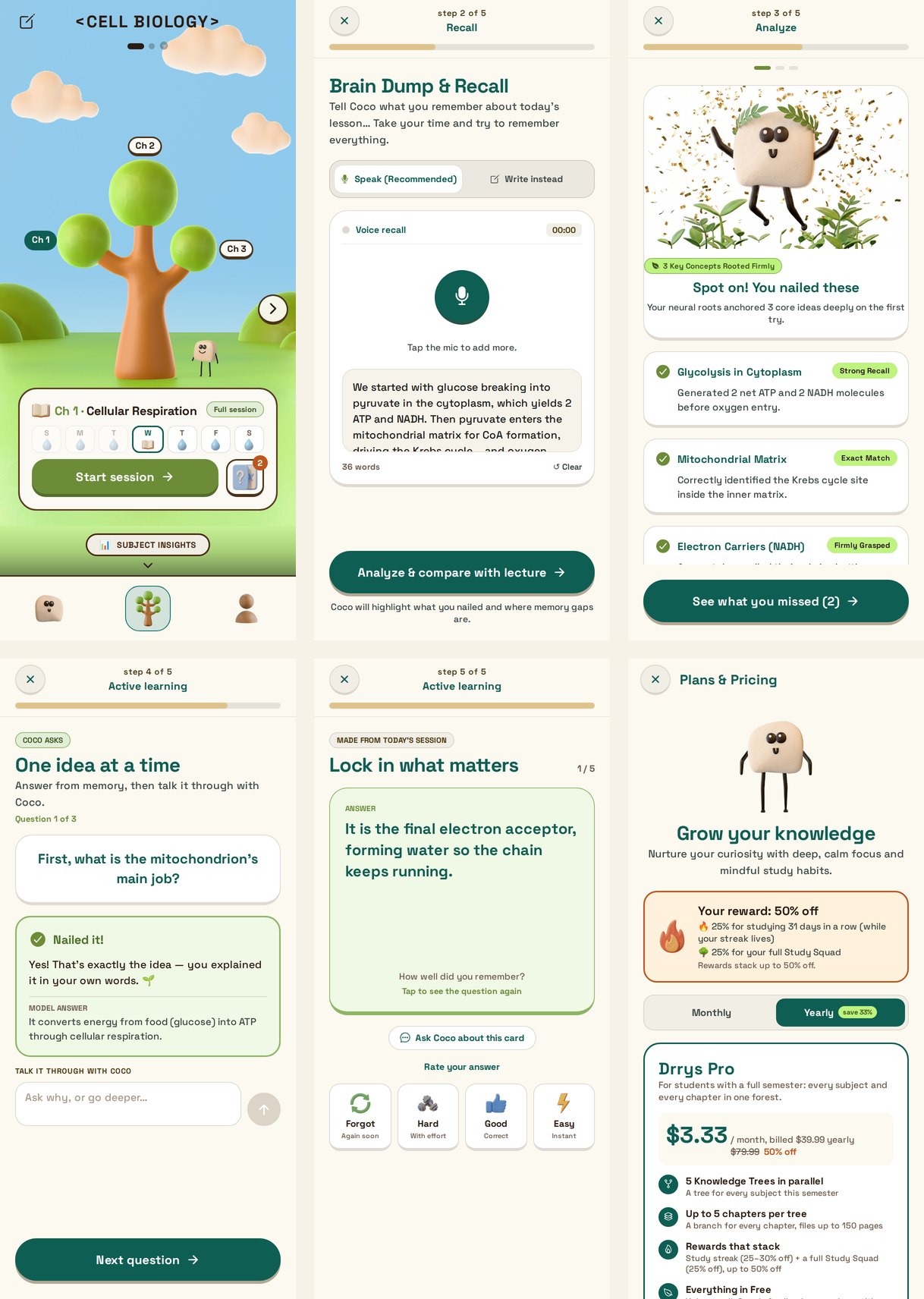
Every day, after they attend their lecture at university and go home, they open the app. The app already has all the files for the subject, the past exams and everything that helps the AI understand the full context and predict the exam patterns and questions. Then, for each subject, they do one of two things:
A full session: this is on the day they had the lecture, so the session is longer. It has active recall, the Feynman technique, and flashcards to review what was given in the lecture. A flashcard session (faster): just a review of the flashcards, which follow a spaced repetition system and were made in the full sessions.
Challenges we ran into
The first and most important thing for us when we started was to change everything we had before in the visual identity and start a new, strong one. So I opened Blender and started working on our character Coco, the trees, the environment and the style in general. After a long effort and a lot of tries, it worked, and I made the app in the minimalist, clay style you're going to see.
also, one of the biggest challenge for us was turning the app from pictures into a real app with the help of Claude. Designing a screen in Figma is one thing, but making it actually work is something else. Every screen that looked finished in Figma needed a lot of real work behind it: saving the student's trees and cards, making Coco's animations play smoothly on the phone, and connecting everything together.
We also found a lot of bugs only when we tested the app on a real phone, like the app crashing , and other challenges . So we went through many rounds of testing, finding problems, fixing them and testing again. Another hard part was making Coco's AI stick only to the student's own lecture files and past exams, and not make things up. It took a lot of tries until the questions and flashcards felt right.
Accomplishments that we're proud of
One of the nice ideas we came up with, and learned about during this Shipaton, is discounts on Pro. They come in two ways:
The daily streak: study 30 days in a row and you get 25% off, 60 days and it's 30% off. We did this to encourage students to stay consistent. The "squad": you and 3 friends join the app together with one code, and when the squad is full, each of you gets 25% off Pro while the squad stays together. This helps Drrys spread wider.
The two discounts stack, up to 50% off. On top of that, the free plan gives you one tree with one branch (one chapter), but if you bring a friend to the app and they finish their first session, you get two branches instead of one.
What we learned
We learned sooo many things from all of these problems. And the most important one, from our point of view, is that your app has to be the way the user wants it, not the way you want it.
What's next for Drrys — Grow what you know
I'm really happy with this competition because it was a very big step for the app, and what's coming next is going to be even bigger in every way, God willing. We want to add mnemonics, AI-made videos, live Ai chatting with coco, audio podcasts and a lot of other features we have in mind.
And I really want to thank the RevenueCat team for all the effort they put in before the submission, and the effort they will put in after it. I want to remind you that you helped me, and helped thousands of people, build apps, grow and learn. So thank you.


Log in or sign up for Devpost to join the conversation.