-
-
thumbnail
-
architecture
Inspiration
I've been on the wrong end of overselling more than once — "your order is confirmed," then twenty minutes later, "sorry, it actually sold out." It happens because when thousands of people buy in the same second, the system loses count. I wanted to build the thing that makes that impossible — and run it on infrastructure that could take real traffic, not a toy.
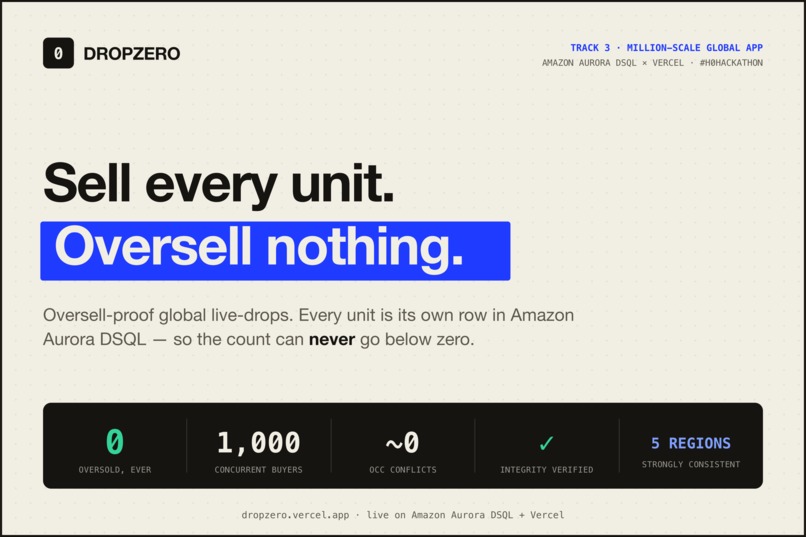
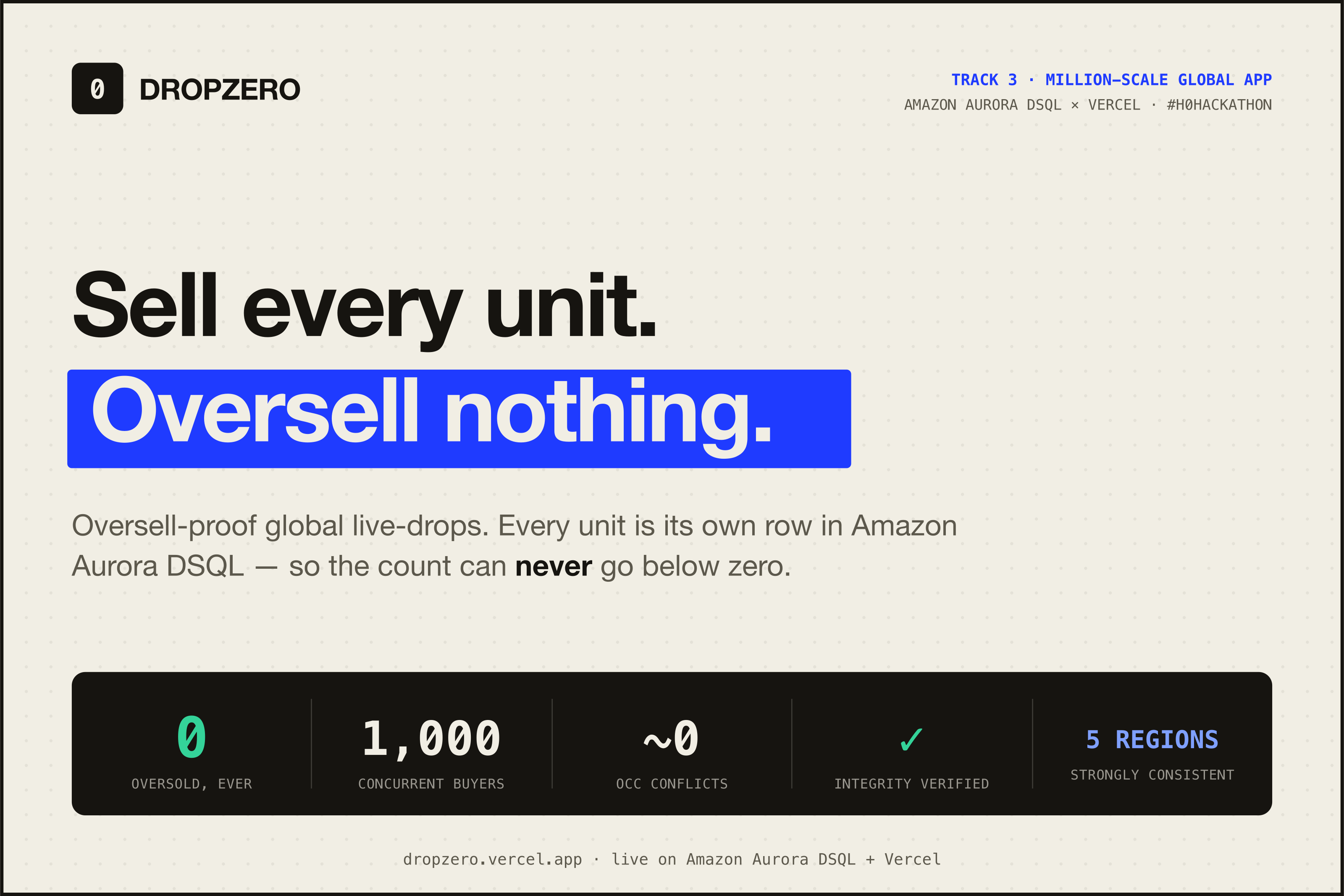
When I saw Amazon Aurora DSQL on this stack — serverless, multi-region, strongly consistent — I realized it was exactly the right database for the problem. So I built DropZero: a flash-sale engine where overselling is mathematically impossible, even with thousands of buyers worldwide hitting the same drop at once.
What it does
A seller creates a "drop" with fixed inventory. When it goes live, buyers everywhere rush in, and every purchase atomically claims a distinct unit in Aurora DSQL — so the count can never go below zero. There's a seller console, a live global activity feed, seller analytics (revenue, sell-through, velocity), and a Consistency Console that fires thousands of concurrent buys on demand and shows the result live: confirmed, rejected, 0 oversold, integrity verified, and the optimistic-concurrency conflict rate.
How I built it
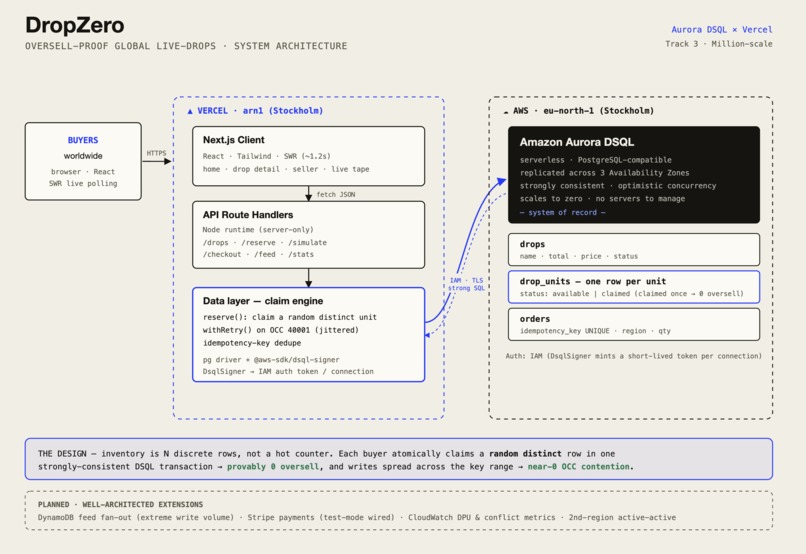
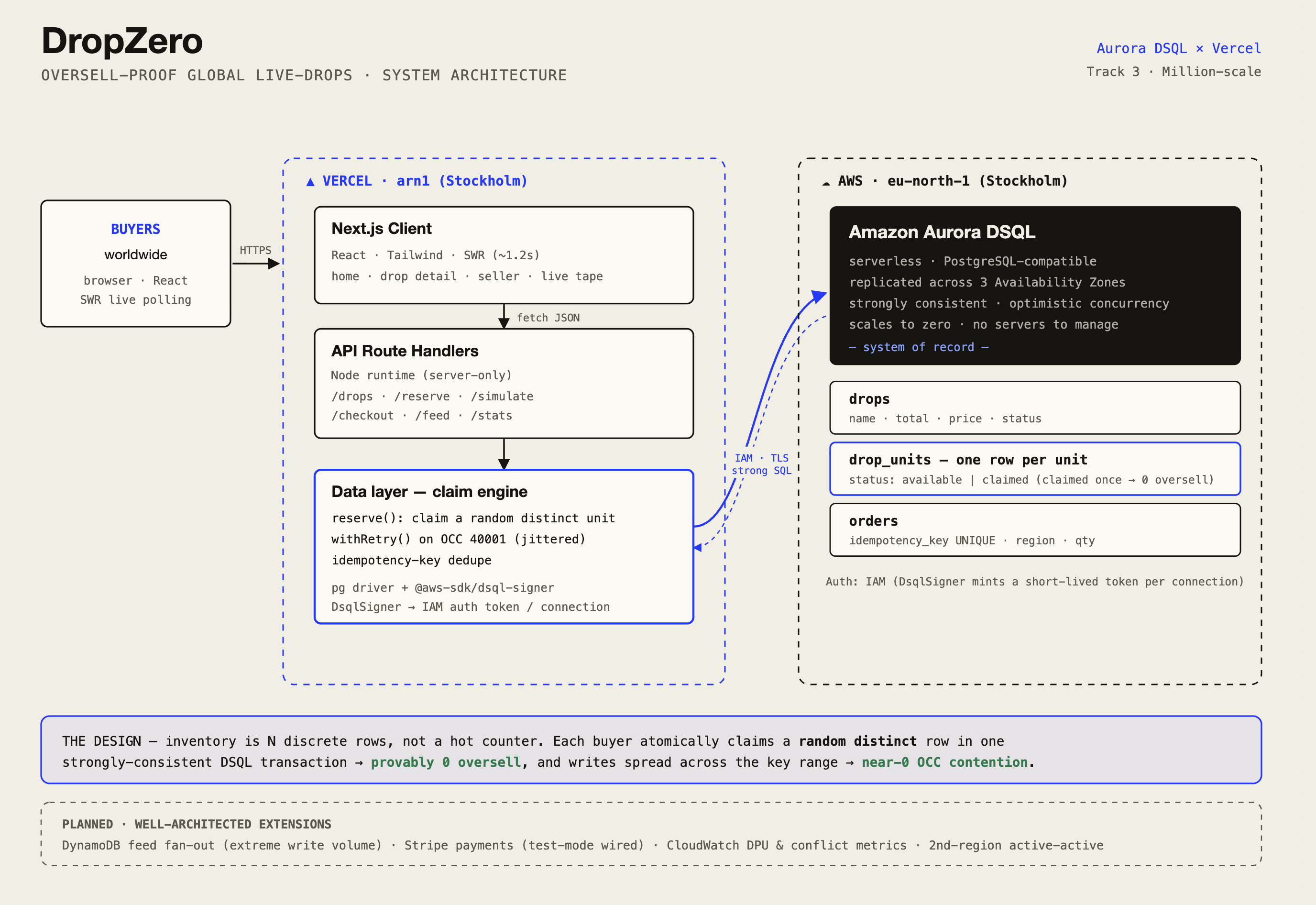
The front end is Next.js (App Router) + Tailwind, deployed on Vercel. The data
layer talks to Amazon Aurora DSQL through the pg driver, authenticating with
short-lived IAM tokens via @aws-sdk/dsql-signer — no stored passwords. I also
built a zero-credential in-memory mode so the whole app runs locally before any
cloud is wired up.
The heart of it is the claim engine: reserve() claims a random distinct unit row
in one strongly-consistent transaction, wrapped in an OCC retry with jittered
backoff, plus idempotency keys so a double-click never double-buys.
Challenges I ran into
I almost built it the obvious way — one remaining counter that every buyer
decrements. On a normal database, that's fine. On Aurora DSQL's optimistic
concurrency control, that single hot row is the worst possible workload:
thousands of writes to one key produce a storm of 40001 serialization conflicts.
So I flipped the entire model — every unit is its own row, and each buyer
claims a random distinct one. Now thousands of buyers touch thousands of
different rows, overselling is impossible by construction, and contention stays
near zero. The flaw became the best part of the design.
DSQL also has real differences from PostgreSQL I had to design around: no foreign
keys, no JSON, only one DDL statement per transaction (which is why my schema
kept failing in the query editor until I ran each CREATE TABLE on its own),
CREATE INDEX ASYNC instead of plain CREATE INDEX, and a 10k-row transaction
limit (so I batch the unit minting).
And my first live stampede had a p99 of ~8.6 seconds — because my Vercel functions
were in the US while my cluster was in Stockholm. Co-locating the functions in
arn1 (same region as eu-north-1) dropped p99 to ~1 second.
What I learned
Distributed databases don't remove the hard parts — they move them into your data model. The single best decision in this project was turning one hot row into many cool rows. I also learned a lot about DSQL's optimistic concurrency, IAM-token auth, and what "strongly consistent at global scale" actually buys you.
What's next for DropZero
It isn't really about tickets. Anywhere a crowd grabs for limited slots at the same instant — university course registration, government visa / passport / appointment slots, vaccine and benefit sign-ups, ERP inventory allocation — is the same problem. DropZero is fair, oversell-proof allocation of any scarce resource, on infrastructure built to scale to millions.
Built With
- amazon-aurora-dsql
- next.js
- node.js
- postgresql
- react
- stripe
- swr
- tailwindcss
- typescript
- vercel

Log in or sign up for Devpost to join the conversation.