-
-
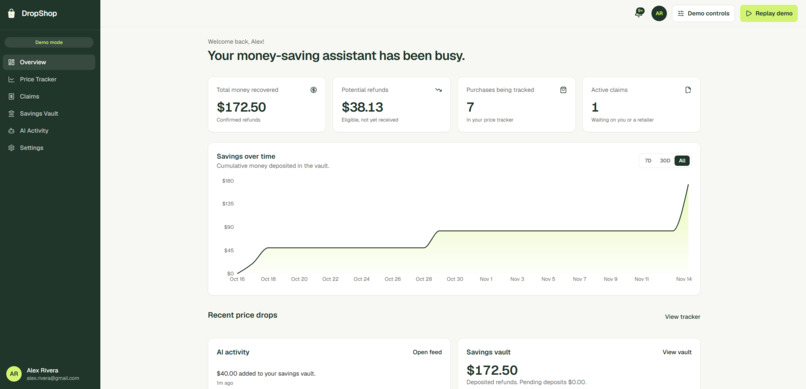
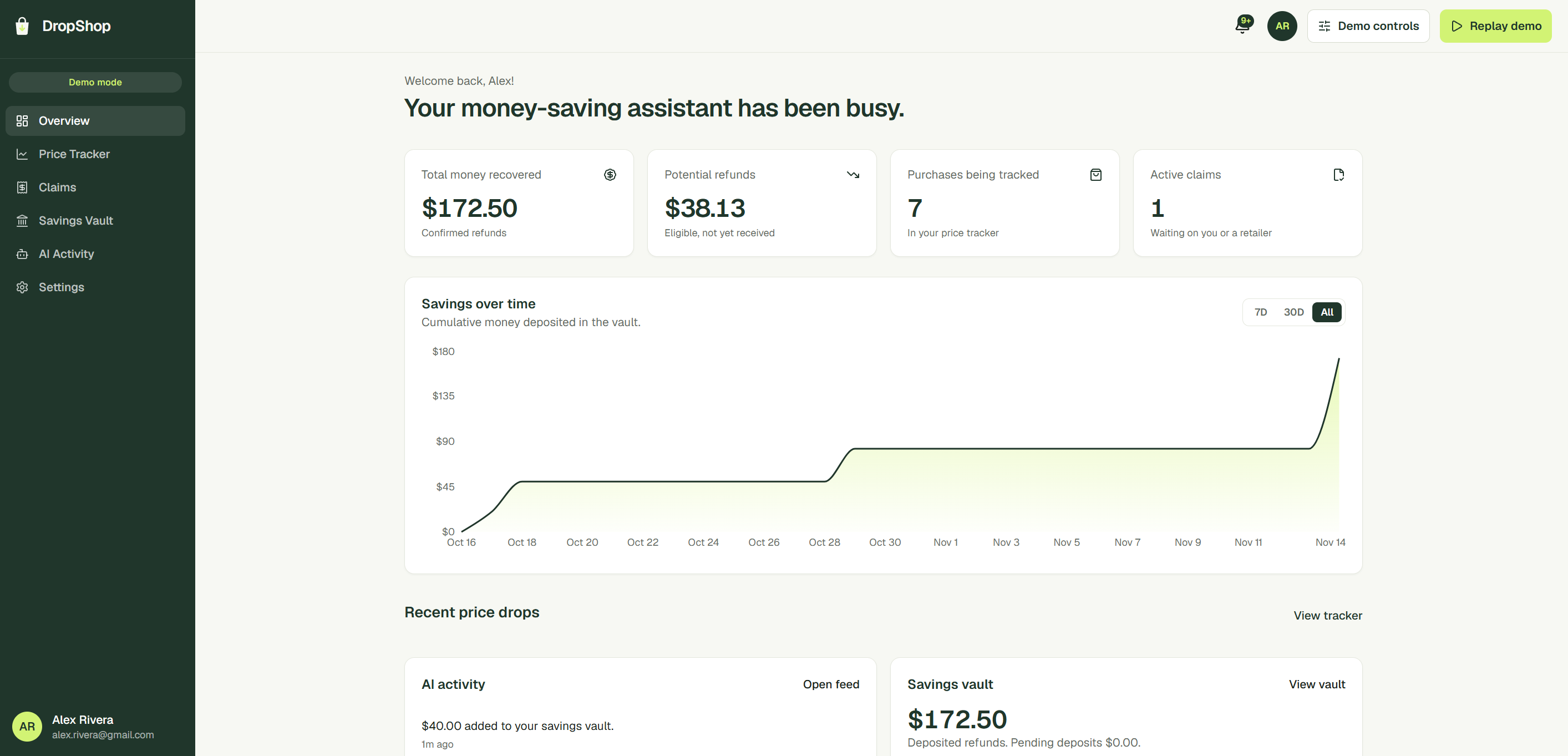
Dashboard Main Pages
💡 What Inspired Us
The primary inspiration behind DropShop was the upcoming Black Friday shopping season and the often tedious process of requesting price adjustments or refunds from retailers. Many retailers have different price-adjustment policies, eligibility requirements, and claim procedures, making it difficult and time-consuming for consumers to recover money when an item they purchased drops in price.
We wanted to address this problem by creating a solution that simplifies and automates the refund recovery process. DropShop makes it easier for consumers to receive refunds without having to navigate each retailer's policies manually. Additionally, this project presented an opportunity to integrate multiple platforms, technologies, and applications into one cohesive system.
📚 What We Learned
Throughout the development of DropShop, we gained valuable experience working with different technologies and integrating them into a unified application.
In particular, we strengthened our understanding of database management systems, including MongoDB and Tiger Data, and learned more about how they can be used to store, organize, and manage application data. We also improved our AI-assisted coding skills through our use of Cursor, learning how to write more accurate and detailed prompts, communicate requirements clearly, and troubleshoot AI-generated code.
Overall, this project helped us strengthen both our technical abilities and our capacity to collaborate effectively while developing a project within a limited timeframe.
🛠️ How We Built the Project
Cursor was the team's primary AI-powered coding tool throughout the development of DropShop. We primarily used Cursor to develop the frontend, financial layer, and portions of the backend infrastructure. It helped us generate, refine, and debug code while accelerating the overall development process.
In addition to Cursor, we used Claude Code to assist with integrating different branches and layers of the project, resolving compatibility issues, and developing additional backend functionality.
By combining these AI-powered development tools, we were able to bring the various components of DropShop together into a unified and functioning application.
🚧 Challenges We Faced
One of the primary challenges we encountered during the project was ensuring that the backend code compiled correctly and integrated seamlessly with the frontend for our final DropShop demonstration. Connecting the different layers of the application required significant troubleshooting and debugging to ensure that all components communicated as intended.
Another major obstacle involved Sentient OS, which was an important component of our project but was not compatible with Windows operating systems, as it only supported macOS. This created additional limitations and required us to work around operating system compatibility constraints during development.
Additionally, configuring and managing API keys proved challenging due to outdated API key issues, which occasionally disrupted our ability to connect different services.
Despite these obstacles, we worked collaboratively to troubleshoot technical issues, resolve integration challenges, and bring the project together for our final demonstration.
Built With
- cursor
- docker
- gemini
- grok
- javascript
- mongodb
- nessie
- next.js
- python
- react
- solana
- tigerdata
- typescript


