Inspiration
We started with a simple question: what if AI could launch an entire e-commerce business on its own? No human copywriters, no designers, no sourcing agents—just AI building everything from concept to launch. The idea became Droppit, a project to explore how far autonomous systems could go in replacing the manual parts of entrepreneurship. The inspiration came from watching how people on TikTok find trending products and realizing that AI could not only do the same, but also build the entire brand around them.
What it does
Droppit is a fully autonomous e-commerce creation platform. You type in a niche or a product idea, and the system builds everything automatically. It finds trending products, creates a complete brand identity, writes marketing copy, generates realistic product images, builds the website, and even runs A/B tests to improve conversion rates.
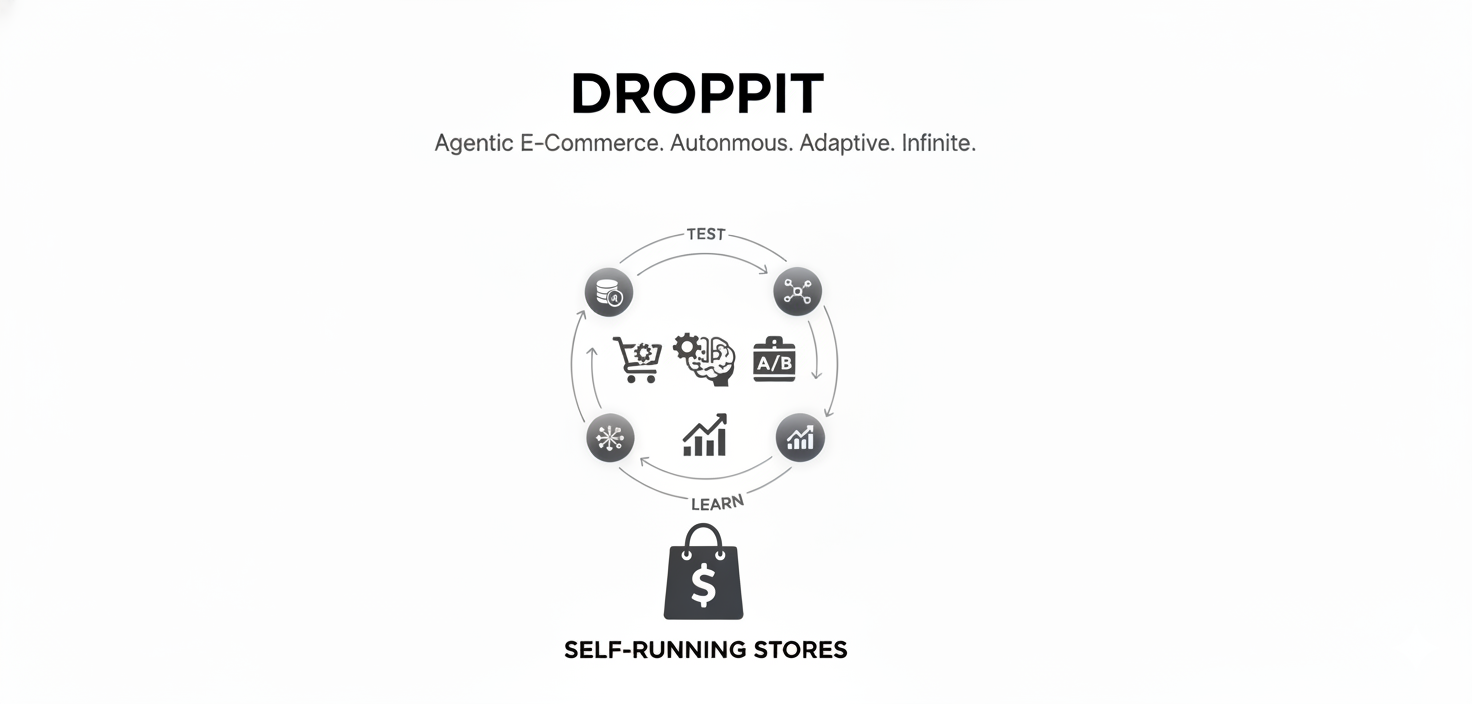
It doesn’t stop at generation. The system continuously learns which styles, headlines, and products perform best across all stores and uses that knowledge to optimize new ones. Every store Droppit creates gets better because it learns from all the others. The best part is that no human ever has to intervene—from sourcing to design to deployment, it’s 100 percent AI-run.
How we built it
Droppit runs on a serverless microservices architecture hosted on Vercel. We use Supabase for database management and storage, giving us a completely scalable and stateless backend. Each stage of the business creation process—authentication, product sourcing, brand profiling, content generation, image generation, and website rendering—is modular and operates independently.
For intelligence, we used X AI as the main brain behind content creation and strategy. It generates brand profiles, marketing copy, photography prompts, and SEO metadata. To find products, X AI analyzes trending keywords, then uses those keywords to crawl TikTok videos and content to identify what’s going viral. Once the products are sourced, the system automatically writes product descriptions, generates brand-aligned images using Gemini AI, and builds the full website template.
Every image, product listing, and headline is generated by AI and then automatically published. Even A/B test variants—different headlines, CTAs, and layouts—are created, assigned, and analyzed entirely without human input.
Challenges we ran into
Building something that runs end to end without human involvement was harder than expected. Coordinating so many asynchronous AI systems while keeping everything in sync was one of the biggest challenges. Long-running operations like image generation and content writing had to be carefully managed in a serverless environment with strict time limits.
Another challenge was making sure the AI-generated outputs felt coherent across stages. The brand tone had to match the images, and the products needed to align with the aesthetic. We had to get really creative with prompt chaining and data persistence, ensuring that each step carried the right context from the one before it.
On top of that, building our own A/B testing and statistical analysis system from scratch took time. Getting reliable significance data in a distributed, serverless setup required a lot of trial and error.
Accomplishments that we’re proud of
We built a system where AI can independently create, launch, and optimize an entire e-commerce business. No templates, no human editors, no intervention. Watching Droppit go from a single keyword to a complete live store with a unique brand identity and trending products felt surreal.
We’re also proud of the product sourcing intelligence. Having X AI scan TikTok trends and automatically turn that data into brandable products showed how far AI can go beyond text generation—it can actually sense what’s popular and turn that into opportunity.
The A/B testing system is another huge milestone. It doesn’t just run tests; it learns from them across all stores, building a shared understanding of what performs best for different niches.
What we learned
We learned that autonomous systems need structure to stay creative. Giving AI freedom without defined data pipelines leads to chaos, but when each module is focused and well-scoped, the results feel purposeful.
We also learned a lot about building for reliability in a serverless world. Handling asynchronous image generation, rate limits, and API retries forced us to think carefully about resilience and failover.
Most importantly, we learned that the future of e-commerce is not about humans using AI tools—it’s about AI running the entire process and humans just steering the direction. Droppit proved that with the right architecture, full automation is not only possible but already within reach.
What’s next for Droppit - Agentic E-Commerce
Next, we want to make Droppit even more autonomous and adaptive. The plan is to add a real-time analytics dashboard that helps each AI store self-optimize in real time. We’re also working on multilingual content generation, AI-driven video ads, and dynamic pricing based on market trends.
The long-term vision is for Droppit to become an agentic e-commerce system that not only launches stores but continuously evolves them. It will learn from every click, every purchase, and every store it has ever built. The goal is simple: a world where starting a business takes one sentence and the rest is handled by AI.
Built With
- ai
- grok
- javascript
- python
- xai


Log in or sign up for Devpost to join the conversation.