-
-
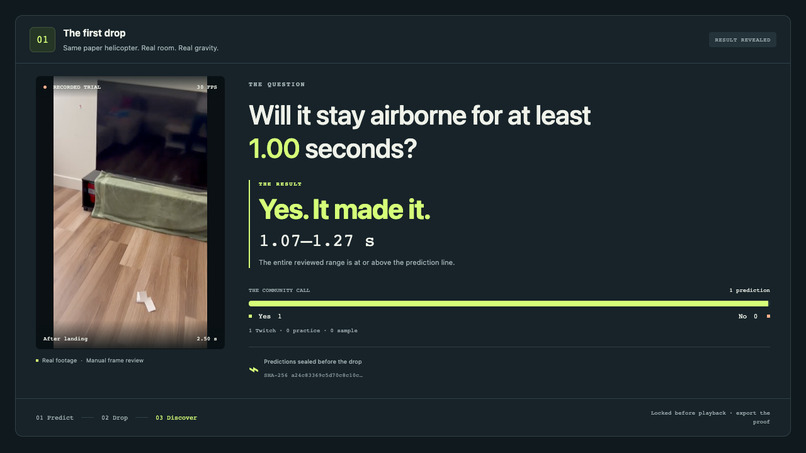
A real Twitch prediction, locked and resolved from a recorded physical trial, reaches the synchronized overlay.
-
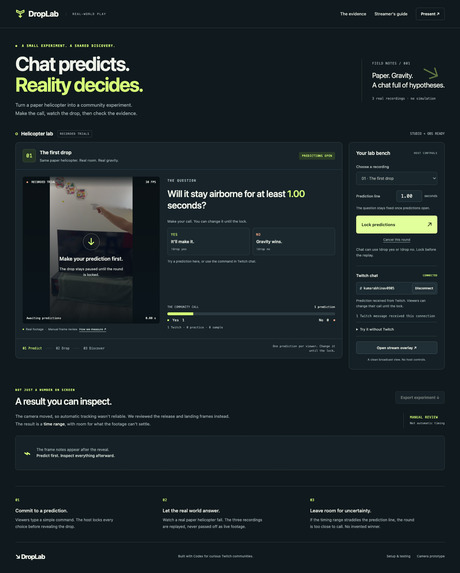
Verified incoming Twitch prediction: 1 Twitch, 0 practice, 0 sample.
-
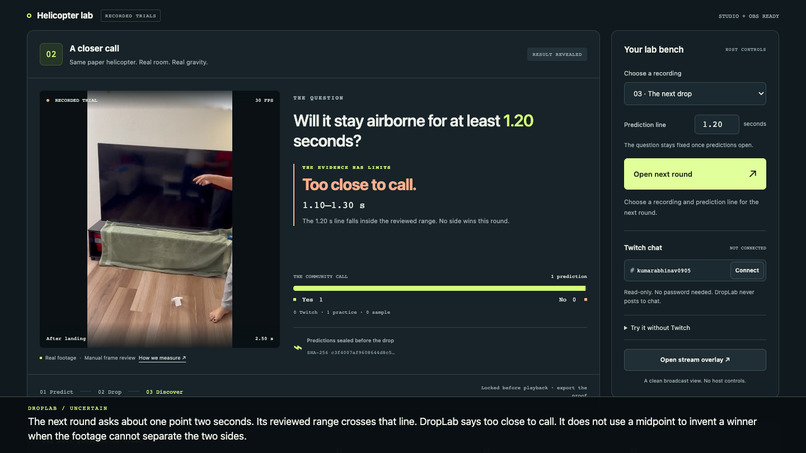
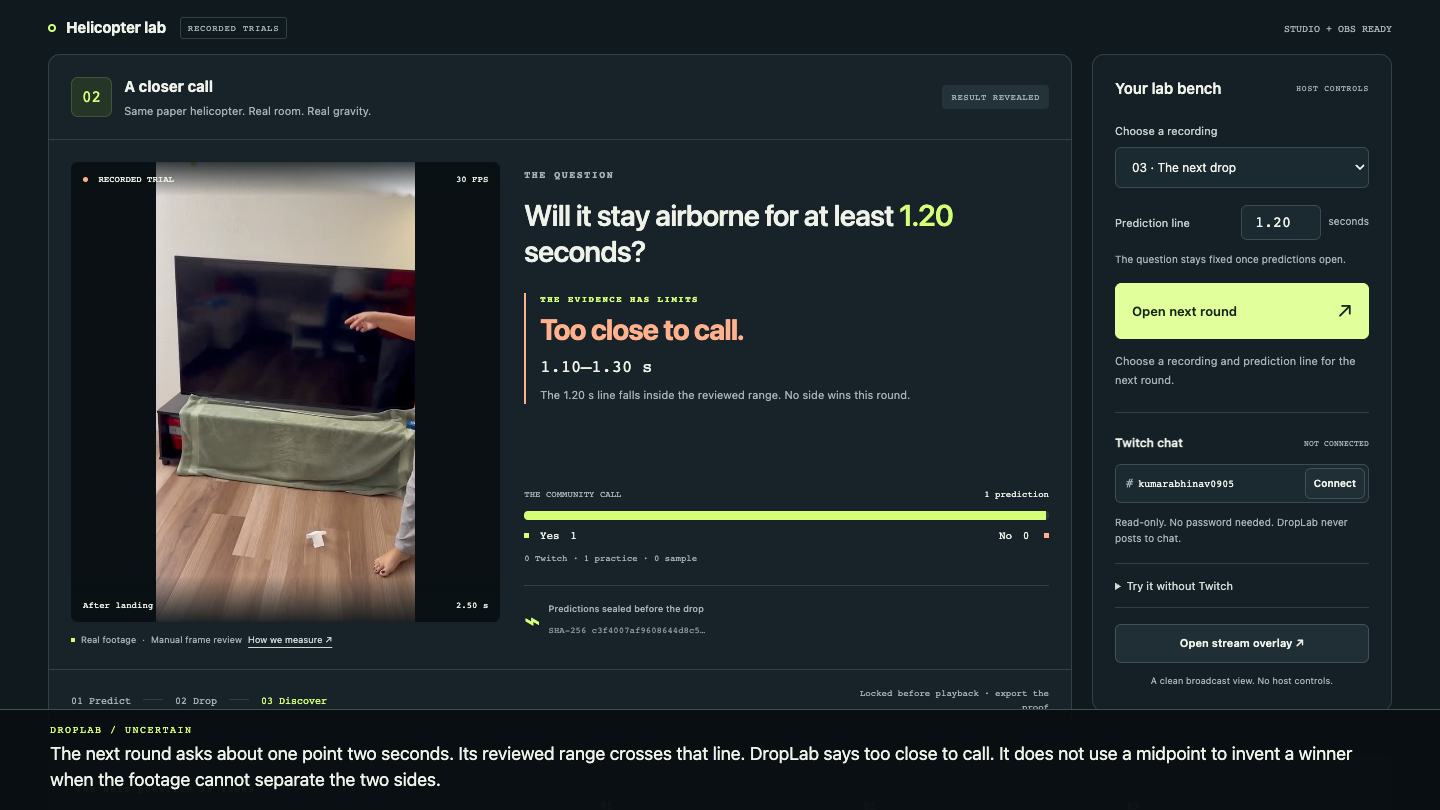
The reviewed range crosses 1.20 seconds: Too close to call. Clearly labelled practice walkthrough.
-
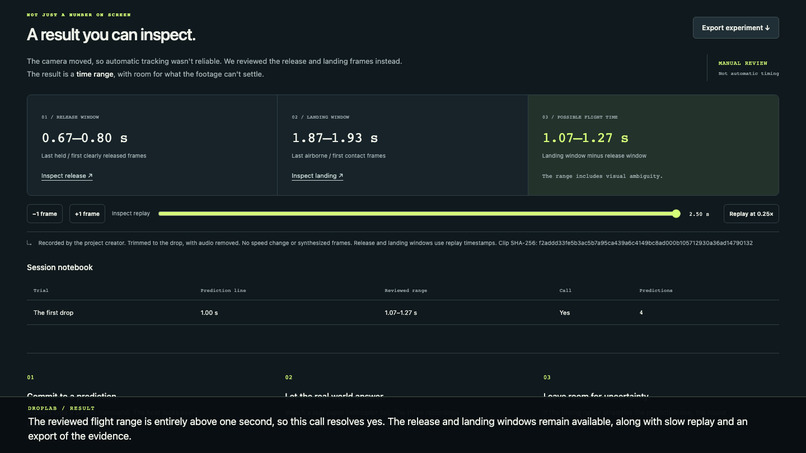
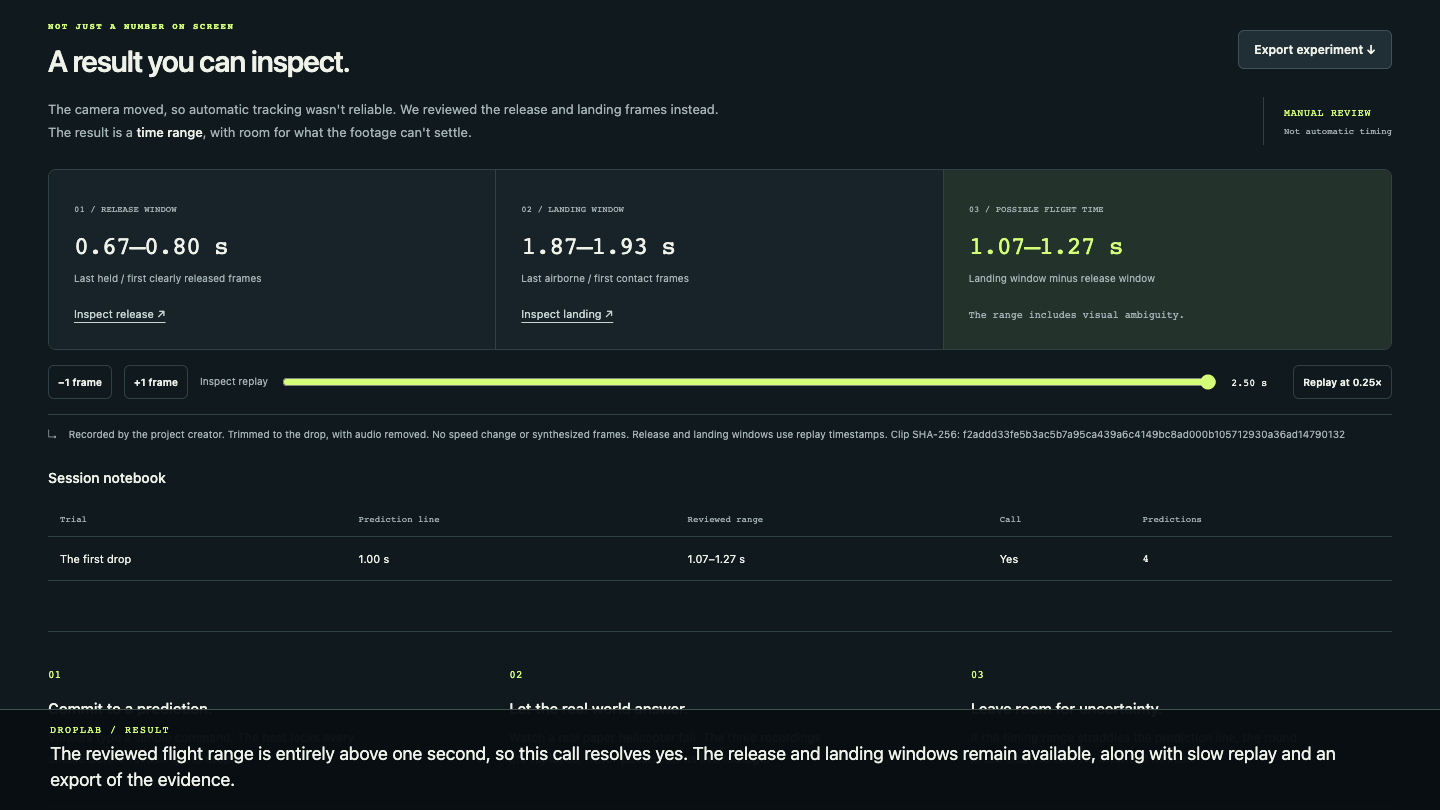
Reviewed release and landing windows, slow replay, frame stepping and an exported experiment notebook.
-
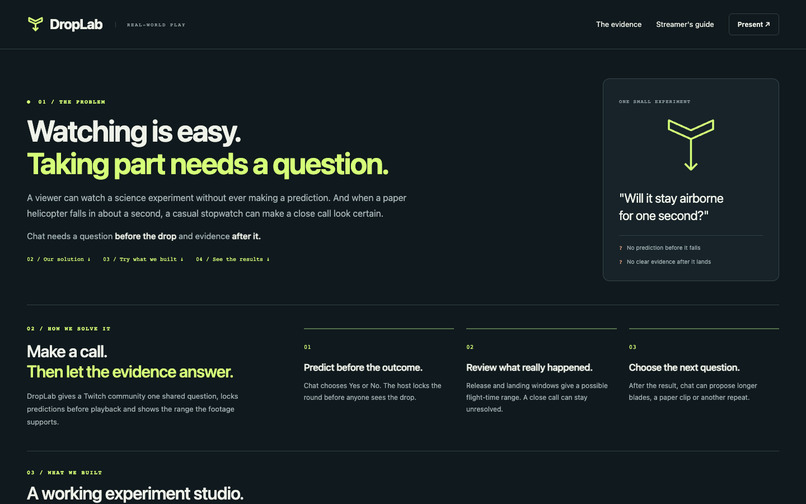
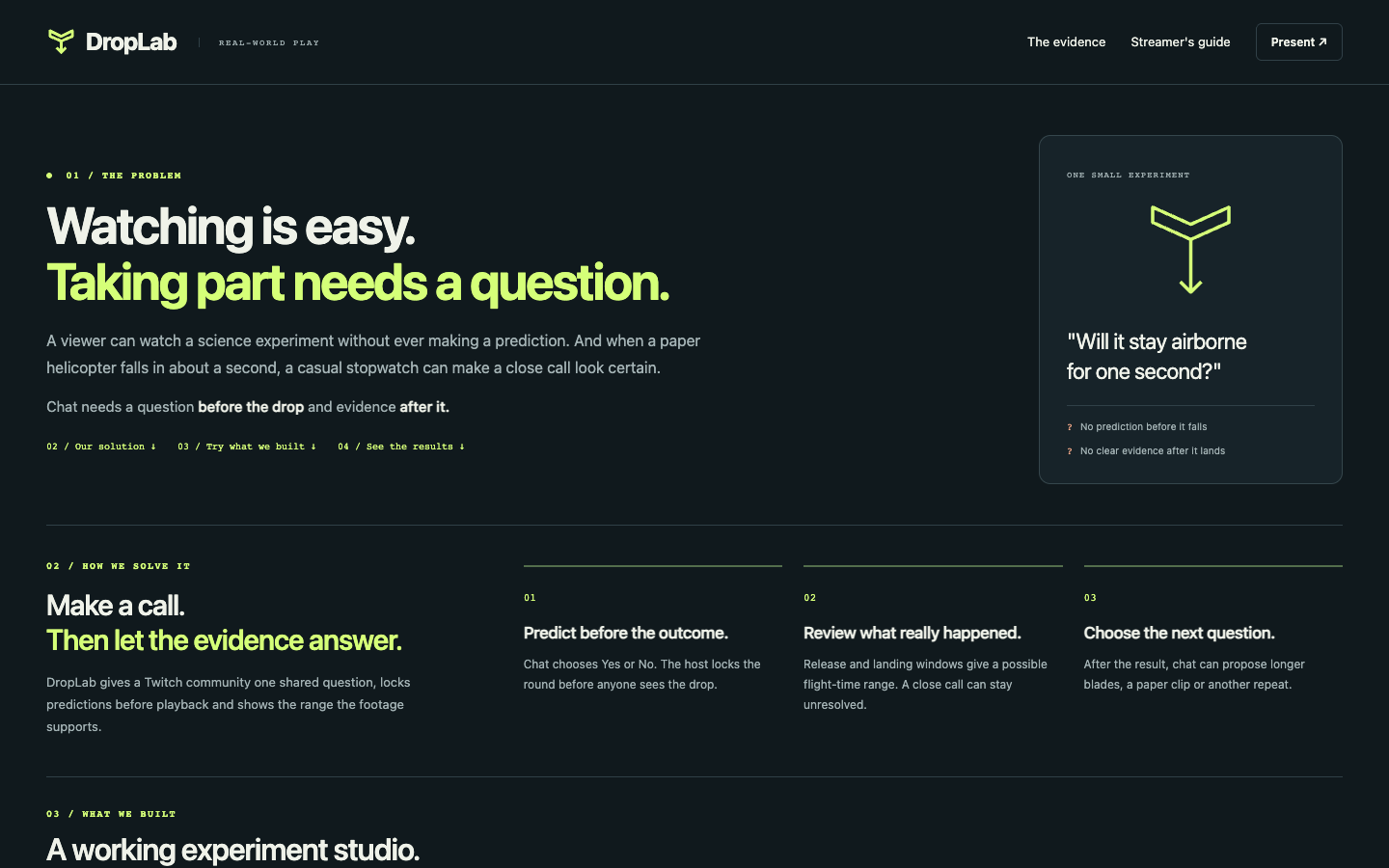
The revised public app starts with the problem and solution, followed by the working studio and verified results.
The problem
A paper helicopter falls in about a second. On a science stream, viewers can watch it happen without ever making a prediction. A casual stopwatch can also make an uncertain release or landing look like an exact measurement.
I wanted to give chat a question before the drop and evidence afterward. Viewers should be able to make a call, inspect the result and choose what to test next.
How we solved it
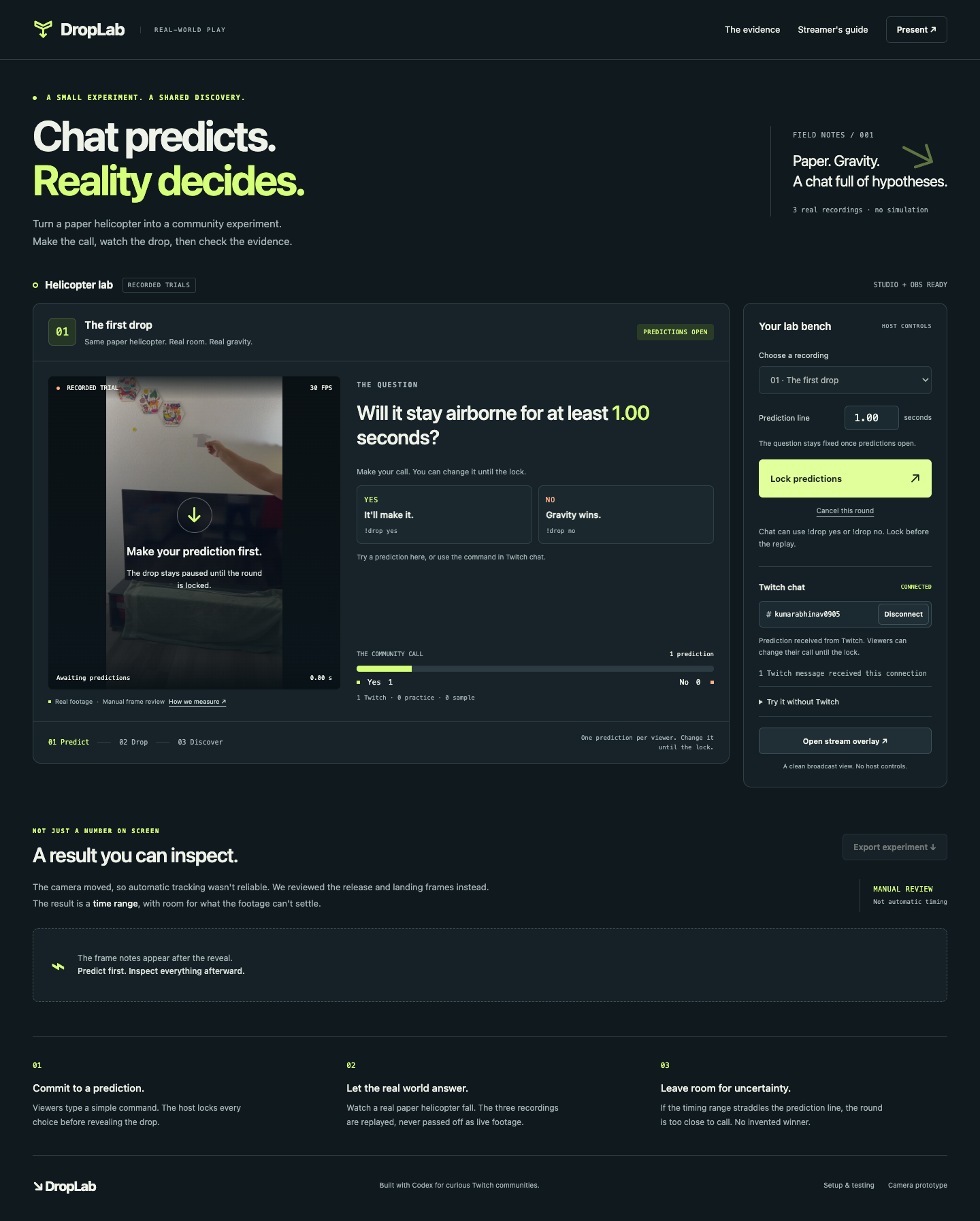
DropLab turns the experiment into a shared round. Viewers type !drop yes or !drop no. The host locks predictions before the recording plays. Reviewed release and landing windows determine a possible flight-time range.
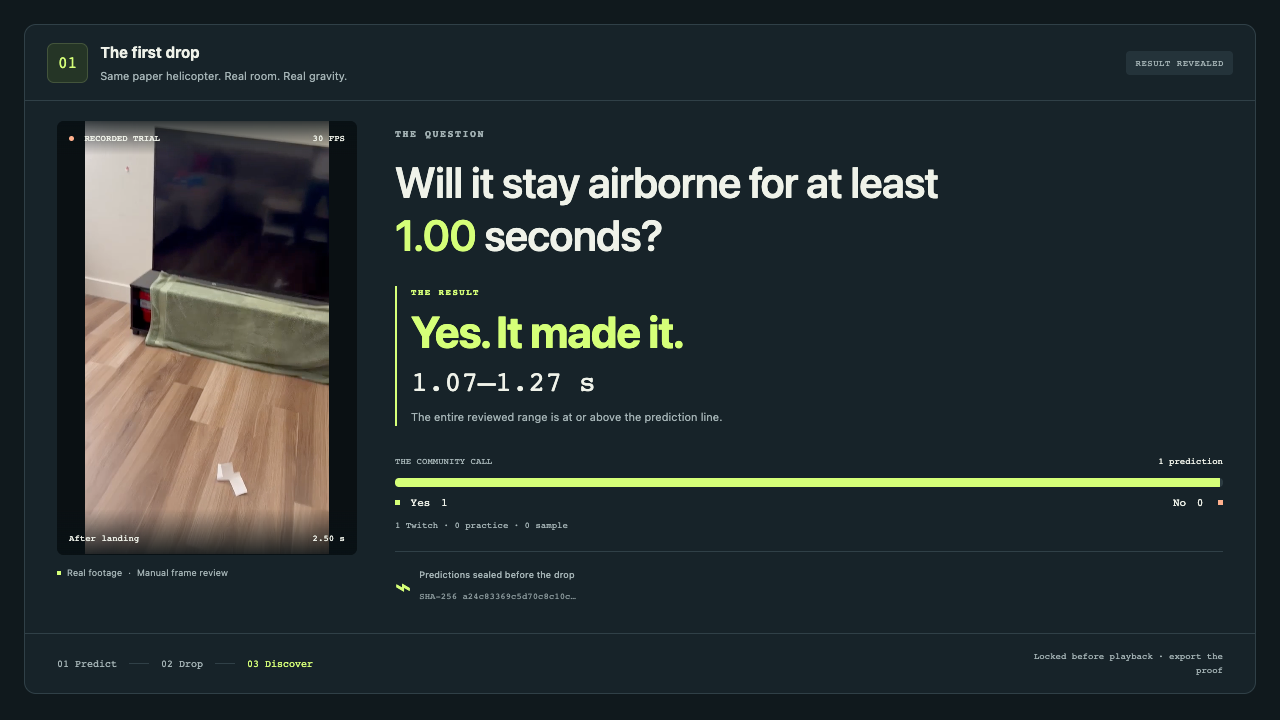
If the whole range is at or above the prediction line, the result is Yes. If it is below, the result is No. When the range crosses the line, DropLab returns Too close to call. No side wins that round.
A close result remains open to inspection. The evidence determines what we can claim.
What we built
A working Twitch experiment studio with:
- Read-only chat commands and one editable prediction per viewer, until the lock.
- Three real paper-helicopter recordings, clearly labelled as replays.
- A locked prediction record and SHA-256 digest in the exported notebook.
- Release and landing windows, individual-frame inspection and slow replay.
- A synchronized browser overlay for the local host and OBS.
- Next-test proposals through
!test blades,!test weightor!test repeat.
The app uses HTML, CSS and JavaScript, with a dependency-free Node.js local host. The same round logic runs in the hosted browser demo. There is no runtime language model or paid API requirement.
How Codex helped
Codex helped compare five directions, challenge the idea and implement the first camera tracker. I made the paper helicopter and recorded the trials.
The physical footage changed the product. White paper, camera movement and the room background confused color tracking. Codex helped inspect the frames and replace unsupported automatic timing with manually reviewed ranges. It then helped build and test the chat reader, locks, interface, overlay and export.
Try the build
Open the public app, choose Open predictions, make a practice choice, lock the round, play the recording and reveal the result. The first default round resolves Yes, the second is too close to call and the third resolves No.
To run locally, clone the repository, use Node.js 22 or newer and run npm start. Open http://127.0.0.1:8768. Connect your Twitch channel and send !drop yes while a round is open. The overlay dialog supplies the OBS browser-source URL. Full instructions and test commands are in the README.
The hosted demo shares state between tabs in the same browser. A separate OBS process uses the local host.
Results
On November 2, a real !drop yes from kumarabhinav0905 reached DropLab. That check contained 1 Twitch prediction, 0 practice predictions and 0 sample predictions. The lock, recorded replay, reviewed result and synchronized overlay were verified. The repository includes the exported record and its checked digest.
27 software tests and six browser scenarios passed. They covered round ordering, vote changes, stale and duplicate messages, lock integrity, uncertain outcomes, host authorization, media seeking, the overlay, browser storage and phone layouts. The public website also completed a round without sign-in.
The result so far is a working prototype with a verified Twitch interaction. We have not measured learning gains or audience engagement. All three clips show the same helicopter, so they do not establish a performance difference between designs. Timing is manually reviewed; automatic camera accuracy is not validated.
The overlay was verified in a browser, not a live Twitch broadcast. The digest supports inspection but is not an independent timestamp or anti-cheat guarantee. Next-test votes are proposals for future physical experiments.
The next step is matched trials with controlled release height, followed by the design changes chat proposes. A live-camera mode needs to hold up against frame-by-frame review before it can supply results.
Built With
- css
- html
- javascript
- node.js
- openai-codex
- playwright
- twitch

