-
-
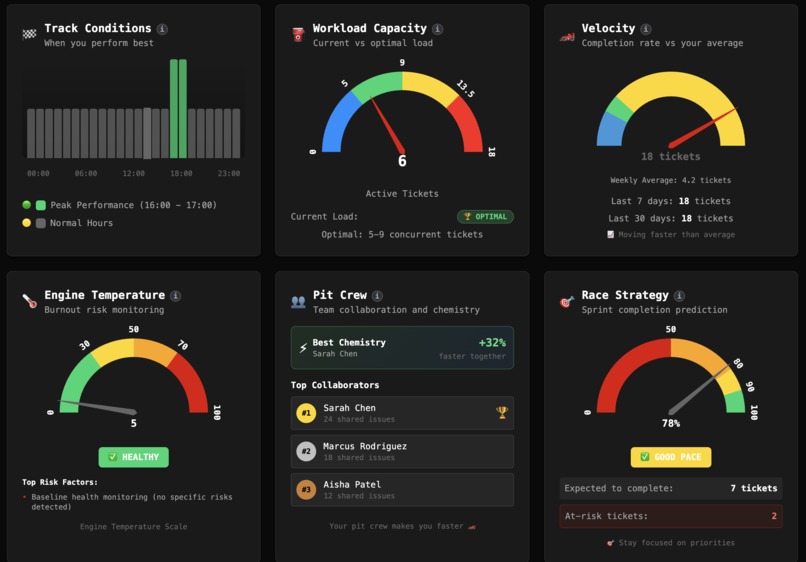
Dashboard - F1-style personal performance
-

Driver Telemetry branding
-
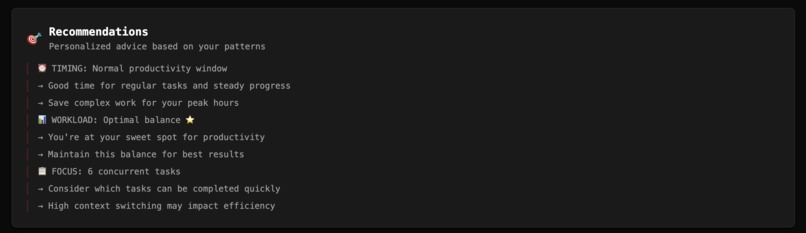
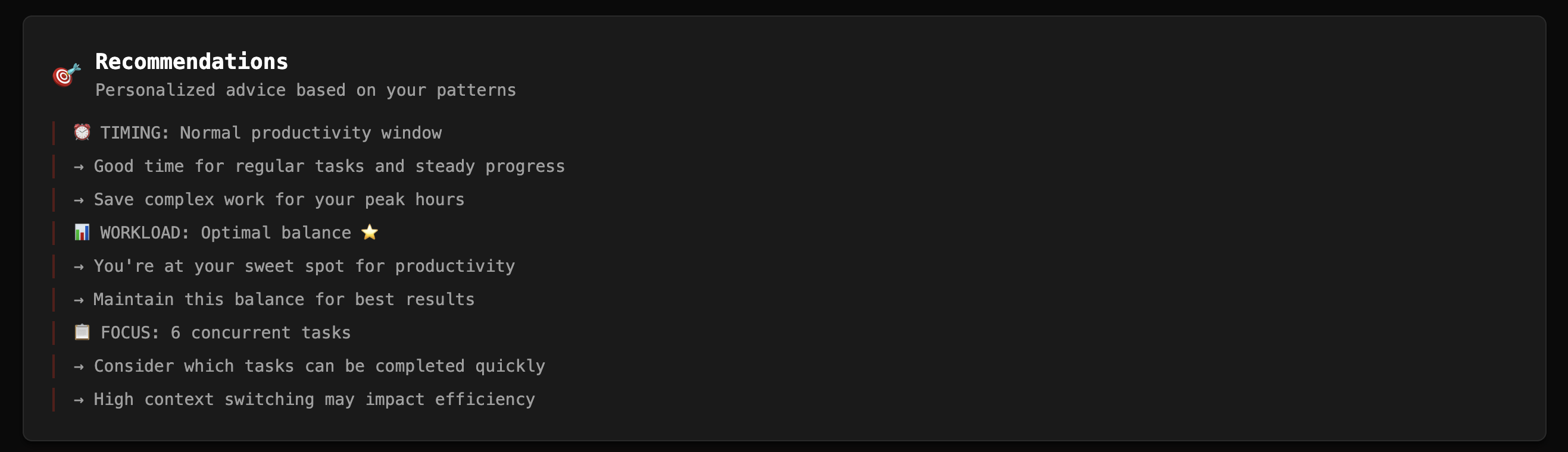
Recommendations
-
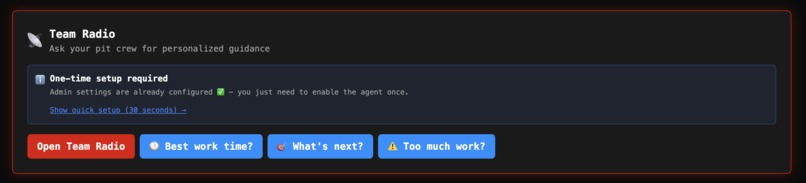
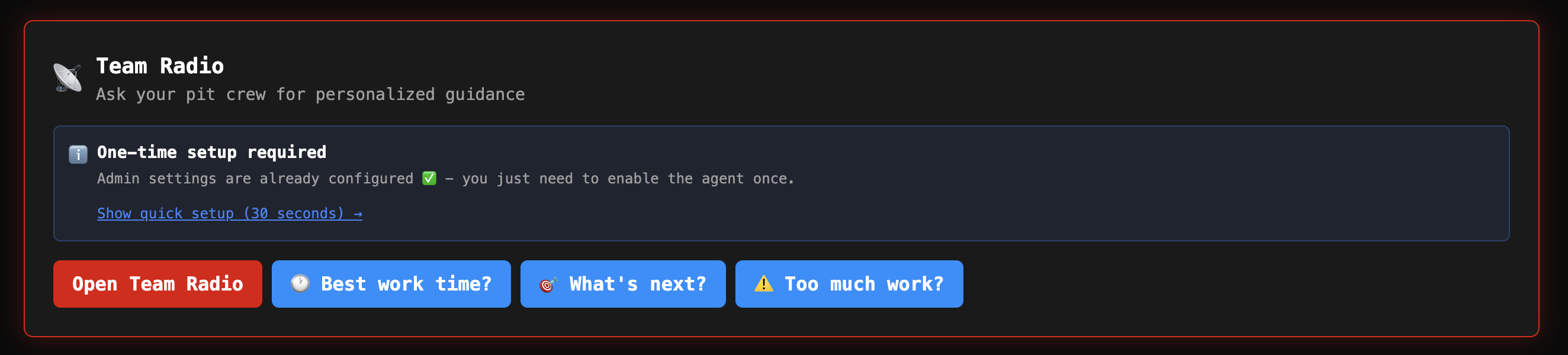
Team Radio

Inspiration
Modern work tools show tasks, tickets, and timelines, but they don’t show how an individual is actually performing. People usually realize they are overloaded, losing focus, or burning out only after productivity drops.
I was inspired by Formula 1 dashboards, where drivers always know their pace, engine health, track conditions, and strategy in real time. I wanted to bring that same clarity to individual contributors at work: a personal performance cockpit that shows how you’re operating inside a company, not just what tasks you have.
That idea became Driver Telemetry.
What it does
Driver Telemetry is an F1-style personal performance dashboard for individuals.
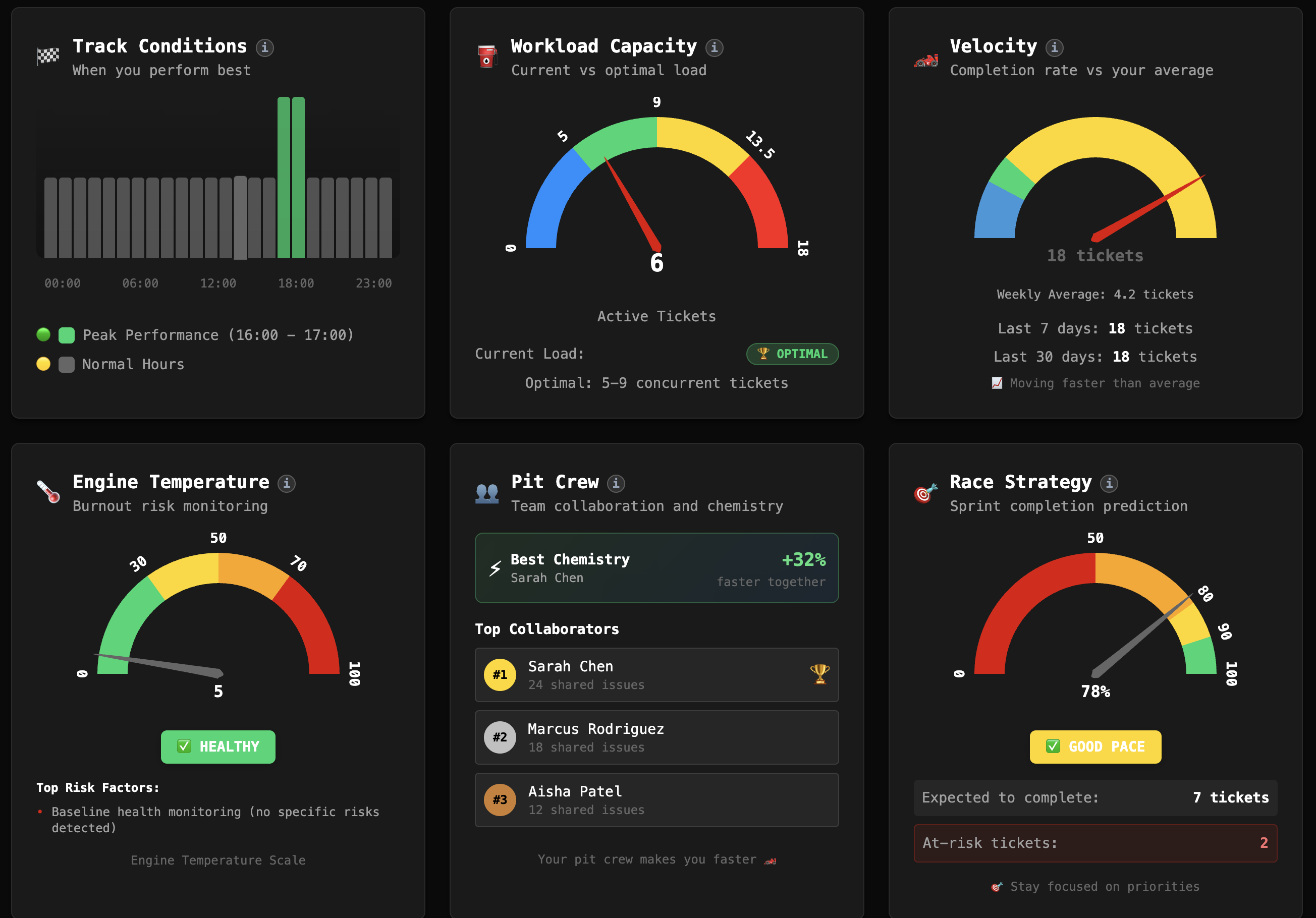
It turns everyday work activity into clear performance signals such as:
- Track Conditions – when you perform best during the day
- Workload Capacity – current load vs a healthy operating range
- Velocity – your output compared to your own average
- Engine Temperature – sustained pressure and burnout risk
- Pit Crew – collaboration chemistry with teammates
- Race Strategy – sprint outlook and at-risk work
- Recommendations – actionable guidance based on your patterns
- Team Radio – a conversational interface to ask questions like “What’s next?” or “Am I overloaded?”
The goal is to help individuals manage pace, focus, and energy proactively, not reactively.
How I built it
Driver Telemetry is built as a Jira-integrated application using Atlassian’s platform.
Work signals such as issue activity, sprint data, collaboration patterns, and time distribution are translated into simple, intuitive gauges inspired by motorsport dashboards.
The interface is intentionally visual and minimal:
- Gauges instead of tables
- Signals instead of raw metrics
- Guidance instead of noise
Everything is designed to run inside existing workflows, so individuals don’t need another tool or manual input.
Challenges I ran into
One of the biggest challenges was mapping work behavior to meaningful signals without overwhelming the user.
Another challenge was maintaining the right tone:
- Helpful, not judgmental
- Insightful, not prescriptive
- Personal, not managerial
Balancing accuracy, clarity, and simplicity in a single dashboard took several iterations.
Accomplishments that I'm proud of
- Turning abstract work patterns into intuitive, real-time signals
- Designing a dashboard that feels motivating instead of stressful
- Creating a tool focused on individual control, not monitoring
- Completing an end-to-end, production-ready app as a solo builder
What I learned
I learned how powerful good visualization can be when it replaces complex reports with simple signals.
I also learned that performance tools work best when they help people understand themselves, not when they try to optimize them aggressively.
Clarity and trust matter more than raw metrics.
What's next for Driver Telemetry
Next steps include:
- Deeper personalization of performance thresholds
- Long-term trend views across months and quarters
- Optional goal setting and pacing modes
- Expansion beyond Jira into other work platforms
The long-term vision is to make Driver Telemetry a personal performance companion for knowledge workers.
Built With
- atlassian-forge
- framer-motion
- node.js
- postcss
- radix-ui
- react
- recharts
- tailwind-css
- tanstack-react-query
- typescript
- webpack
- zustand


Log in or sign up for Devpost to join the conversation.