-
-
Detail Image
Driver Safety AI
Inspiration
Road accidents often happen because of driver distraction, drowsiness, and a lack of attention while driving. We wanted to build an AI-powered solution that can help identify potential driving risks and encourage safer driving habits. This inspired us to create Driver Safety AI, a project that combines computer vision and artificial intelligence to make driving safer and smarter.
What it does
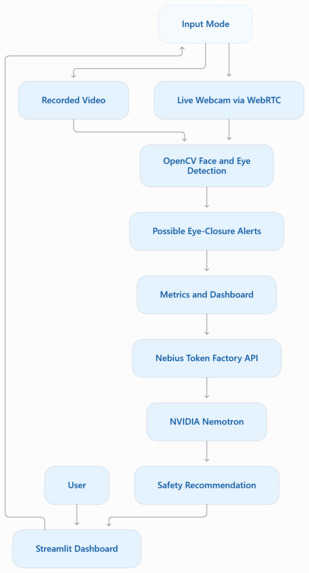
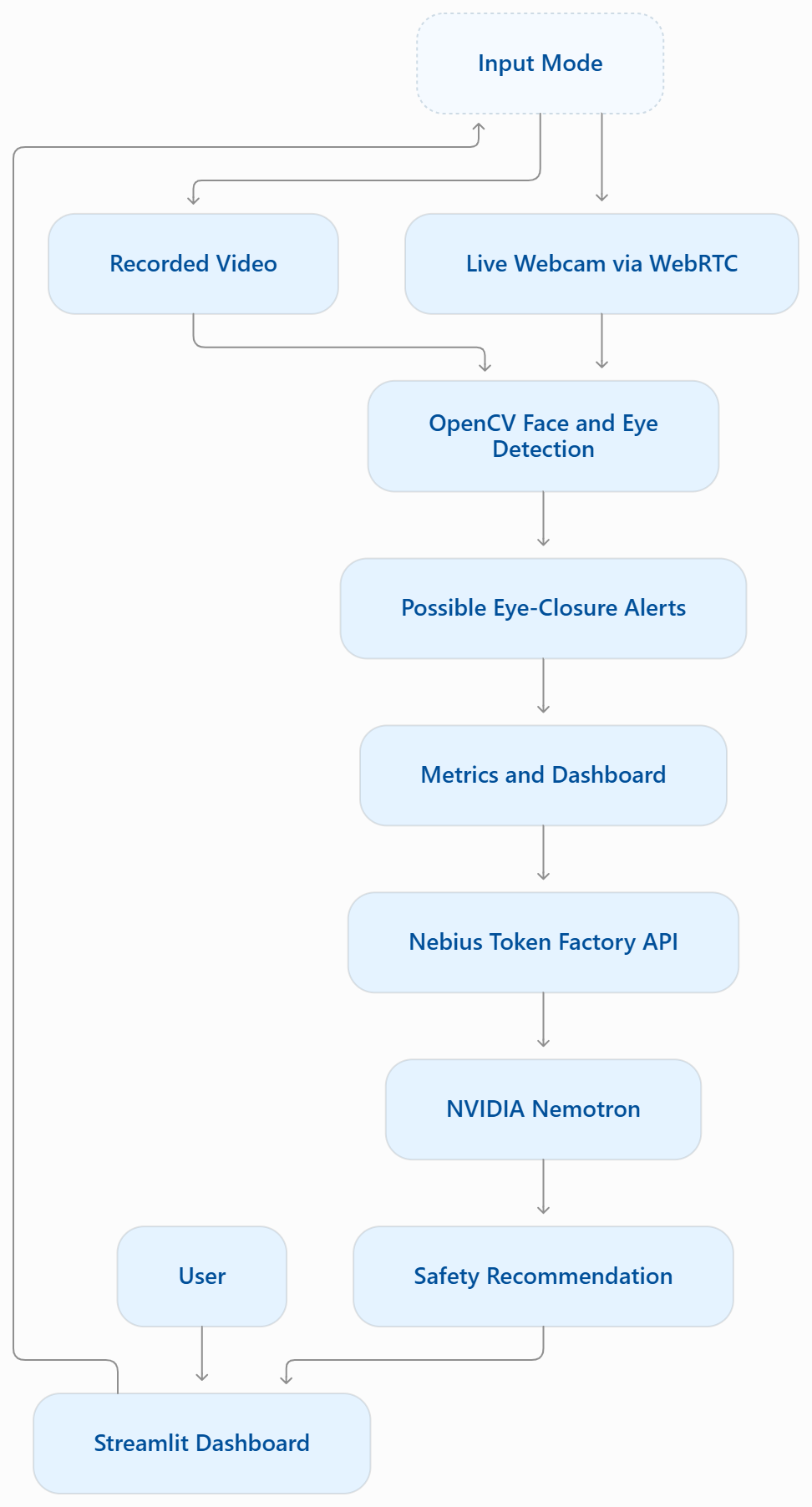
Driver Safety AI is an AI-powered driver monitoring application designed to help detect potential safety risks while driving. It uses a live camera feed and computer vision to process video frames and analyze driver-related visual information. By integrating AI capabilities, the system aims to identify unsafe driving behavior and provide timely alerts or warnings when potential risks are detected.
The application is built with an interactive Streamlit interface, making it easier to access and monitor the system in real time.
How we built it
We built Driver Safety AI using Python and several AI and computer vision technologies:
- Python: Used as the primary programming language.
- Streamlit: Used to create the interactive web application and user interface.
- OpenCV: Used for video frame processing and computer vision tasks.
- Streamlit-WebRTC: Used to access and process live camera streams in the application.
- AI model integration: Used to connect AI capabilities for analyzing relevant visual information and supporting driver safety monitoring.
- Streamlit Auto Refresh: Used to help refresh application components during monitoring.
These technologies work together to create a real-time driver monitoring workflow through a web-based interface.
Challenges we ran into
One of our main challenges was integrating live video streaming with AI-based analysis in a Streamlit application. Handling continuous video frames while keeping the interface responsive required careful implementation.
We also faced dependency and environment configuration issues, particularly with OpenCV and Python package compatibility. Configuring AI model access and managing API keys securely were additional challenges.
Through debugging, testing, and refining the application, we gained a better understanding of how computer vision, AI integration, and real-time web applications work together.
Accomplishments that we're proud of
We are proud to have developed a working foundation for an AI-powered driver safety application that combines computer vision, live camera streaming, and a web-based interface.
We successfully brought together multiple technologies into one project and worked through practical challenges involving dependencies, video processing, and AI integration. Most importantly, we created a foundation that can be expanded into a more advanced driver assistance and safety monitoring system.
What we learned
During this project, we learned how to integrate Python libraries, build interactive applications with Streamlit, process video using OpenCV, and work with live camera streams through WebRTC.
We also learned about AI model integration, API key management, dependency troubleshooting, and the challenges of building real-time applications. This project helped us understand that developing an AI solution requires not only a model but also reliable data processing, efficient integration, testing, and a user-friendly interface.
What's next for Driver Safety AI
Our next goal is to make Driver Safety AI more accurate, reliable, and feature-rich. Future improvements may include:
- Drowsiness detection: Identify signs of driver fatigue, such as prolonged eye closure.
- Distraction detection: Detect when a driver appears to be looking away from the road.
- Real-time alerts: Provide audio or visual warnings when unsafe behavior is detected.
- Mobile and edge-device support: Explore deployment on smartphones or compatible in-vehicle devices.
- Performance optimization: Reduce processing delays and improve real-time responsiveness.
- Advanced analytics: Generate safety reports and summaries to help users understand driving behavior.
- Improved testing: Evaluate the system under different lighting conditions, camera positions, and real-world driving scenarios.
Our long-term vision is to develop Driver Safety AI into a practical driver monitoring solution that supports safer driving through intelligent, real-time assistance.
