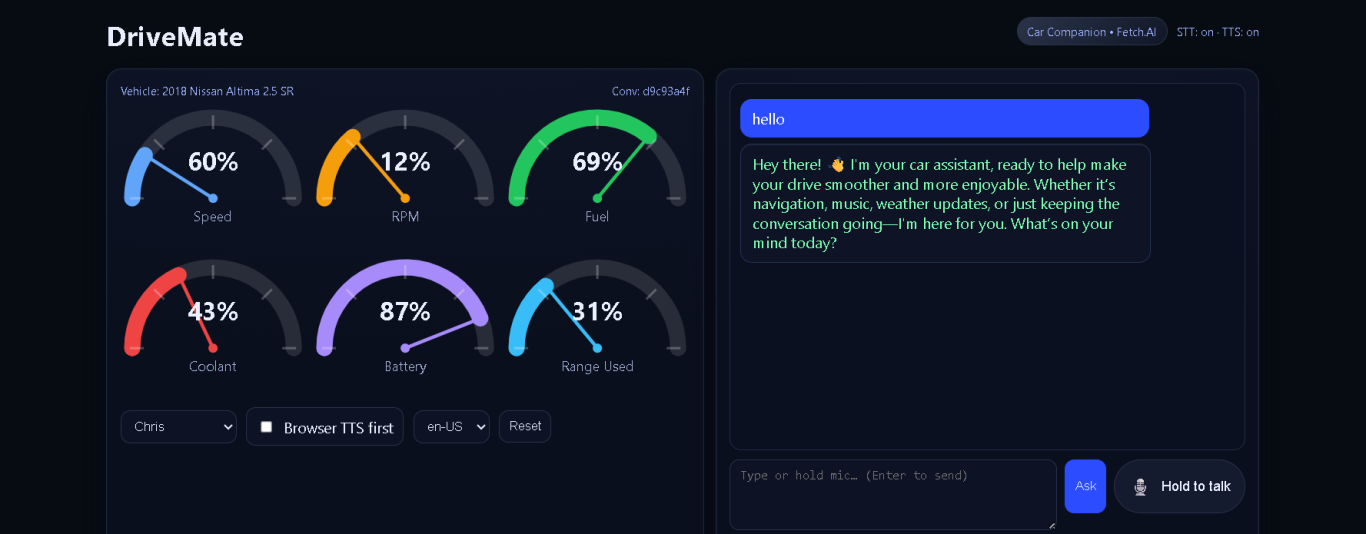
Inspiration: The idea for DriveMate came from a personal experience. I often drive long distances, and during one of those trips, I realized how easy it is to lose focus when you are alone. There is a point where the music fades into the background, the road stretches endlessly, and your thoughts start to drift. That kind of quiet can quickly turn into drowsiness, which is one of the most dangerous things that can happen behind the wheel. I remember thinking how strange it was that modern cars come with advanced features and smart assistants, yet none of them truly talk to you. Google Assistant and Siri can follow commands, but they do not hold conversations or notice when you are tired. They are tools, not companions. That is when we decided to build a companion not a tool. How We Built It: DriveMate was built using a combination of modern web technologies and AI frameworks. The frontend was developed in React and Next.js, styled for a responsive, dark-themed interface. For voice recognition, we used the browser’s native Speech API to convert speech into text in real time. On the backend, we implemented the ASI-1 (Fetch.ai) agent, which processes user input, generates context-aware replies, and sends them back to the interface through RESTful endpoints. The system is deployed on Vercel for quick iteration and live testing. Conceptually, the conversational loop can be expressed as: f(input)=A(voice→text)+B(intent)+C(response) where A represents speech recognition, B is intent understanding, and C is conversational output. Together, these stages form a seamless interaction between the user and DriveMate. Challenges We Faced: Like any hackathon project, DriveMate came with its share of technical and design challenges. Integrating large AI models within limited local memory was a major hurdle. Synchronizing the voice recognition flow with AI responses required extensive debugging and optimization. We also faced challenges in connecting multiple agent layers and handling API rate limits. On the design side, creating a dark, neon-themed interface that felt both futuristic and minimal took several iterations. Finding the right tone for DriveMate’s personality, helpful but conversational, was another key learning moment. What We Learned: This project taught us the value of designing AI for human connection, not just functionality. We learned how to integrate real-time conversational systems and how important timing, tone, and pacing are for engagement. We also strengthened our understanding of full-stack development, from frontend design and backend APIs to voice input handling and AI model communication. Most importantly, we learned how collaboration and creativity under time pressure can turn a simple idea into something impactful. The Future We see DriveMate evolving into a fully integrated in-car assistant capable of much more. Future versions could include real-time fatigue detection, integration with local maps and telemetry data, offline NLP for areas with poor connectivity, and multilingual support. Our vision is to make DriveMate more adaptive, a co-passenger that not only talks but listens, learns, and helps drivers stay engaged and safe no matter where the road takes them.
Built With
- companion
- eleven-labs
- fetch.ai
- javascript
- jsx
- next.js
- npm
- python
- react
- tts


Log in or sign up for Devpost to join the conversation.