Inspiration
We live in an era where the "Cloud" is marketed as an abstract, placeless digital ether. But every AI prompt quietly pulls electricity from a stressed power grid and fresh water from a local watershed. A single 50-message conversation with GPT-4 "evaporates" roughly 500ml of water—the size of a standard water bottle. With two billion daily queries globally, AI has become one of the fastest-growing draws on our resources, yet it remains entirely invisible to the user. DripImprint was born from a simple realization: users cannot steward a resource they cannot see.
What it does
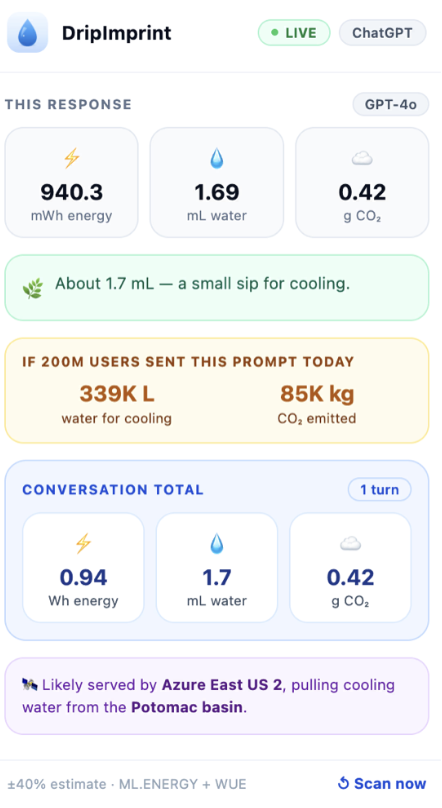
DripImprint is a lightweight (90KB) browser extension that provides a real-time "environmental receipt" for your AI usage. As you chat with ChatGPT, Claude, or Gemini, DripImprint:
Meters in Real-Time: Calculates the water (mL), energy (Wh), and carbon (gCO2) cost of every response.
Locates the Impact: Identifies the likely data center and watershed being impacted (e.g., the Roanoke river basin for Azure users).
Translates to "NYC Units": Converts abstract data into visceral local metaphors, like "seconds of a Brooklyn fire hydrant" or "fractions of a NYCHA apartment’s daily water draw."
Protects Privacy: All calculations happen client-side. No prompt content ever leaves your browser.
How we built it
We developed a local DOM-scraping engine that monitors chat interfaces without intercepting private data. The "Calculation Engine" utilizes a three-tier coefficient model:
Energy Model: Based on the ML.ENERGY Leaderboard and MIT’s "From Words to Watts" paper, accounting for the 10x energy intensity of output tokens vs. input tokens.
Water/Carbon Model: We mapped the disclosed Water Use Effectiveness (WUE) and carbon intensity of specific hyperscale regions (Azure East US 2, AWS us-east-1, Google Council Bluffs).
The NYC Layer: We integrated NYC DEP and NYCHA 2023 consumption data to calibrate our "local impact" metaphors.
Challenges we ran into
The biggest hurdle was the "Opacity of the Infrastructure." Cloud providers don't always disclose exactly which data center handles a specific 2:00 PM prompt. We had to build a probabilistic routing model based on known primary regions for these LLMs. Additionally, handling "streaming" text in the DOM required precise timing to ensure we didn't double-count tokens as they flickered onto the screen.
Accomplishments that we're proud of
We successfully turned a global, abstract crisis into something a New Yorker can feel. Seeing a prompt register as "0.08 of a low-flow toilet flush" changes user behavior more effectively than a 100-page sustainability report ever could. We also kept the extension incredibly lean—under 100KB—ensuring the tool itself has a negligible digital footprint.
What we learned
We learned that output tokens are the true "thirst" drivers of AI. Because every generated token requires a full forward pass through the model, the length of the AI's response matters far more than the length of your question. We also discovered the staggering regional disparity in water efficiency—where AWS’s closed-loop cooling in Virginia can be nearly 10x more water-efficient than older facilities.
What's next for DripImprint
Model Expansion: Adding support for local LLMs (via Ollama) and image generators like Midjourney.
The "Green Route" Feature: A toggle that suggests which AI model is currently running on the cleanest grid or most efficient cooling system based on the time of day.
Policy Dashboard: An anonymized (opt-in) data aggregator to help climate researchers visualize the true aggregate footprint of AI across urban populations.
Built With
- claude
- html
- javascript