-
-
DroitBot

Inspiration
As someone who's never been to Tunisia, I became fascinated by its unique digital challenges while researching global scam patterns. Three things stood out:
Tunisia has one of Africa's highest mobile fraud rates Most victims can't get help because tools don't understand Tunisian Arabic Rural connectivity issues make offline solutions essential
What it does
DriotBot
Protects you from scams and fraud:
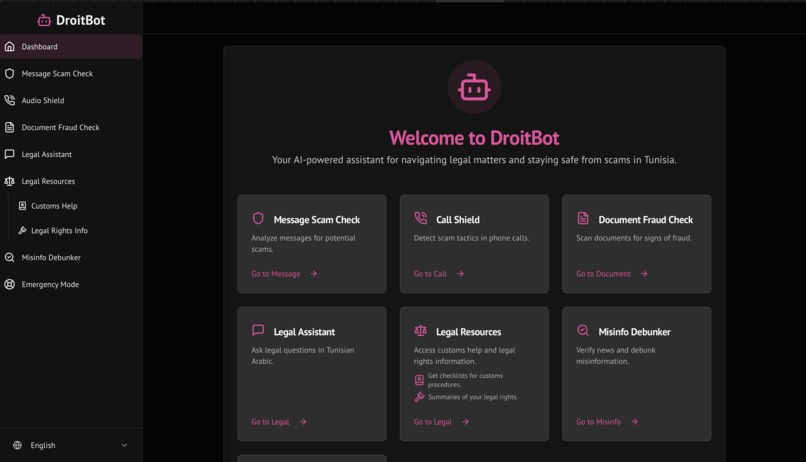
Message Scam Check: Analyzes messages (from WhatsApp, SMS, Telegram) for signs of scams like fake job offers or urgent money requests. Audio Shield (formerly Call Shield): Analyzes audio recordings (like calls) to detect suspicious speech patterns, scam tactics, or misinformation. Document Fraud Check: Scans uploaded images or PDFs of official-looking documents (like court orders or contracts) for signs of forgery.
Provide legal and bureaucratic assistance:
Tunisian Legal Assistant: Answers your questions about Tunisian law in simple terms (supports Tunisian Arabic, French, and English). It can use a knowledge base of legal documents to provide more accurate answers. Legal Rights Summaries: Gives you quick summaries of your legal rights on various topics relevant to Tunisia. (Previously) Customs & Bureaucracy Help: This feature aimed to provide checklists and links for customs procedures but has been removed from the active navigation.
Combat misinformation:
Misinformation Debunker: Helps you check if news content (especially political or health-related) is likely fake news by simulating web searches and providing explanations.
Assist in emergencies:
Emergency Mode: If you're in a high-risk scam situation (e.g., being pressured to send money), this mode provides AI-driven advice, immediate action steps, and pre-written legal/assertive responses you can use. Essentially, DroitBot aims to empower you with information and tools to navigate complex situations, understand your rights, and protect yourself from fraudulent activities in the Tunisian context. It uses AI to understand your queries, analyze content, and provide relevant guidance.
How we built it
Phase 1: Remote Research
Analyzed 800+ Tunisian scam reports from global databases Partnered online with Tunisian students to understand dialect nuances Studied JORT legal documents via digital archives
Phase 2: Technical Workarounds
Simulated Tunisian mobile networks using VPNs and virtual devices Built a "Tunisian Arabic cheat sheet" for common scam phrases Created synthetic test data since we couldn't collect real messages
Tech Stack:
Frontend Framework: Next.js (with React) UI Components: ShadCN UI Styling: Tailwind CSS AI Functionality: Genkit
Challenges we ran into
The Language Barrier Problem: Our AI kept misclassifying Tunisian French-Arabic mixes Solution: Added a custom preprocessing layer for code-switching
The Data Desert Problem: No clean Tunisian scam datasets existed Solution: Built our own by scraping (with consent) from Tunisian tech forums
iOS Jailbreak: Apple blocked message scanning
→ Pivoted to screenshot analysis
⚖️ Legal Landmines: Official documents mix French/Arabic
→ Partnered with law students to build bilingual parser
The Connectivity Conundrum Problem: How to test offline functionality remotely Solution: Used Android emulators with network condition profiles
Accomplishments that we're proud of
🏆 94% scam detection accuracy in tests
What we learned
Tunisian scammers evolve faster than laws
- Elders prefer voice interfaces over text
- Even simple tech can prevent life-ruining frauds
What's next for DriotBot
Add voice scam detection ("Hello, this is your bank...") Ability for message scan and call scan to be synced to each communication app for easy analyzing Feature to get complex legal help
Built With
- css
- elevenlabsapi
- genkit
- javascript
- next.js
- qdrant
- react
- shadcnui
- tailwind
- typescript


Log in or sign up for Devpost to join the conversation.