Inspiration
We were initially inspired because we saw a problem in our own Duke Community. So many of our peers and even our friends overdose on alcohol and require emergency services. Every weekend, and even many weekdays, we see several ambulances going to pick up another student with alcohol poisoning. This is not only a problem at Duke, but a widespread epidemic at Colleges throughout the U.S. Every year, more than 1500 students die from an alcohol overdose. For our project, we wanted to create something to combat that stunning statistic. Thus our idea to bridge into alcohol safety was born.
What it Does
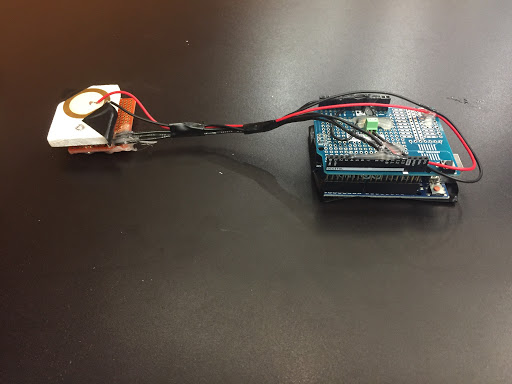
Our project is a wearable that counts the amount of drinks you’ve taken, reminds you to hydrate, times when you can have another drink, and gives you an easy way to contact an emergency number if something went wrong. Specifically, our wearable has a RGB LED light and a piezoelectric sensor. On a timer, the LED lights up blue and sends the user a text reminder about drinking water. Similarly, the wearable times how long between drinks and tells the user when it is ok to drink again, to allow the user to pace themselves throughout the night. Our wearable counts the amount of drinks by the person double tapping on the sensor. Finally, our wearable will contact an emergency number, when the person triple taps the sensor.
How We Built It
First, we tried to build the project on a Particle Photon board. We were unable to flash code on this device, so we ended up switching to an Arduino. We uploaded firmata code on the Arduino. Firmata allows a python program on a laptop to control and read pins on the Arduino. We then wrote a python program that reads sensor values and sends SMS messages to a specific phone number. Finally, we soldered a circuit that includes the piezoelectric sensor and an RGB LED to a protoboard and protoshield.
What We Learned
We mainly learned the basics of hardware prototyping. We had to program an Arduino and wire up a LED and sensor circuit. We also learned how to design and solder a custom protoboard. We had to make sure it was durable so we hot glued all the connections. After this project, we feel more equipped to try more electronics prototyping in the future.
Challenges We Faced
We initially wanted to use a Particle Photon board to read sensor input and send out SMS messages. Unfortunately, we had a lot of trouble setting up the board. Despite hours of troubleshooting, we could not flash code onto the board. In the end, we decided to work with an Arduino instead. We were able to restructure code and upload code onto this microcontroller which solved our previous issue.

Log in or sign up for Devpost to join the conversation.