-
-
DrillGuard AI
-
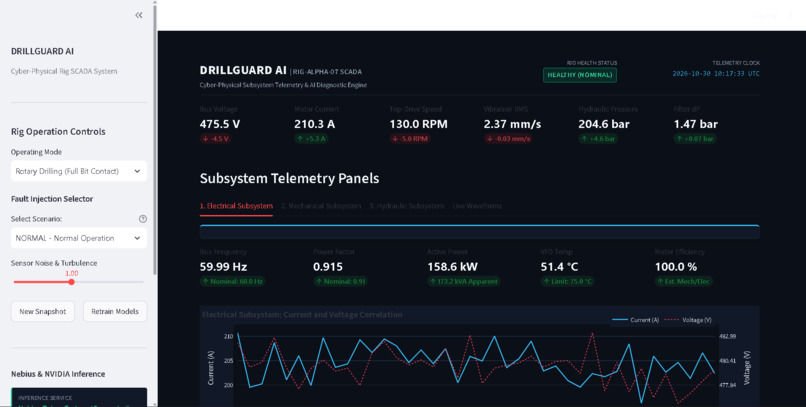
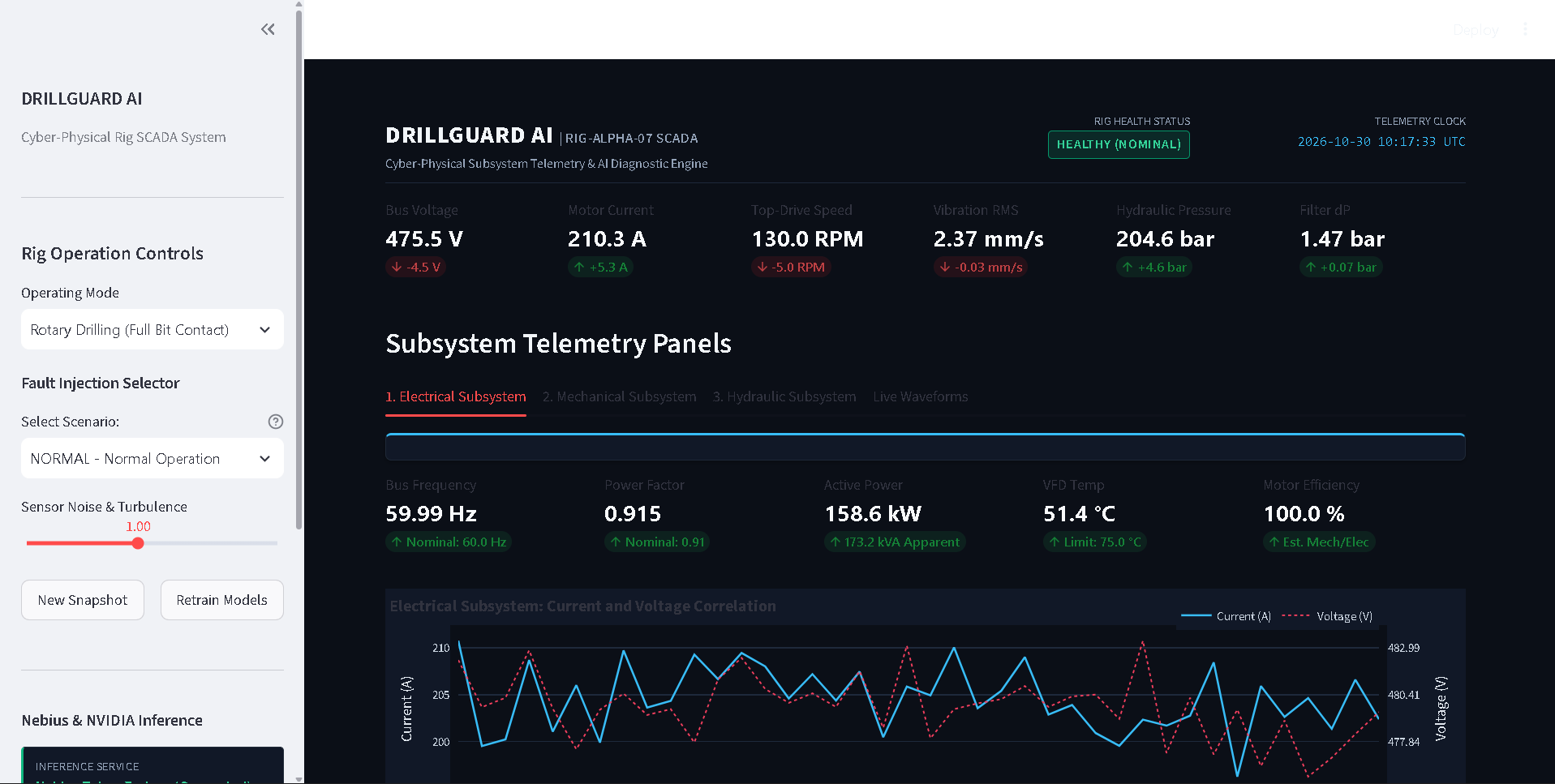
Subsystem Telemetry Panels
-
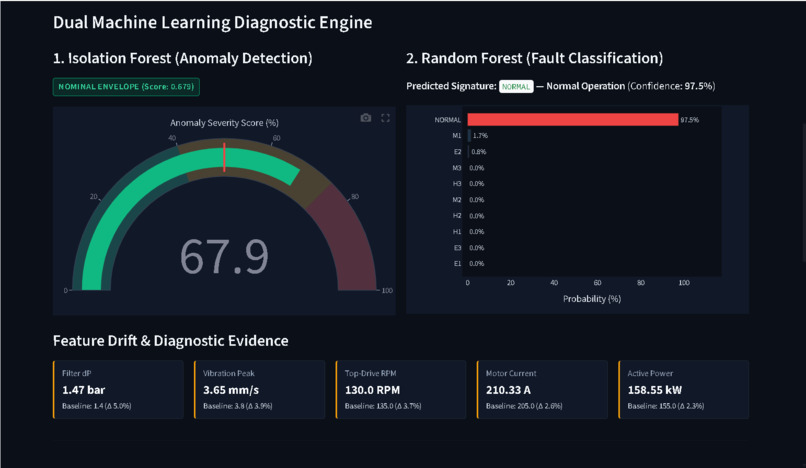
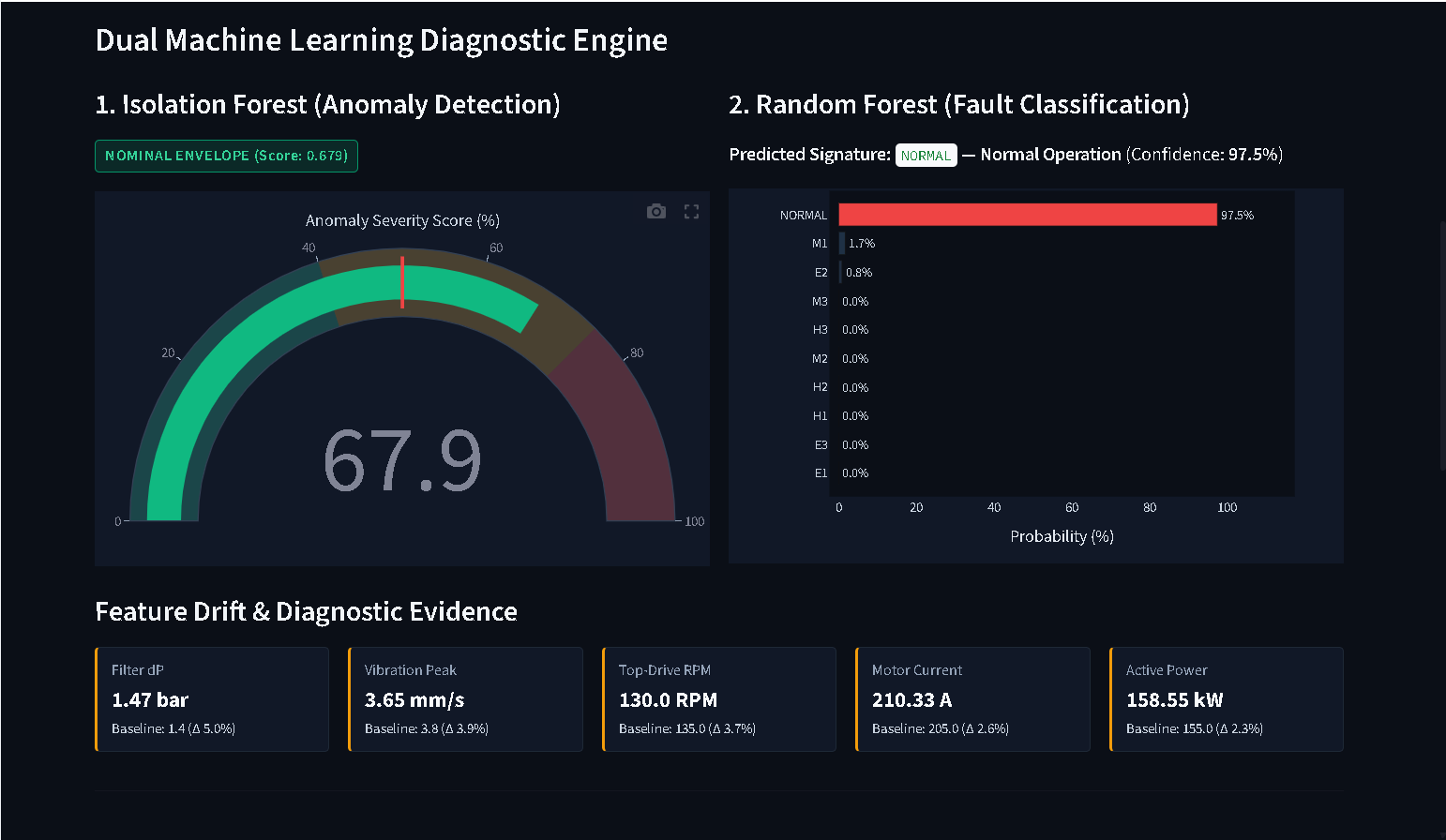
Dual Machine Learning Diagnostic Engine
-
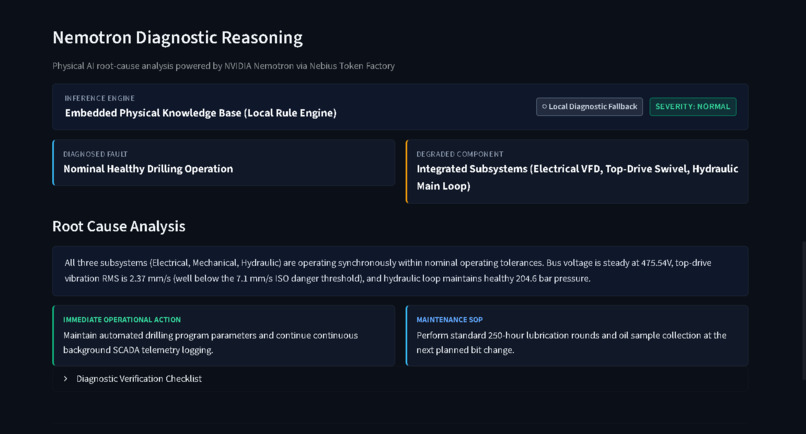
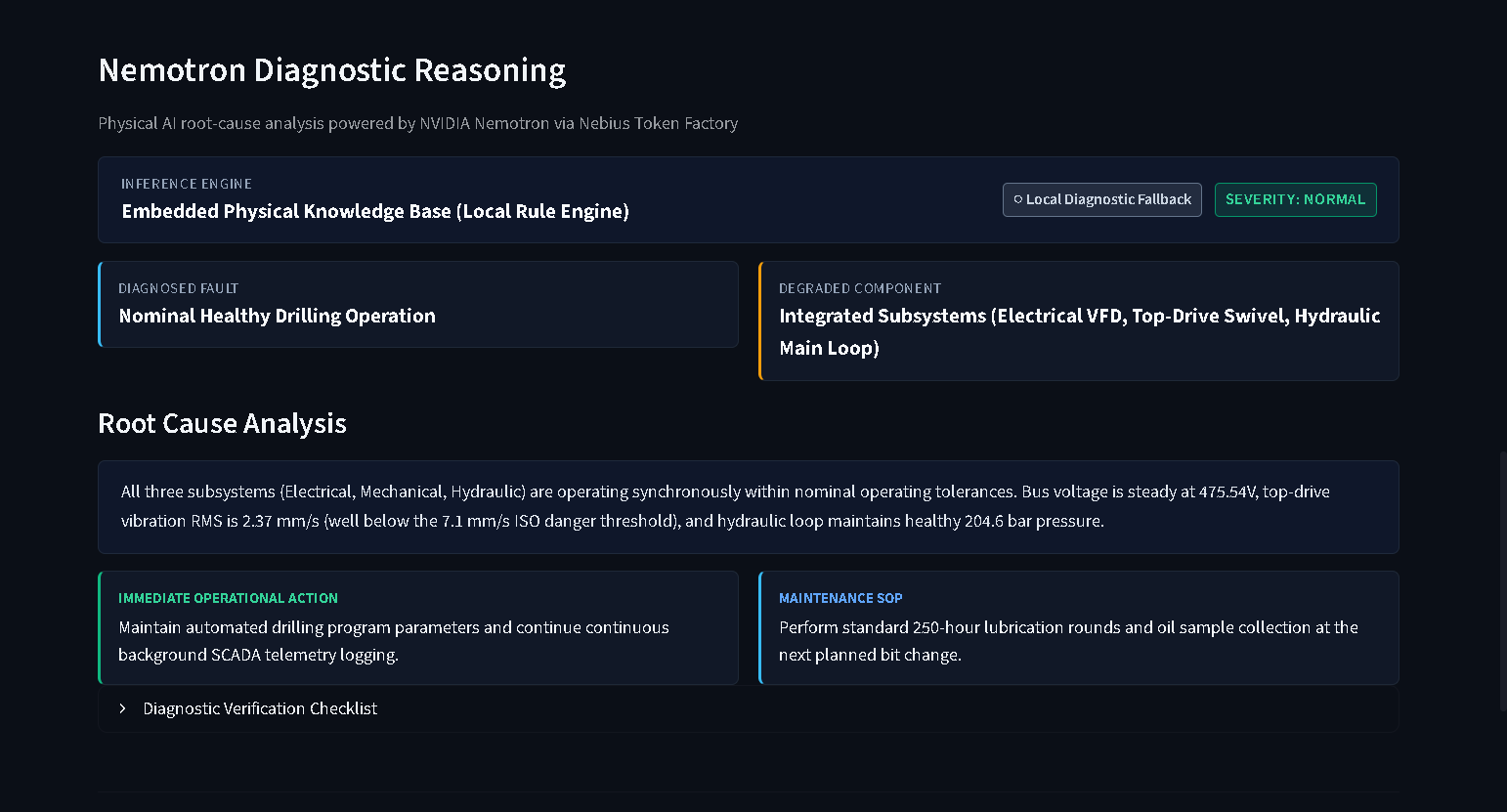
Nemotron Diagnostic Reasoning
-
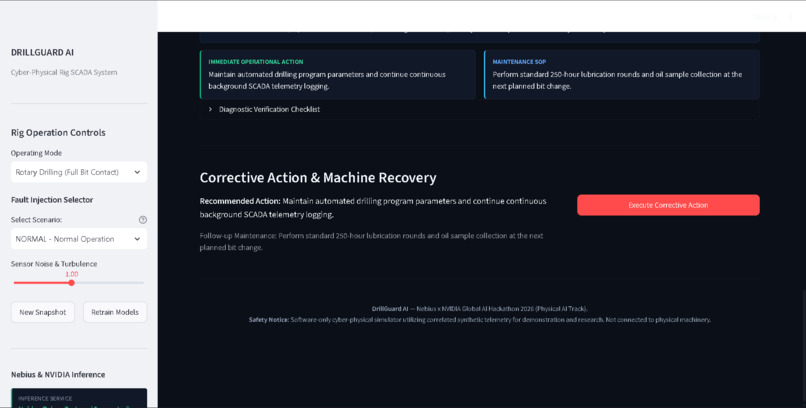
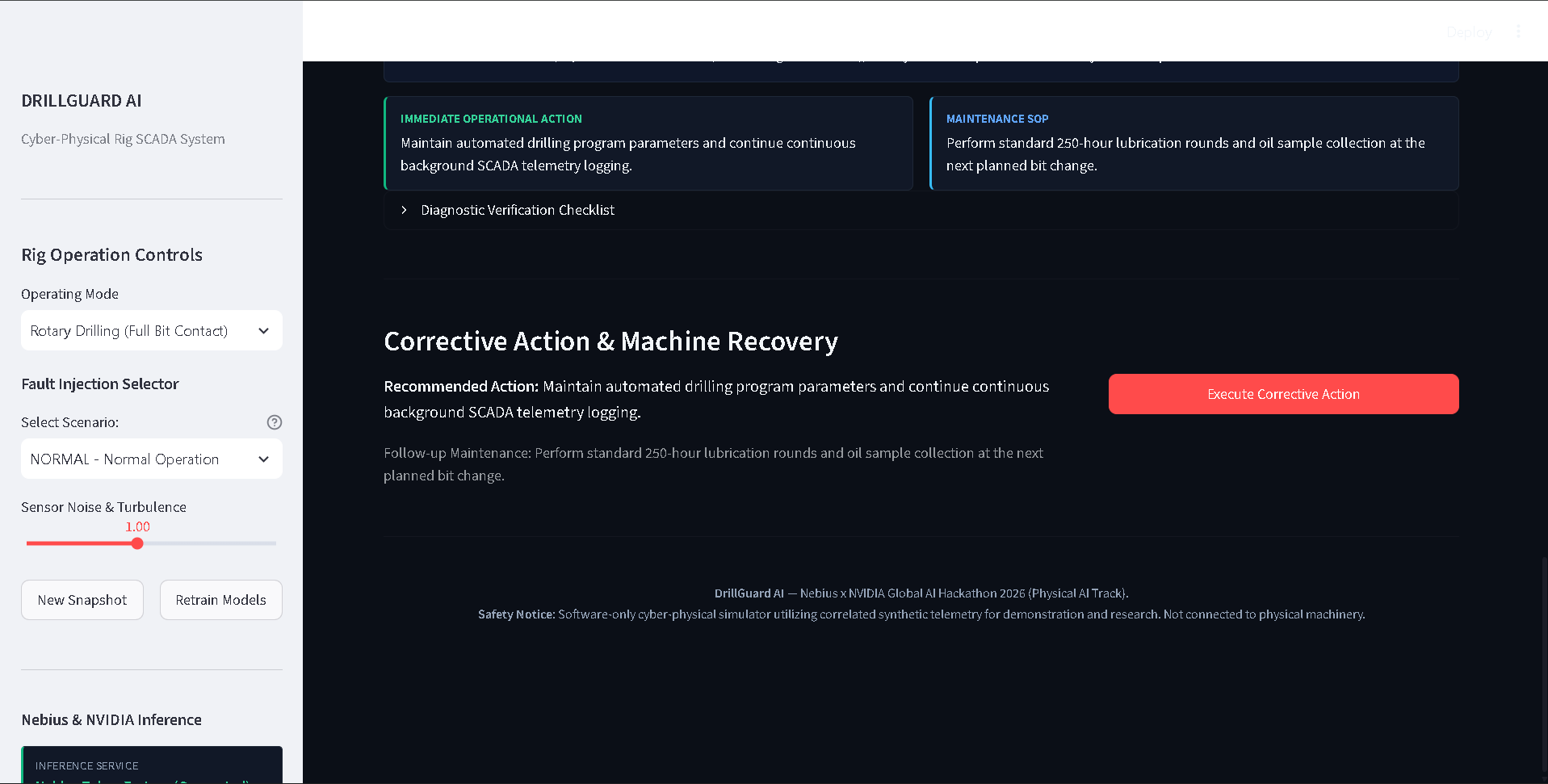
Corrective Action & Machine Recovery
Inspiration
Drilling rigs are complex industrial environments where human operators and maintenance personnel must continuously monitor equipment, interpret sensor readings, identify abnormalities, and make critical decisions.
However, fatigue, high workloads, incomplete information, communication gaps, and time pressure can make it difficult to recognize developing problems.
Real-world drilling incidents highlight why reliable monitoring and better decision support matter:
- Indian onshore drilling rig incident (May 2024): An Oil Industry Safety Directorate (OISD) safety alert documented an incident in which a worker's fingers were crushed when a power tong was accidentally operated while the worker was adjusting equipment by hand. Two fingers were eventually amputated. OISD Safety Alert.
- Scarabeo 8 drilling facility (July 2024): Norway's Ocean Industry Authority investigated a worker injury involving drilling-floor equipment. Its findings highlighted communication failures, inadequate procedures, and failure to follow red-zone safety procedures. Investigation Report.
- Drilling industry incident statistics: The International Association of Drilling Contractors reported 832 recordable incidents, 227 lost-time incidents, and 9 fatalities among participating contractors in its 2024 reporting data. IADC Incident Statistics.
These incidents have different causes, and not all are attributable to equipment faults or human error. However, they demonstrate the importance of equipment awareness, reliable monitoring, clear diagnostic information, and informed human decision-making.
This inspired us to ask:
What if an intelligent diagnostic assistant could continuously analyze drilling-rig telemetry, identify abnormal machine behavior, explain potential faults, and help operators make better-informed decisions?
That question became DrillGuard AI.
What it does
DrillGuard AI is a software-based Physical AI diagnostic and monitoring application that simulates intelligent fault detection and decision support for industrial drilling rigs.
It monitors three major subsystems:
- Electrical: Voltage, current, frequency, power factor, and motor performance.
- Mechanical: Vibration, torque, rotational speed, bearing temperature, and gearbox conditions.
- Hydraulic: Hydraulic pressure, fluid temperature, filter differential pressure, and pump performance.
The application generates correlated synthetic sensor telemetry and supports ten operating scenarios:
- Normal operation
- E1 – Electrical Overcurrent
- E2 – Voltage Instability
- E3 – Motor Abnormality
- M1 – Excessive Vibration
- M2 – Bearing Degradation
- M3 – Gearbox Abnormality
- H1 – Pump Degradation
- H2 – Filter Blockage
- H3 – Hydraulic Pressure Loss
Its main capabilities include:
- Real-time-style telemetry visualization and subsystem monitoring.
- Machine-learning-based anomaly detection using Isolation Forest.
- Fault classification using Random Forest.
- AI-powered diagnostic explanations and recommendations using NVIDIA Nemotron.
- Structured diagnostic outputs with severity, fault, affected component, recommended action, maintenance action, and additional checks.
- Simulated corrective actions and machine recovery visualization.
- Local rule-based fallback diagnostics when live API inference is unavailable.
DrillGuard AI is designed as a human-in-the-loop decision-support system. It provides diagnostic information and recommendations while leaving operational decisions to human personnel.
How we built it
We built DrillGuard AI using Python and Streamlit, with Plotly for interactive visualizations and Scikit-learn for machine learning.
1. Synthetic telemetry generation
We developed a telemetry simulation engine that generates correlated sensor readings across electrical, mechanical, and hydraulic subsystems. It supports normal operation and ten predefined fault scenarios.
2. Machine learning pipeline
We implemented two complementary models:
- Isolation Forest: Identifies abnormal sensor behavior and produces anomaly scores.
- Random Forest Classifier: Classifies operating conditions into the ten predefined scenarios.
Feature engineering derives additional indicators from sensor readings to improve fault detection.
3. NVIDIA Nemotron integration
We integrated nvidia/Nemotron-3_5-Lightning through the Nebius Token Factory API.
The model receives telemetry data, anomaly scores, predicted fault classifications, and diagnostic evidence. It generates structured diagnostic responses containing severity, explanation, identified fault, affected component, recommended operational action, maintenance recommendation, and additional diagnostic checks.
We implemented structured JSON extraction and validation to make the responses consistent.
4. Simulated recovery
We developed a corrective-action simulation that models how selected sensor values may move toward nominal operating conditions after a corrective action is selected. Recovery is visualized through telemetry changes and recovery charts.
5. Dashboard and integration
Streamlit provides the industrial monitoring interface, while Plotly displays telemetry waveforms, anomaly scores, fault probabilities, and simulated recovery behavior.
A local rule-based diagnostic fallback keeps the application functional when live API inference is unavailable. The interface distinguishes live Nemotron results from fallback results.
Challenges we ran into
1. Generating meaningful synthetic telemetry
Generating realistic-looking sensor data was not enough. We needed correlated sensor behavior so that different fault scenarios produced recognizable patterns across multiple readings.
2. Combining machine learning with language-model reasoning
The ML models produce anomaly scores and fault classifications, while Nemotron generates diagnostic explanations and recommendations. Connecting these outputs into a consistent workflow required careful data preparation and structured response validation.
3. Handling API latency and reliability
Live inference through Nebius Token Factory sometimes required longer response times. We improved timeout handling and implemented a local fallback diagnostic engine to maintain application functionality when API inference is unavailable.
4. Making diagnostics understandable
A fault prediction alone is not always useful to an operator. We focused on presenting the fault, supporting evidence, affected component, recommended action, and additional diagnostic checks in an organized dashboard.
5. Simulating recovery responsibly
We wanted to demonstrate the full diagnostic workflow without suggesting that the application controls real machinery. We therefore implemented a software-based recovery simulation rather than physical equipment actuation.
Accomplishments that we're proud of
- Built a working industrial drill-rig diagnostic dashboard with three simulated subsystems.
- Implemented ten operating scenarios covering normal, electrical, mechanical, and hydraulic conditions.
- Combined Isolation Forest anomaly detection with Random Forest fault classification.
- Integrated NVIDIA Nemotron 3.5 Lightning through Nebius Token Factory for live AI diagnostic inference.
- Implemented structured JSON diagnostic responses with validation.
- Added a local rule-based fallback for API availability and reliability.
- Developed a simulated corrective-action and recovery workflow.
- Created a human-in-the-loop diagnostic experience that presents explanations and recommendations rather than only raw model predictions.
- Published the project source code with setup instructions and an open-source MIT license.
What we learned
Building DrillGuard AI helped us understand how traditional machine learning and large language models can complement each other in industrial applications.
We learned how to:
- Generate correlated synthetic industrial sensor telemetry.
- Apply unsupervised anomaly detection and supervised fault classification.
- Integrate NVIDIA Nemotron through Nebius Token Factory.
- Design structured JSON-based diagnostic workflows.
- Handle inference latency and API failures using fallback mechanisms.
- Visualize industrial telemetry and simulated recovery.
- Design AI-assisted decision-support interfaces.
Our biggest takeaway was that industrial AI should do more than identify an anomaly. It should help people understand what may have happened, why it matters, and what they should investigate next.
What's next for DrillGuard AI: Intelligent Physical AI Drill-Rig Diagnostics
We see several opportunities to extend DrillGuard AI:
- Real sensor integration: Connect the application to real industrial sensor streams and equipment data.
- Real-world validation: Evaluate detection and classification performance using real drilling-rig datasets.
- Nebius AI Cloud deployment: Explore deployment on Nebius infrastructure for scalable inference and application hosting.
- Predictive maintenance: Develop capabilities to identify degradation trends before faults become critical.
- Edge computing: Explore deployment closer to industrial equipment for responsive local monitoring.
- Human-in-the-loop improvements: Add operator feedback, diagnostic review, and maintenance-history integration.
- Expanded safety capabilities: Investigate additional monitoring and decision-support features while maintaining established industrial safety procedures.
Current scope and limitations: DrillGuard AI is a software-only Physical AI simulation using synthetic telemetry. It has not been connected to physical drilling-rig hardware or validated as a real-world physics or control system. Its recovery behavior is simulated and does not actuate machinery. The system is intended to support human judgment, not replace operators or guarantee accident prevention.
Built for the Nebius × NVIDIA Global AI Hackathon 2026 — Physical AI Track.
Built With
- ai
- genai
- isolationforest
- largelanguagemodels
- llm
- ml
- nebiustokenfactory
- nemotron
- nvidia
- plotly
- python
- scikit-learn
- streamlit

