-
-
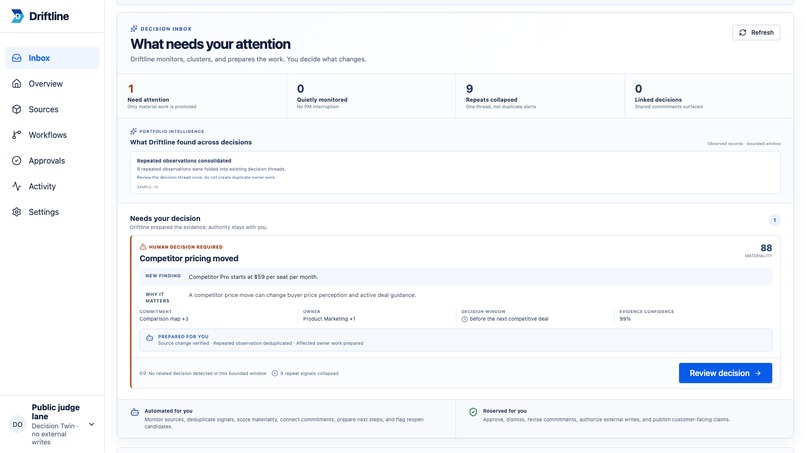
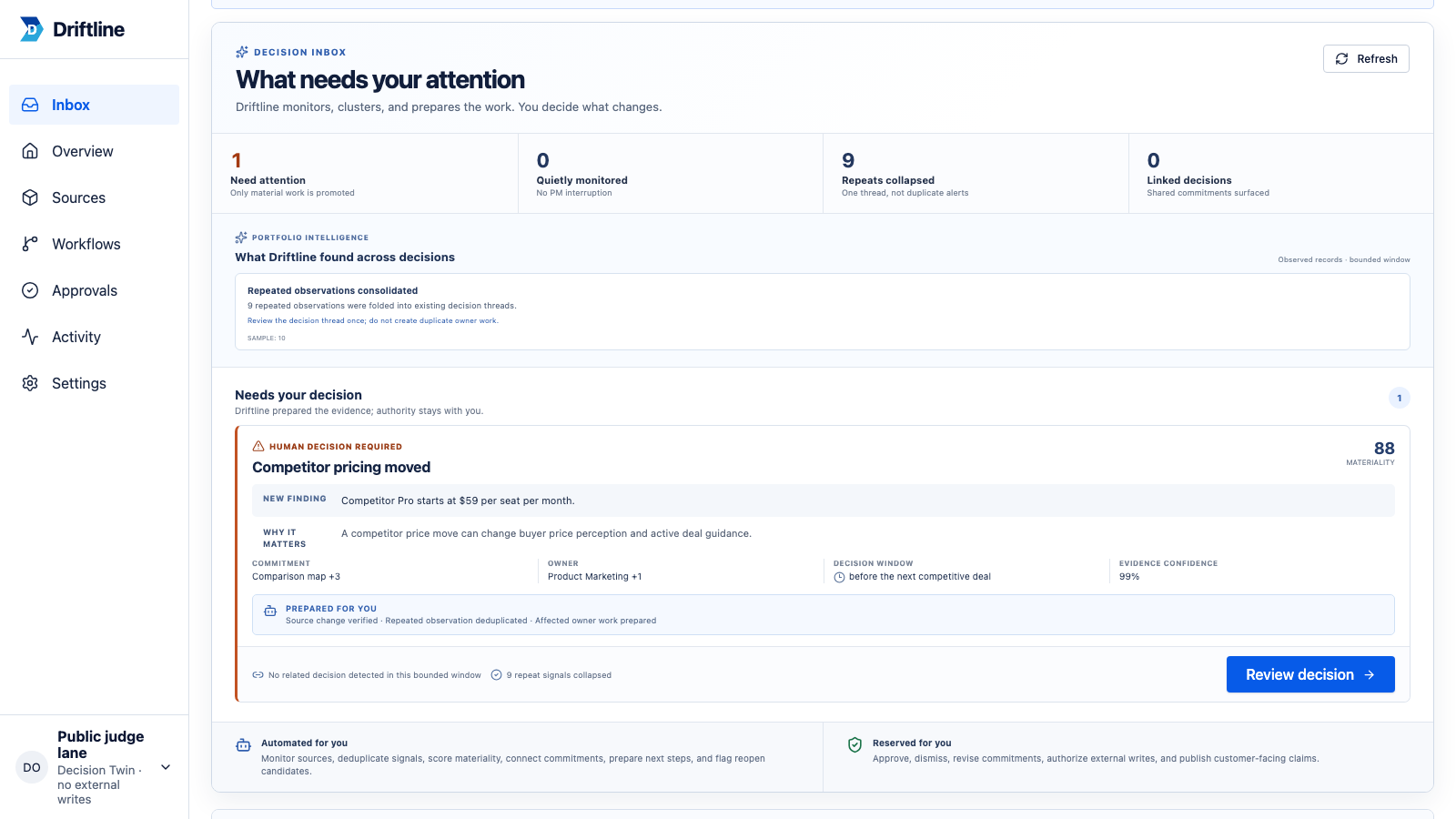
Decision Inbox: nine repeated observations collapse into one durable thread; Driftline prepares the work while the PM keeps authority.
-
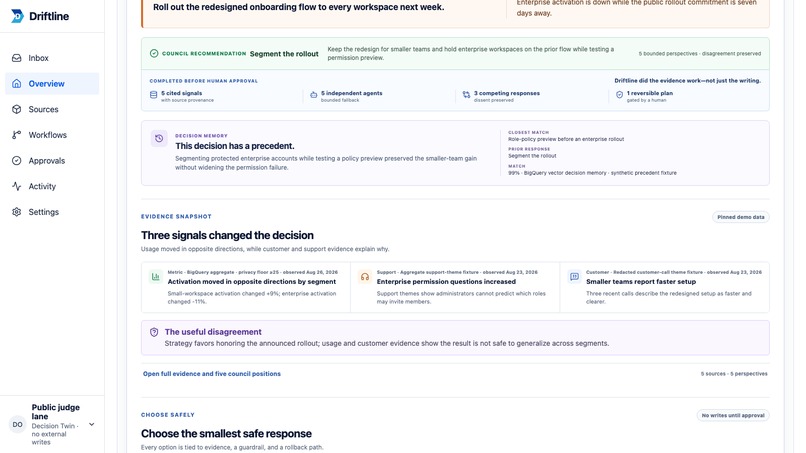
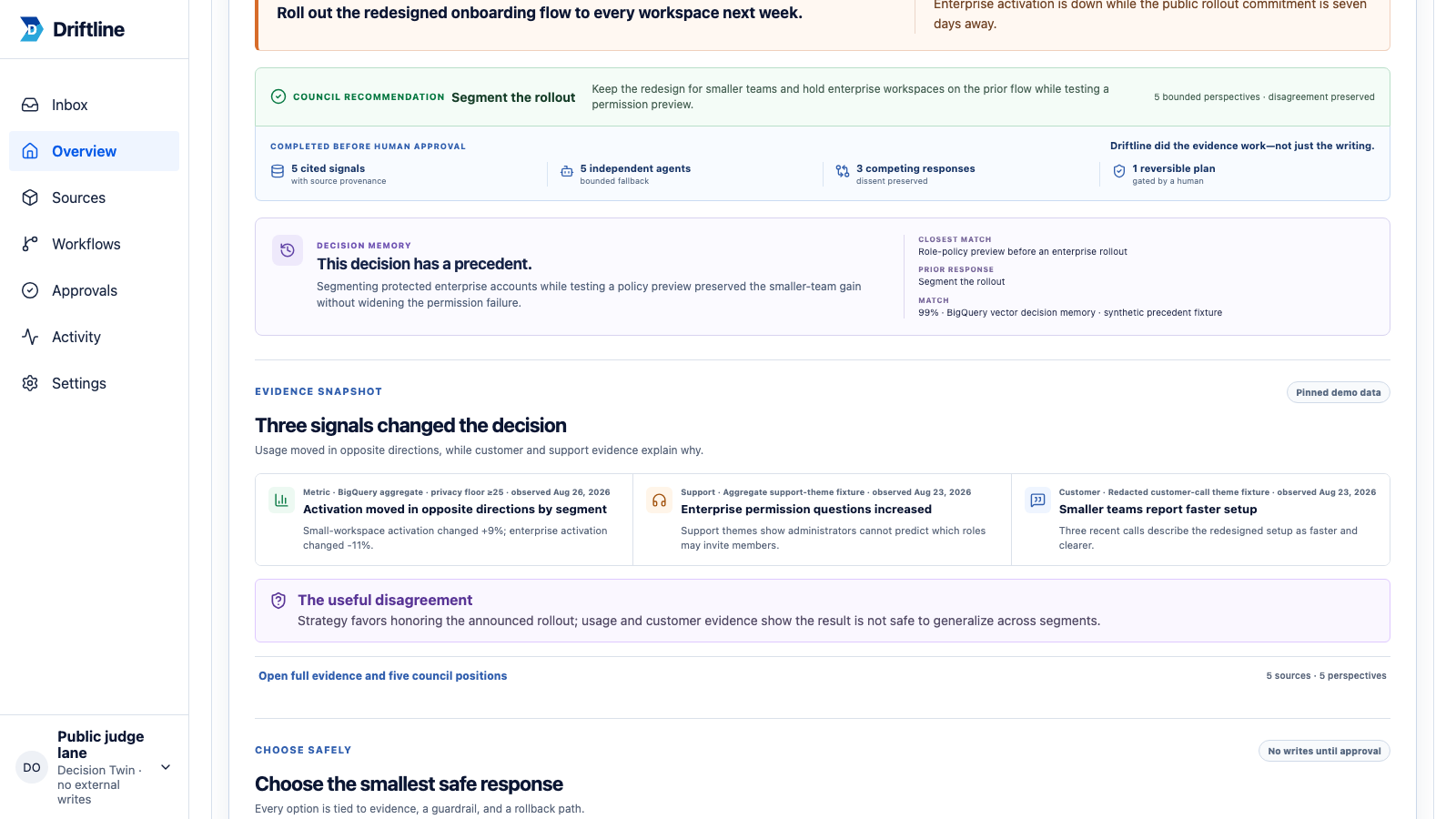
Generation 1: five ADK specialists use Gemini 3.5 Flash to preserve cited disagreement and compare reversible options.
-
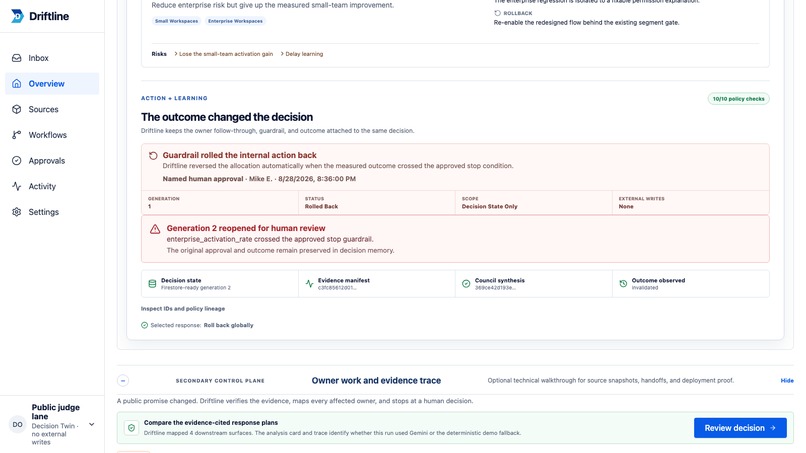
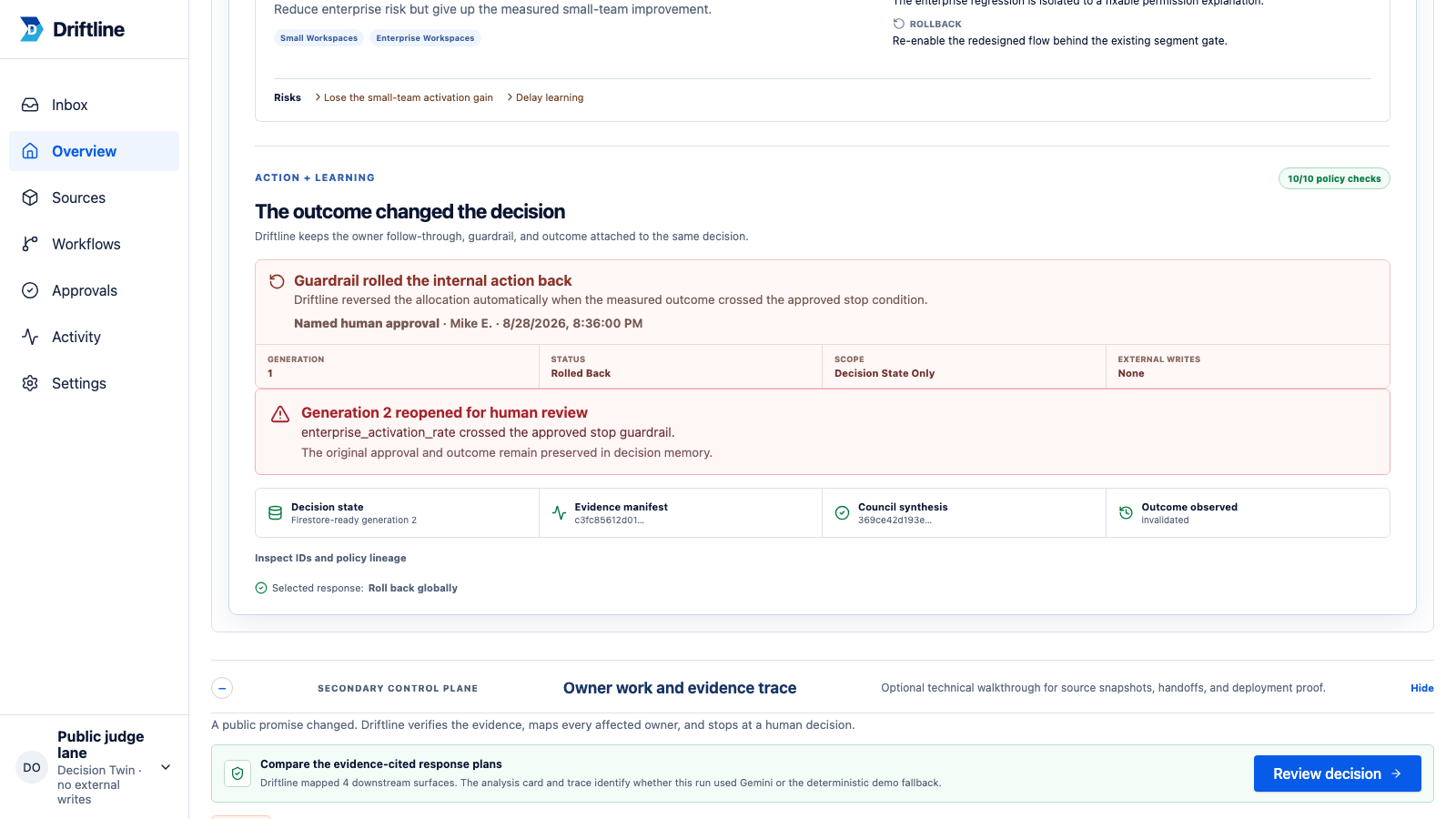
Generation 2: a failed guardrail triggers decision-state rollback and reopens the same case with evidence and lineage intact.
-
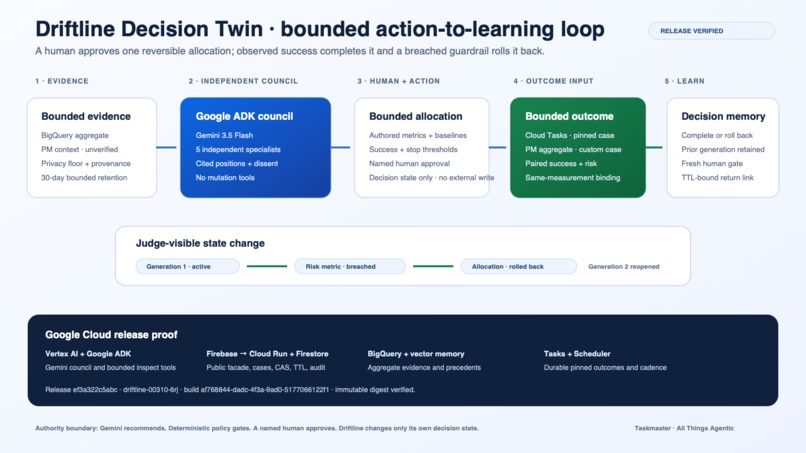
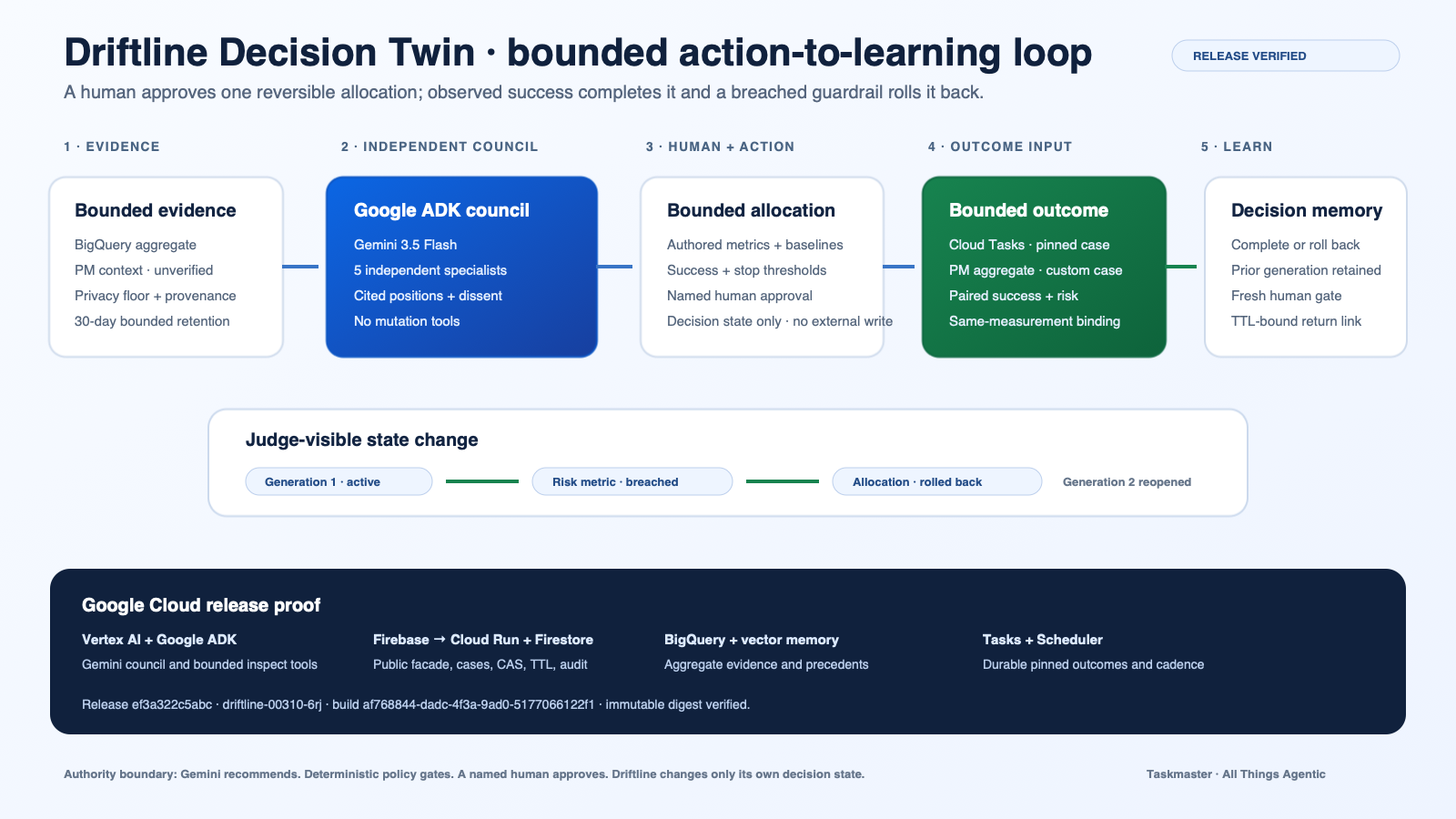
Release-bound architecture: Gemini + ADK on Cloud Run, Firestore lineage, BigQuery memory, and Cloud Tasks outcome monitoring.
The product decision should change when the evidence does
Product teams do not lack signals. They lose the reasoning, ownership, and follow-through that turn contradictory signals into a defensible decision. Driftline is an autonomous decision-operations system for PMs: it monitors commitments, collapses repeated evidence, prepares bounded options, stops at a named human approval, measures the approved outcome, and reopens the same decision when reality invalidates it.
It automates work for PMs—monitoring, deduplication, materiality scoring, evidence assembly, dissent discovery, relationship mapping, option preparation, follow-up, and reopen detection—without automating the PM's authority. Approval, dismissal, commitment changes, external writes, and customer-facing publication remain human-only.
Judge it in under three minutes
- Open the live Decision Inbox. Driftline has already grouped repeated signals into a durable decision thread and identified the commitment needing attention.
- Run the decision workflow. The public lane opens a clearly labelled, pinned redacted case with five evidence-bound decision lenses. The production architecture separately runs Google ADK specialists and Gemini 3.5 Flash on bounded source projections.
- Compare ship, rollback, segment, and defer. Each option exposes downside, success metric, stop condition, owner work, and rollback.
- Enter a reviewer name and approve one bounded experiment. The model cannot approve itself.
- Stop clicking. Cloud Tasks evaluates the committed measurement. When the enterprise guardrail fails, Driftline rolls back its internal decision-state allocation, writes a learning receipt, and reopens Generation 2 with the original evidence, dissent, approval, and outcome intact.
The public judge lane requires no credentials and performs no external writes.
Why this is agentic
Before a human acts, Driftline completes a multi-step background task: detect commitment drift, harvest cited evidence, convene specialists, preserve material disagreement, connect related decisions, compute commitment health, and prepare the smallest safe responses. One named authorization starts a second durable task: monitor the measurement window, evaluate success and risk guardrails, record the outcome, roll back when required, and reopen the decision without another PM prompt.
This is not a chatbot summarizing a meeting. It is a continuous, compounding operating loop:
signal → commitment → evidence → dissent → options → approval → measurement → outcome → reopen
Google architecture
- Gemini 3.5 Flash on Vertex AI interprets bounded evidence and produces structured specialist positions.
- Google Agent Development Kit (ADK) runs the coordinator and five independent specialists. Agents have read/inspect tools, never approval authority.
- Cloud Run hosts the FastAPI workflow runtime and React application.
- Firestore stores decision threads, generations, evidence identity, approvals, outcomes, and lineage.
- BigQuery supplies privacy-thresholded product aggregates and vector precedent memory.
- Cloud Tasks runs OIDC-authenticated asynchronous monitoring and retries; Cloud Scheduler triggers bounded source monitoring.
- Firebase Hosting provides the stable public judge URL and rewrites to Cloud Run.
- Cloud Build, Artifact Registry, Cloud Storage, and Secret Manager provide release, artifact, and credential custody.
Model output never authorizes a consequential transition. Pydantic schemas, evidence hashes, allowlists, compare-and-set state changes, idempotency keys, policy gates, and rollback rules are deterministic code. The public demo visibly reports External writes: none.
Production proof
The exact public-main release 465b22a76de822ee0dad1df0bab7d39b0de3d0da is live on Cloud Run revision driftline-00313-kg5 from Cloud Build cc761d63-05ea-486e-9c52-c8f16078be65, serving immutable image digest sha256:62b5522578b91436f9612fc950ae3427dd678ed2f61719dd679e8d9ffa1dc1bb at 100% traffic. The public /health response exposes the same release SHA and build ID.
Release gates pass:
- 578 backend tests and Ruff
- 14/14 trace evaluations at overall, safety, and usefulness 1.0
- frontend production build and literal-ID contract
- dependency vulnerability and third-party-license checks
- repository hygiene, submission packet, and standalone backend image
- fresh 1453×726, 390×844, and 320×844 browser journeys without console, accessibility, or overflow failures, including actual redacted file upload and Gemini-backed artifact extraction
The final demo is one continuous 135.233-second production take. It shows the Decision Inbox, the labelled pinned/redacted decision case, named human approval, automatic rollback, Generation 2 reopen, release-bound architecture, direct *.run.app/health identity, exact public commit, and return to the live application. It includes burned English captions and an embedded subtitle track.
What was hard
The hardest problem was separating interpretation from authority. Driftline needs the model to understand messy, contradictory evidence while guaranteeing it cannot approve itself, widen scope, duplicate an action on retry, or erase the reasoning that preceded an outcome. Stable operation identities, atomic transitions, explicit reconciliation, evidence-bound receipts, and generation lineage make retries converge rather than manufacture a second action.
The second challenge was honest demoability. Anonymous judges need a complete public workflow, but they should not inherit a production connector credential. Driftline therefore proves the full decision loop in a packet-safe public lane while reserving external writes for a separate signed, least-privilege operator lane.
What I learned
An agent becomes trustworthy when its authority is smaller than its reasoning ability. Provenance, dissent, ownership, stop conditions, and rollback are not infrastructure details; they are the product.
Deployment proof is also not customer proof. Driftline does not claim an independently validated PM pilot, paid customer, causal time savings, or ROI. Those remain unmeasured until a qualified external PM brings a current decision and completes the precommitted review window.
Testing instructions
- Open https://driftline-ops.web.app/ while logged out.
- In the Decision Inbox, choose Review decision, then Run the decision workflow.
- Confirm the public case is labelled pinned/redacted, shows cited evidence and visible disagreement, and compares four bounded responses. Use the architecture and release proof for the production Google ADK/Gemini implementation; do not treat pinned case content as a fresh model run.
- Enter any review name and approve the segmented experiment once.
- Stop clicking. Confirm the guardrail rolls back Generation 1, the receipt states Decision State Only and External Writes: None, and Generation 2 reopens for a fresh human review.
- Verify the serving identity at https://driftline-xvxczqg62a-uc.a.run.app/health and compare it with the exact public commit.
Local reproduction, architecture, data labels, threat boundaries, and evaluation commands are documented in the public repository README.
Originality and third-party disclosure
Driftline continued earlier product ideation; implementation began during the contest period on August 18, 2026 from an entrant-supplied source archive. The repository, Google Cloud project, first build, archive hash, file timestamps, and Git history are reproducibly documented in submission/ORIGINALITY_PROVENANCE.md. The entry does not claim that the earlier ideation began during the contest. Locked dependencies and license evidence are documented in submission/THIRD_PARTY_DISCLOSURE.md.
Live application: https://driftline-ops.web.app/
Source and reproducible setup: https://github.com/mikeyerke/driftline
