-
-
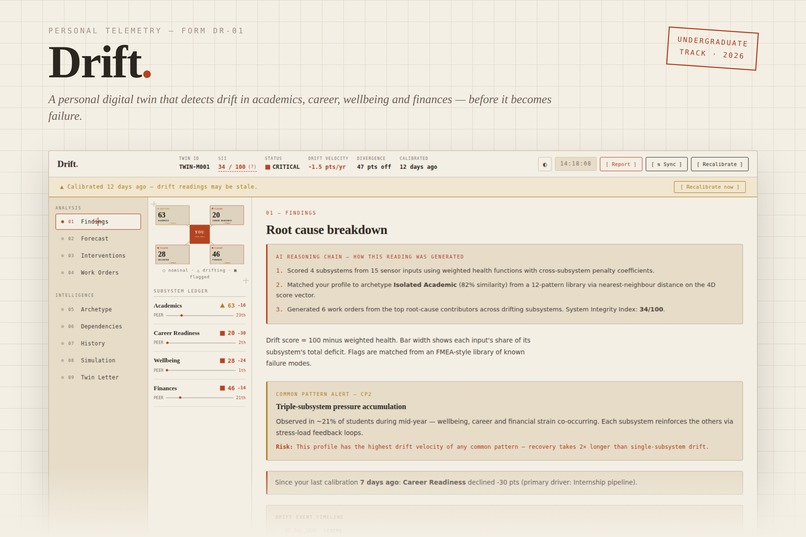
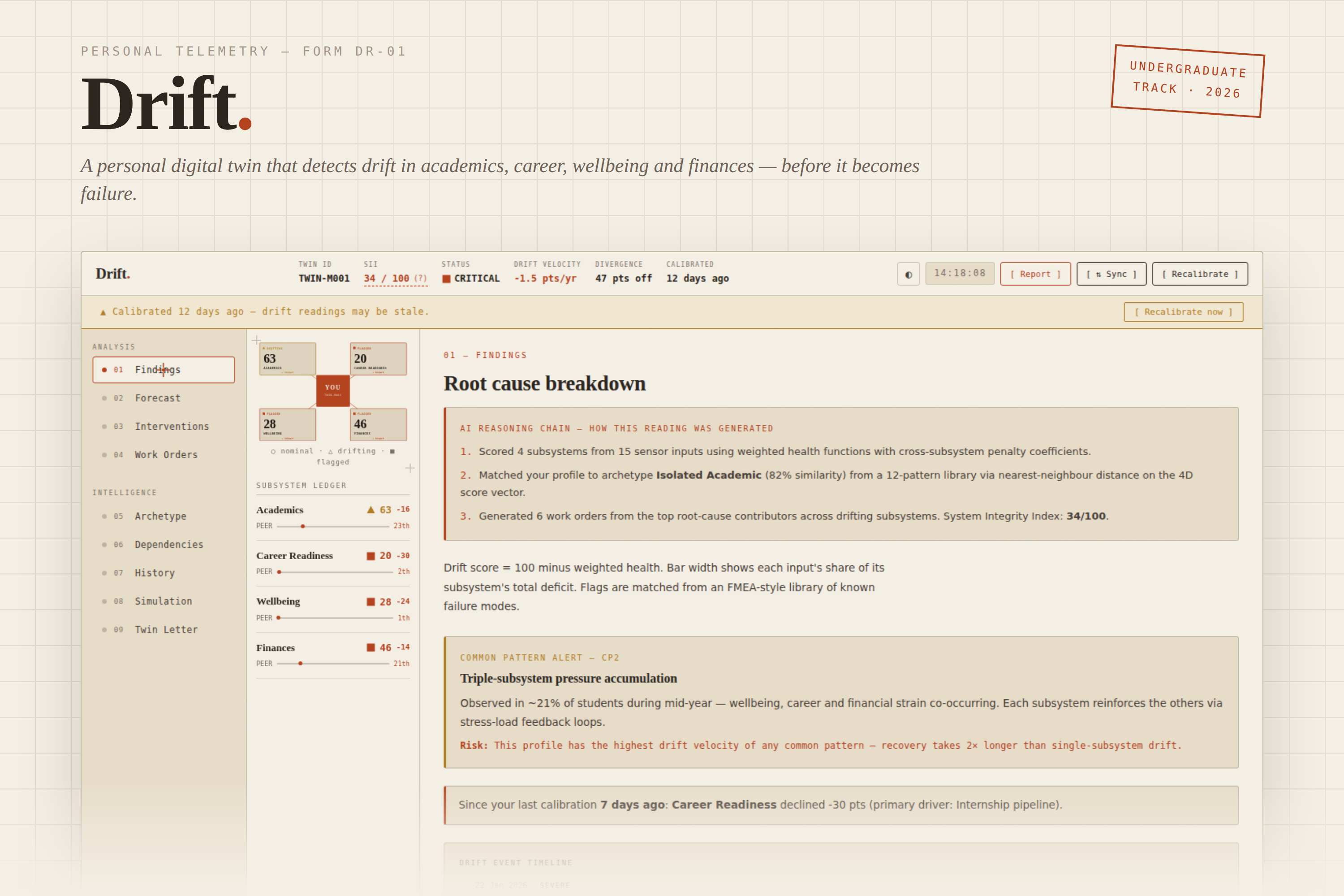
Root-cause breakdown and AI reasoning chain — DRIFT's Findings panel, live.
Inspiration
I build engineering simulation platforms — FactoryOS monitors machines and predicts failures before they happen. One day I realised: nobody applies that same thinking to students. We have dashboards for factory floors but nothing that monitors a student's trajectory the way a real monitoring system would. DRIFT was born from that gap.
The name comes from engineering: industrial systems don't fail suddenly — they drift out of calibration slowly, measurably, before something breaks. That's exactly what happens to students who burn out, miss opportunities, or fall behind. The signals were always there. Nobody was reading them.
What it does
DRIFT is a personal digital twin for students — available in both High School and University modes.
You calibrate your twin by entering your current state across four monitored subsystems:
- Academics — grades, study habits, backlog, trend
- Future Readiness (HS) / Career Readiness (Uni) — work experience, portfolio, exploration, activities
- Wellbeing — sleep, stress, extracurricular load, recovery time
- Finances — cash flow, savings buffer, income stability
DRIFT then runs a full diagnostic pipeline:
- Root cause analysis — identifies which specific inputs are driving drift in each subsystem, with percentage breakdowns (like an engineering fault tree)
- Pattern recognition — matches your 4-dimension score vector against a library of 8 high school or 12 university archetypes using nearest-neighbour distance (e.g. "The Hidden Burnout — 87% similarity")
- Monte Carlo simulation — runs 500 stochastic trajectory simulations to show probability distributions of where you'll be at any deadline you set
- Drift event timeline — reconstructs when drift first became detectable and projects future failure events if no intervention is made
- Counterfactual simulator — lets you toggle real interventions and see quantified impact on each subsystem live
- Work orders — auto-generated, prioritised action cards derived from the root cause analysis, each with expected impact and confidence rating
- Twin Letter — a plain-English doctor-style assessment letter you can take to an advisor
Both modes have completely different calibration fields, scoring formulas, archetypes, and work orders — a 15-year-old and a 21-year-old face genuinely different problems.
How I built it
Single HTML file — vanilla JavaScript, Chart.js (bundled inline), custom SVG for all diagrams. No APIs, no server, no accounts. Every figure traces back to a stated formula in the source code.
The AI reasoning layer is a transparent pipeline:
- Weighted scoring engine with cross-subsystem penalty cascades (sleep below threshold penalises academics and career via cognitive load coefficients)
- Nearest-neighbour archetype matching on a 4-dimensional normalised score vector (Euclidean distance, disclosed)
- Gaussian Monte Carlo simulation using Box-Muller transform for noise generation
- Rule-based FMEA-style failure mode detection against a library of known student stress patterns
- System Integrity Index — urgency-weighted composite where faster-drifting subsystems count more than stable ones
Everything runs locally on the device. No data leaves the browser.
Challenges I ran into
The hardest part was making the "AI reasoning" feel genuinely explainable rather than a black box. Every number had to trace back to a formula a judge could audit. The cross-subsystem penalty engine (where financial stress cascades into wellbeing, which cascades into academics) required careful calibration so it produced realistic outputs without overcounting.
Building two genuinely different modes (high school vs university) with different subsystems, archetypes, scoring weights, work orders, and demo twins — all in one file, swapping live — was the most technically complex part.
Accomplishments I'm proud of
- 9-panel dashboard built entirely without any external AI API — the intelligence is pure engineering logic
- Monte Carlo simulation producing real probability distributions with Gaussian noise, entirely client-side
- The field-report aesthetic — warm paper, ink typography, industrial registration marks — designed to feel handcrafted rather than AI-generated
- Two complete student profiles (high school + university) in one file, fully interchangeable
What I learned
That "AI" doesn't have to mean a language model. The most defensible, explainable, and genuinely useful AI systems are ones where you can point to every number and say "here's exactly why." DRIFT has no hallucination risk, no API cost, no privacy exposure — and it reasons more transparently than any chatbot could.
What's next
A mobile app version. A teacher/counsellor view that can monitor a cohort of twins. Integration with school information systems for automatic calibration. And a longitudinal study — if enough students use it, the archetype library becomes genuinely data-driven rather than synthetic.
Built With
- box-muller-transform
- chart.js
- css
- html
- javascript
- localstorage
- monte-carlo-simulation
- nearest-neighbour-classification
- svg
- weighted-scoring

Log in or sign up for Devpost to join the conversation.