The problem
Design systems do not fail loudly. They fail one screen at a time.
Somebody ships a button in a slightly brighter indigo because it looked better that afternoon. Six weeks later a different person, in a different sprint, with no memory of the first three onboarding screens, writes a fourth one whose button says "Submit" where the others say "Continue", and whose heading reads "Account provisioning complete" where the others read "Let's get you set up". Every one of those changes passed code review, because every one of them is fine on its own. What is wrong is only visible across screens, and nothing in a normal pipeline ever looks across screens.
Linters read source, not renders. Visual regression tools compare a screen to its own past and go quiet when the drift ships in the first commit. Design review is a person, once a quarter, from memory. So the drift accumulates, and the honest answer to "is our product still consistent?" is that nobody knows.
What Drift does
Drift is a background agent that watches a deployed product, the real rendered thing rather than the source, and does five things on its own.
It measures
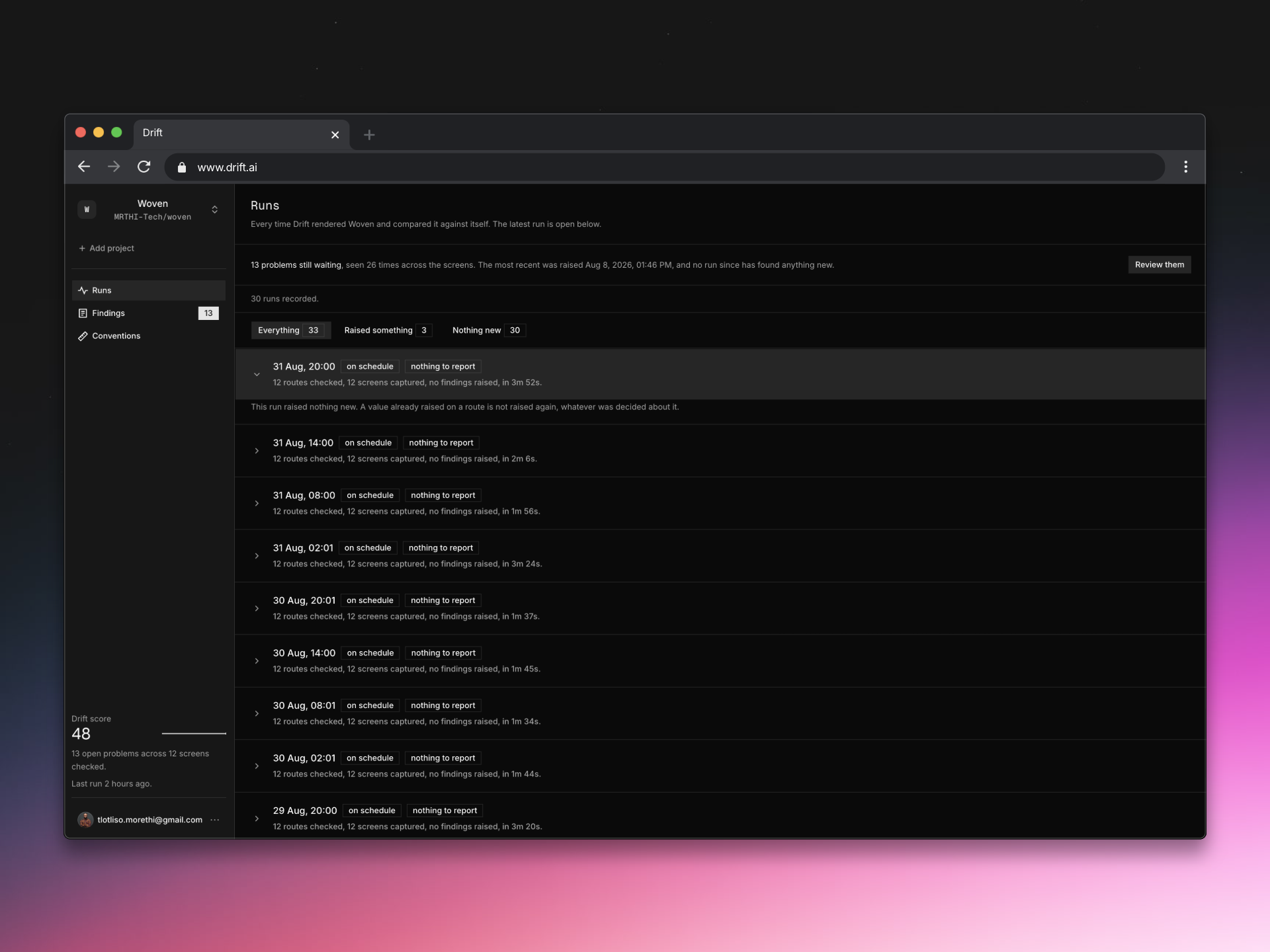
A Cloud Run job renders every route the watched repo declares, at every viewport it declares, with Playwright. It walks the resolved computed styles and the visible text of every element and stores that record. That record, not a model's impression of a screenshot, is the evidence for everything that follows.
It finds three kinds of drift
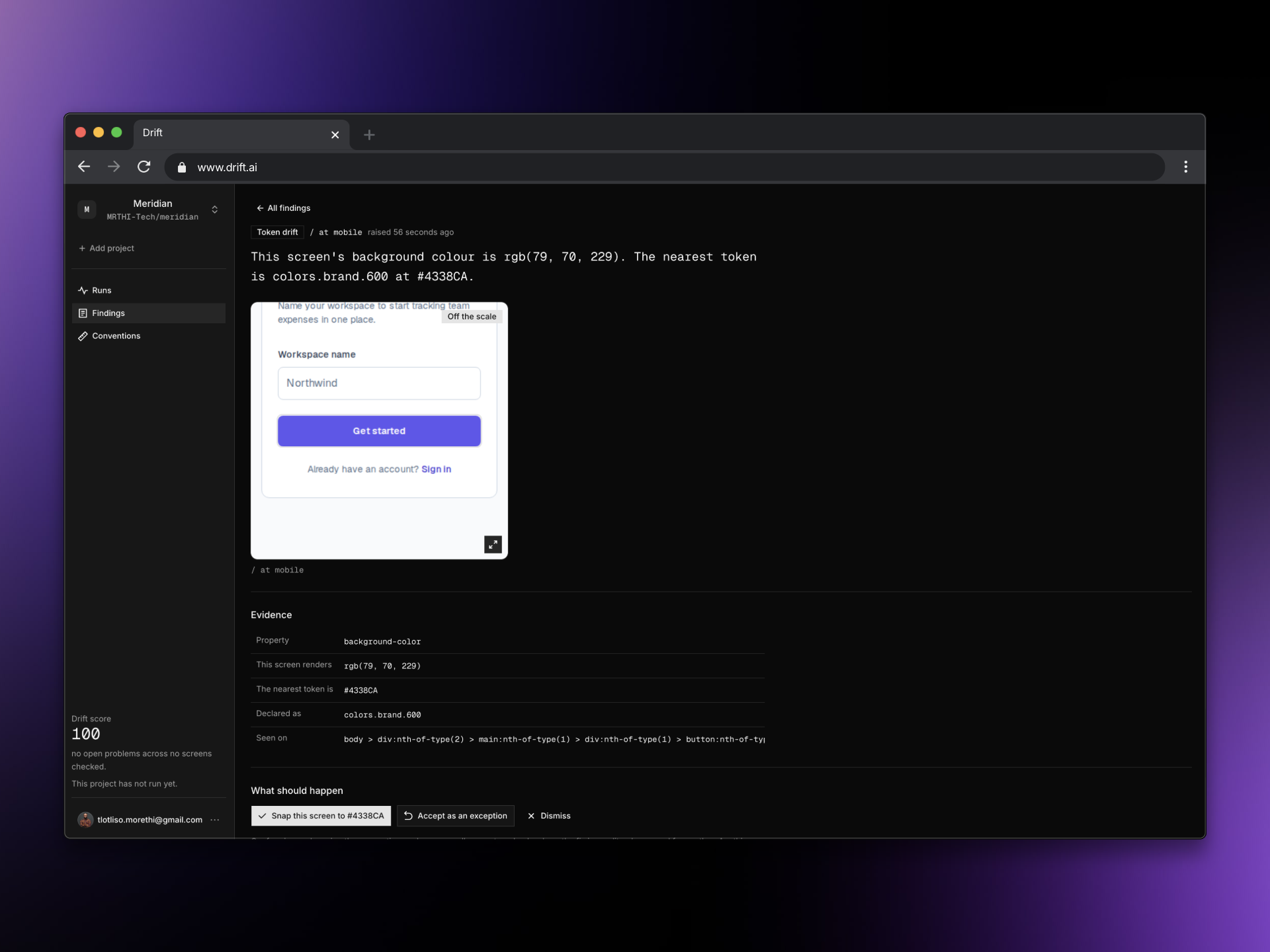
Token drift is a value that missed the design system: the run reads the repo's own token file as source, compares every rendered colour, size, weight, spacing and radius against those scales, and raises what sits off them with the nearest token attached.
Pattern drift is a screen that departs from what its own siblings agreed on: screens are grouped into families by embedding distance, a value becomes a convention when three or more screens of a family agree on it, and a screen that disagrees is raised against it.
Component drift is counted product-wide: square radio buttons on one screen when every other radio in the product is round.
It refuses to guess
Every fact Drift states was measured deterministically before any model was involved. The model is never handed a screen and asked what is wrong with it; it is handed a numbered list of pre-computed candidates and asked which ones matter. Anything it proposes must name a candidate from that list, and the value it cites is read back out of the screen's own extraction record before the finding is allowed to exist. Invented, rounded, or misattributed values are dropped silently and counted. This gate has no configuration flag.
It opens pull requests nobody asked for
A token finding whose value sits close enough to the token it missed has a right answer that requires no human judgment, so Drift fixes it: a bounded literal-for-literal substitution, branched, opened, with before-and-after renders in the body. Where the value is never written in source, because it is composed at runtime from a variant map, the substitution fails first and then a Gemini-backed Fixer reads the repository through a fixed set of tools and writes the correction. Everything it proposes passes a second gate that proves the edit applies to a file it actually read, matches exactly once, stays in bounds, and arrives at the value the finding named. Because that gate cannot prove the result compiles, a Fixer patch opens as a draft and a person merges it. The whole of Drift's autonomy is one function, in one file, that returns its reason either way.
It checks whether the fix worked
This is the part nothing else does. When somebody resolves a finding and the pull request merges, the next run re-renders the product and asks the only question that settles it: is the value still on the screen? A merged, deployed fix that did not move the render is reported as ineffective rather than fixed. That is the single most common way a fix silently fails, and it is invisible to every tool that treats the merge as the evidence.
And what the product settles on leaves the dashboard: conventions are exported as drift.rules.md, committed to the watched repo, so the coding agent writing screen twelve is told what screens one through eleven already decided.
How it is built
TypeScript in strict mode, pnpm workspaces, four packages: a Next.js App Router dashboard, a Playwright render worker, a core package holding every deterministic analysis and every Firestore repository, and a Genkit package that is the only path to a model anywhere in the system.
The architectural spine is a rule the repository enforces rather than recommends: rendering, extraction, token diffing, dedupe, signature construction, convention counting and the drift score never call a model, and may not. Model calls are confined to six flows (screen embedding, archetype classification, convention derivation, convention labelling, pattern judgment over pre-computed candidates, and the Fixer), and each returns structured output through a schema. A model that is unavailable costs a run its pattern findings and nothing else; every deterministic finding still lands.
The other spine is that every boundary a model crosses is a named function with a test, not a convention: the reconciliation gate before Firestore, the fix gate before a patch leaves the flow, isAutonomousFix before anything opens unprompted, and a repository allowlist that refuses every GitHub write outside it regardless of what the database says.
Google Cloud
| Service | What it does here |
|---|---|
| Cloud Run (service) | The dashboard, behind Firebase Auth |
| Cloud Run (job) | The render worker, Playwright and Chromium in a container |
| Firestore (Native) | Projects, runs, screens, archetypes, conventions, findings, resolutions |
| Cloud Storage | Full-page screenshots, served only through a signed proxy |
| Cloud Build + Artifact Registry | Both images, built linux/amd64 |
| Pub/Sub | The watched product publishes on redeploy; the push subscription starts a run, its identity token verified against the one service account allowed to push |
| Cloud Scheduler | The unattended run, one entry per watched project |
| Cloud Logging | One JSON object per line from both runtimes, every line carrying its run and project id |
| Secret Manager | Every credential in the deployed environment |
| Firebase Auth | Google provider; each person arrives at their own empty Drift |
Deployed in africa-south1, with Firestore, Cloud Run and Artifact Registry all in the same region.
Gemini and Genkit
Gemini 3.5 Flash (gemini-3.5-flash) behind every flow, and gemini-embedding-2 for the screen embeddings that place a screen with its siblings. Genkit is the agent framework and the only way any of it is reached: packages/agent is the single door, structured output on every call, at most one retry, and a failure that returns empty rather than throwing into the pipeline.
Data sources
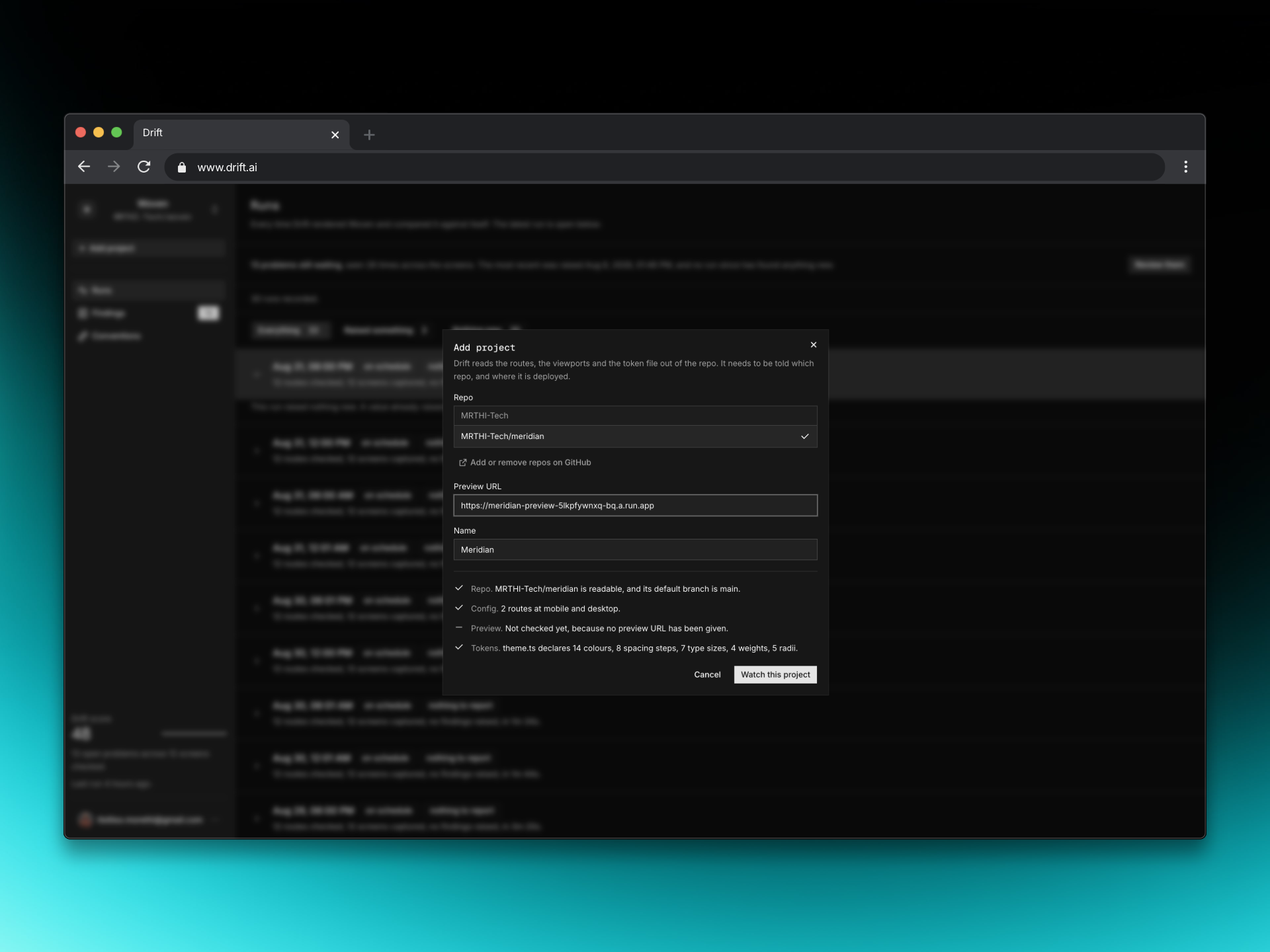
Drift uses no third-party dataset. Everything it reasons about is produced by the product being watched: the resolved computed styles and visible text of each rendered screen, extracted in-browser; the watched repo's design-token file, read as source text and never executed; drift.config.json in the watched repo, which is the only declaration of what gets rendered, because Drift never crawls; repository contents and pull requests through the GitHub API under an installation the user granted; and full-page screenshots in Cloud Storage.
What was hard
The reconciliation gate exists because of what happened without it. A model looking at a screenshot will confidently cite #4F46E4 for a button that is actually #4F46E5, and a finding built on that is worse than no finding: it is a bug report that sends somebody looking for a value that does not exist. The fix was to stop letting the model originate facts at all. It comments on candidates the deterministic phase already measured, and every value it repeats is checked against the screen's own record before anything is written. It drops real proposals sometimes. That is the correct trade.
The second one: nothing in a repository contains the word "warm", so when a heading has to be rewritten to sound warm again, there is no literal for a gate to look for. That check reads the proposed line with the same function that measured the original, so the gate and the measurement can never disagree about what warm means.
What's next
Production watching alongside preview, a second rules-file format for other coding agents, and light mode, all deliberately fenced off until after the deadline so the loop could be finished and proven first.
Built With
- cloud-build
- cloud-run
- cloud-scheduler
- cloud-storage
- firebase-auth
- firestore
- gemini
- genkit
- github-api
- google-cloud
- nextjs
- octokit
- playwright
- pnpm
- pub-sub
- secret-manager
- shadcn-ui
- tailwindcss
- typescript
- zod

Log in or sign up for Devpost to join the conversation.