
Drift — Circadian Misalignment Sensor
Inspiration
Most wellness tools measure what happened — steps taken, hours slept, calories burned. But none of them answer the question we kept coming back to:
Why do some people follow every health rule and still feel completely off?
The answer, we discovered, lies in chronoception — the body's internal time sense. Humans possess far more than the traditional five senses. Emerging science identifies anywhere from 22 to 33 distinct senses, and chronoception is one of the least understood. Your body runs on a precise 24-hour biological clock governed by the suprachiasmatic nucleus (SCN) in the brain. Every cell, organ, and system expects to sleep, eat, and move at specific times.
For the 4.6 million shift workers in the US alone, that clock is perpetually ignored.
We were inspired by the stories of ICU nurses finishing 12-hour night shifts and lying awake at 8am, unable to sleep. Logistics workers rotating schedules weekly, never feeling fully present. New parents surviving on 90-minute sleep windows, making critical decisions in a fog. These people aren't failing at wellness — their schedules are failing their biology.
That gap between biological expectation and lived reality has never had a name, a number, or a visual. We wanted to give it one.
What it does
Drift is a circadian misalignment tracker that makes your body clock visible for the first time.
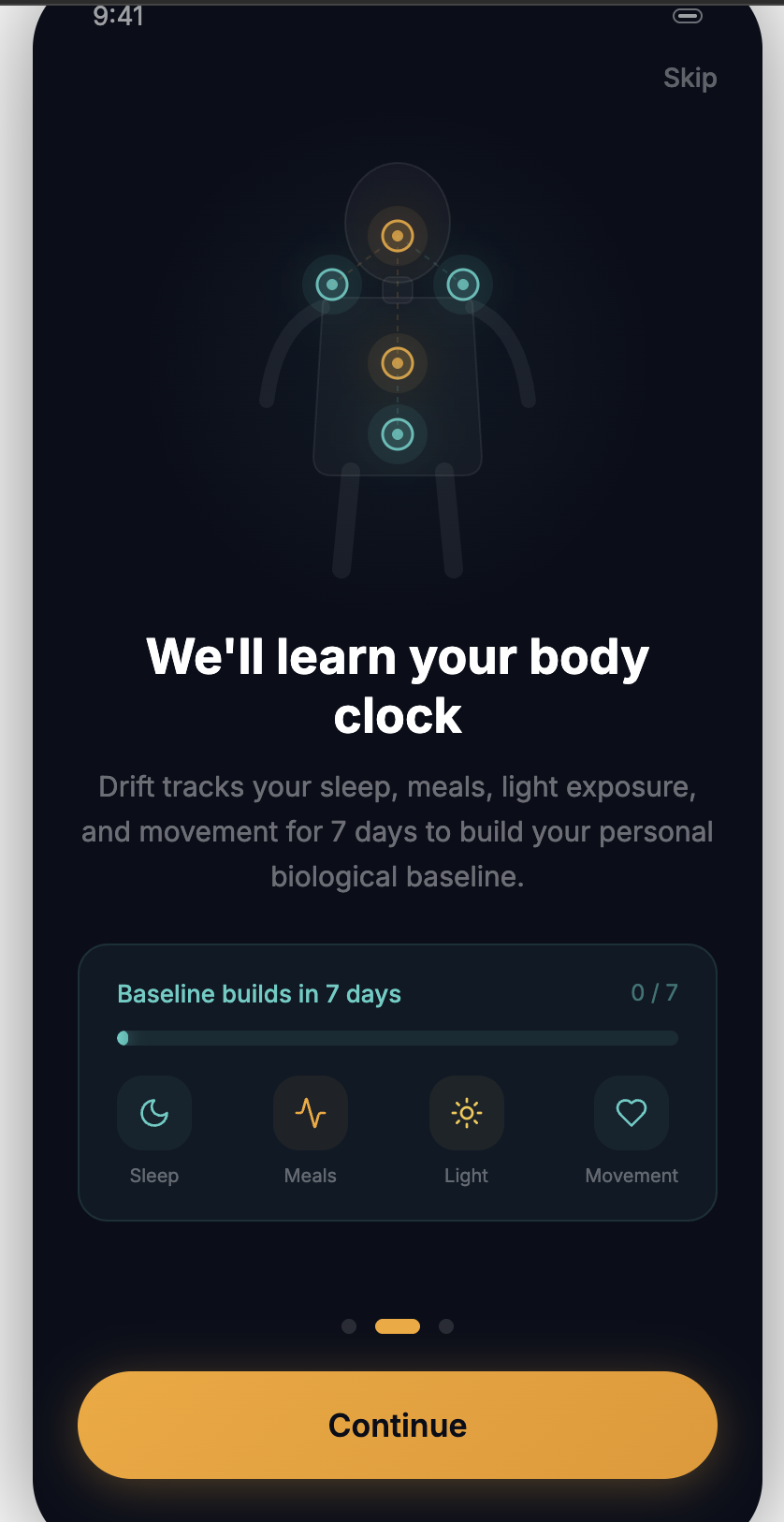
It passively measures four biological signals:
- Sleep timing
- Meal timing
- Light exposure
- Movement windows
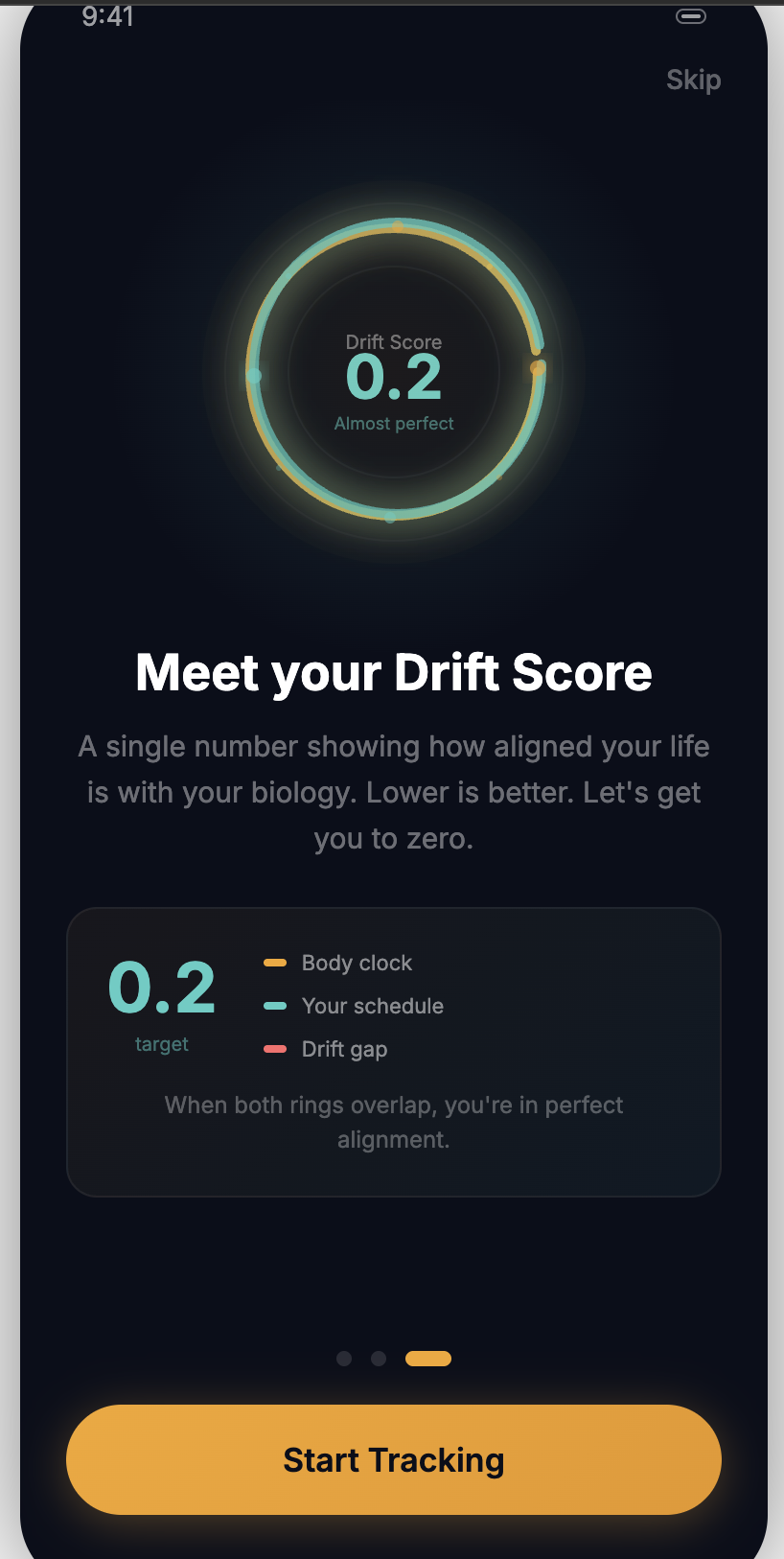
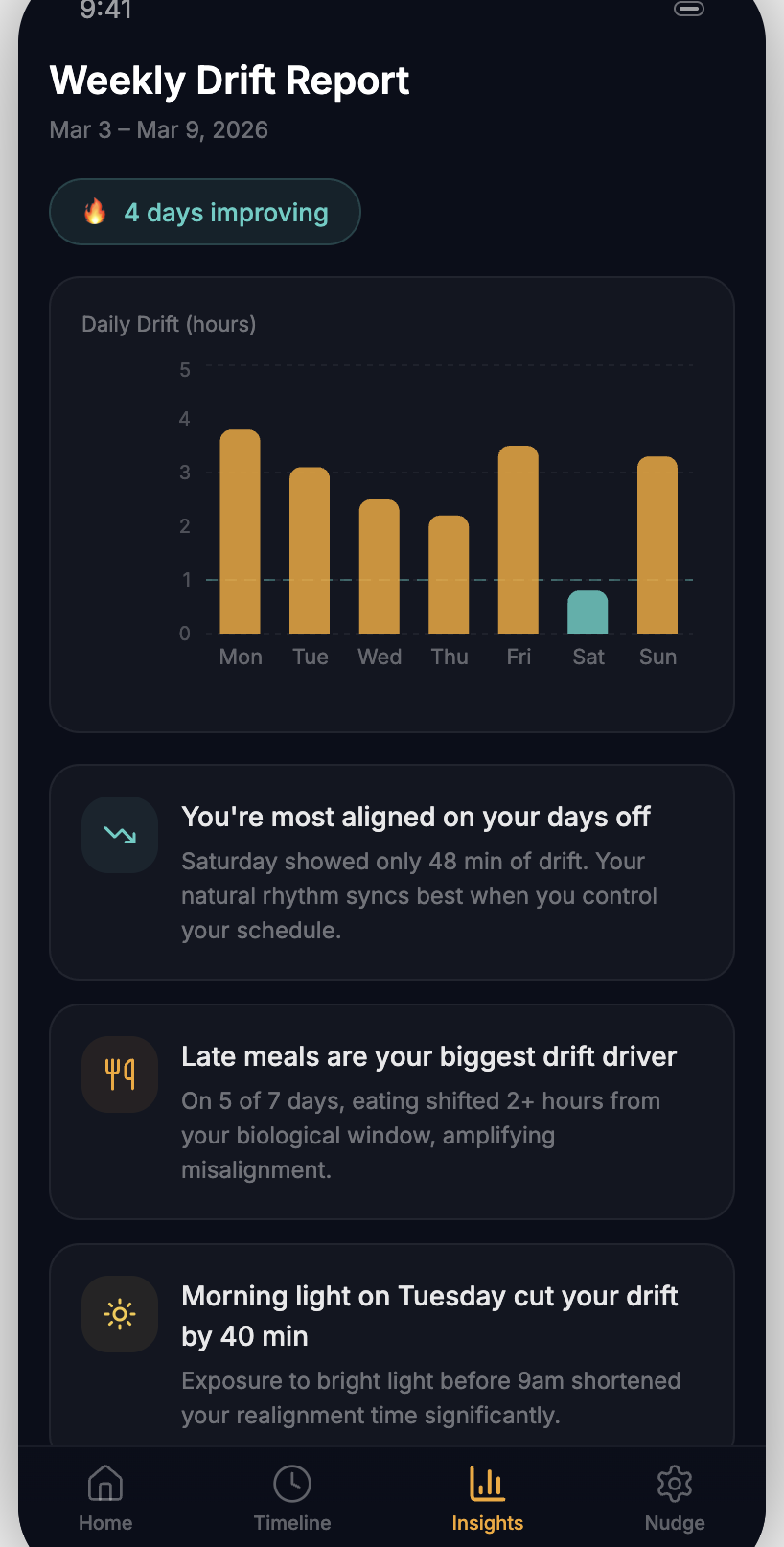
It then computes a single Drift Score — the average hourly deviation between when your biology expects these events and when they actually occur.
$$ \text{Drift Score} = \frac{1}{n} \sum_{i=1}^{n} |T_{\text{biological},i} - T_{\text{actual},i}| $$
Where $T_{\text{biological},i}$ is the biological expectation for event $i$, $T_{\text{actual},i}$ is the actual time it occurred, and $n$ is the number of tracked signals.
The app surfaces three core experiences:
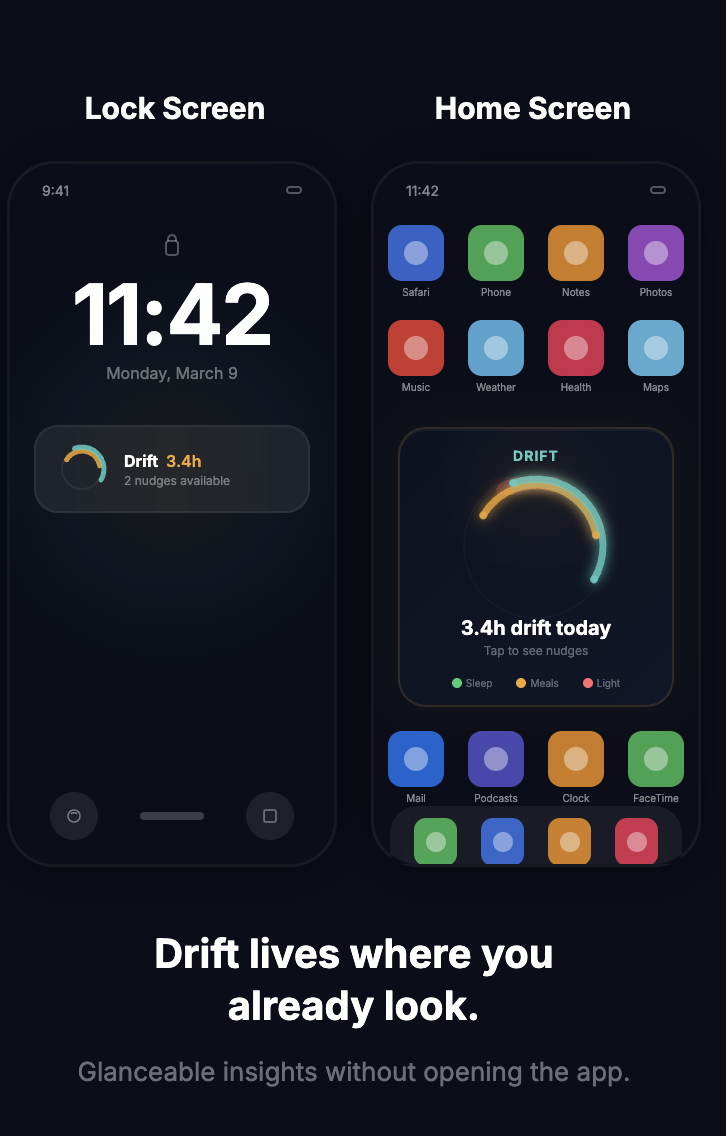
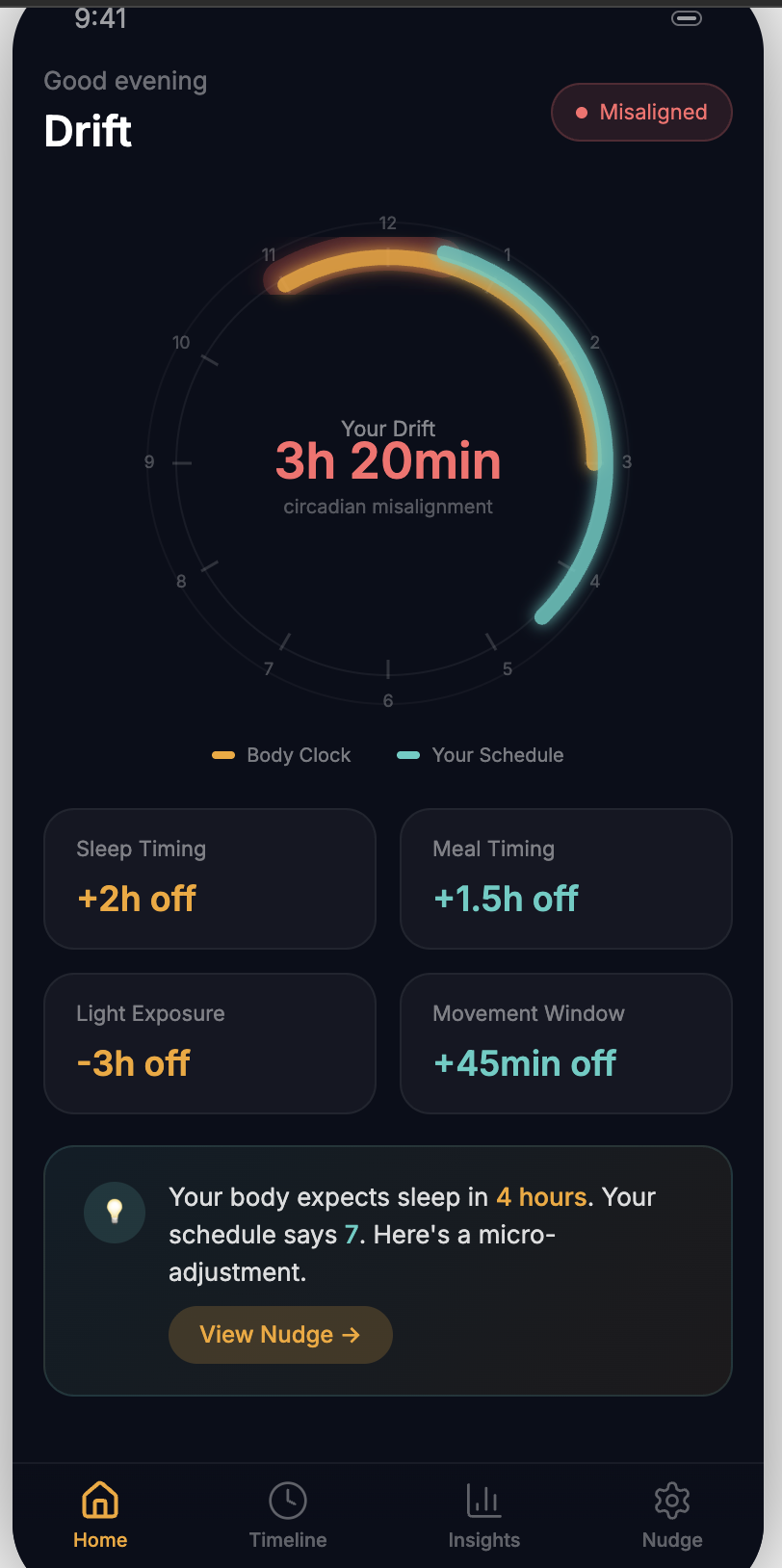
- The Clock Face — a real-time visualization of your biological clock vs. your lived schedule, showing the gap as an overlapping orbital arc
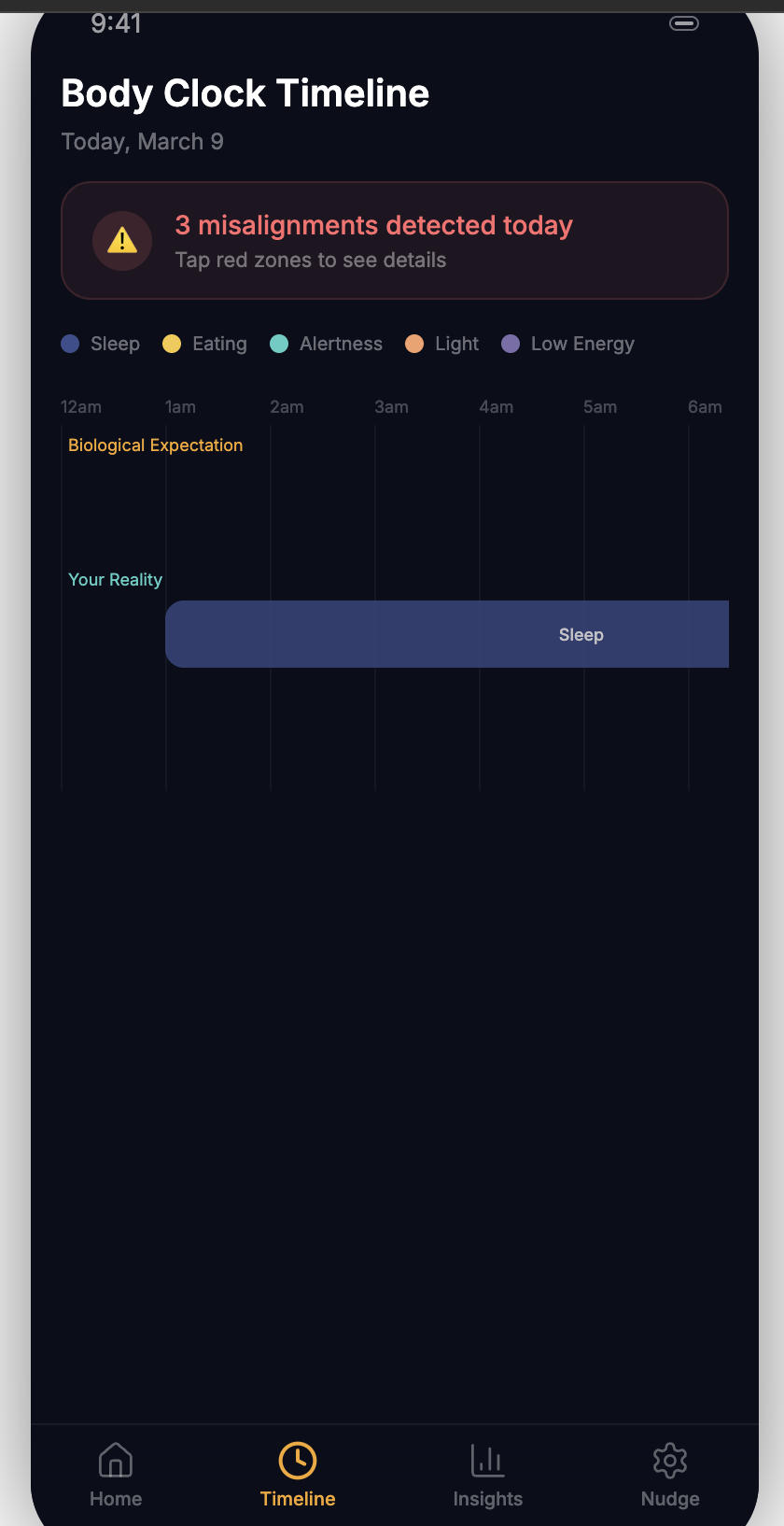
- The Body Clock Timeline — a scrollable daily view showing misalignment zones across sleep, meals, light, and movement
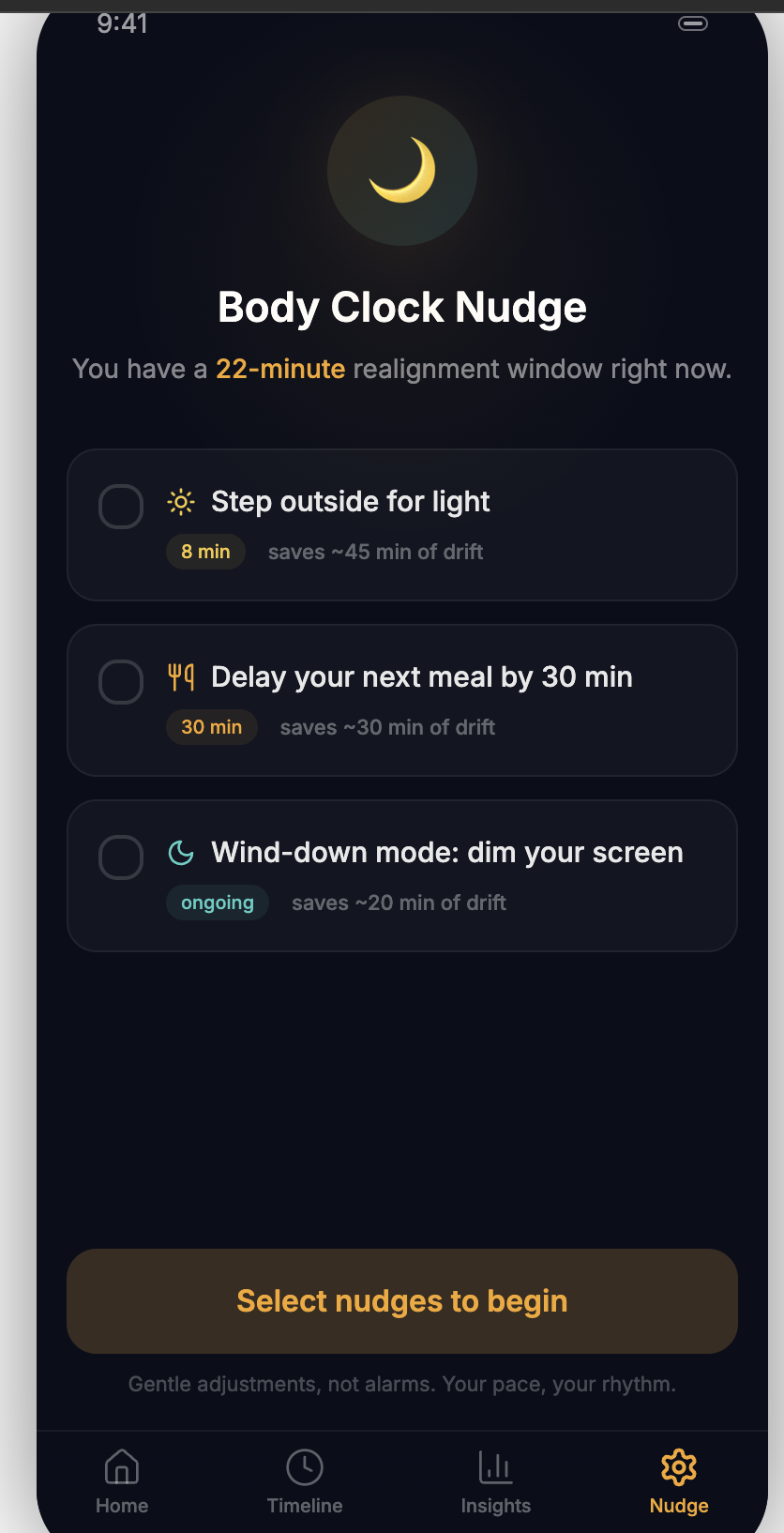
- Nudge Sessions — gentle, timed micro-interventions during personal realignment windows (light exposure, meal delays, wind-down cues)
Drift doesn't tell you what to do. It tells you when your body is most ready to be helped.
How we built it
Drift was designed entirely in Figma, using a combination of:
- Figma Make for interactive prototype flows and app screen generation
- SnapDeck AI for rapid slide generation from detailed written prompts
- Figma Prototyping for linking screens into a navigable user flow
- Manual component design for the Clock Face orbital visualization, Drift Score dial, and Body Clock Timeline swimlanes
Our design process followed three phases:
Phase 1 — Problem Definition We mapped the science of chronobiology, identified shift workers as our primary audience, and defined the three core personas: Maya (night shift nurse), Derek (rotating logistics worker), and Priya (new mother with fragmented sleep).
Phase 2 — System Design We designed the sensing model, the Drift Score formula, and the three-part interaction framework: Sense → Calculate → Nudge.
Phase 3 — Interface Design We built four core app screens and a 12-slide presentation deck, maintaining a consistent dark navy, amber, and teal design language across all surfaces.
Challenges we ran into
Making an invisible sense feel tangible Chronoception has no natural visual metaphor. Unlike heart rate (a number) or steps (a bar chart), circadian misalignment is abstract and cumulative. We went through many iterations before landing on the overlapping orbital arc as the core visual — two rings, slightly offset, showing the gap between biological expectation and reality.
Avoiding the "just another sleep tracker" trap Early versions of Drift looked too similar to existing tools like Oura or Whoop. We had to repeatedly push ourselves away from sleep-centric thinking and toward the full circadian picture — meals, light, movement, not just hours of rest.
Designing for information without anxiety Giving people a new sense means giving them new things to worry about. We spent significant time designing the alert system to be gentle rather than alarming — limiting nudges to 3 per day, building in a snooze mode, and framing all insights as opportunities rather than failures.
Balancing speculative design with real-world grounding This is a speculative tool — the sensors and algorithms don't fully exist yet. But the need is completely real. Holding that tension, designing something fantastical but emotionally grounded, was the hardest creative challenge we faced.
Accomplishments that we're proud of
- Designed a novel visual metaphor for an invisible biological phenomenon that users can understand within seconds
- Created a scoring system grounded in real chronobiology research that feels simple on the surface but captures genuine complexity underneath
- Built three distinct use cases that span healthcare, logistics, and family life — showing the breadth of the problem without losing focus
- Designed ethical safeguards into the core product architecture from day one, not as an afterthought
- Maintained a cohesive, premium design language across app screens, presentation slides, and all visual touchpoints
What we learned
Humans have far more than five senses. Researching chronoception opened up an entire world of underexplored biological signals — proprioception, interoception, nociception — any of which could be the basis of the next generation of wellness tools.
The best interfaces disappear. The most important design decision we made was choosing not to overwhelm users with data. A single Drift Score is more powerful than 12 graphs.
Speculative design requires real empathy. You can't design a future tool without deeply understanding a present pain. The shift worker stories weren't just use cases — they were the compass for every design decision we made.
Ethical design is a feature, not a footnote. Building privacy, consent, and misuse protection into the core interaction model made Drift feel more trustworthy and more useful, not more restricted.
What's next for Drift
Short term
- Conduct a 12-week pilot study with 50 shift workers at a partner hospital
- Validate the Drift Score formula against clinical chronobiology benchmarks
- Refine the nudge timing algorithm based on real-world feedback
Medium term
- Integrate with existing wearables (Apple Watch, Oura, Whoop) for passive biometric data collection
- Launch Team Drift Sync — a workplace tool that helps shift managers schedule around collective biological alignment
Long term
- Environmental Integration — partner with smart lighting manufacturers to auto-adjust workspace environments to individual drift profiles
- Healthcare Mode — enable users to share drift data with physicians as a clinical input for fatigue-related diagnoses
- Expand beyond shift workers to anyone whose schedule fights their biology — frequent flyers, remote workers across time zones, caregivers
The clock is already ticking. Drift just lets you finally see it.
Built With
- figma
- react


Log in or sign up for Devpost to join the conversation.