Inspiration
Dreams are often a reflection of our subconscious, filled with emotions, symbols, and messages that can guide us toward self-discovery. We wanted to create a tool that helps people understand their dreams in a structured way, using AI to uncover deeper insights.
What It Does
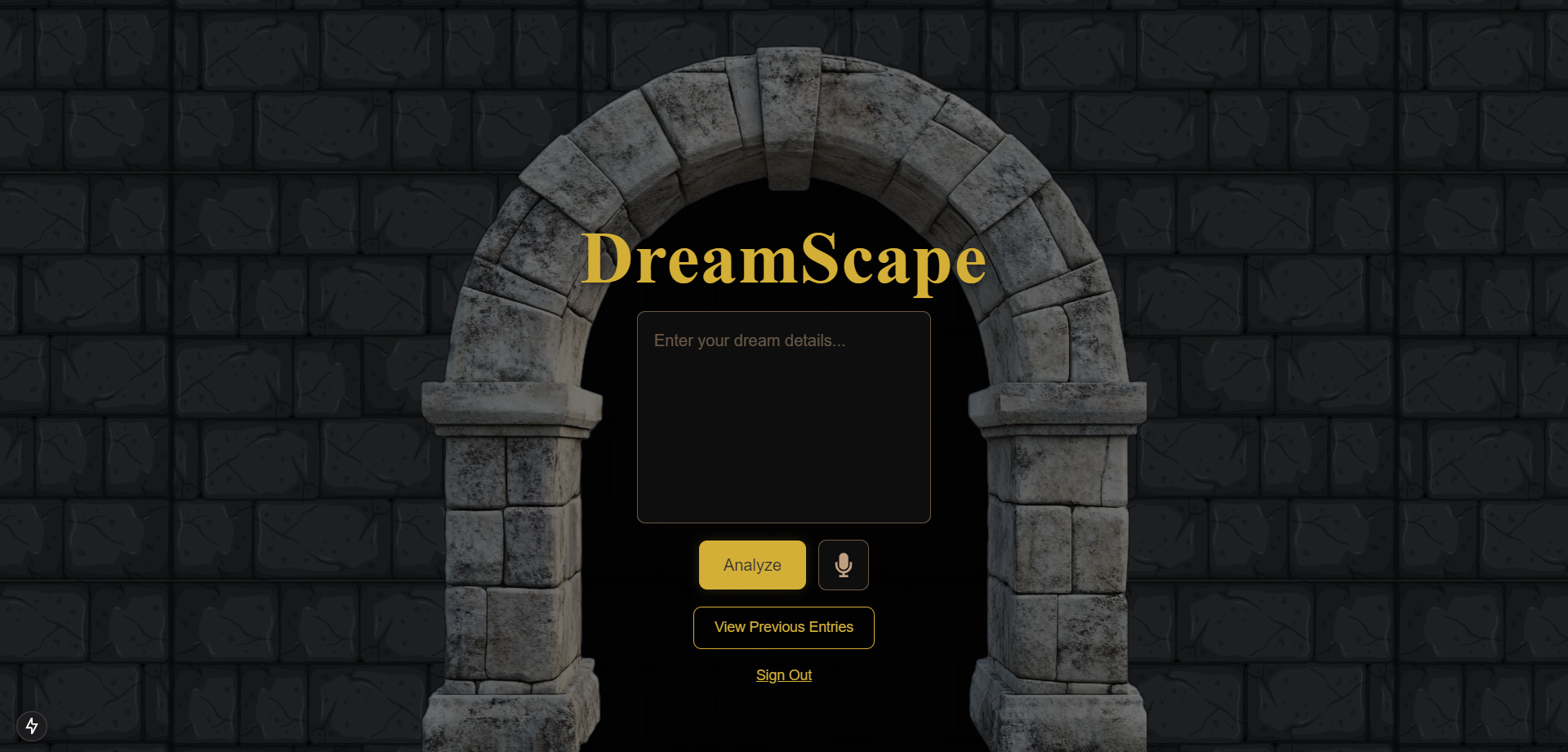
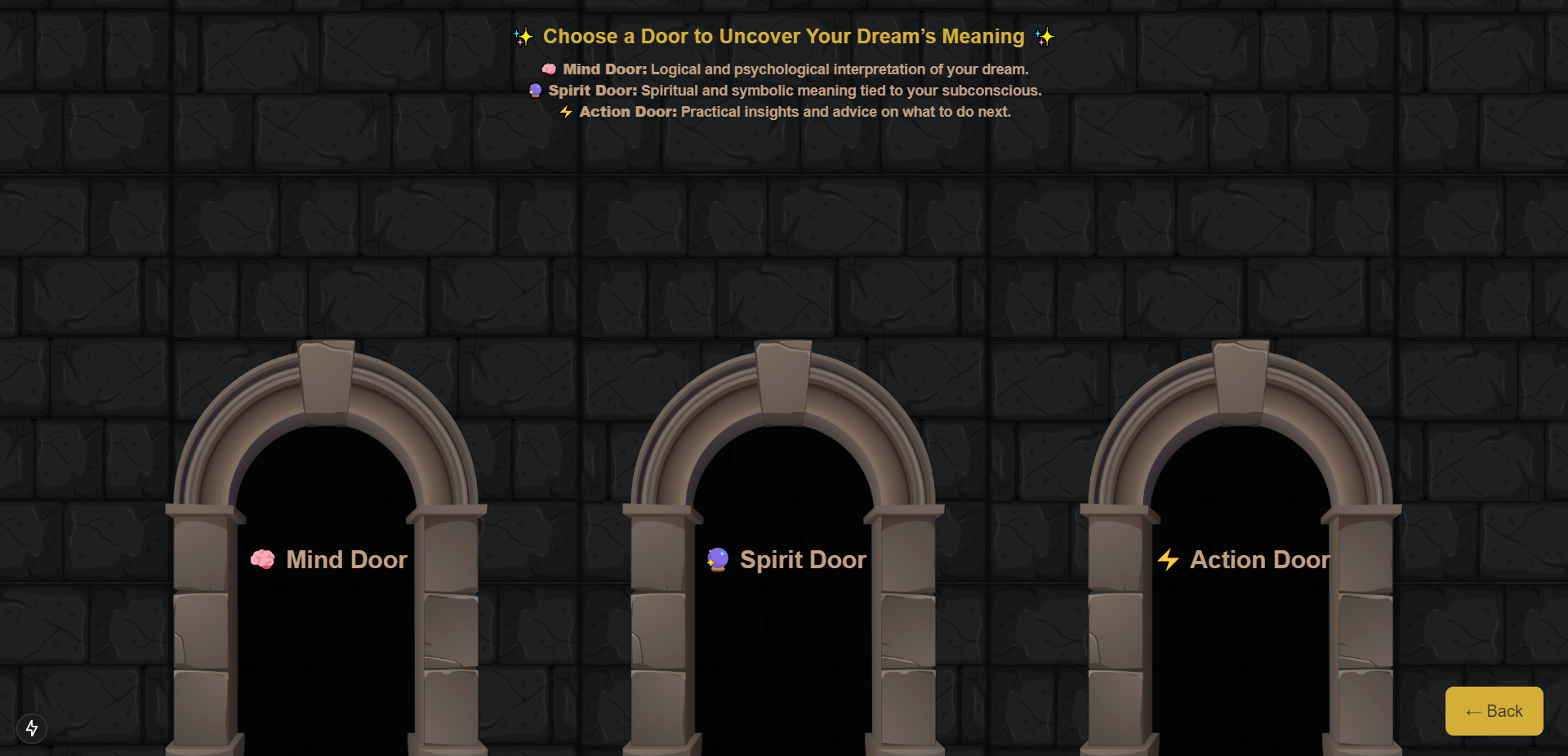
DreamScape allows users to input a dream, either by typing or speaking, and receive three different interpretations:
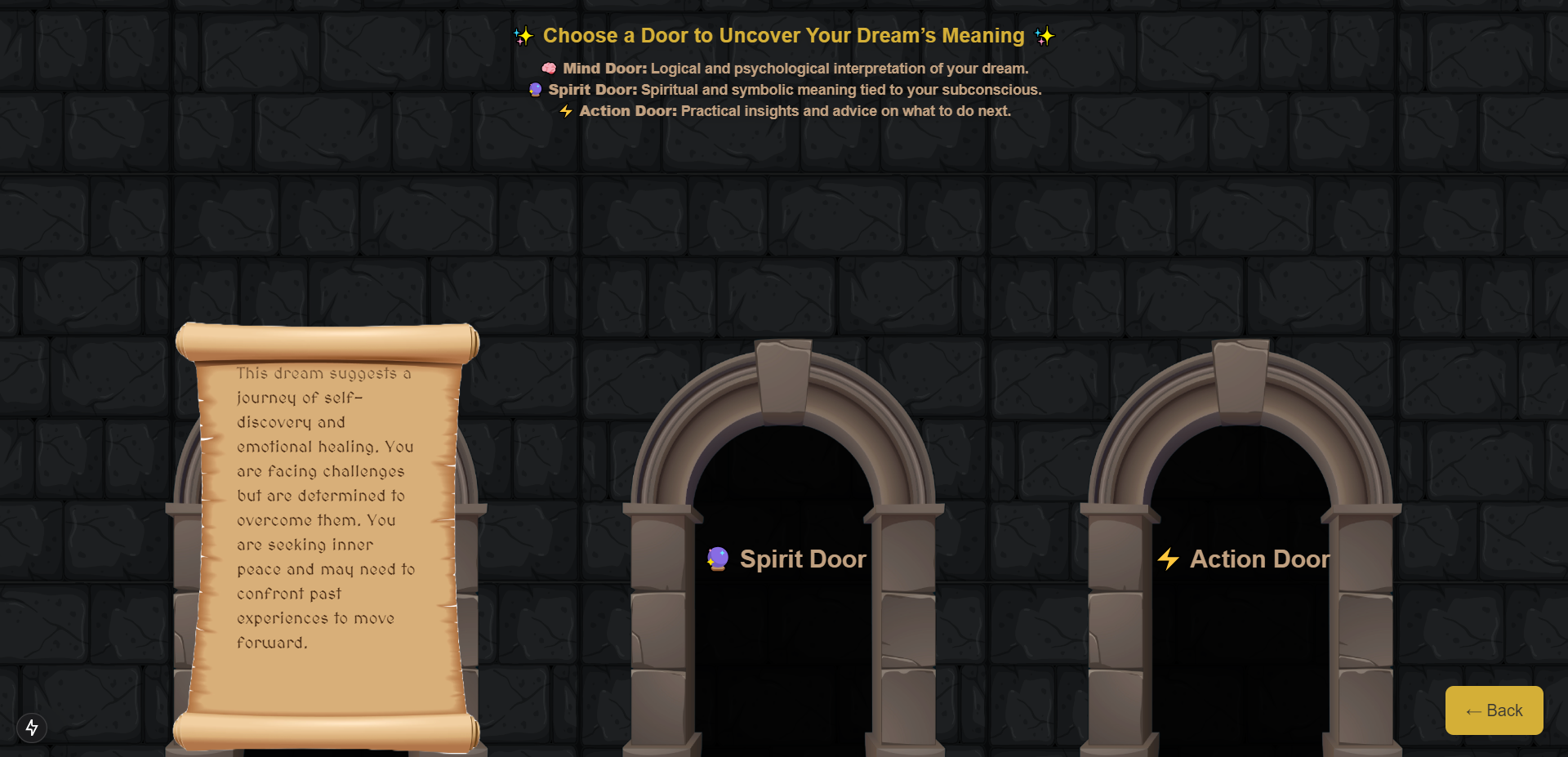
- Mind Door 🧠 – A psychological and emotional analysis of the dream.
- Spirit Door 🔮 – A symbolic or spiritual interpretation.
- Action Door ⚡ – A practical step or task related to the dream.
The interpretations are generated using Natural Language Processing (NLP) and AI to provide meaningful and personalized insights.
How We Built It
DreamScape was developed using a full-stack approach:
- Frontend: Next.js, Tailwind CSS, and React for an interactive UI.
- Backend: Express.js to handle API requests and pass dream inputs to a Python NLP script.
- NLP Processing:
- Tokenization and filtering using NLTK to extract meaningful words from the dream.
- Removal of stopwords, punctuation, and common filler words to improve analysis.
- Tokenization and filtering using NLTK to extract meaningful words from the dream.
- AI Interpretation:
- The processed dream is sent to Google Gemini AI ** to generate interpretations for **mind, spirit, and action.
- AI prompts are structured to generate concise and meaningful responses based on the dream’s content.
- The processed dream is sent to Google Gemini AI ** to generate interpretations for **mind, spirit, and action.
Challenges We Ran Into
One of the biggest challenges was ensuring the AI-generated interpretations were relevant and concise. Since dream analysis is highly subjective, crafting effective NLP pre-processing was crucial to improve AI responses.
Integrating Google Gemini AI with the Python NLP script also required fine-tuning prompts to keep interpretations within a structured 50-word limit while maintaining coherence.
Another challenge was real-time Speech-to-Text transcription, ensuring users could narrate dreams with high accuracy.
Accomplishments That We're Proud Of
- Successfully integrating AI-powered dream interpretation using NLP and Google Gemini AI.
- Creating a scroll-based medieval UI for an immersive and thematic experience.
- Implementing speech recognition to allow users to narrate their dreams instead of typing.
- Fine-tuning AI-generated responses to stay concise and meaningful.
What We Learned
This project deepened our understanding of:
- NLP techniques for extracting meaningful words from unstructured text.
- AI model integration, specifically how to optimize prompts for Gemini AI.
- State management and UI design for a seamless user experience.
- Handling user input across multiple modalities (text vs. speech).
What's Next for DreamScape
To further enhance DreamScape, we plan to:
- Improve AI models by incorporating deep learning-based NLP techniques for more accurate dream interpretations.
- Introduce a dream journal feature so users can save and track past dream analyses.
- Enable community-driven dream sharing, allowing users to compare interpretations with others.
- Expand AI-generated insights, possibly integrating Jungian or Freudian analysis models.
DreamScape is just the beginning of a larger vision to help people unlock the deeper meanings of their dreams. 🚀✨


Log in or sign up for Devpost to join the conversation.