-
-
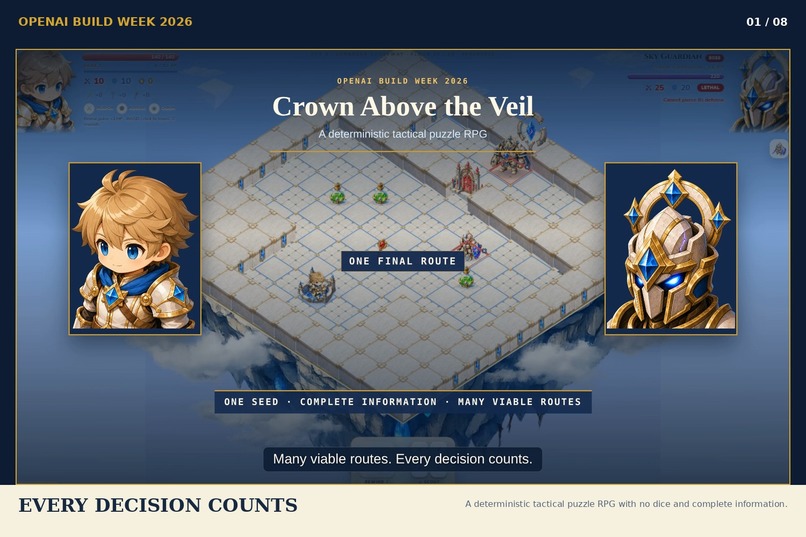
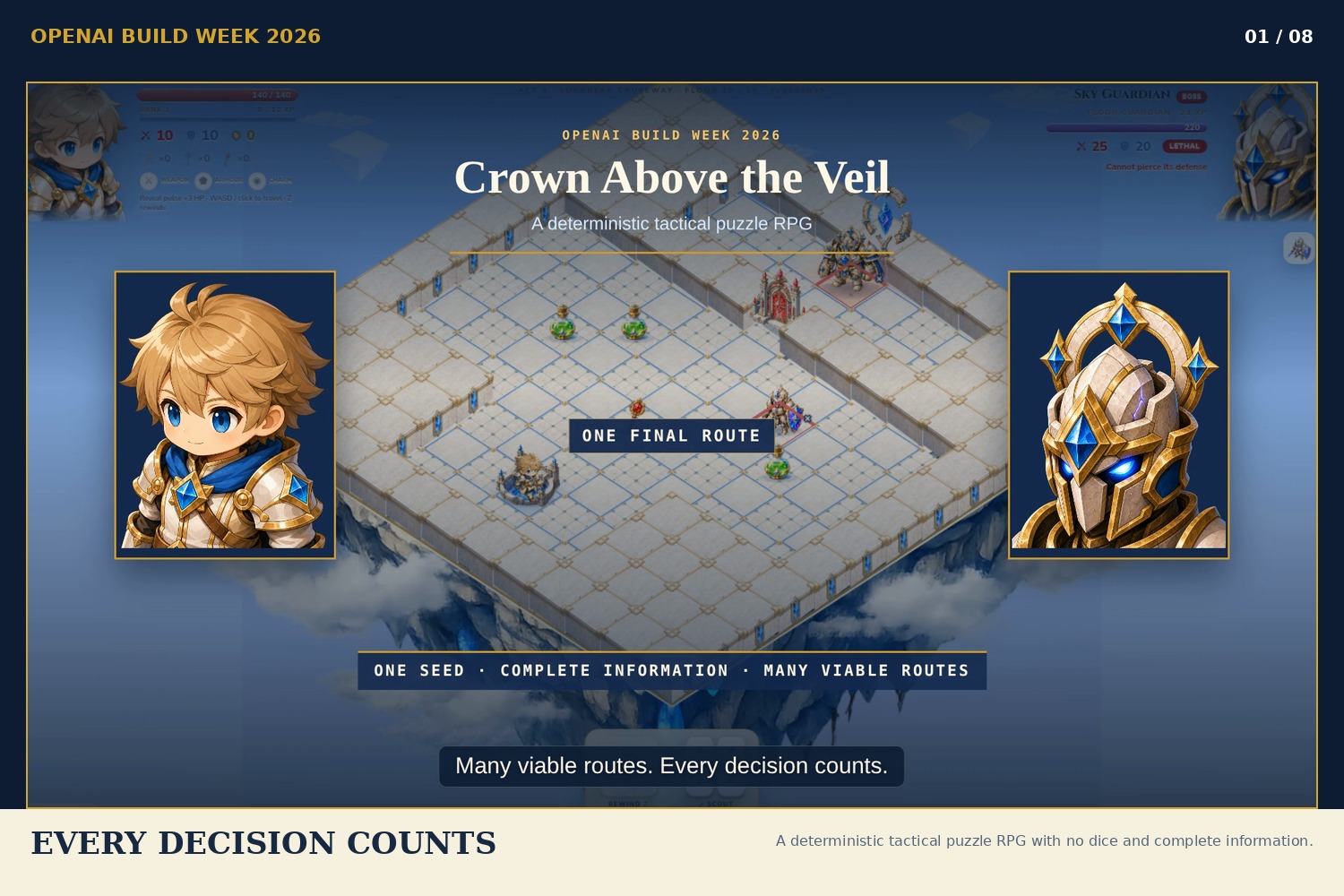
Crown Above the Veil is a deterministic tactical puzzle RPG where every decision has an exact cost.
-
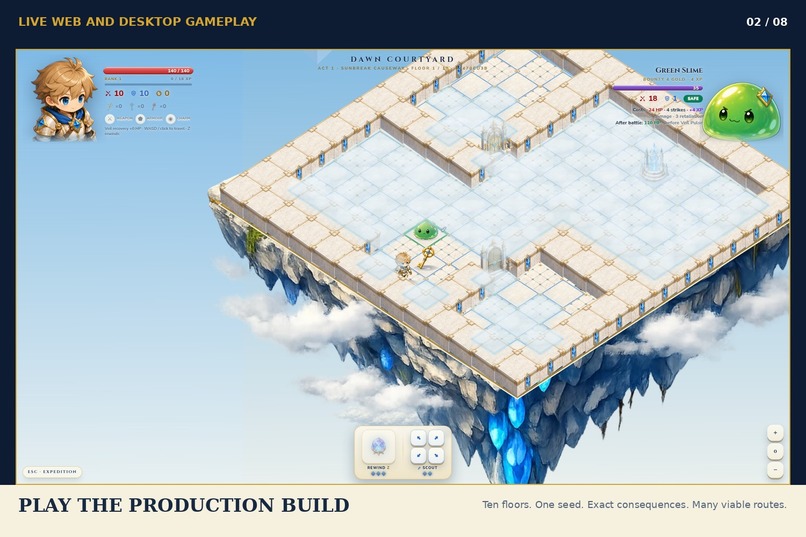
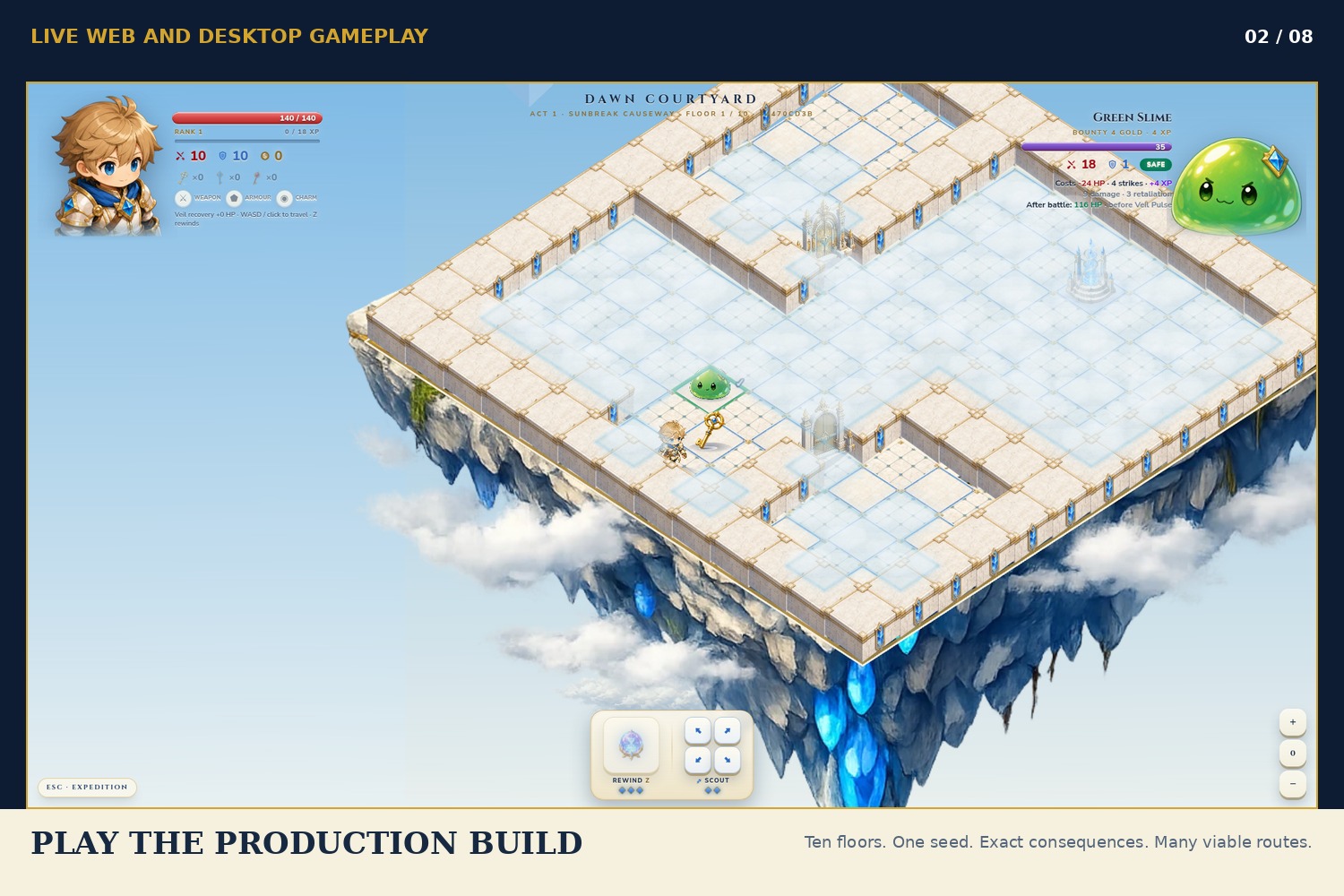
The production Web and Desktop build presents the same seeded ten-floor expedition, deterministic rules, saves, and assets.
-
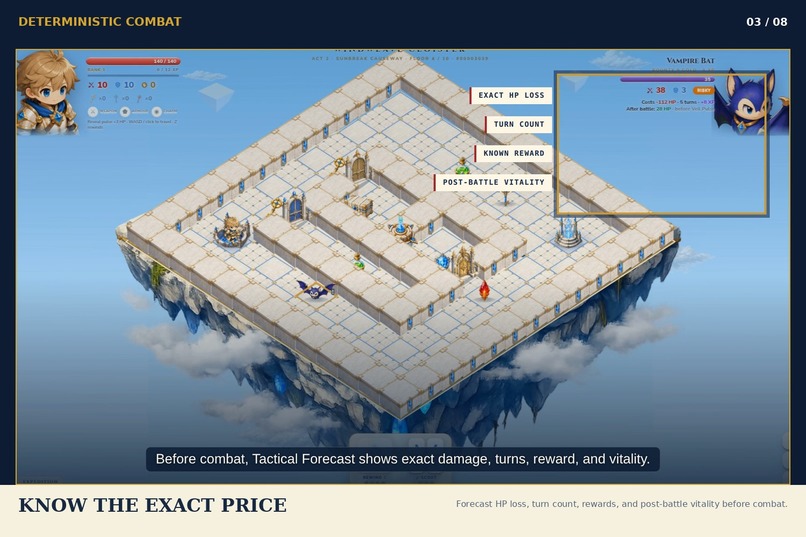
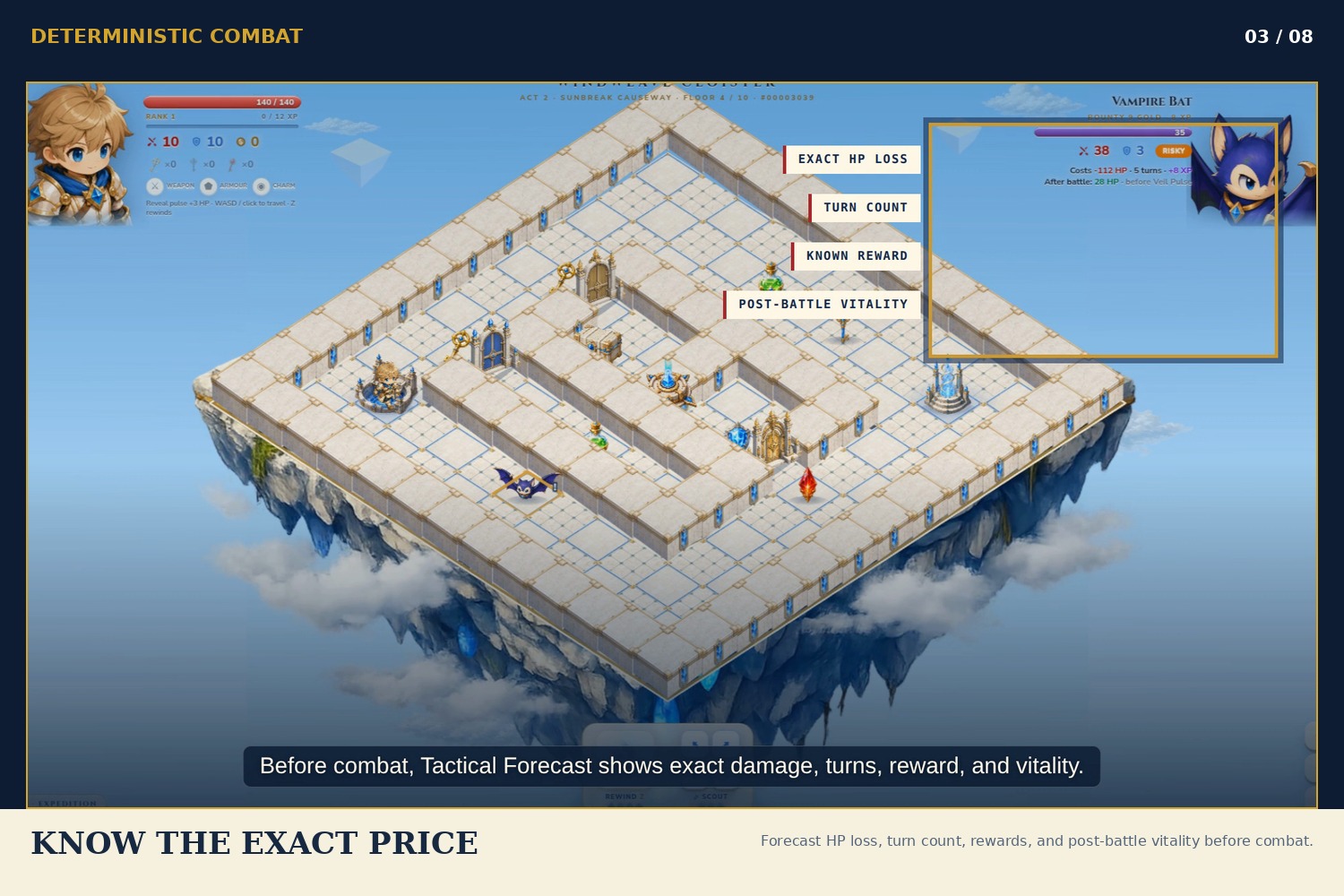
Before combat, Tactical Forecast shows exact HP loss, turn count, rewards, and post-battle vitality.
-

At Rank 3, players commit to Dawnblade, Aegis Warden, or Veilbinder—three distinct, solver-proven route identities.
-
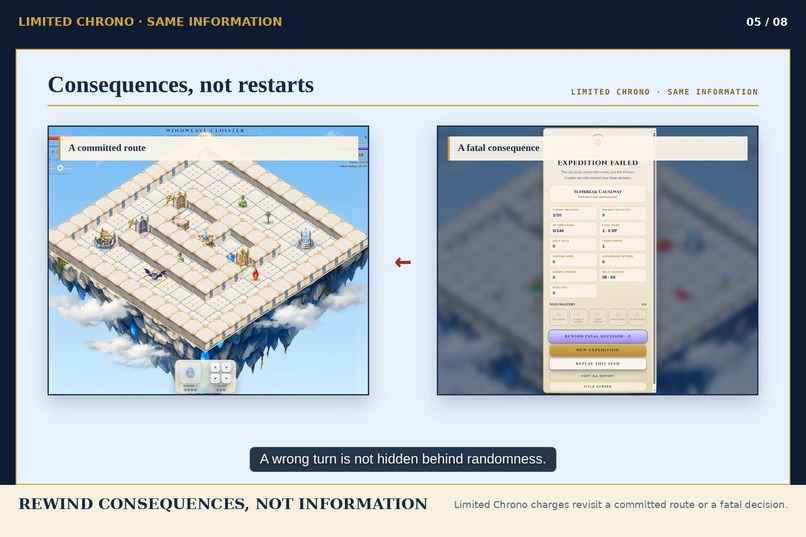
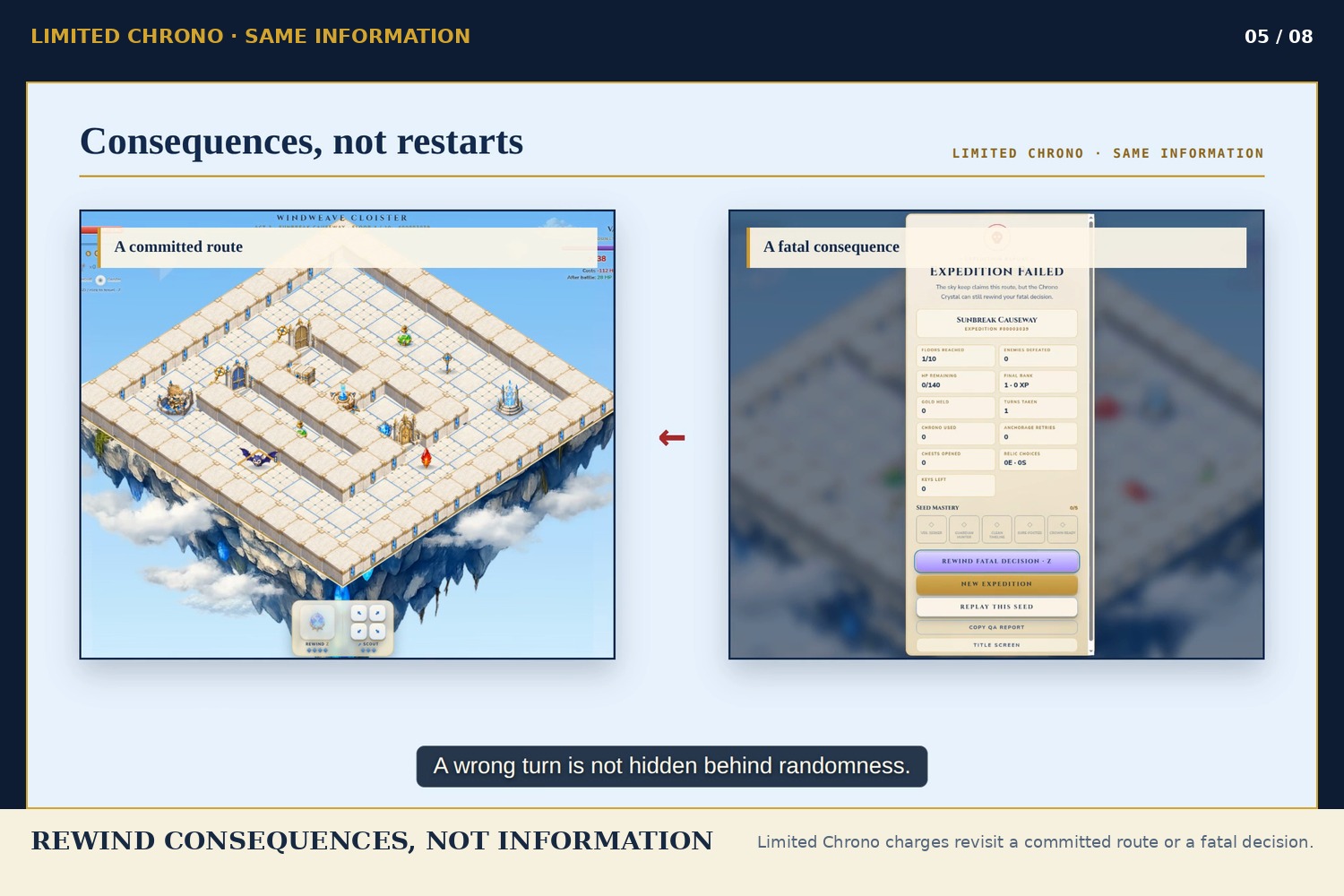
Limited Chrono charges let players revisit a committed route or rewind a fatal decision without hiding new information behind randomness.
-
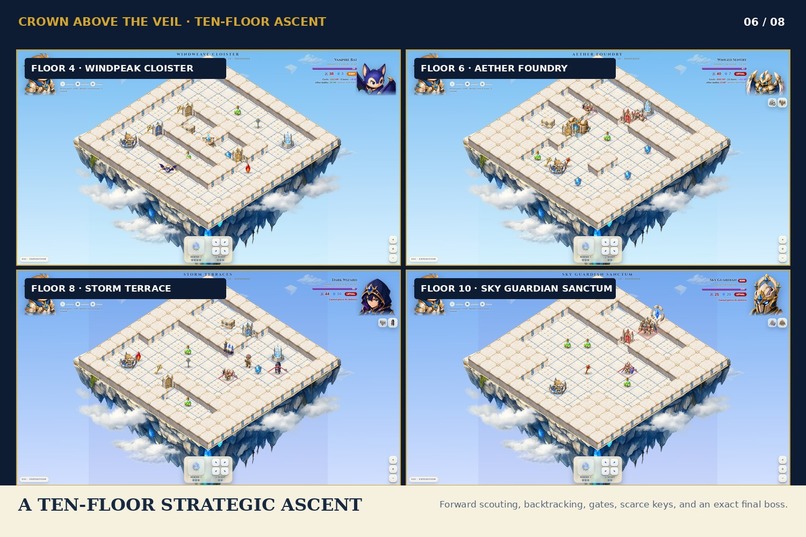
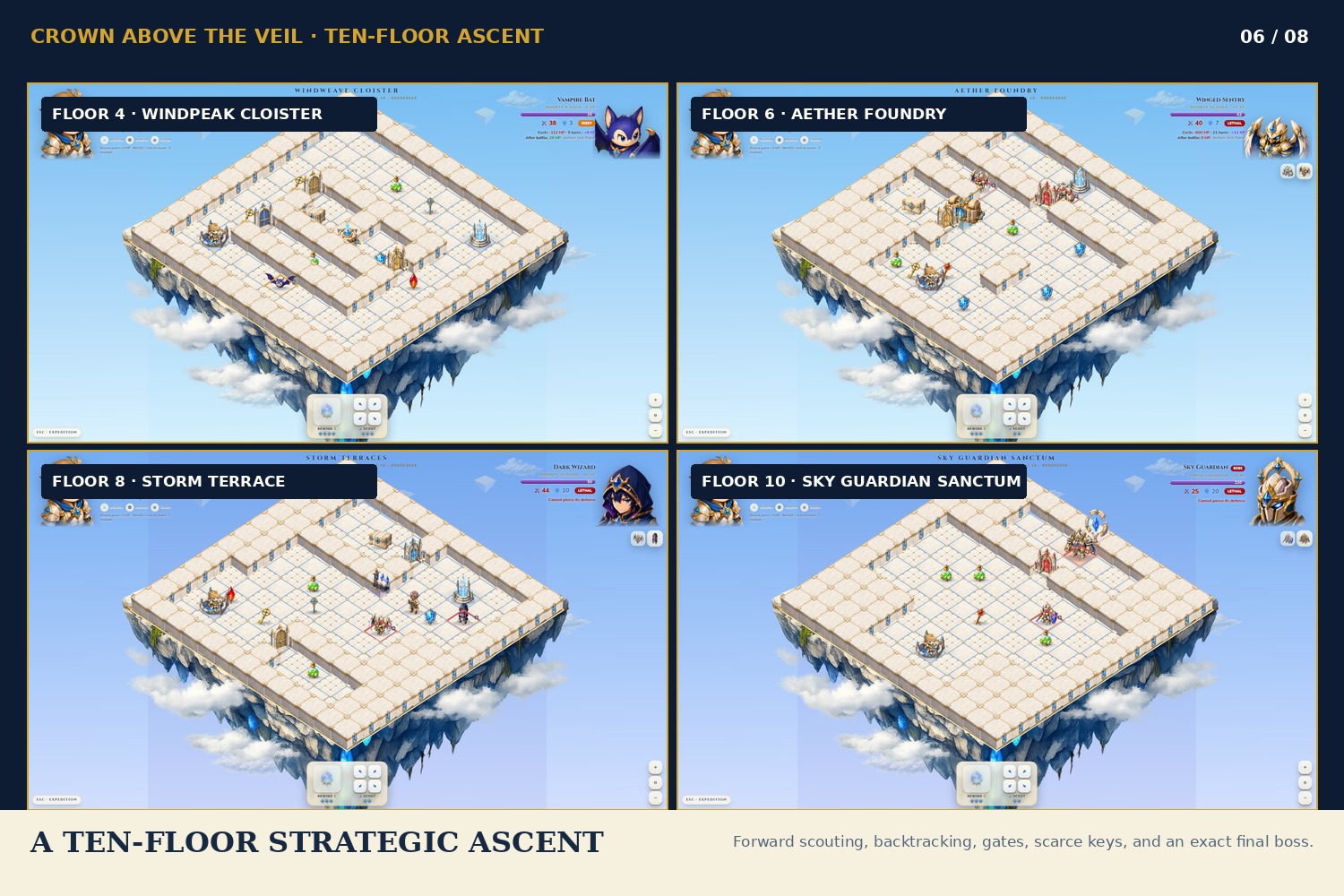
Ten floors create a compact strategic arc built around forward scouting, deliberate backtracking, scarce keys, and an exact final boss.
-
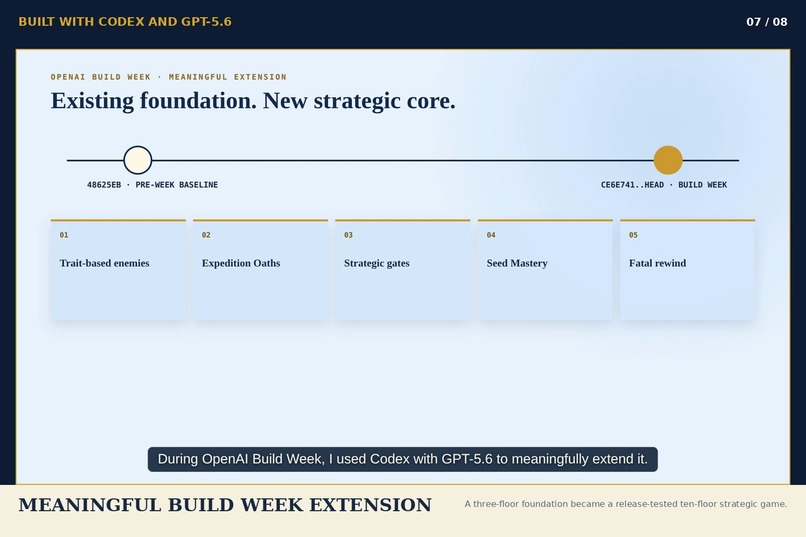
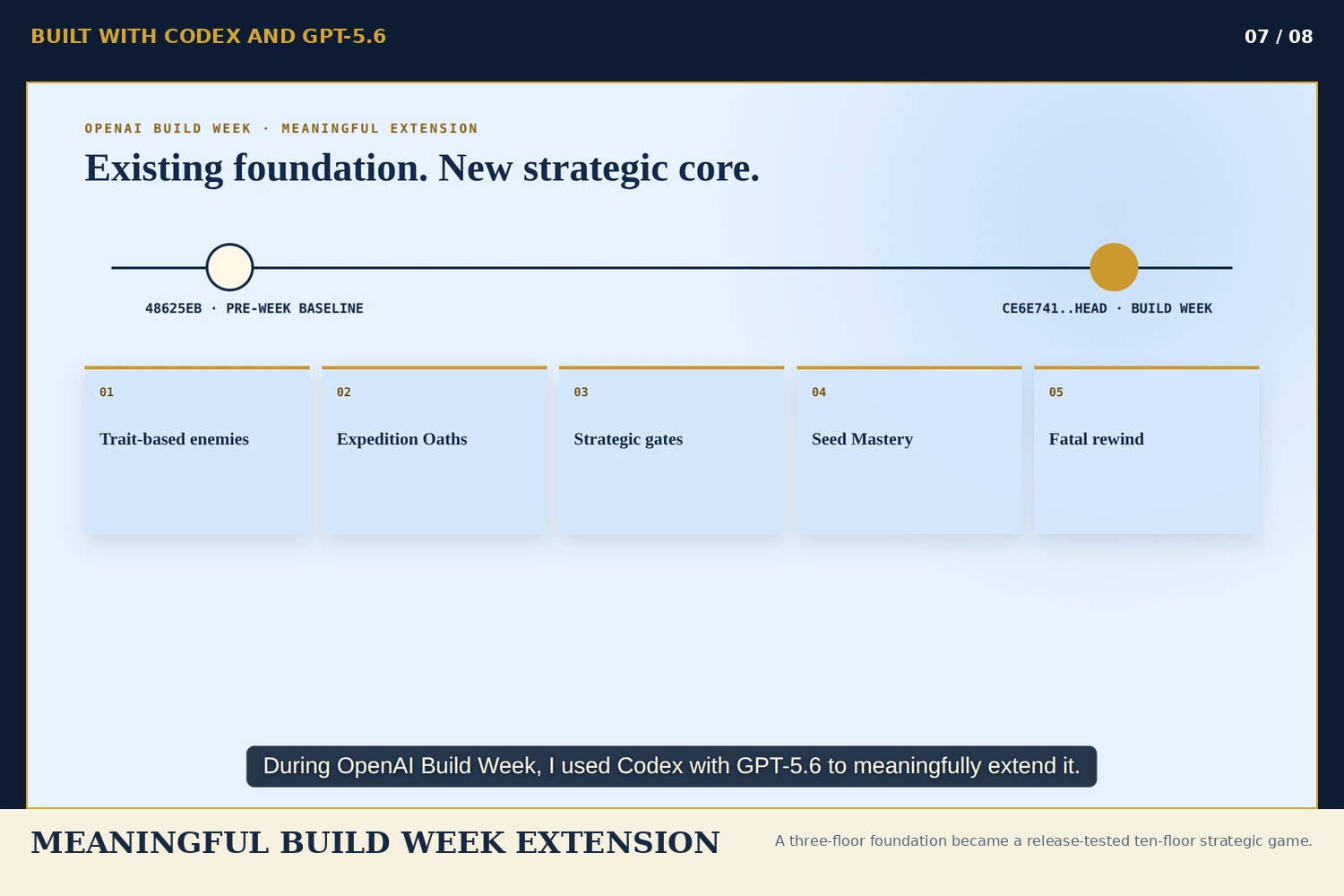
During OpenAI Build Week, Codex with GPT-5.6 helped extend a three-floor foundation into a release-tested ten-floor strategic game.
-
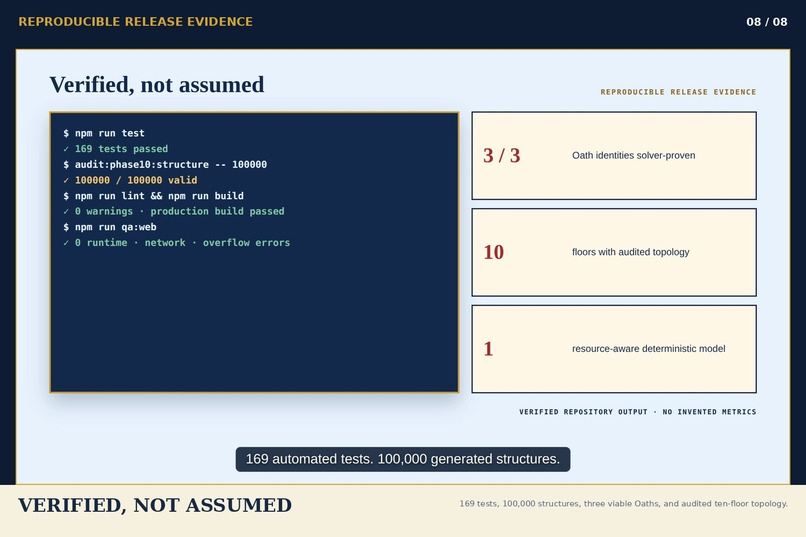
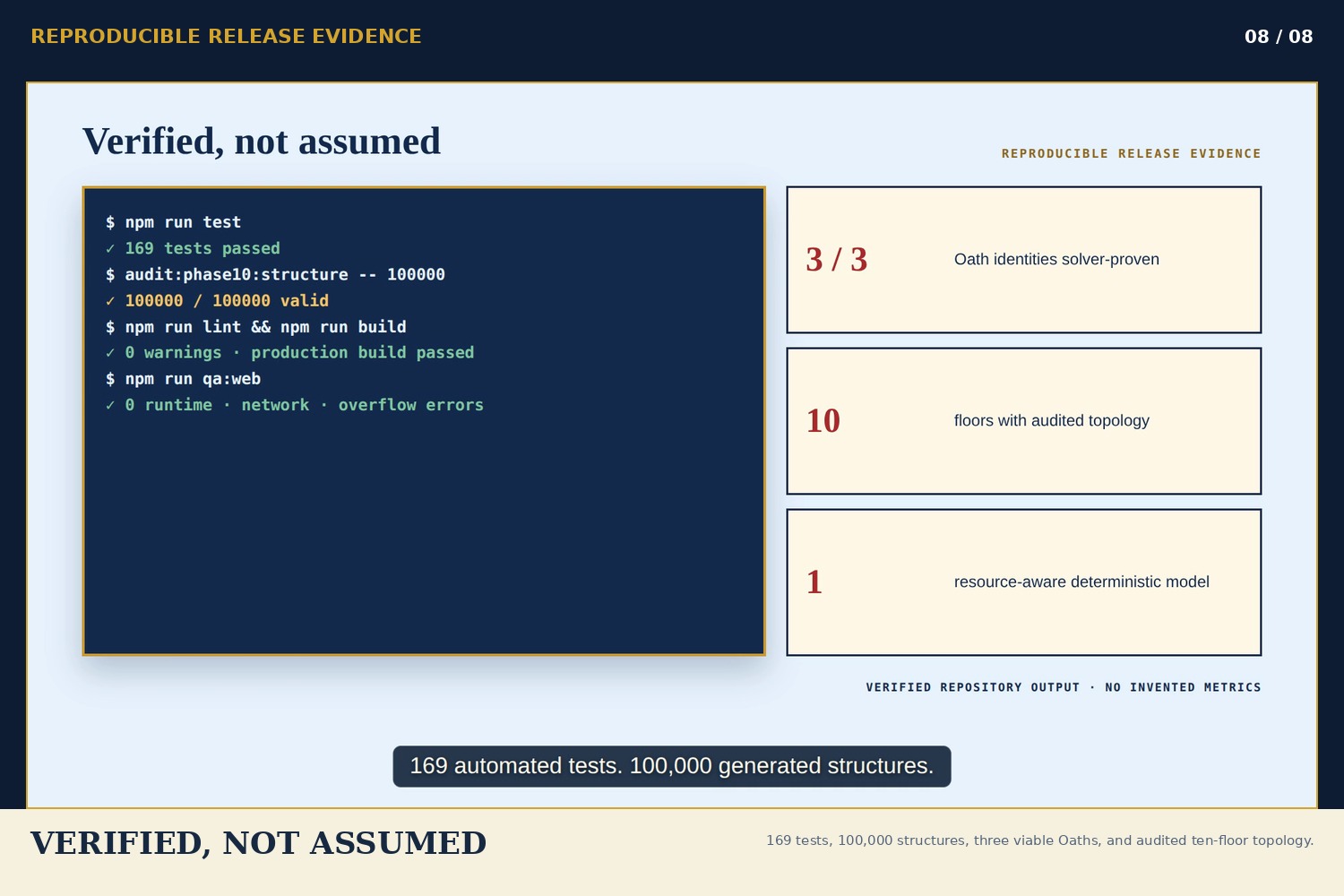
Release evidence includes 169 automated tests, 100,000 generated structures, three solver-proven Oaths, and audited topology.

Inspiration
I kept coming back to one question: what if an RPG never hid the consequences of a decision from the player?
Many RPGs use random rolls, critical hits, or lucky drops to create excitement. I wanted to explore a different kind of tension—one where every enemy has an exact cost, every key opens one specific opportunity, and a poor route cannot be rescued by luck.
That idea grew into Crown Above the Veil, a tactical puzzle RPG set inside a floating castle. The cloud-covered tower gave me a way to combine incomplete information with deterministic rules: players cannot see everything immediately, but once something is revealed, the game explains exactly what it will do.
The project entered OpenAI Build Week as a playable three-floor prototype. Its original foundation was developed with assistance from Claude. During Build Week, I used OpenAI Codex with GPT-5.6 to turn that foundation into a much deeper ten-floor strategy game with stronger progression, build choices, backtracking, automated solvability checks, and release-focused QA.
What it does
Crown Above the Veil is a ten-floor deterministic tactical puzzle RPG for Web and Desktop.
Players climb a semi-procedural floating tower, collect keys and equipment, manage HP and Gold, reveal areas hidden by the Cloud Veil, and prepare for the Sky Guardian at the summit.
Combat contains no hidden randomness. Before entering a fight, the Tactical Forecast shows the enemy’s traits, every expected hit, the exact HP cost, the XP reward, and the resulting Rank progression. Enemies can use disclosed abilities such as First Strike, Multi-Strike, Armour, and Arcane defence penetration, so the challenge comes from understanding the numbers and choosing the right route.
At Rank 3, players choose one of three Expedition Oaths:
- Dawnblade focuses on offensive breakpoints.
- Aegis Warden reduces incoming pressure.
- Veilbinder supports Armour penetration, Arcane resistance, and exploration.
Each Oath grows stronger at later Rank milestones and leads to a different viable strategy.
The Chrono Crystal gives each expedition three rewinds. It can undo a committed choice or recover from a fatal decision, but its limited charges prevent the player from brute-forcing the whole tower. Seeded expeditions make it possible to replay the same layout, compare routes, and complete optional Seed Mastery goals.
The result is a game where every move has a price—but players are always given enough information to understand that price.
How we built it
DreamsAfterHours is my independent game-development label, so this was primarily a solo project supported by AI development tools.
The game is built with:
- React 19 and TypeScript in strict mode
- PixiJS for the tactical board
- Tailwind CSS v4 for the interface
- Vite for the Web build
- Electron for Windows and Linux packages
- Vitest and Oxlint for automated verification
The Web and Desktop versions share the same deterministic game engine, content, save format, seeds, and production assets. Game transitions run through a pure reducer, while combat, encounters, progression, persistence, rewind snapshots, and the solver use shared authoritative data.
During Build Week, I worked with Codex and GPT-5.6 to expand the game from three floors to ten and to implement the new strategic systems. Codex assisted with reducer changes, combat traits, Expedition Oaths, Chrono rewind behaviour, solver coverage, regression tests, debugging, documentation, and release QA.
I remained responsible for the game rules, product direction, balance targets, visual approvals, acceptance criteria, and final review.
Codex is part of the development process, not a runtime dependency. The finished game does not require an AI API call to play.
Challenges we ran into
The biggest challenge was making the game deeper without simply making it longer. Adding seven more floors would have meant very little if every floor could still be cleared by walking forward and collecting everything.
To prevent that, I introduced fixed progression thresholds, scarce-resource decisions, and two intentional forward-scout-and-backtrack loops. The player may discover something useful on a higher floor, return to unlock an earlier opportunity, and then use that reward to pass the next major guardian.
Another difficult problem was automated solvability. The solver had to understand much more than combat. It needed to model keys, doors, shops, equipment, chests, Oaths, Rank milestones, status effects, downward floor transitions, and limited resources without accidentally approving a route that the production game could not perform.
Rewind also required careful state management. A rewind must restore the complete decision state—not just the player’s position—while consuming the correct Chrono charge and remaining safe across autosaves.
Finally, visual clarity was a constant balancing act. The board needed to feel like a premium 2.5D fantasy environment while keeping exact tactical information readable at a glance. Decorative polish could never be allowed to obscure enemies, gates, resources, or danger states.
Accomplishments that we're proud of
I am especially proud that the final ten-floor game is not just playable—it is backed by repeatable evidence.
The release candidate currently passes:
- 169 automated tests
- 100,000 generated structure seeds
- 10,000 full-resource solver seeds
- Topology and door audits across all ten floors
- Web production smoke tests
- Desktop packaging and runtime checks
- Deterministic seed replay and save compatibility checks
The solver verifies that all three Expedition Oaths have viable routes on the fixed mastery seed. It also proves that a simple “click everything floor by floor” strategy fails at a lethal frontier, while a strategic route using equipment, shops, chests, an Oath, and deliberate backtracking can defeat the Sky Guardian.
I am also proud of the transparency around the Build Week work. The repository documents the pre-existing prototype baseline separately from the Codex-assisted extension, with dated commit history and reproducible QA commands.
Most importantly, the final game expresses the original idea clearly: no dice, no guesswork, but still plenty of uncertainty, pressure, and meaningful choice.
What we learned
I learned that deterministic design is not necessarily simpler than random design. Removing randomness means every number, route, reward, and recovery opportunity must withstand much closer scrutiny. If a strategy is dominant or a route is impossible, the player cannot blame bad luck—the rules have to own the result.
I also learned that AI coding tools are most useful when they are given strong engineering constraints. Codex performed best when I paired each feature with explicit invariants, regression tests, failure cases, and acceptance gates rather than asking it to generate large features without verification.
The solver became more than a testing tool. It helped expose weak resource loops, accidental autopilot strategies, false build diversity, and cases where the documented rules did not match production behaviour.
On the visual side, I learned that polish must serve comprehension. Animation, lighting, generated assets, and UI styling only improve a strategy game when they make state changes easier—not harder—to read.
What's next for DreamsAfterHours
The next step is broader human playtesting. Automated solvers can prove that a route exists, but they cannot fully answer whether a clue feels fair, whether a backtracking opportunity is memorable, or whether a first-time player understands why a decision failed.
Future work will focus on:
- Blind-run playtesting and balance refinement
- Improved onboarding and accessibility
- Expanded sound design and music
- More enemy and equipment interactions
- Additional deterministic seeds and mastery challenges
- Better touch controls for tablet play
- Continued Web and Desktop parity
- A carefully scoped expansion beyond the current ten-floor campaign
The long-term goal for DreamsAfterHours is to create compact games with strong atmosphere, transparent rules, and decisions that remain interesting after the player understands the system—not because the game hides the answer, but because knowing the answer still leaves a difficult choice.

Log in or sign up for Devpost to join the conversation.