Inspiration
Dreams have fascinated humans for centuries. From ancient civilizations to modern psychology, people have tried to understand the hidden meanings behind dreams. However, most people today either forget their dreams or rely on generic dream dictionaries that provide very shallow explanations.
We were inspired to build DreamMind AI – an AI Dream Interpreter Agent that can analyze dreams using artificial intelligence, emotional context, and psychological symbolism. Instead of giving static definitions, the system uses AI reasoning to interpret dreams dynamically and connect them with the user's emotions and real-life context.
Our goal was to create an intelligent agent that helps users explore their subconscious mind, understand recurring dream patterns, and gain meaningful psychological insights.
What it does
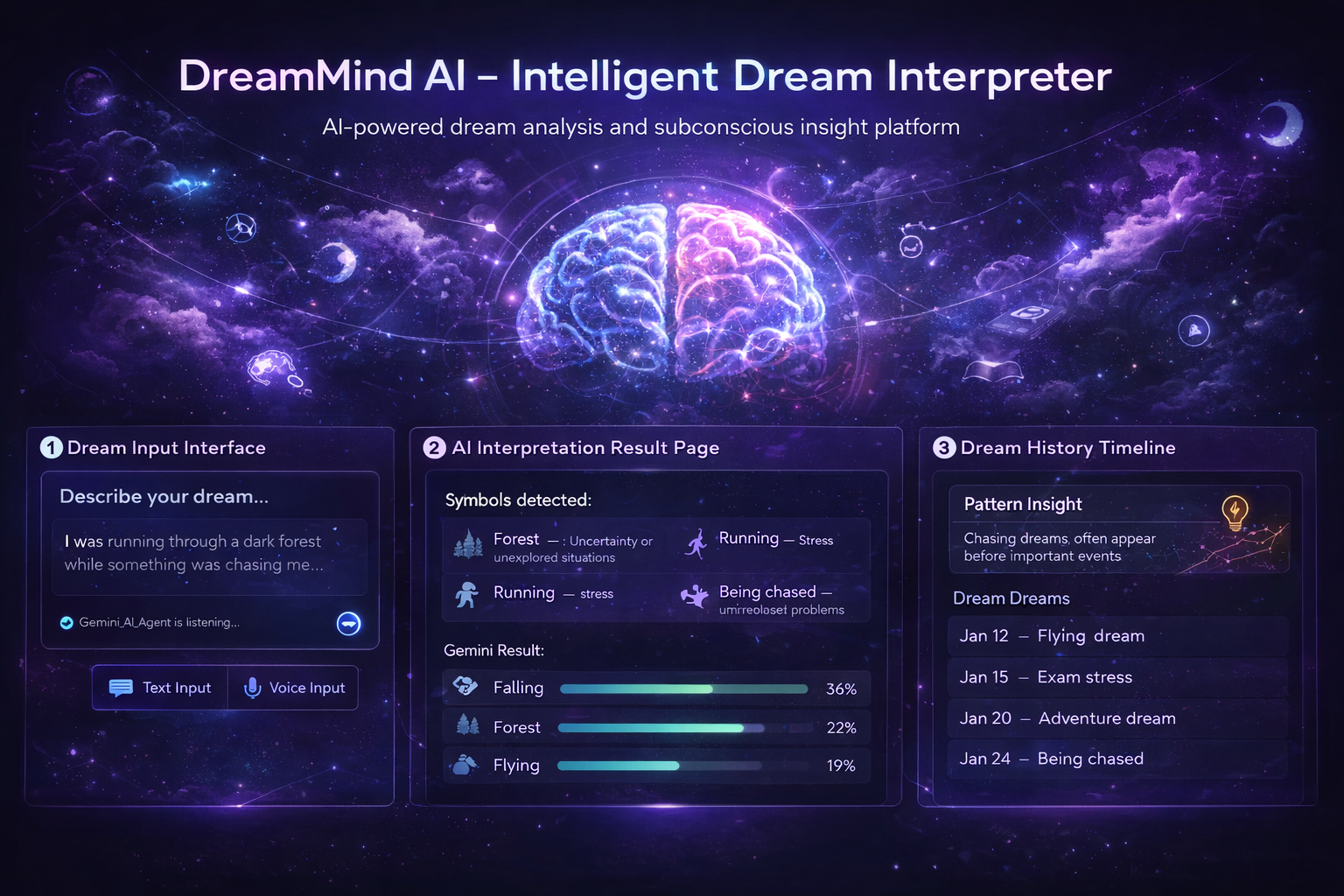
DreamMind AI is an AI-powered dream analysis agent that allows users to record their dreams and receive intelligent interpretations.
The system performs several layers of analysis:
Dream Text Analysis
- The AI extracts key symbols from the dream narrative.
Emotion Detection
- It identifies emotions such as fear, anxiety, excitement, or curiosity.
Symbol Interpretation
- The system analyzes common dream symbols (falling, flying, being chased, etc.) and maps them to psychological meanings.
Personal Context Linking
- The AI relates dream symbols with possible real-life situations or emotional states.
Pattern Recognition
- Over time, the system identifies recurring dream themes and emotional trends.
This allows the agent to generate personalized interpretations instead of generic explanations.
How we built it
The project uses a combination of modern AI technologies and web development tools:
AI Language Models for dream interpretation and reasoning Natural Language Processing (NLP) to analyze dream descriptions Emotion Detection Algorithms to detect psychological signals Vector Databases to store and analyze dream history Interactive Web Dashboard for recording and visualizing dreams
The system processes dream narratives in real time and generates interpretations instantly.
Challenges we ran into
Building a dream interpretation system presented several challenges:
Ambiguity in Dream Narratives
Dream descriptions can vary widely in language and detail, making consistent interpretation difficult.Symbol Context Variability
The same dream symbol can mean different things depending on emotional context.Balancing Creativity and Accuracy
Dream interpretation requires a balance between psychological reasoning and meaningful storytelling.
To address these challenges, we designed the AI agent to combine symbolic analysis, emotional context detection, and pattern recognition.
Accomplishments that we're proud of
One of our biggest accomplishments was successfully designing an AI agent that explores a highly creative and unconventional domain — dream interpretation. Instead of building a traditional chatbot or productivity tool, we developed a system that attempts to understand and analyze human subconscious experiences through artificial intelligence.
We are particularly proud of the following achievements:
1. Building a Context-Aware Dream Analysis System
We developed an AI pipeline capable of extracting dream symbols, detecting emotional signals, and generating meaningful interpretations. The system goes beyond simple keyword matching and attempts to understand the narrative structure of dreams.
2. Transforming Abstract Dream Narratives into Structured Insights
Dreams are often vague and symbolic. We designed a framework that converts unstructured dream descriptions into structured elements such as symbols, emotional states, and contextual interpretations.
3. Creating a Human-Centered AI Experience
Our goal was to make AI feel reflective and insightful rather than purely technical. The interpretations generated by the system aim to help users explore their thoughts, emotions, and subconscious patterns in a thoughtful way.
4. Designing a Scalable Dream Analysis Framework
The architecture supports dream journaling, historical analysis, and pattern recognition. This allows the system to evolve from a simple interpreter into a long-term personal dream analysis platform.
5. Combining Creativity with AI Technology
Most AI projects focus on automation or productivity. We are proud that this project demonstrates how AI can also be applied in creative and psychological contexts, encouraging users to reflect on their inner experiences.
Overall, this project represents a meaningful step toward exploring how artificial intelligence can assist in understanding complex human experiences such as dreams, emotions, and subconscious thought patterns.
What we learned
Through this project we learned how AI can be applied beyond traditional productivity tools and used to explore human psychology and subconscious patterns.
We also learned how to design AI systems that generate interpretable and human-centered insights rather than just factual responses.
What's next for DreamMind AI – Intelligent Dream Interpreter
While the current version of DreamMind AI demonstrates the core capability of interpreting dreams using artificial intelligence, our vision is to expand the platform into a comprehensive AI-powered dream analysis and mental insight system.
1. Advanced Dream Pattern Analytics
We plan to introduce long-term dream tracking and analytics that can detect recurring dream themes, emotional patterns, and subconscious signals over time. This will help users better understand psychological trends in their dreams.
2. Personalized Dream Intelligence
Future versions will adapt interpretations based on individual user history, lifestyle patterns, and emotional context, allowing the AI to generate more personalized and meaningful insights.
3. Visual Dream Insights Dashboard
We aim to build an interactive dashboard where users can explore dream timelines, emotional graphs, and recurring symbols. This will transform raw dream entries into intuitive visual insights.
4. Mobile Dream Journal Integration
To make the experience more accessible, we plan to develop a mobile-friendly version that allows users to record dreams immediately after waking up using voice or text input.
5. Mental Wellness and Reflection Tools
DreamMind AI has the potential to support emotional reflection and self-awareness. Future iterations may include guided reflection prompts, mindfulness suggestions, and connections between dream patterns and mental well-being.
6. Multimodal Dream Analysis
We also plan to explore multimodal inputs such as voice recordings, sketches, and images to capture dreams in richer ways and improve interpretation accuracy.
7. Continuous AI Learning
By leveraging user feedback and improved AI models, the system will continue learning and refining its interpretations, making the dream analysis more contextual and insightful over time.
Our long-term vision is to evolve DreamMind AI into a trusted AI companion that helps individuals explore their subconscious mind, understand emotional signals, and gain deeper self-awareness through their dreams.


Log in or sign up for Devpost to join the conversation.