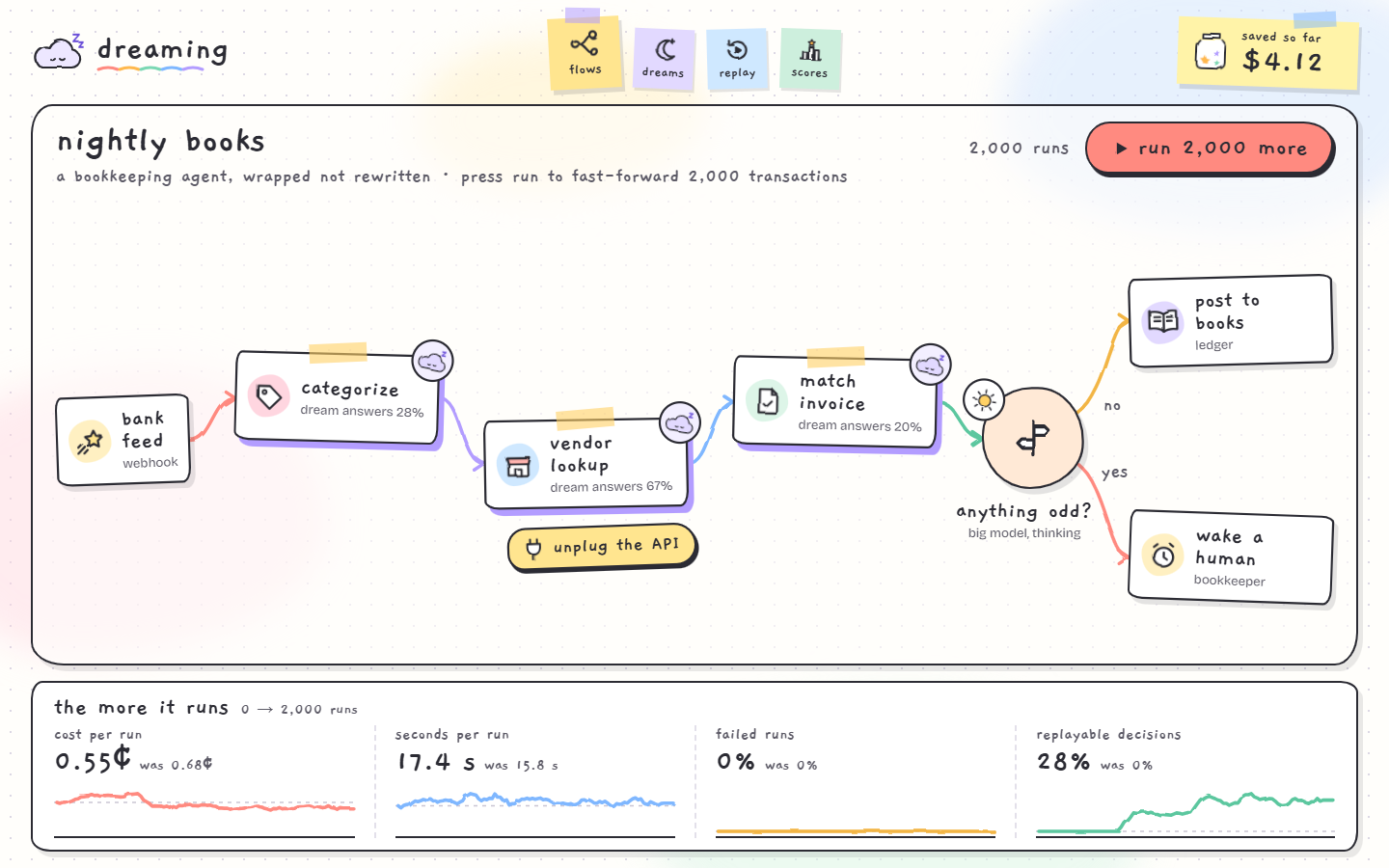
Run your AI workflows for 87% less, 4× faster, with almost no training and a full audit trail.
| 87% | 4× | 50 | ≤ 5% |
|---|---|---|---|
| cheaper per call | faster per call | examples to match the big model | certified error |
In plain words: your agent calls a big, expensive model on every step. Dreaming teaches a small, cheap model to take over the steps it can handle, proves how often it's right, and only calls the big model when it isn't sure.
💡 Why we built it
Making a small model stand in for a big one is easy to say and hard to do well:
- 💸 It costs too much to keep up. Nobody wants to retrain and host a whole model every time they edit one prompt.
- 🏷️ There's no labelled data. Most workflows have none, and a small model that matches a big one on everything would need just as many weights.
- 🔍 You can't audit it. Hardware differences make LLM providers return different outputs, even at temperature 0.
🌙 How it works
- 📝 Log. Every call is saved: input, output, cost, speed.
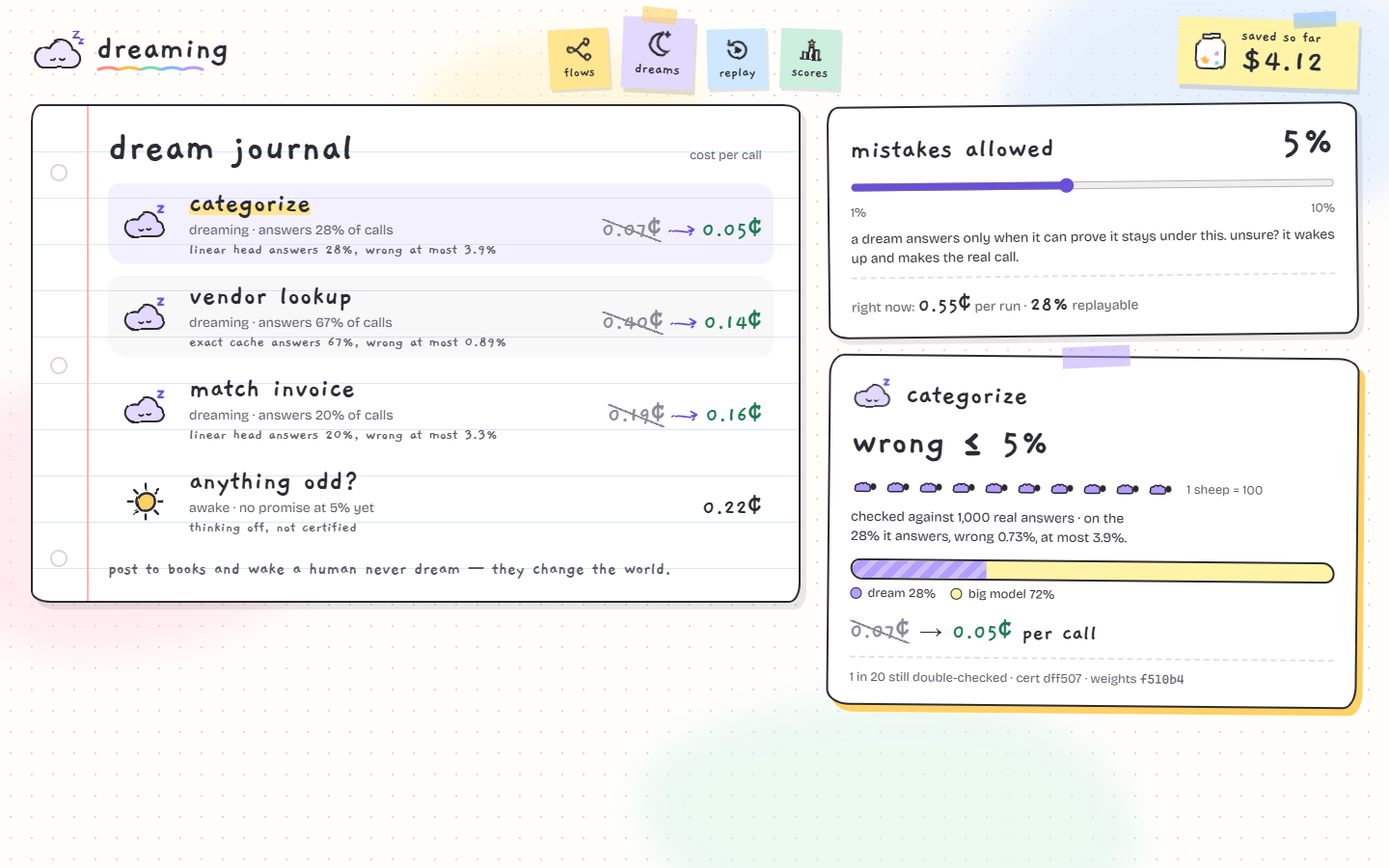
- 💭 Dream. Small stand-in models learn from the big model's own answers. Nobody has to label anything.
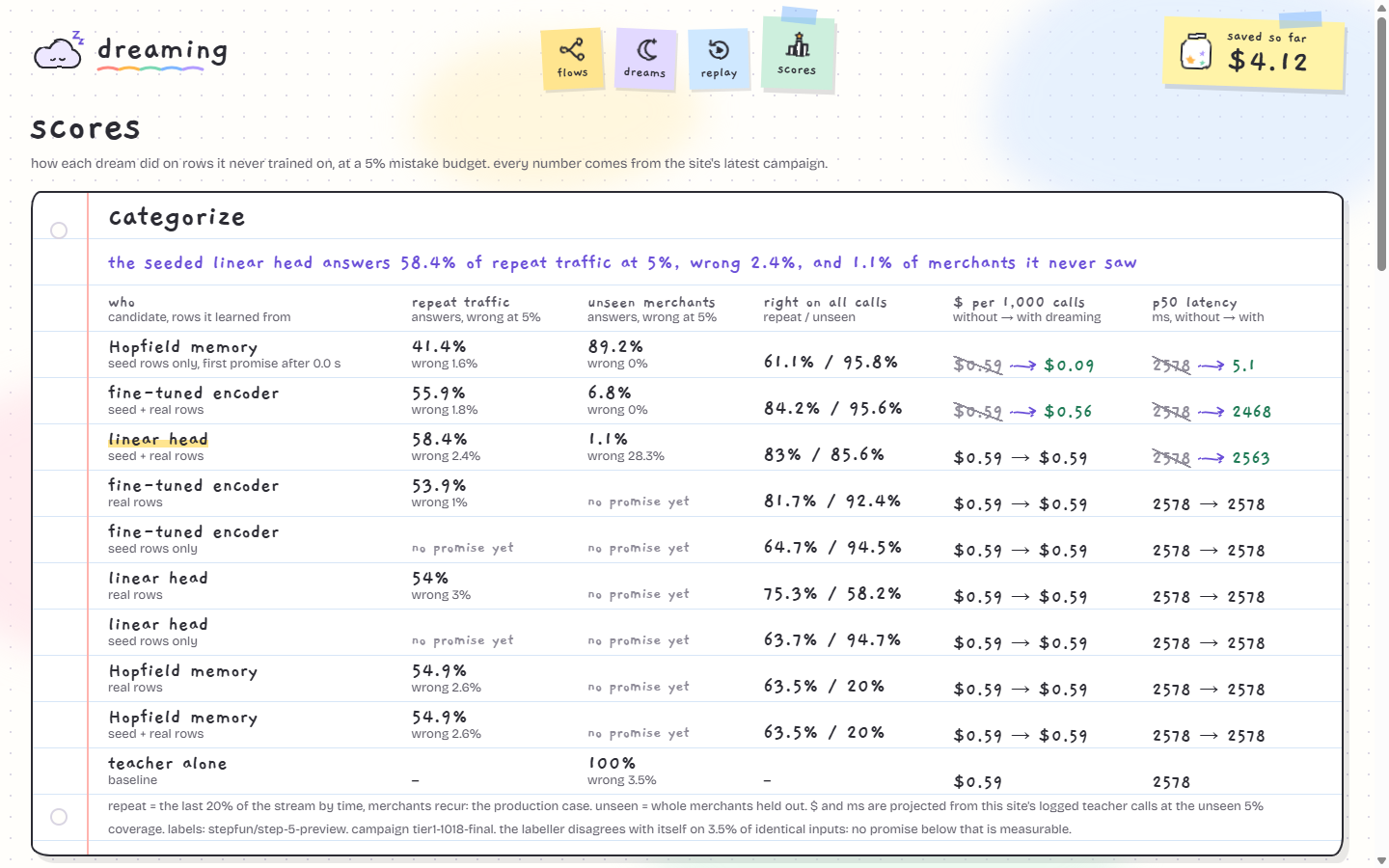
- ✅ Certify. Each stand-in is tested on calls it never saw, and earns a guarantee: wrong at most N% of the time. You pick N.
- ⚡ Serve. The best certified stand-in takes over, cheaper and faster. One answer in twenty still goes to the big model as a live audit.
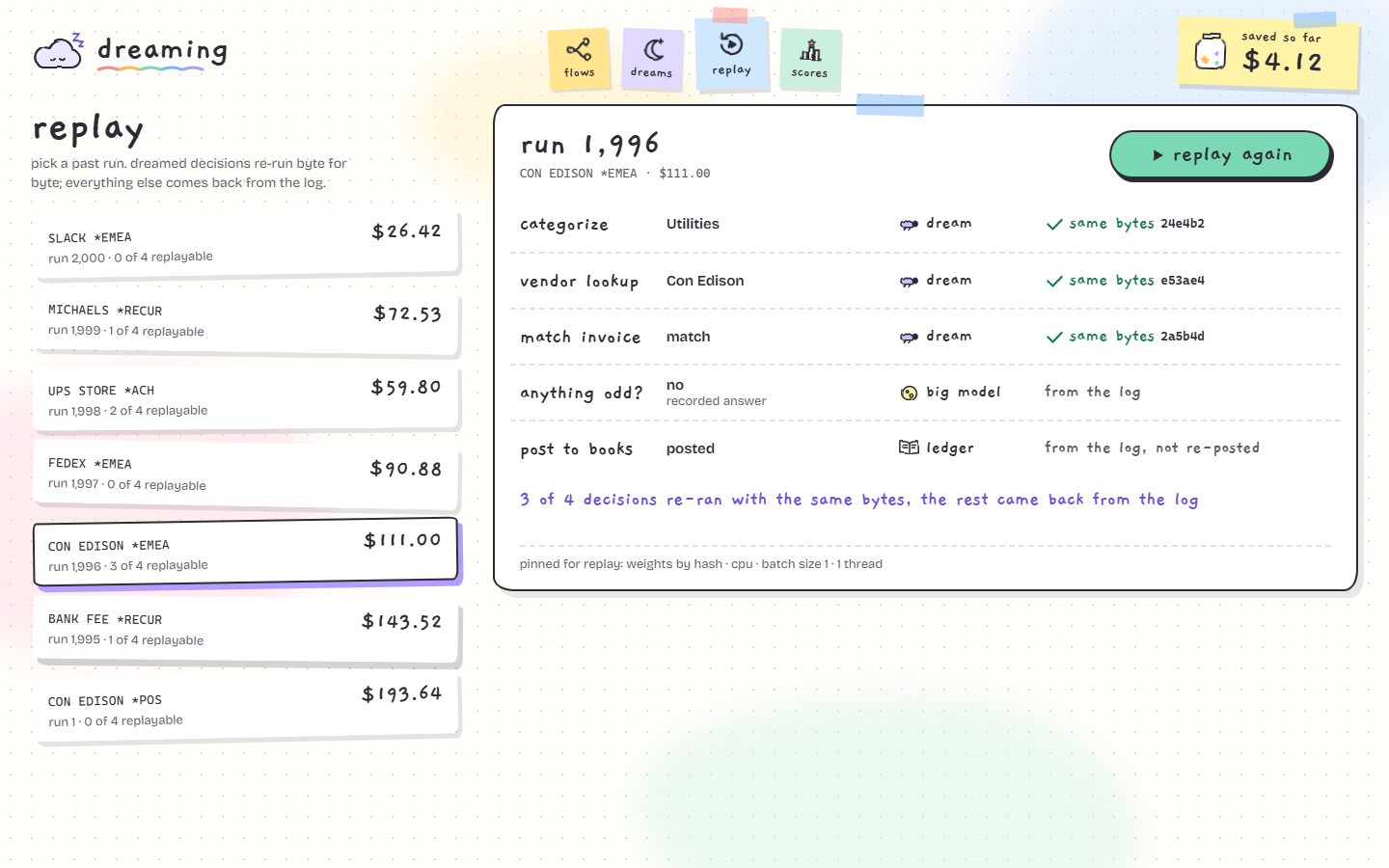
- 🔁 Replay. Every answer can be re-run byte for byte, months later.
On QuickBooks bills from companies the model had never seen, it answered 94.3% of calls at a 1.8% real error rate. Training the whole set of stand-ins cost $0.06.
🧠 Psi: the small model that needs almost no training
Psi has already learned how to learn from examples. It is a 4B-parameter Qwen3 with a small LoRA adapter, trained once on about 160 different tasks. To answer a call, it finds the 8 most similar past decisions, reads them like worked examples, and writes the answer.
- 🚫 Zero training per workflow. About 50 examples matched the big model. Learning is adding a row, and forgetting is deleting one.
- 🧾 Auditable. Every answer shows the past decisions it read, and can be replayed exactly.
- 🏠 Cheap to run. It's small enough to self-host, even on a CPU, so you control the hardware behind every answer.
- 🔤 Not stuck with a fixed list of labels. It can return a label or structured JSON.
🛠️ How we built it
- ☸️ A Kubernetes cluster that runs workflow steps in parallel (hence the name Dreaming), caches repeated environment calls, and serves Psi on its own pods.
- 🧪 A training campaign that trains many stand-ins at once, then picks the one with the most certified coverage.
- 🌐 FastAPI on Fly.io, Postgres on Supabase, training on Modal, StepFun as the big model.
- 🎨 The UI and demo video were styled with Higgsfield and Claude Design. We tried to make deep learning look as cool as possible.
🚀 What's next
More workflows beyond bookkeeping, bigger memories, and one-click self-hosting.
🙏 Thank you to LA Hacks for putting this together!
Built with: Python · FastAPI · Kubernetes · Fly.io · Modal · Supabase · Qwen3 · StepFun · QuickBooks · Fetch.ai uAgents · Sentry
Built With
- agentverse
- asi-one
- creao
- devin
- fastapi
- fetch.ai
- fly.io
- hugging-face
- javascript
- modal
- numpy
- paper
- postgresql
- pydantic
- python
- pytorch
- quickbooks
- sentence-transformers
- sentry
- stepfun
- supabase
- typesafe
- uagents
- uv
- veri.studio
