Inspiration
What it does
How we built it
Challenges we ran into
Accomplishments that we're proud of
What we learned
What's next for Dream Provenance Vault
Inspiration
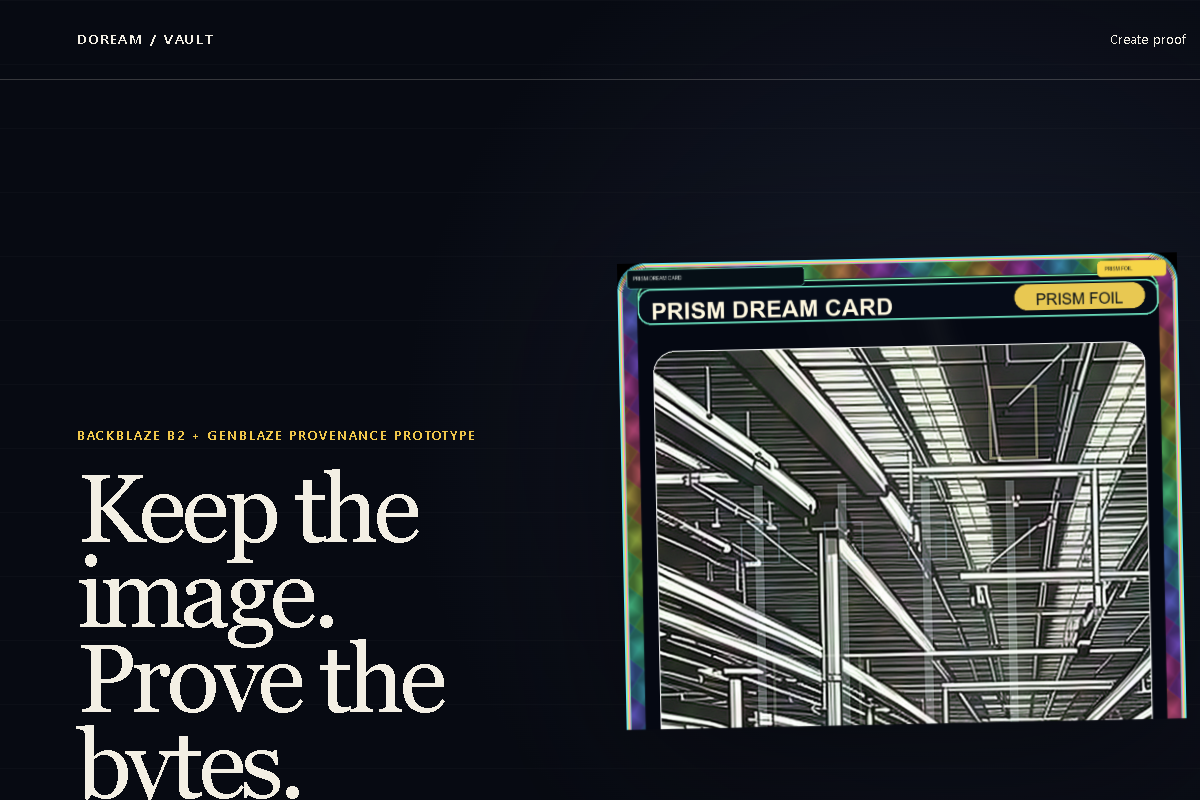
Generative media can be copied in seconds, while the evidence needed to inspect its lineage is often scattered across tools or lost entirely. Doream creates visual Dream Cards, but private dream narratives should not be placed into a public proof system. We wanted a narrow, useful answer: preserve verifiable media lineage and exact file integrity without collecting the private story behind the image.
What it does
Dream Provenance Vault accepts an exported PNG or WebP Dream Card together with a privacy-redacted Genblaze canonical manifest. In the browser it calculates the card's SHA-256 and checks that the final Genblaze asset points to those same bytes. The server repeats both checks and, only after they pass, writes three objects to a private Backblaze B2 bucket:
- the exact card image;
- the Genblaze canonical manifest; and
- an application receipt with a random artifact ID, byte count, MIME type, server-calculated SHA-256, timestamp, and B2 object keys.
The returned proof page reads the private receipt and displays the card through a short-lived signed B2 URL.
How we built it
The client is React, TypeScript, and Vite. Netlify Functions perform
server-side validation and connect to Backblaze B2 through its S3-compatible
API. We use genblaze-core==0.3.8 to create and verify a two-step generative
media run:
- provider
doream, modeldoream-image-generation; - provider
doream, modeldoream-prism-card-renderer.
The bundled submission sample uses synthetic media. Its source prompt is redacted, its final card hash is bound to the last Genblaze asset, and local filesystem paths are excluded. B2 credentials stay server-side. The bucket is private, artifact IDs are random UUIDs, and image access expires after 15 minutes.
This hackathon extension was built during the submission period. It adds the Genblaze lineage workflow, the private B2 evidence bundle, independent client/server hash verification, and the receipt retrieval experience to the existing Doream concept.
How Backblaze B2 and Genblaze are essential
Genblaze provides the canonical multi-step media lineage and asset hashes. Backblaze B2 preserves both the generated artifact and its provenance evidence as a private evidence bundle. Either layer alone is incomplete: Genblaze explains the media pipeline, while B2 durably stores the exact bytes and the verifiable records together.
Challenges
The main challenge was privacy. A provenance manifest can accidentally include raw prompts or local file paths. We added explicit rejection rules for unredacted source prompts and local paths, then required both browser-side and server-side hash agreement before any receipt is issued.
We also kept the claim deliberately narrow. The receipt verifies stored bytes and recorded provenance; it does not decide copyright ownership or authorship.
Accomplishments
- A real, verified two-step Genblaze canonical manifest
- Three-object private B2 evidence bundles
- Independent browser and server SHA-256 verification
- Final Genblaze asset-to-card hash binding
- Short-lived signed image retrieval
- Privacy tests that reject raw prompts, local paths, invalid signatures, and mismatched lineage
- Responsive desktop and mobile receipt experience
What we learned
Provenance is most credible when the application makes small, testable claims. Separating creative privacy from artifact integrity produced a clearer product and a safer technical boundary.
What's next
Next we would integrate manifest creation directly into Doream's export pipeline, add optional signature verification and lifecycle rules, and support user-controlled deletion and export of the entire evidence bundle.
Built with
Backblaze B2, Genblaze Core, React, TypeScript, Vite, Netlify Functions, AWS SDK, Vitest
Built With
- aws-sdk
- backblaze-b2
- genblaze-core
- netlify-functions
- react
- typescript
- vite
- vitest

Log in or sign up for Devpost to join the conversation.