Inspiration
I moved abroad when I was seven. London, then Switzerland, then back to the States. Every few years I was the new kid again, and more often than not the only kid in the room who looked like me. I was also the only kid I knew who wanted to start companies. So I spent most of my childhood doing the same thing in every new place: hunting for people who sounded like me, were building what I was building, and wanted things as badly as I did.
In high school I got tired of hunting and built the room myself. NEXTGEN was a student entrepreneurship org that ran pitch competitions and brought in executives to teach the stuff school didn't. It worked, and it taught me something I couldn't unlearn: helping one person find the right other person is the highest-leverage thing I know how to do. One intro costs nothing and can change someone's whole year. The upside is wildly asymmetric.
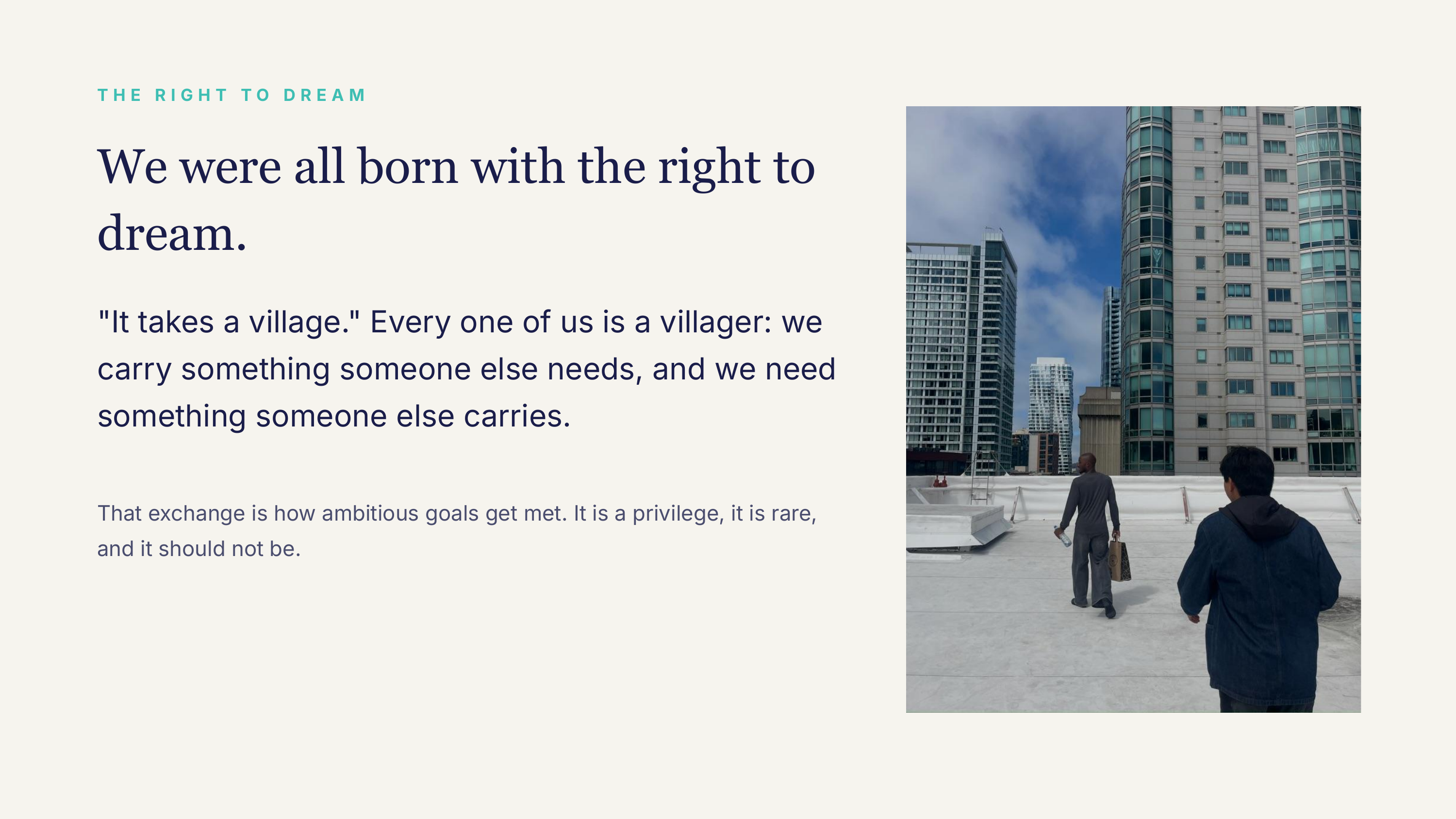
I've always thought that was what the internet was for. Not scrolling. Finding your people.
Two talks at this hackathon turned a long-held feeling into Dream.
Jared told the story of Steve Jobs reading a Scientific American piece that ranked animals by movement efficiency. Humans were mediocre. A human on a bicycle beat everything. Jobs decided to build a bicycle for the mind. Sitting there I kept thinking: nobody has built the bicycle for a community. A club, a department, a conference, an alumni network. Fifty or five thousand people in a room, all carrying what someone else in that room needs, and the only transfer mechanism is small talk and luck.
Then Neha, Replit's CMO, said the thing that made it concrete. Building is cheap now. Attention is the scarce resource, and people only give it when they get something back. That is exactly the shape of Dream: you give what you can offer and you get matched to your most ambitious goal. Both sides of the exchange pay the other.
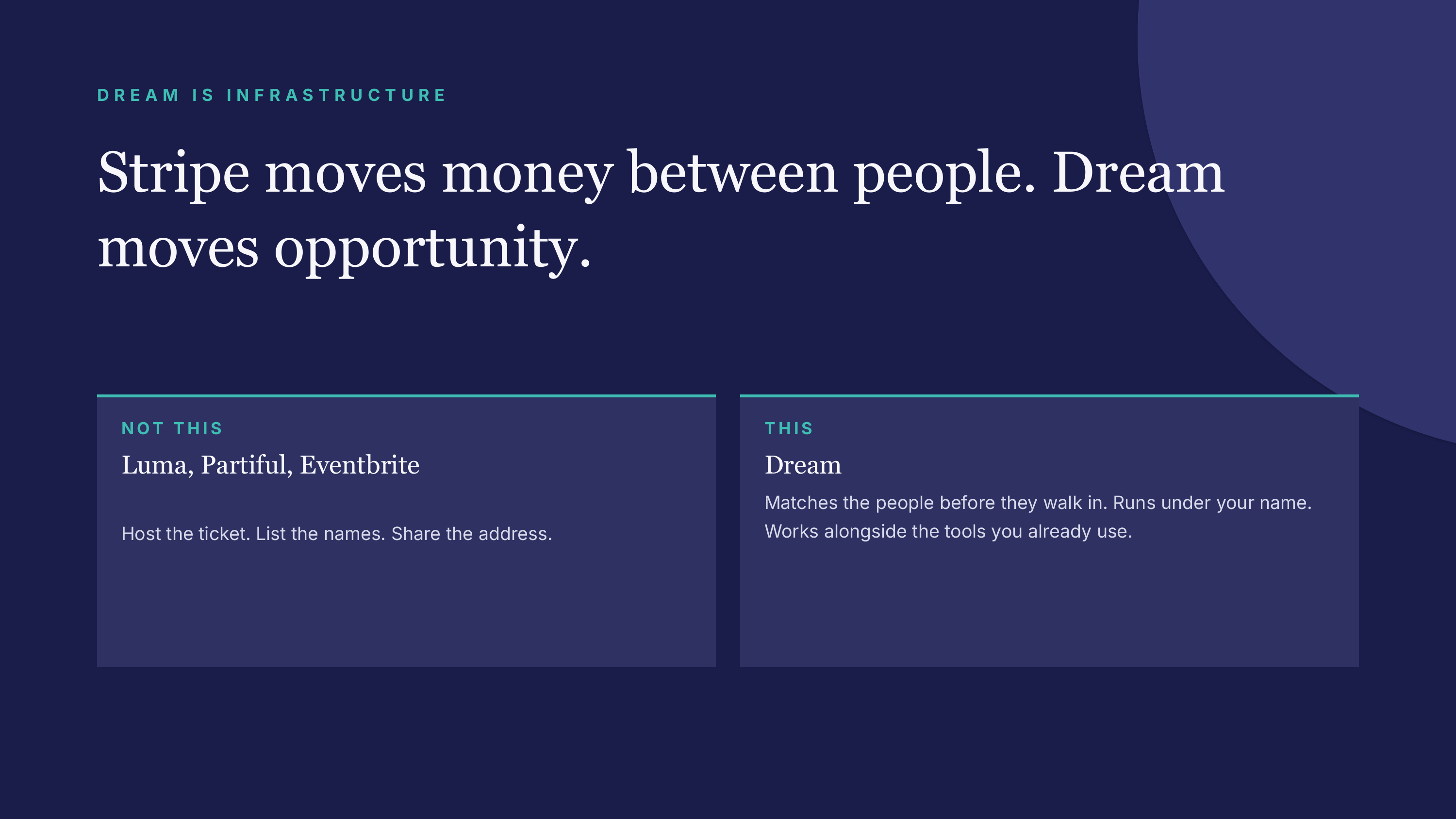
The why now is simple. AI made understanding and matching free text cheap enough to do for every member of every org. The loneliness numbers keep getting worse. And every past attempt at this flopped as a consumer app because B2C network effects are brutal from zero. So we went B2B. Dream is white-labeled and sold to organizations, which means it shows up wearing the brand people already trust. Neha talked about trust being the real moat in AI products. This is how we manufacture it.
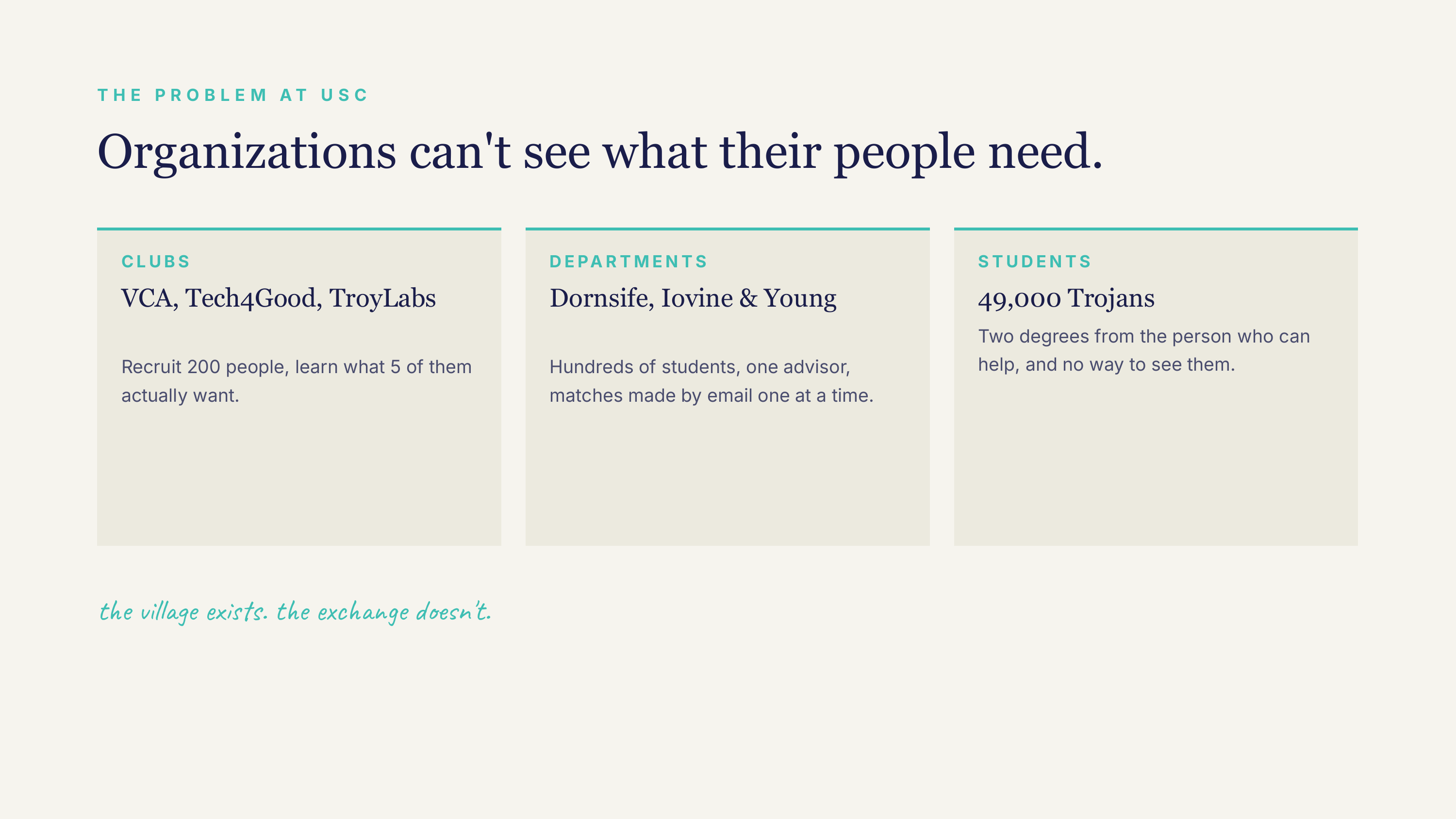
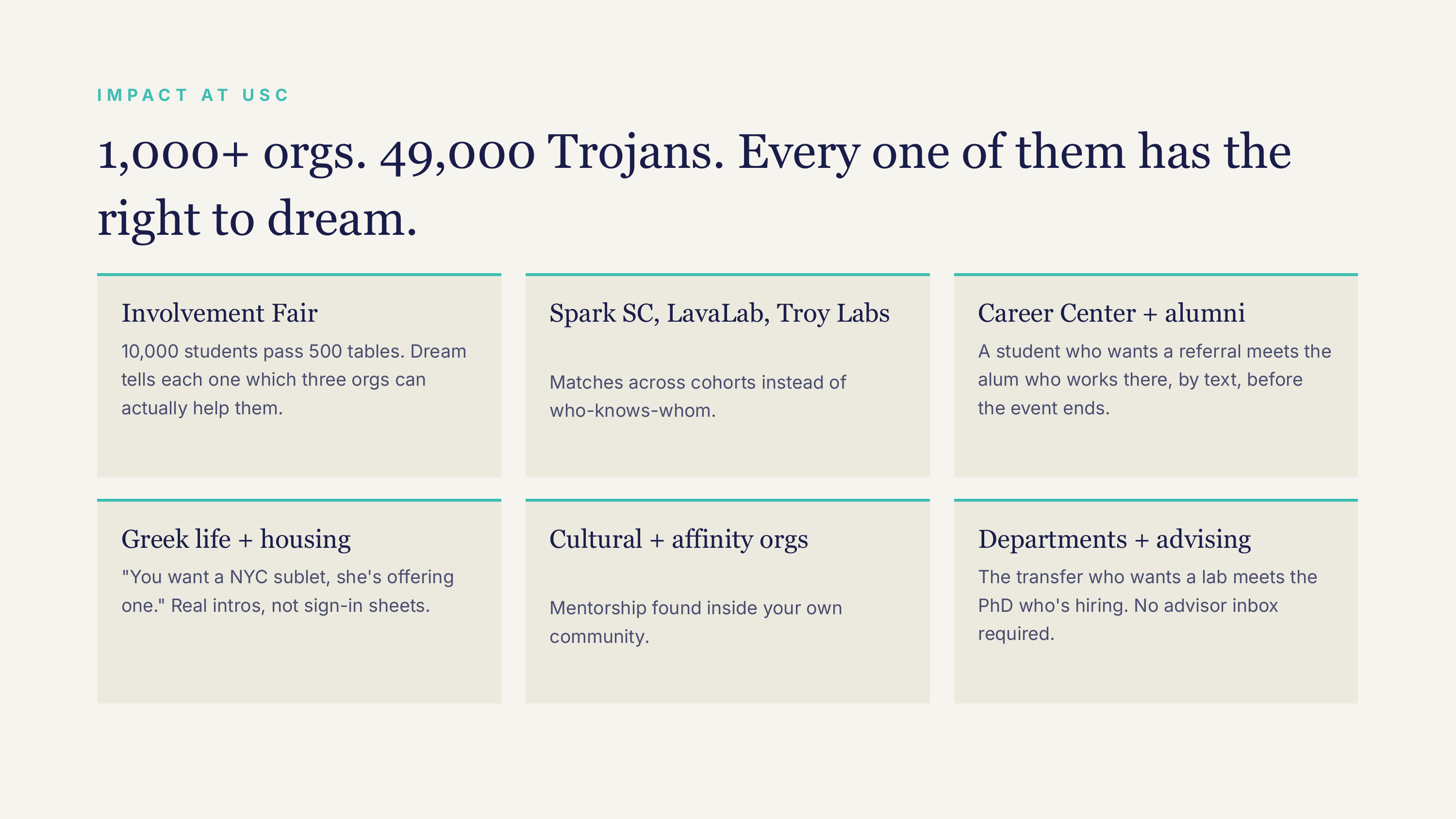
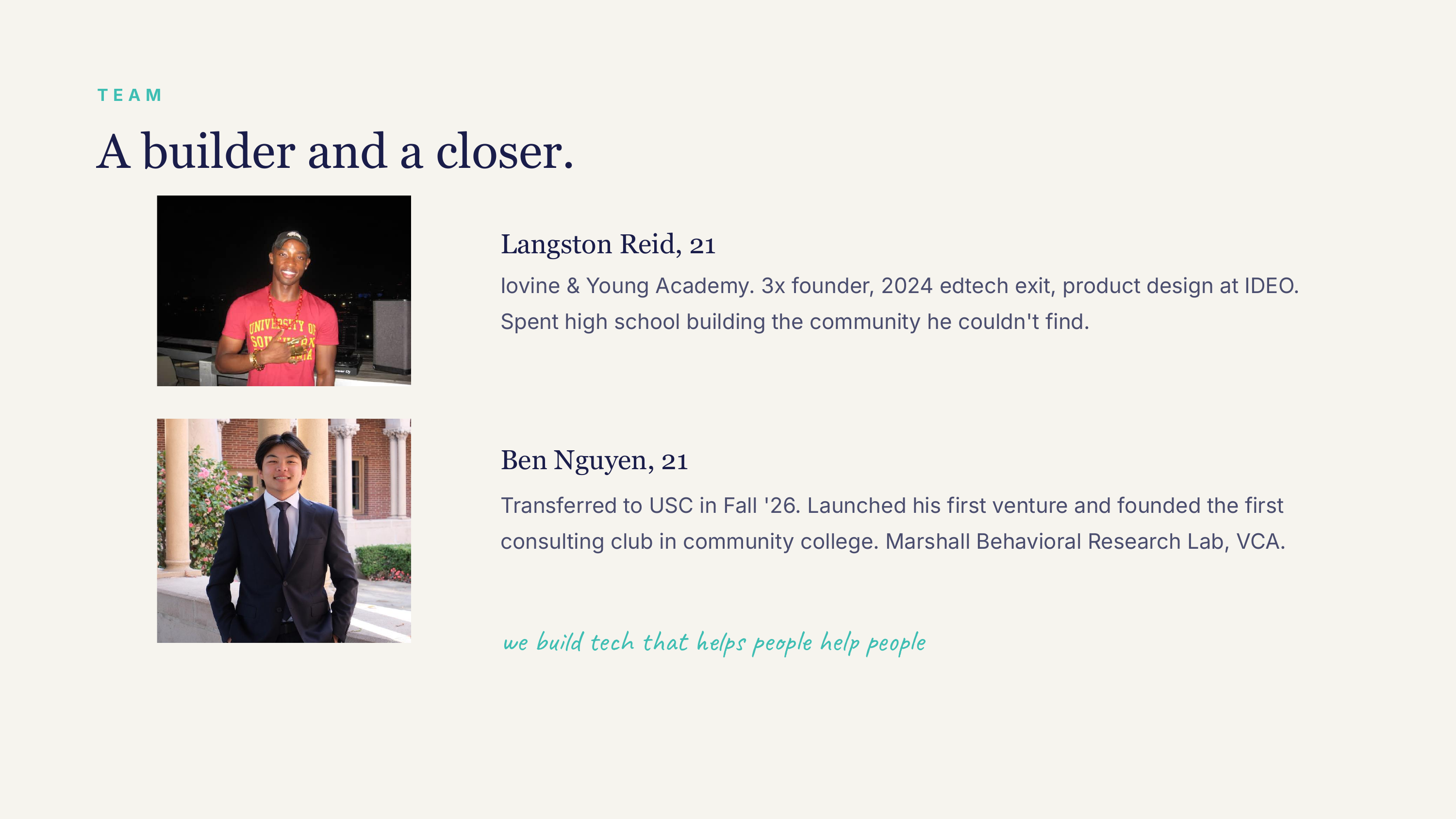
The last inspiration is boring and real: Ben and I are in a lot of USC orgs. Athletics, engineering, media, investment, VC, builder clubs, social clubs. All of them work hard to keep us engaged. All of them struggle to show that membership actually did something for anyone.
What it does
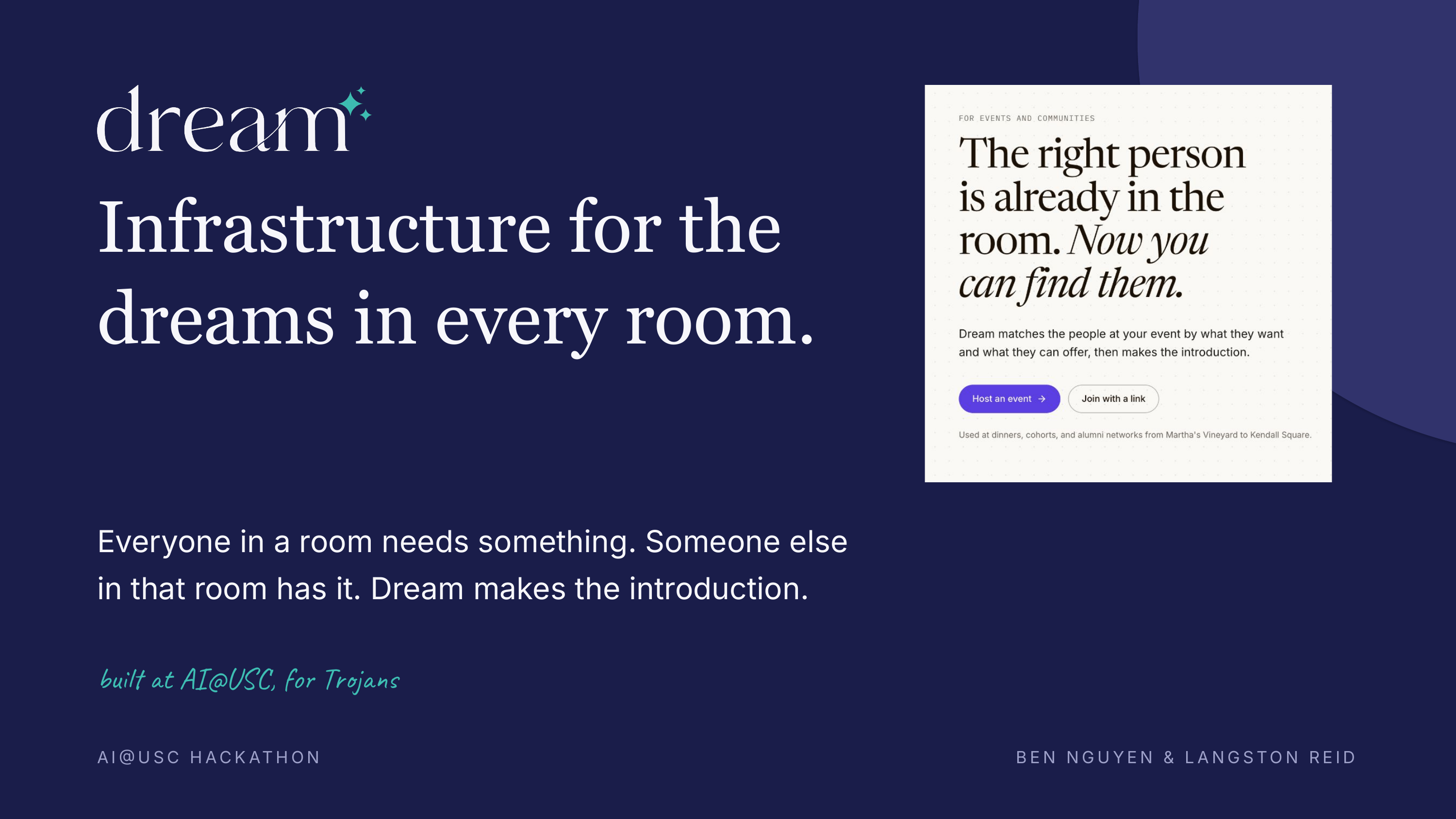
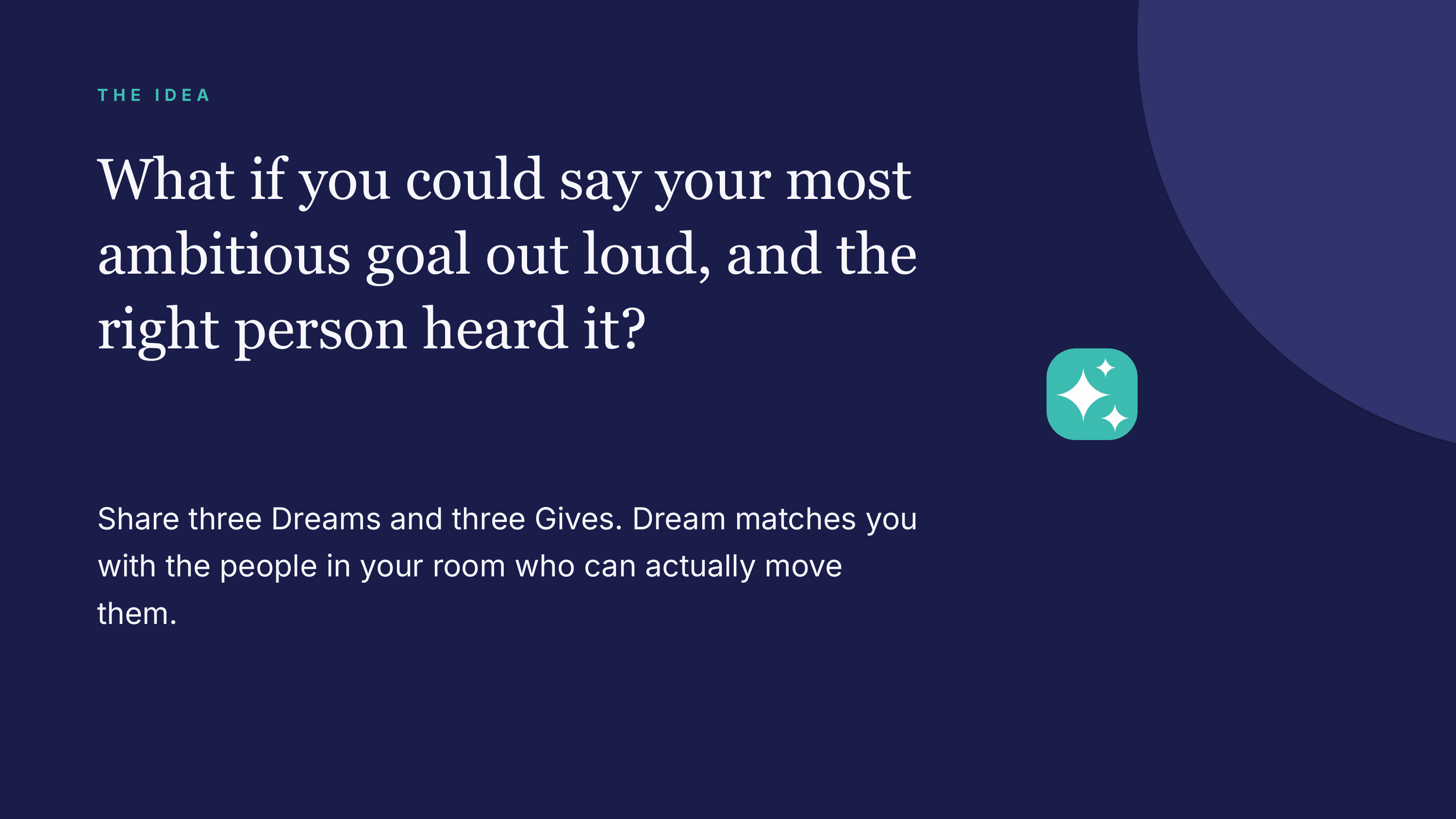
Dream is a start-to-end community connection engine. It connects people based on what they can offer each other and what they most want, so members of any org, from USC clubs to global networks, help each other reach their dreams.
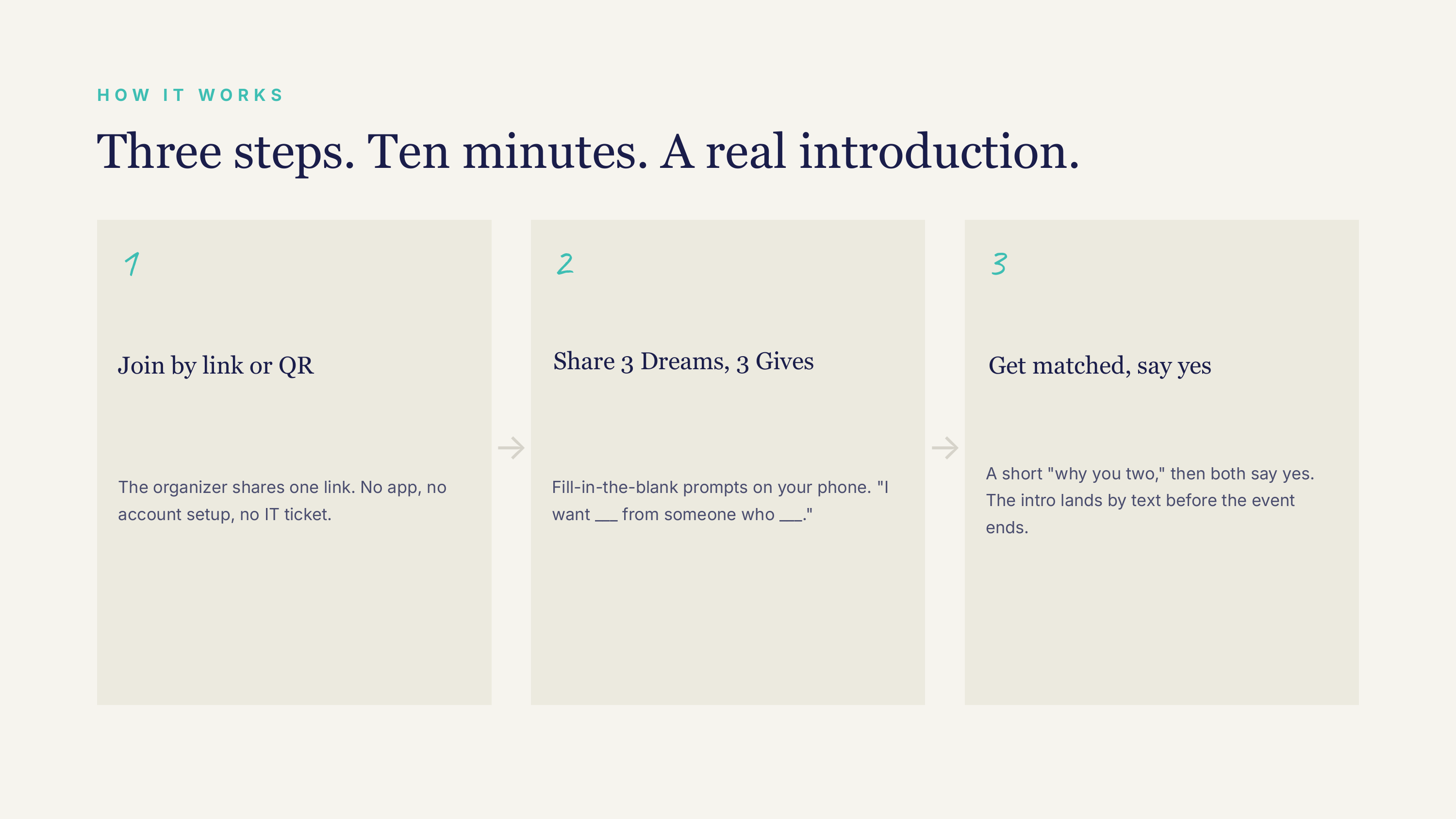
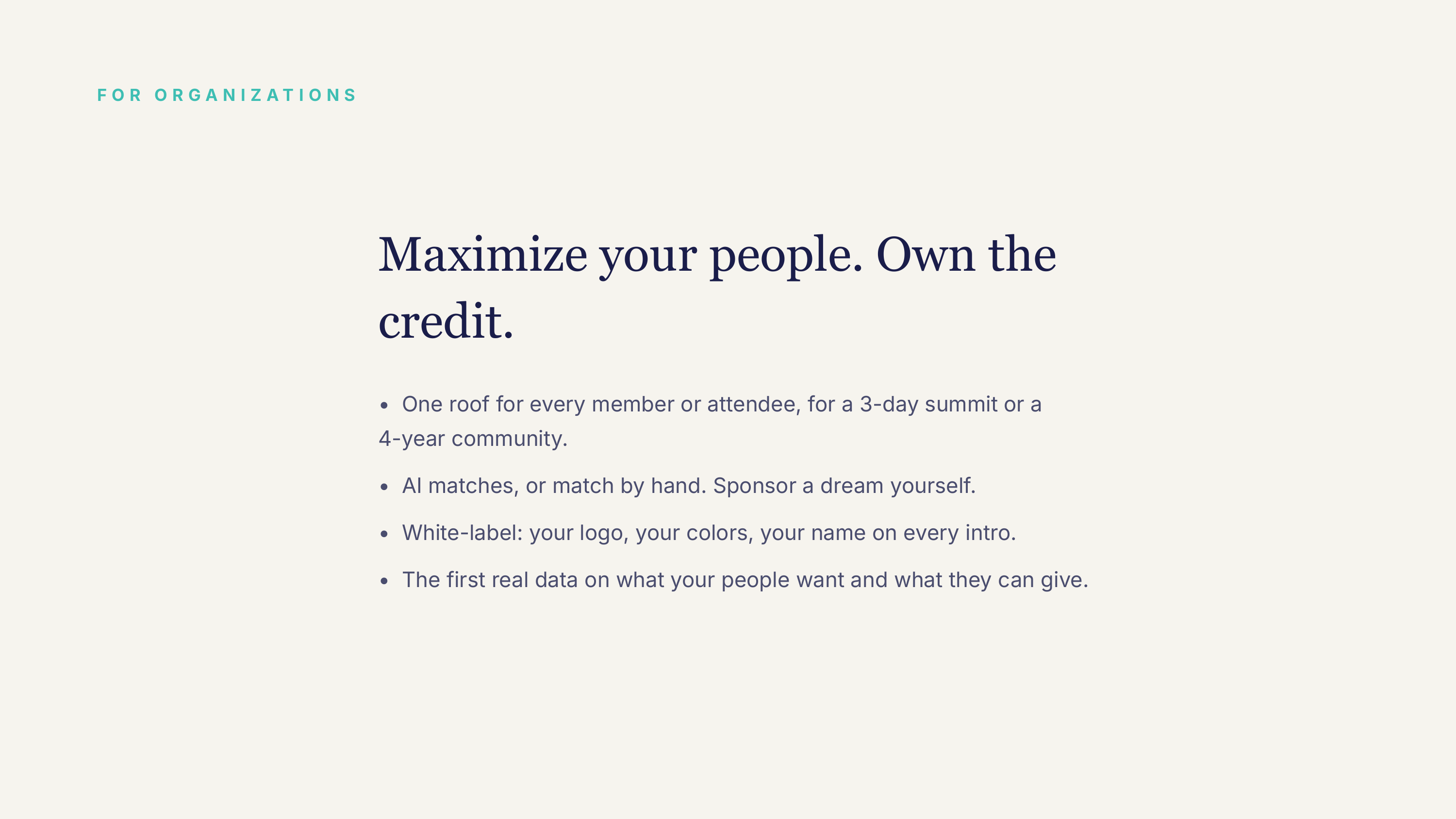
For an organizer: create an event or community, share a link or QR code, and watch matches happen. You get a dashboard of what your people want and can give, AI-made matches (or manual ones), analytics, and the whole thing under your own branding.
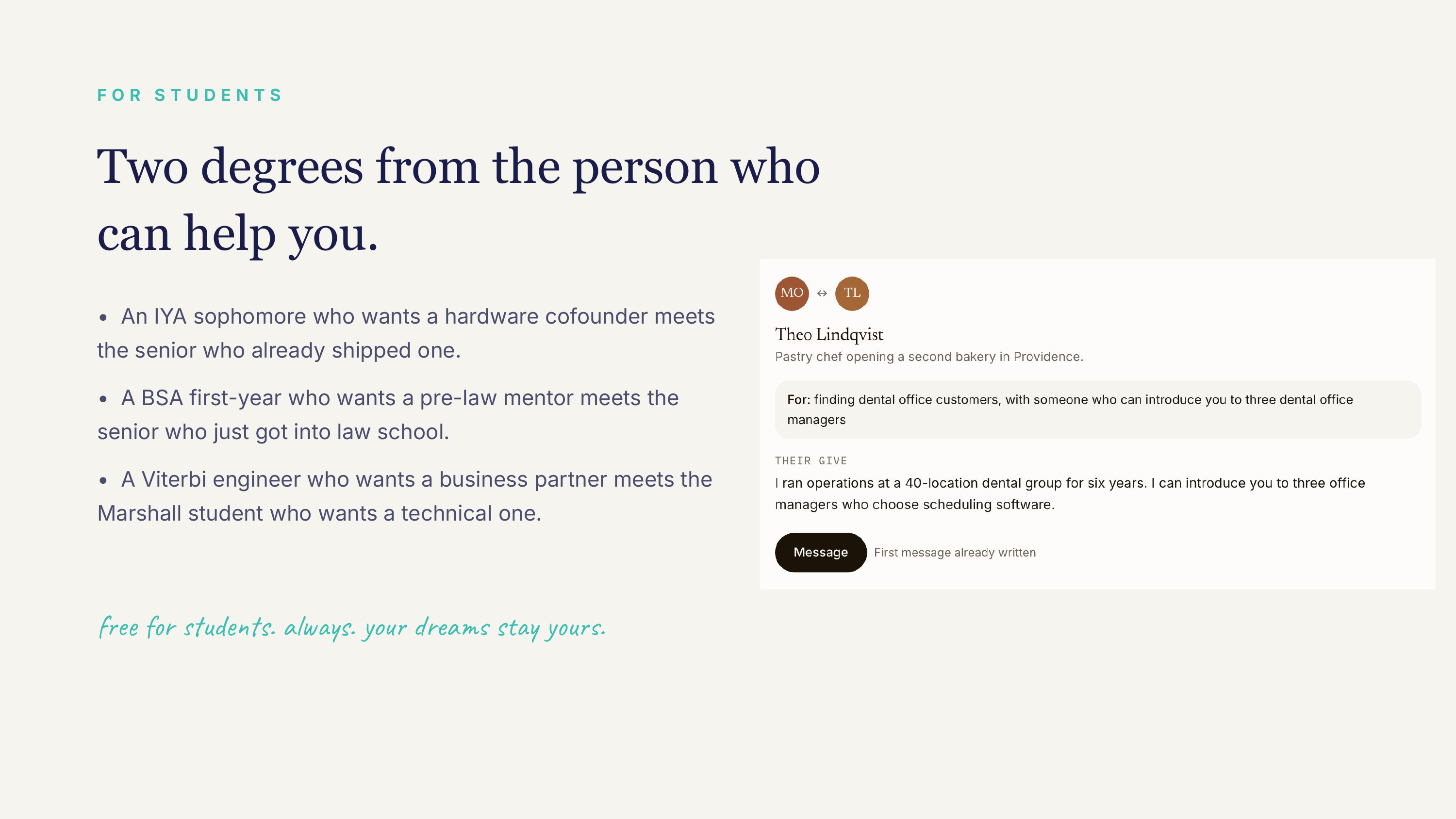
For an attendee: answer a few prompts on your phone. Three dreams, three gives. When a match hits, you get a text and an email with who they are and why you two, and both of you say yes before any details move. Then you talk in the built-in chat. It's free for attendees.
A rough sense of why humans can't do this alone: an event with \(n\) people has \(\frac{n(n-1)}{2}\) possible pairs. At the Involvement Fair's 10,000 students, that's about 50 million. Dream reads all of them. A sign-in sheet reads zero.
How we built it
- Input. A dream by voice or text, plus gives pulled from a resume, LinkedIn PDF, or link.
- Understand. An LLM asks a follow-up or two and extracts goal, stage, blocker, and strengths.
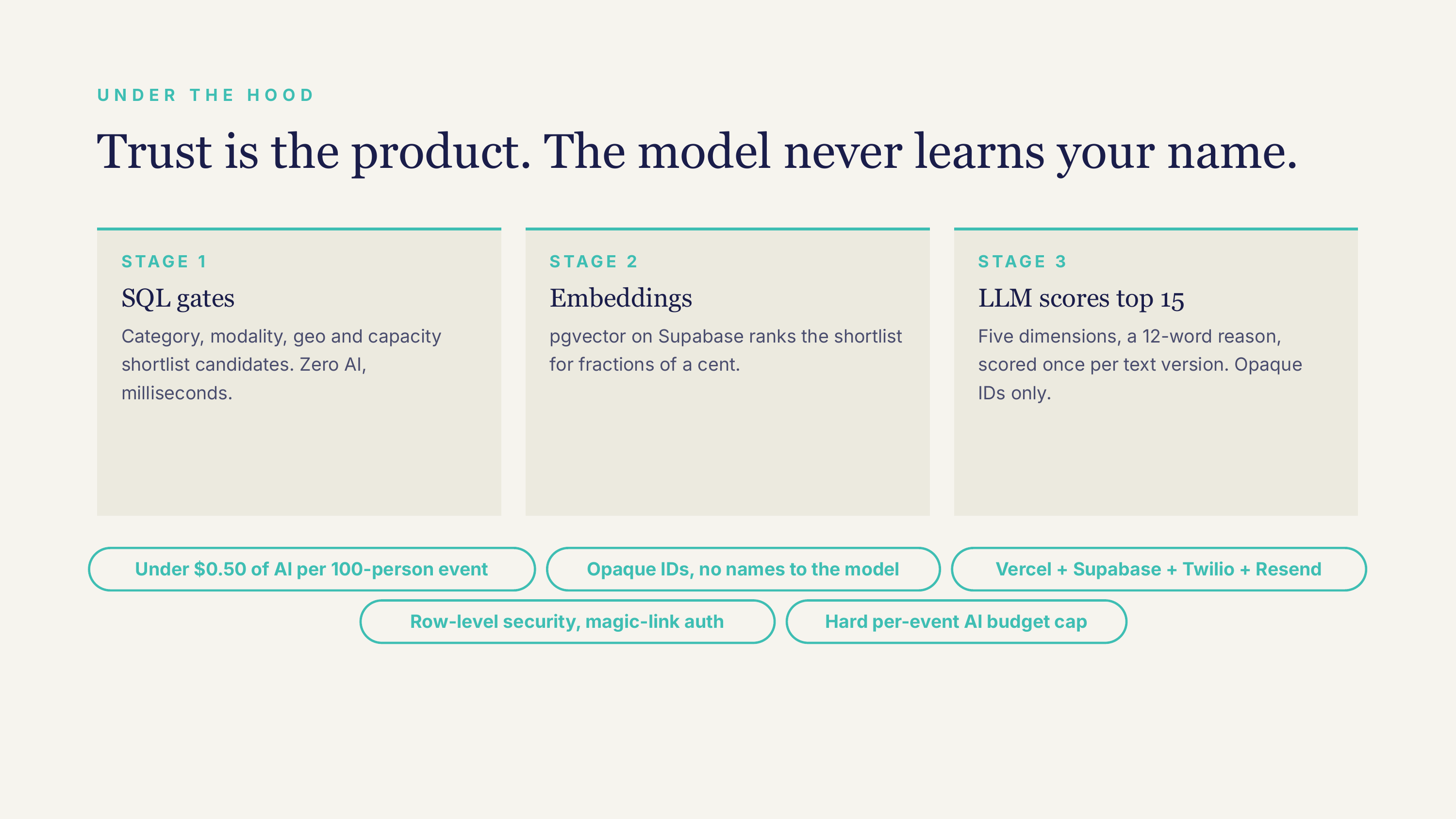
- Embed. Dreams and gives become vectors in Postgres using pgvector on Supabase.
- Rank. A prompted model scores every blocker against every give, both directions, and writes a one-line "why you two."
- Deliver. Twilio for SMS intros, Resend + React Email for email, magic-link auth so nobody makes a password.
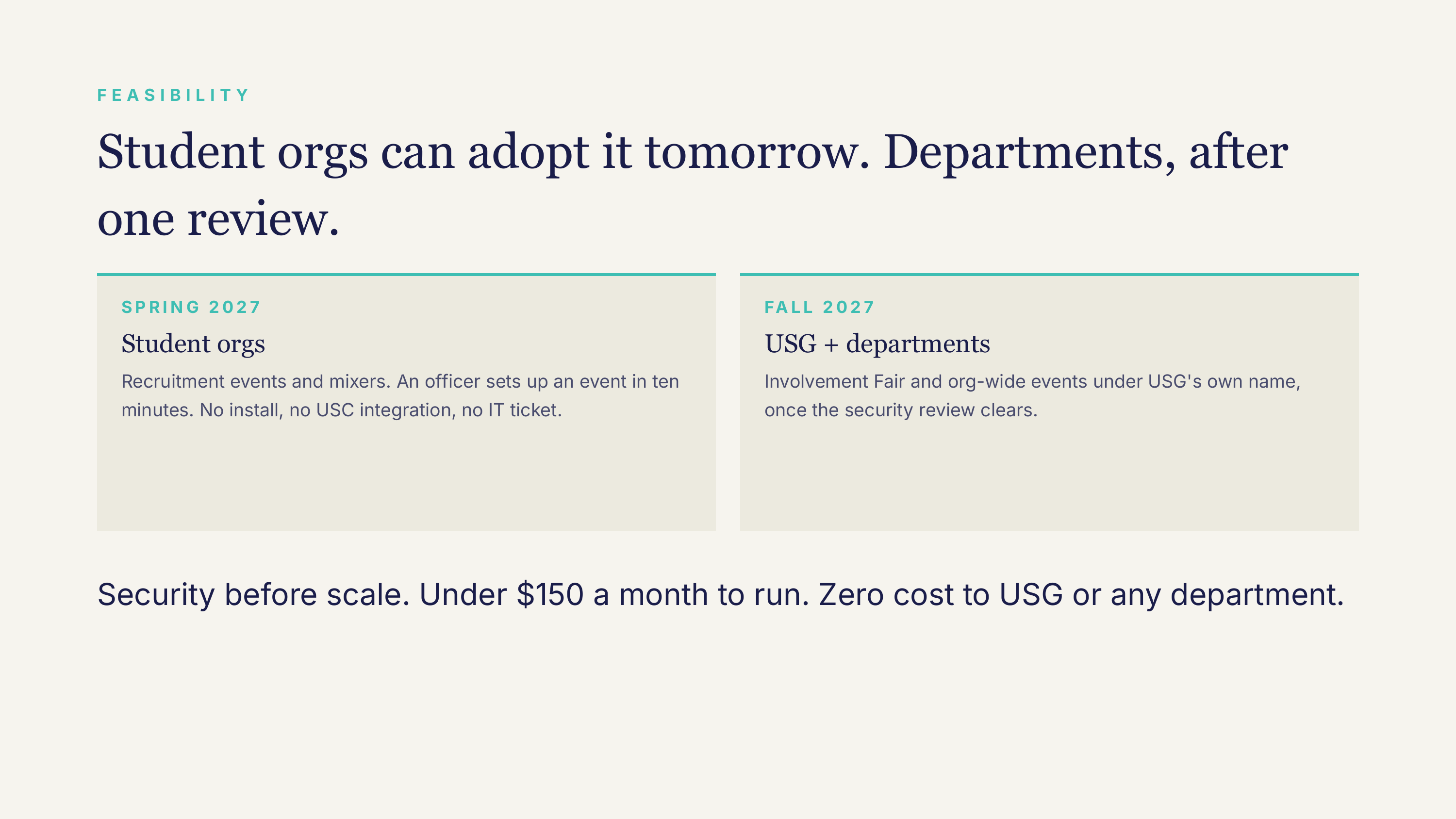
Frontend is React, deployed on Vercel with a preview link for every change. Supabase gives us auth, row-level security so each org only ever sees its own room, and realtime for the organizer dashboard. The whole thing runs under $150 a month at campus scale. We leveraged replit for building.
Challenges we ran into
Raw user input is messy. People type "wanna meet ppl in film" and we need that to match against "I'm an AD on a Netflix show, happy to grab coffee." We added a summarization layer before anything user-written touches an email or match card, because the first drafts read like a group chat.
Matching both ways is harder than it sounds. A give that solves your blocker is only interesting if you're also someone they'd want to meet. Scoring in one direction produced lopsided matches where one person did all the giving.
Double opt-in versus speed. We wanted intros to land before the event ended, but we also refused to leak anyone's details without a yes from both sides. The fix was making the "why you two" compelling enough that people tap yes fast.
Accomplishments that we're proud of
- A working product, not a fake demo or deck. Organizer creates an event, attendee is matched on their phone, intro arrives by text. Nothing to install, no USC system to integrate, no IT ticket.
- White-label per event already works. USG or a department can run Dream under its own name today.
- A rollout a club officer can do in ten minutes.
- A budget where $1,600 covers a full year of hosting for USC at zero cost to any org.
What we learned
Distribution beats product. Both speakers said it and this weekend proved it. The matching was the easy part. Getting a club president to send one link is the whole game, so the product has to be stupid simple on the organizer side.
Trust is engineered, not declared. Wearing the org's brand, verifying USC emails, double opt-in, and spending 25% of the budget on a third-party security review did more for believability than any copy we wrote.
People show up for an exchange. Nobody fills out a form to help a stranger. Everybody fills out a form that might get them their dream.
What's next for Dream
Spring 2027: student orgs run Dream at recruitment events and mixers. Target: 500 USC attendees and 10 orgs by May.
Fall 2027: USG runs it at the Involvement Fair and org-wide events. Departments adopt it once the security and student-data review clears.
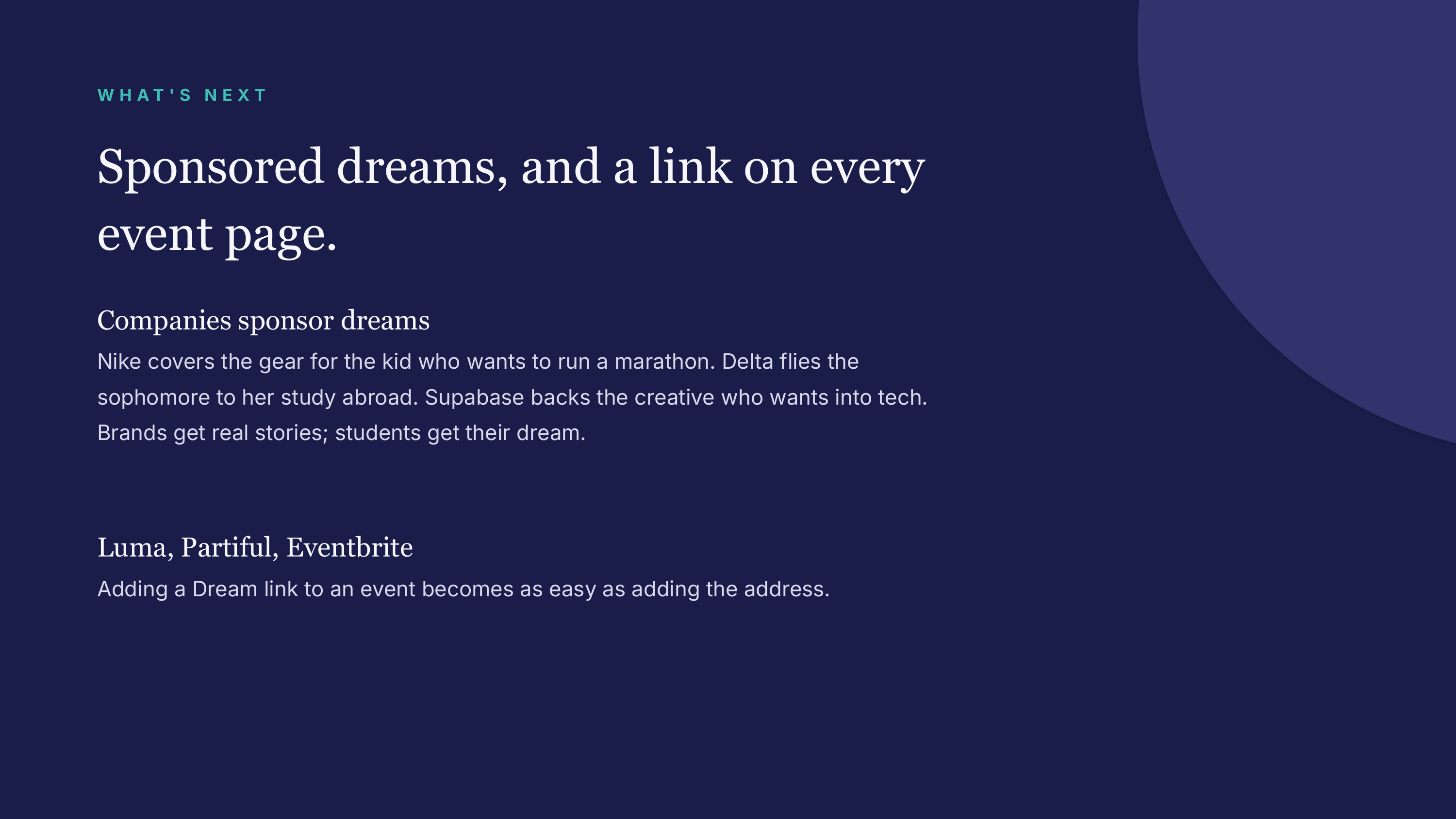
Beyond USC: every community has this problem. Co-living houses, conferences, alumni networks, companies with 50,000 employees and no idea what those employees want to become. We're also building the "add a Dream link" integration for Luma, Partiful, and Eventbrite so adding Dream to an event is as easy as adding the address.
And the long bet: a Dream Graph. Not who knows whom, but who wants what, who can give it, and which intros actually moved someone forward. Every social network maps your past. We want to map where people are trying to go.
Built With
- claude
- css3
- github
- html5
- javascript
- node.js
- openai
- pgvector
- postgresql
- react
- replit
- resend
- sms
- supabase
- twilio
- typescript
- vercel
