-
-
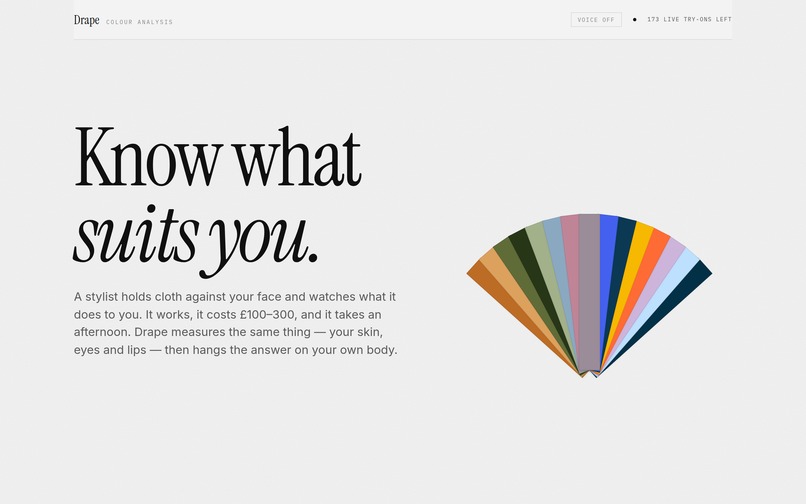
The sitting. The only colour on screen is a measured palette.
-
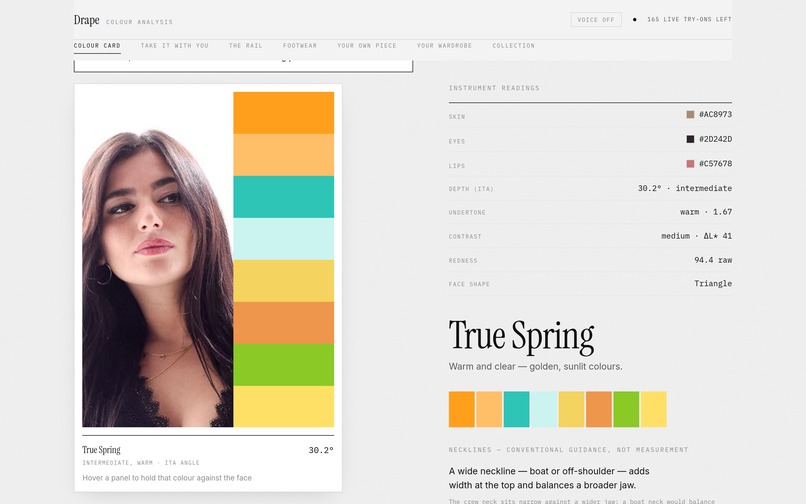
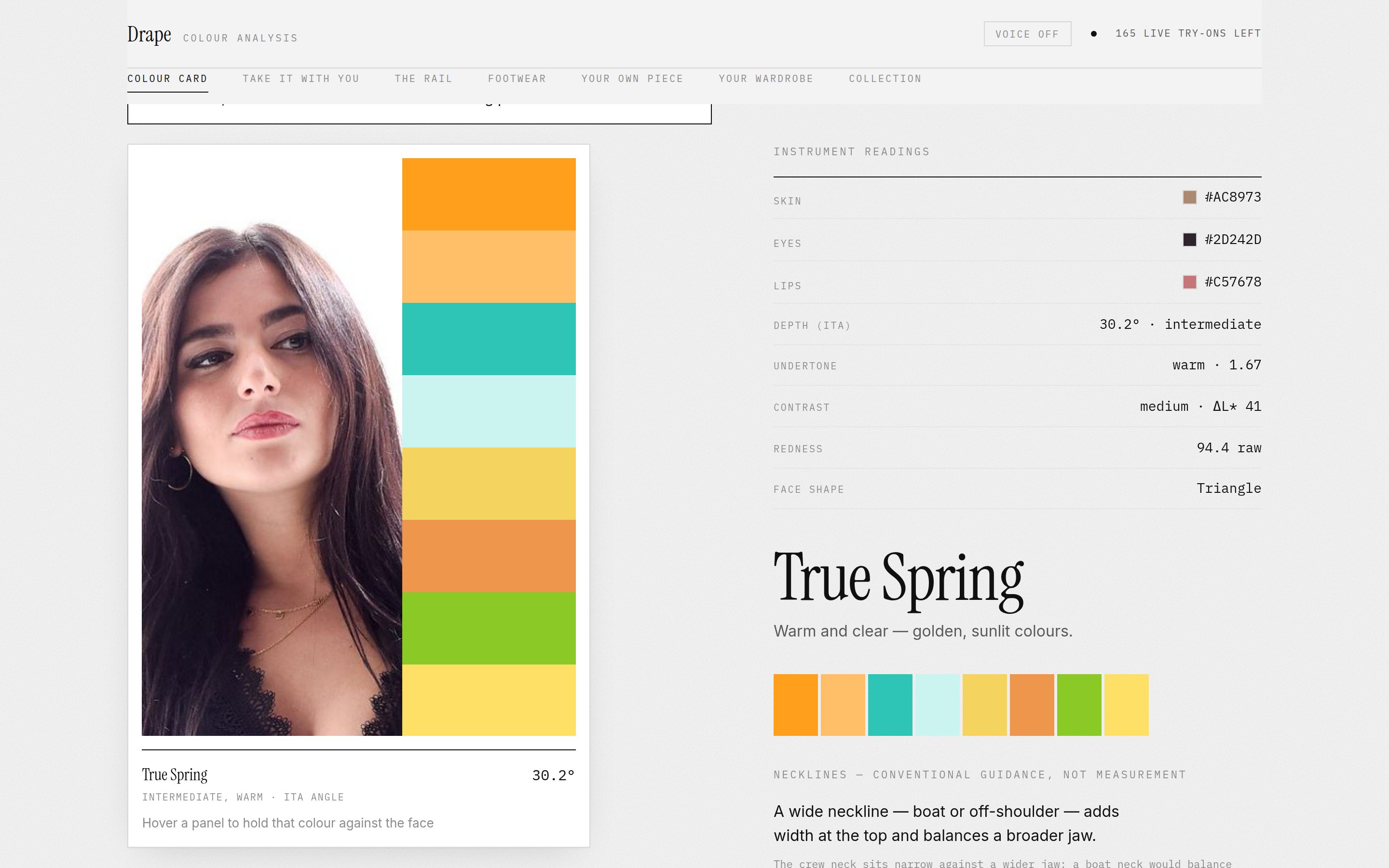
Your colour card. Measured skin, eye and lip hex; ITA depth; undertone;contrast. Monospace means instrument-read.
-
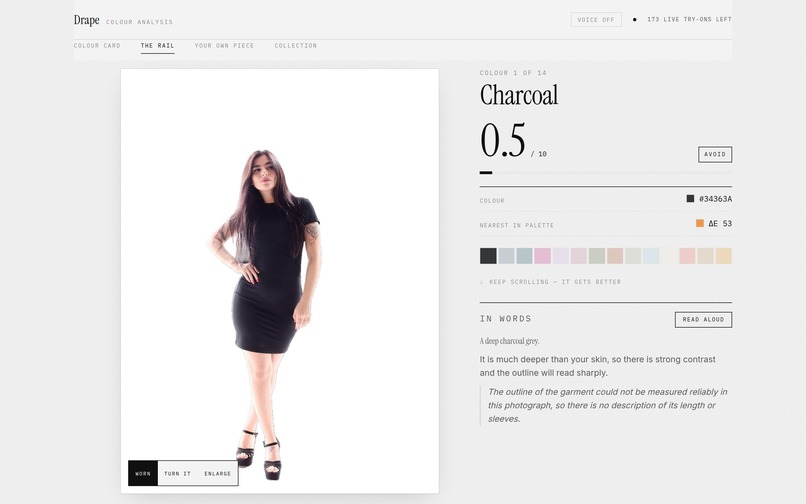
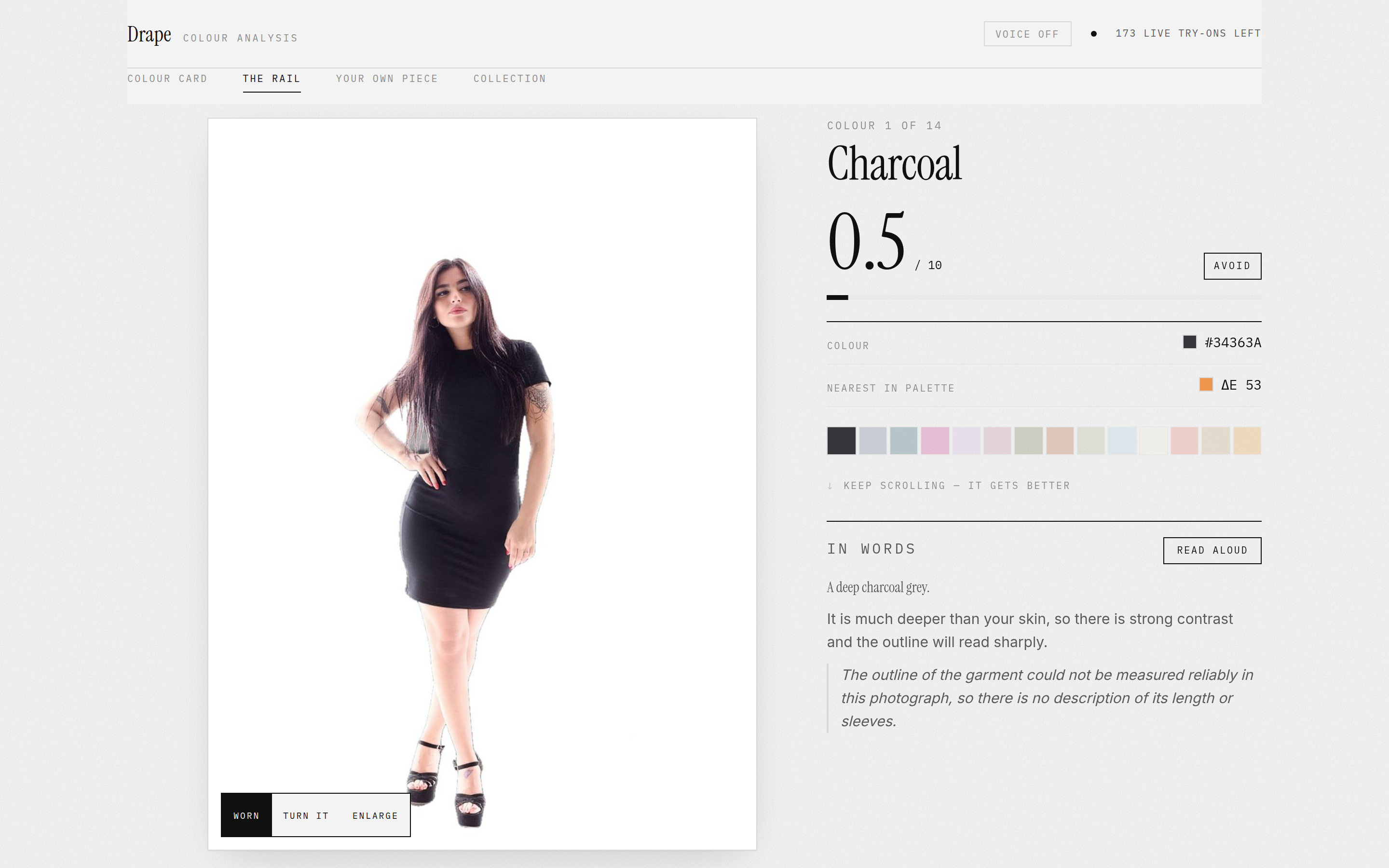
The draping scrub begins on her worst colour: charcoal, 0.5, avoid.
-
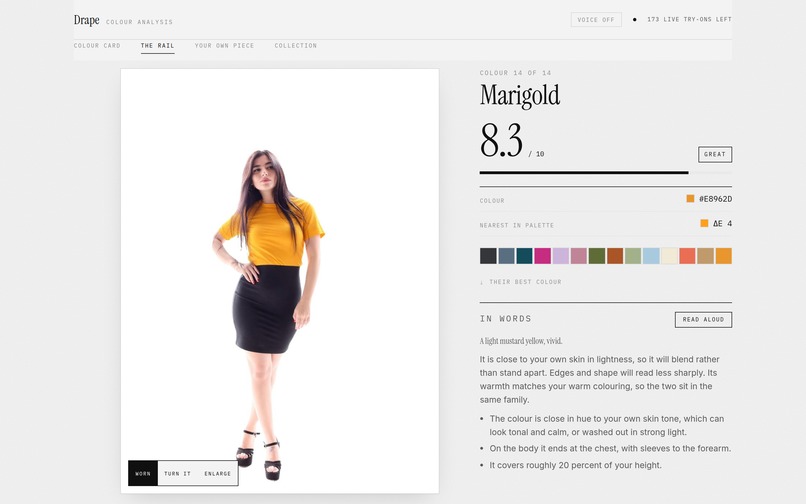
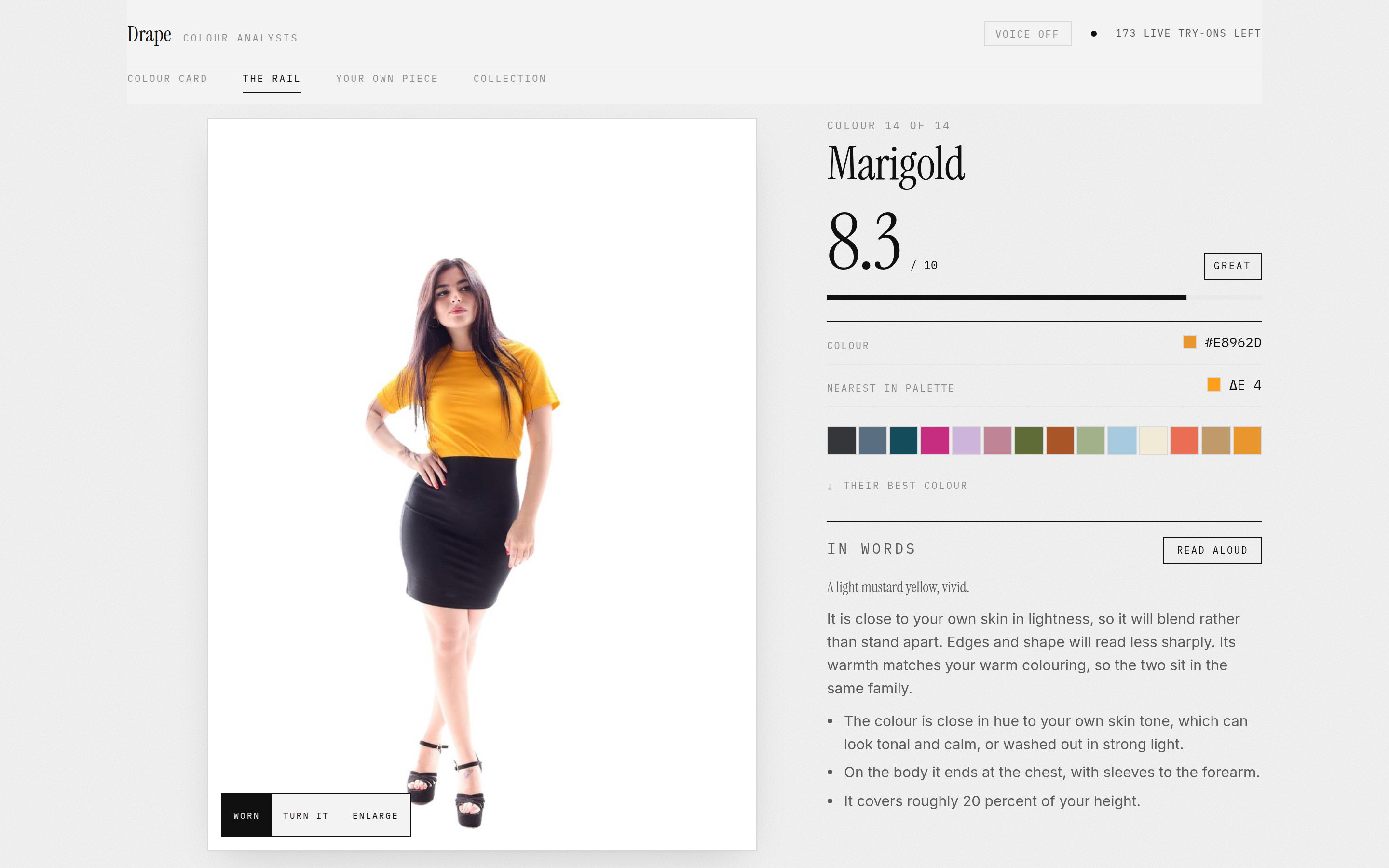
…and ends on her best: marigold, 8.3. Scrolling changed the garment through fourteen real try-on renders.
-
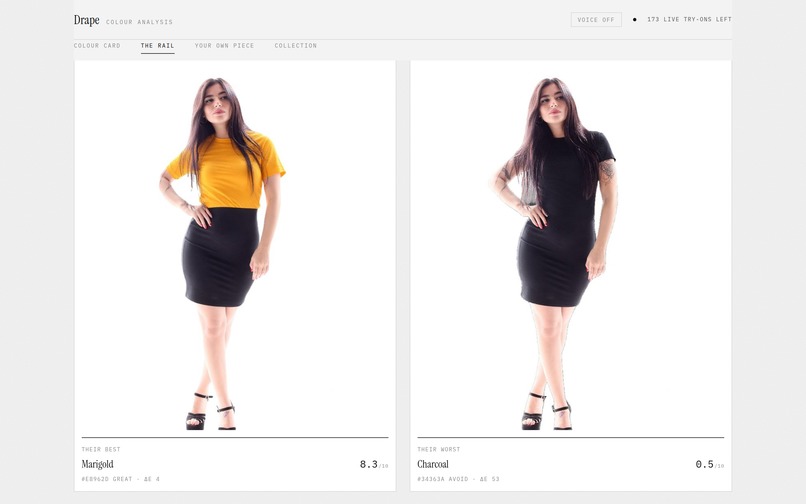
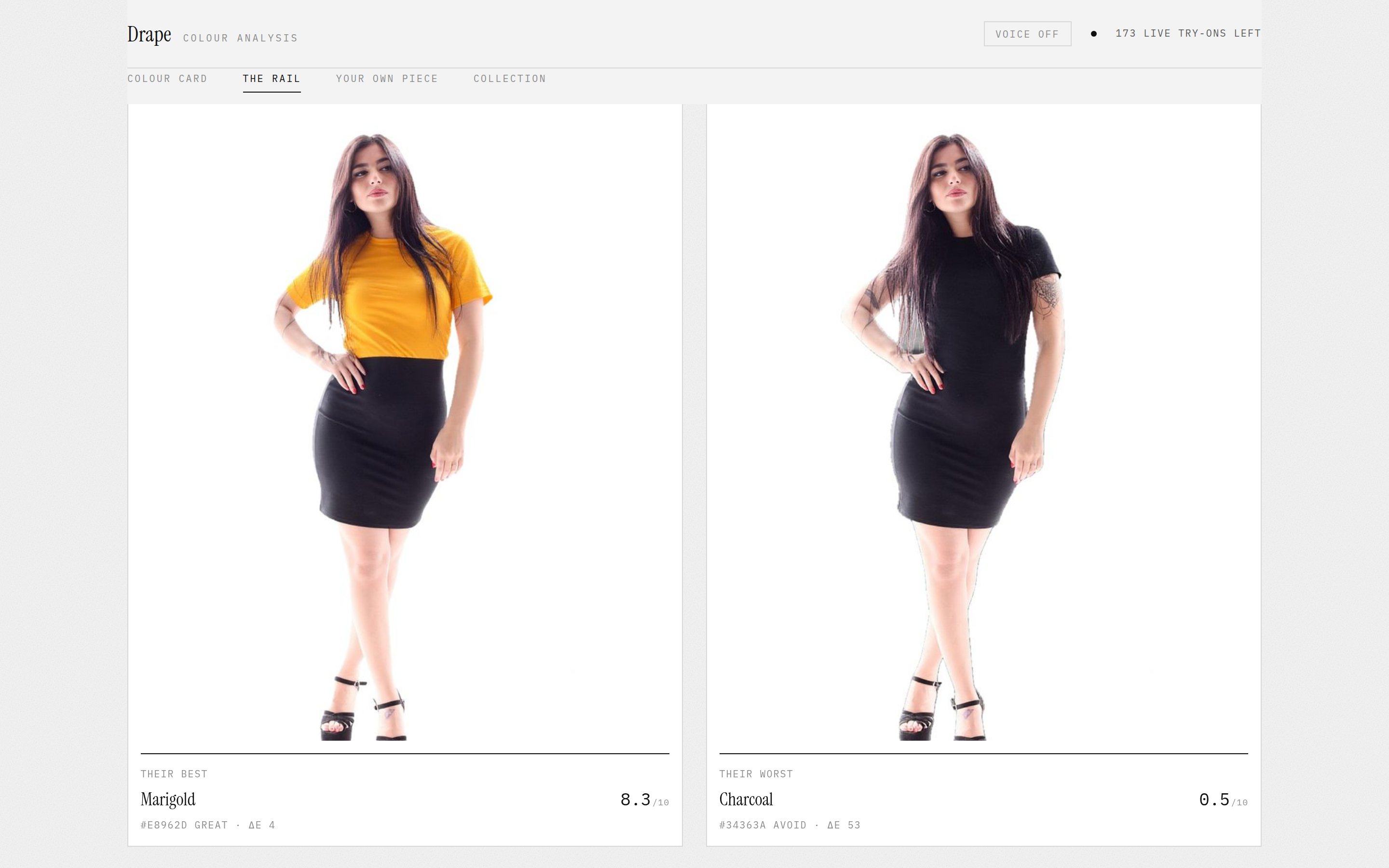
Best against worst. Same body, same light, fourteen colours apart.
-
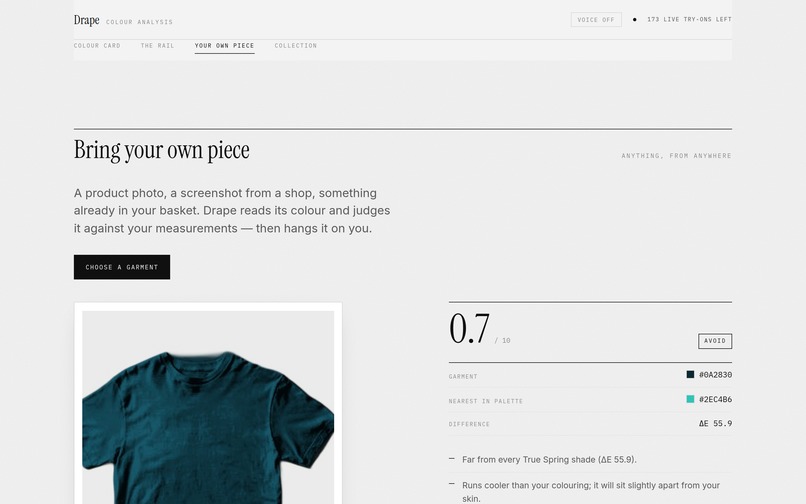
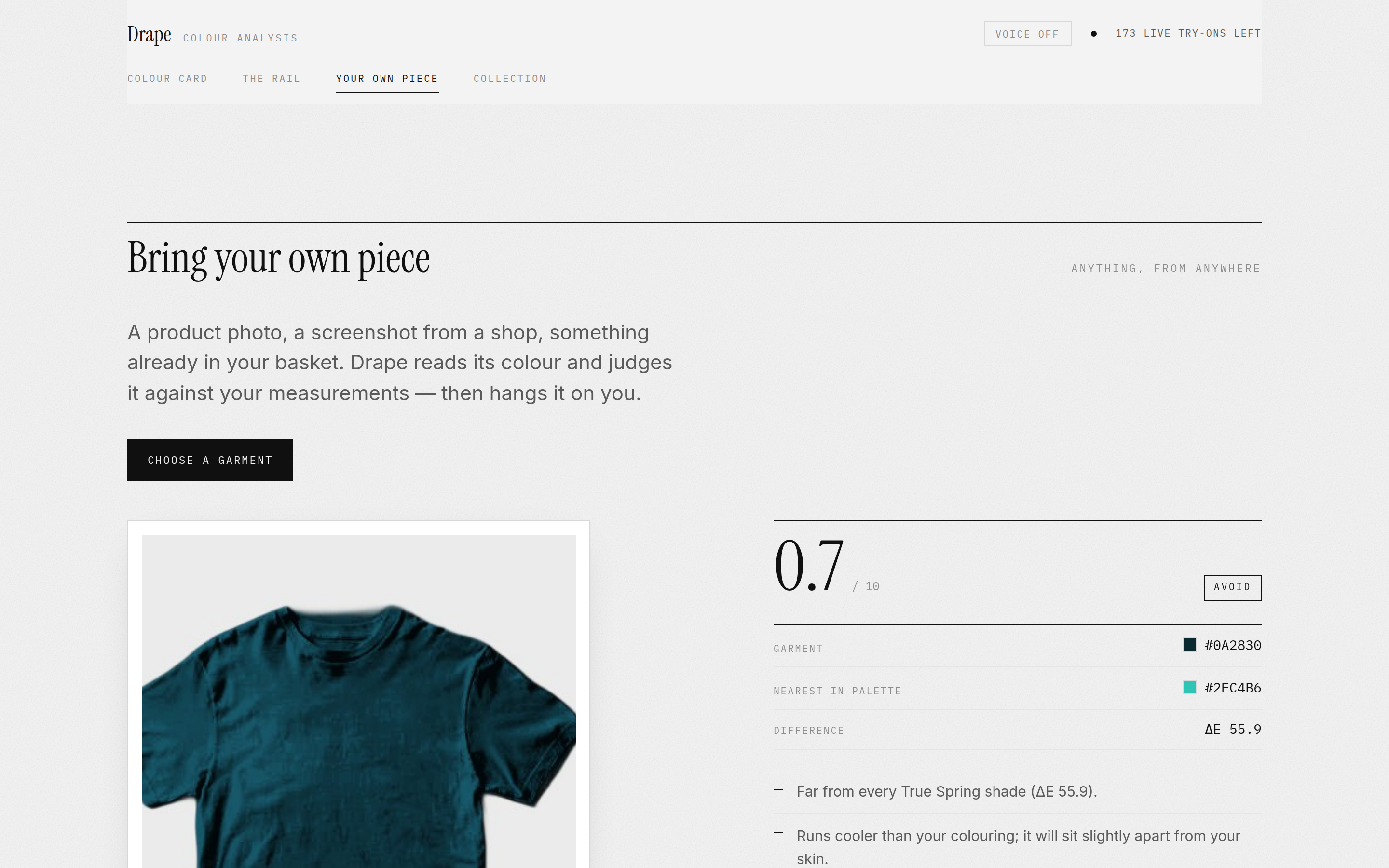
Bring your own piece. Upload any garment; its colour is read in the browser and judged, with reasons.
Inspiration
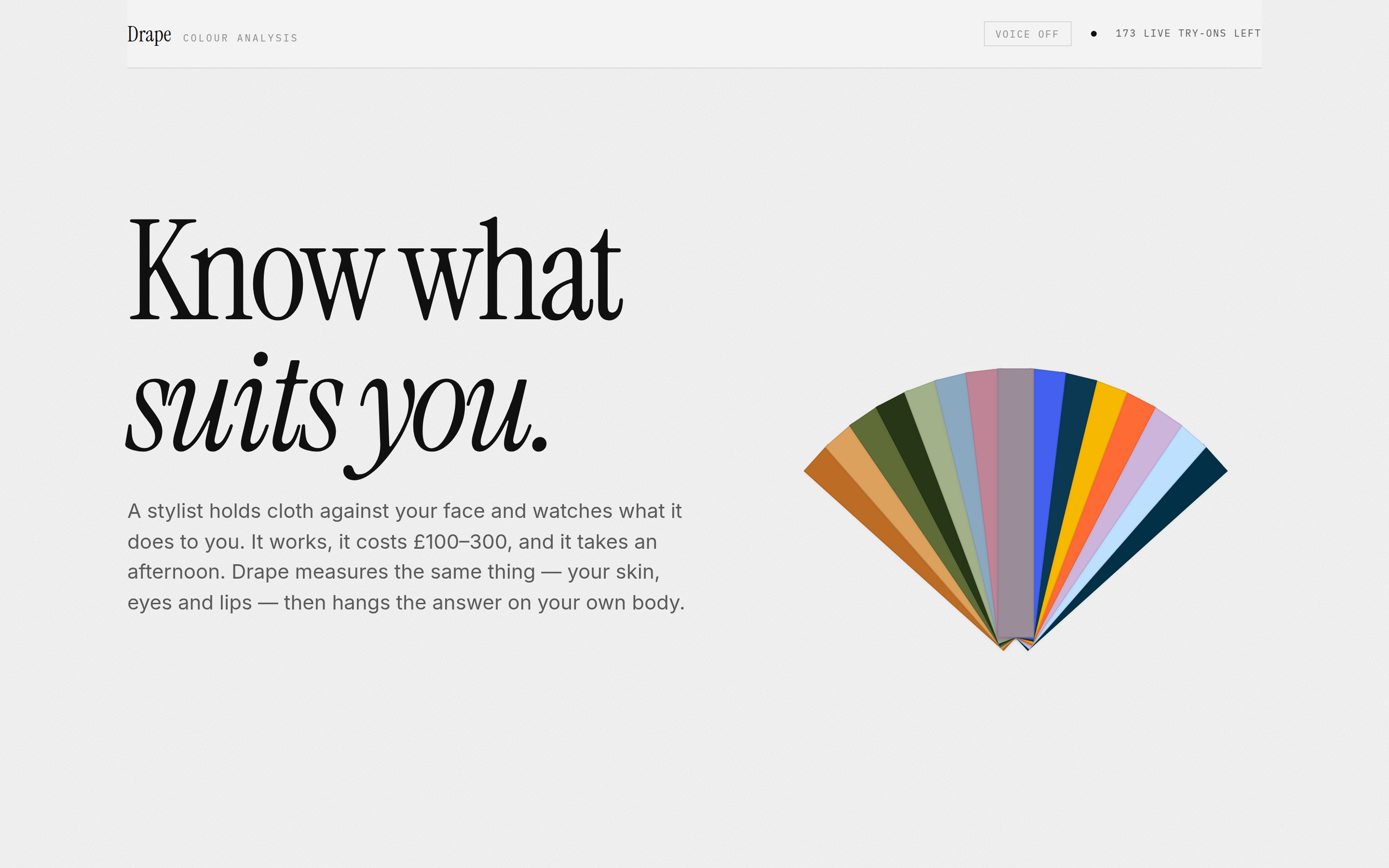
Somebody holds a piece of fabric against your face, and you watch yourself change. One colour makes you look rested. The next makes you look like you have flu. Nothing about you moved only the cloth.
That is colour draping, and it is a real profession. People pay £100–300 and give up an afternoon for a session, and demand is booming across Korea, China and India, where waiting lists run for weeks. It works because a trained eye watching real cloth against real skin in real daylight is genuinely good at this.
And it does not scale, for exactly those reasons. It needs the trained human, the daylight, and the physical fabric. Online, where most clothes are now bought, you get none of them so you guess. Colour is one of the leading reasons clothes get sent back, and "it looked different on the screen" is the most common thing people say when they return something.
We wanted to know whether the thing a stylist does by eye could be done by measurement instead. Not approximated with a quiz, or guessed by a model trained on selfies, but actually measured: your skin, your eyes, your lips, read as numbers, turned into a palette by colour science, and then proven by hanging real garments on your own body so you can see it rather than take our word for it.
That question is the whole project. YouCam's APIs supply exactly the two halves we could not build ourselves an instrument that measures a face, and one that puts clothes on a body and leave the interesting bit, the reasoning between them, to us.
What it does
1. It measures. Five YouCam endpoints run against one sitting. The Facial Colour Tones Analyzer (skin-tone-analysis, 20 units) returns skin, eye, lip and eyebrow colour as hex. AI Skin Analysis (skin-analysis, 16 units) returns fourteen concern scores including redness. Face Attribute Analysis (face-attr-analysis, 10 units) returns face shape. AI Hair Colour (hair-color, 1 unit) shows the contrast axis moving. AI Clothes Virtual Try-On (task/cloth v2, 2 units) hangs the garment on the body.
2. It reasons - and this part is ours. Our own colour engine turns those measurements into a personal palette: ITA angle for depth, the ratio of b* to a* for undertone, hair-to-skin lightness spread for contrast, CIEDE2000 for every colour distance, and a twelve-season classification that names a season plus a runner-up with a confidence figure when someone sits near a boundary. It costs zero API units, which is what makes it affordable to rank a whole catalogue and a whole wardrobe for free.
We did not assume this had to be ours. We enumerated the platform's documented operations looking for a seasonal-palette or personal-colour endpoint. There is none.
3. It judges. Any garment a product photo, a screenshot, something already in your basket is reduced to its dominant colour in the browser and scored against the palette with ΔE2000, weighted by how well its temperature matches your undertone, with a penalty when a hue sits beside measured facial redness. Every score comes with reasons, not just a number.
4. It proves it, by scrolling. The draping scrub pins the sitter while scrolling cycles the garment on their body from their worst colour to their best, through fourteen real try-on renders generated ahead of time. Draping is holding swatch after swatch against someone and watching what each does; scrolling is the same gesture. Because the frames are pre-rendered the interaction costs nothing at view time and cannot fail while a judge is looking at it. It ends on the two extremes side by side.
5. It answers the questions people actually ask. Gold or silver. Which lipstick. Which neckline driven by measured face shape, and labelled as conventional guidance rather than measurement, because a lookup table is not an instrument. None of these needed a new endpoint.
6. It says it out loud. Every garment is described in words and read aloud via Web Speech, with live regions and full keyboard operation. Online clothes shopping is built entirely on pictures and not everyone gets one. A visual API producing a non-visual answer.
7. It hands you the object, and lets you keep the result. Each rail frame toggles between the garment worn and a 3D turntable of it. There is a downloadable palette card, a footwear rail, a render zoom, and a wardrobe audit that scores 24 items you already own zero units, nothing uploaded.
How we built it
Next.js and TypeScript on Vercel. Pixel work happens in the browser on <canvas>; every API call happens on the server, so credentials never reach the client.
The authentication was the first real piece of engineering. YouCam's S2S flow is a V1 RSA PKCS#1 v1.5 id_token, built from the API key and a timestamp and exchanged for a bearer token and it is not in the published OpenAPI specs. We built it from the interface rather than the prose.
The colour engine is pure maths, no model and no units. That is deliberate: it makes ranking free, and it means the reasoning is inspectable rather than asserted.
Challenges we ran into
The most useful thing we can tell you about Drape is what it refused to claim.
Our original headline feature was going to be: run Skin Analysis on the try-on render and prove that the right garment colour measurably improves your skin. We built it, then tested it properly the same shirt in warm orange and cool teal, with a repeat run of an identical input to establish the noise floor. Noise came back at 0. Warm versus cool moved the overall score by 0.2 points. The larger movement we had seen earlier was generative face smoothing, not colour physics. So we deleted our own headline feature rather than ship a confidently wrong number inside a product whose entire pitch is objectivity.
That set the rule for everything after it, and we applied it four times.
1. Garment colour does not measurably improve your skin scores. 0.2 points against a noise floor of 0. We cut the feature that depended on it.
2. face-attr-analysis is the same colour engine as skin-tone-analysis. The tone analyser gets hair wrong it returned #FAF0BE (Blonde) for a subject with abundant dark brown hair so we integrated a fourth endpoint hoping for an independent second reading. Two instruments disagreeing would have been real evidence. Across three sitters and nine colour readings, seven came back byte-identical and the other two differed by less than a just-noticeable difference (ΔE76 2.73 and 0.69). Where one endpoint had no hair reading, neither did the other. It cannot corroborate anything, so we kept it for the one thing it uniquely gives face shape and published the negative result.
3. The Fitzpatrick analyzer returns what our own ITA already predicts. Second attempt at a second opinion, 10 units a call. It returned III for the sitter at ITA 30.2 and VI for the sitter at ITA −47.5. We chose those two deliberately, at opposite ends of the range, because a single mid-range match cannot separate "derivable" from "coincidence" two exact hits at the extremes can.
4. Contrast is measured but does not separate two sitters who share a season. We tried to fix it before the deadline by deriving a contrast coordinate per season from that season's own palette and sweeping the weight. It did not validate: the derivation was circular, and no weight improved all three sitters. A constant has to be stable in a neighbourhood, not merely different at two points. So the defect is documented and the fix is not shipped.
Some things we measured that did work out:
task/clothv2 beatscloth-v4on colour fidelity. Hue shift against a known reference: −4 to −5° on v2 versus −11.8° on v4. Hue is the axis that decides warm versus cool.ui_scoreis not a measurement. Perfect Corp's own docs say it is adjusted upward "to produce more favorable results". Drape showsraw_scorethroughout.- Skin Analysis needs the face to fill more than 60% of the image width. A fraction, not a pixel count a sharp 1000px face in a wide frame still fails, and upscaling does not rescue it.
- The 3D turntable disagreed with its own swatch. Image-to-3D bakes the product photograph's shading into the mesh albedo, so a per-colour mesh sat a mean ΔE76 of 12.2 from the swatch printed beside it. One mesh, tinted at runtime from the same hex the swatch uses, makes them structurally unable to diverge: error fell to about 3, payload from 40MB to 165KB.
Accomplishments that we're proud of
Deleting our own best demo twice, and saying so in the submission.
Beyond that: five endpoints integrated including an auth flow that is not in the published specs; a colour engine that costs nothing to run, so ranking a whole wardrobe is free; a scroll interaction that is the domain metaphor rather than a flourish on it; and a visual API made to produce a non-visual answer.
The design carries the same argument. The interface is deliberately achromatic, because colour analysts judge against neutral surfaces every chromatic pixel on screen belongs to the user's measured palette, never to the brand. Measured values are set in monospace and interpretations in serif, so you can see at a glance what was instrument-read and what was inferred.
What we learned
That the interesting work sits between the two APIs, not inside either one. YouCam measures skin and renders try-ons well; neither tells you which colours suit someone. Building that bridge, and being explicit about where it is confident and where it is estimating, is the product.
And that a platform can wear more names than it has engines. Two attempts at a second opinion, across three endpoints, one colour engine. That is worth knowing, and we would rather publish it than quietly ship a cross-check that cannot cross-check anything.
What's next for Drape
Guided capture. YouCam's JS Camera Kit validates face ratio, lighting and pose live, so people meet the 60%-face-width rule before the shutter rather than as an error message afterwards.
Footwear, which is closer than we thought. We assumed it needed a new endpoint. It does not: task/cloth accepts garment_category: "shoes" for 2 units, preserves the sitter, pose and background, and measures a hue shift of +2.2° better than the −4 to −5° we get on tops. The dedicated task/shoes endpoint is the one to avoid: colour-accurate, but it returns a different pose, a different dress and a beach-sunset background. task/scarf is worse for our purposes given a marigold reference it returned a navy patterned scarf in an invented street scene. What footwear needs is garment photography, not engineering.
An agentic surface via MCP. YouCam ships MCP servers for beauty, fashion and creators. We probed them on the wire and verified they are callable with the bare API key, no RSA exchange they are not integrated in this build. Notably none of their tools answers "does this suit me?": the try-on tools take a reference image, not a colour. So MCP would buy agent-callable rendering, and the colour reasoning stays ours either way.
The wardrobe audit, made real. It already scores 24 items for zero units with nothing uploaded. Next it should tell you what to keep, restyle or let go.
Built With
- accessibility
- apparel-vto
- canvas
- ciede2000
- cielab
- colour-science
- gltf
- model-viewer
- nextjs
- perfect-corp
- react
- runware
- skin-tone-analysis
- typescript
- vercel
- web-speech-api
- youcam-api

Log in or sign up for Devpost to join the conversation.