-
-
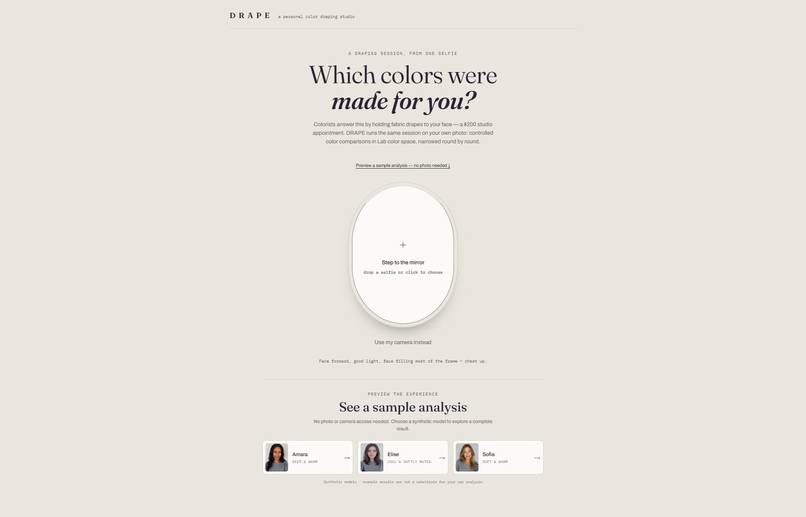
LANDING PAGE
-
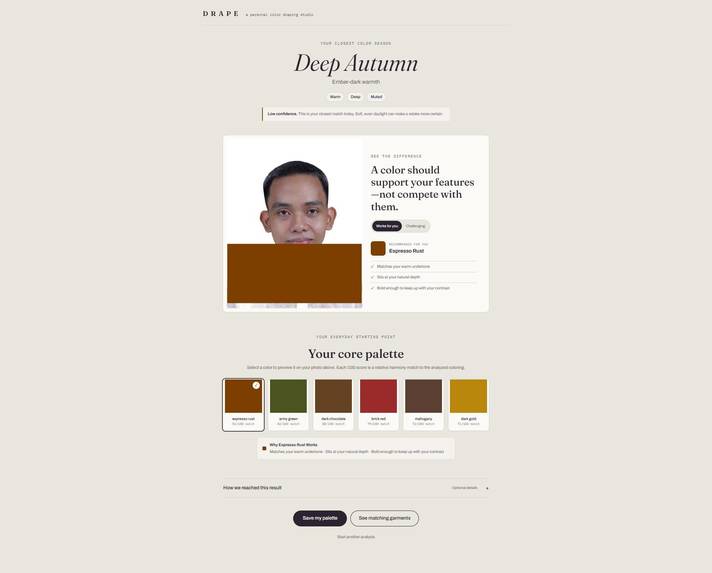
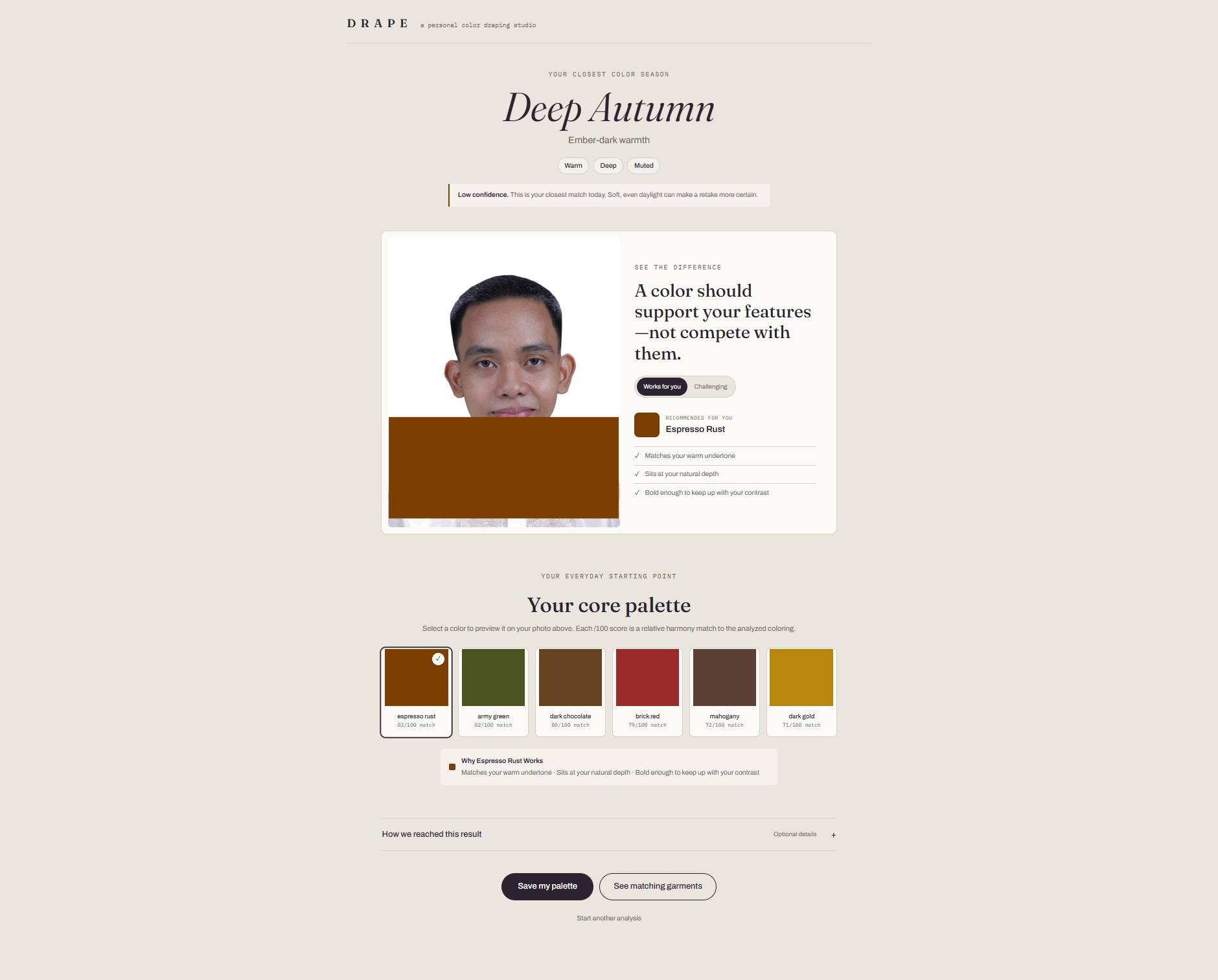
ANALYSIS PAGE
-
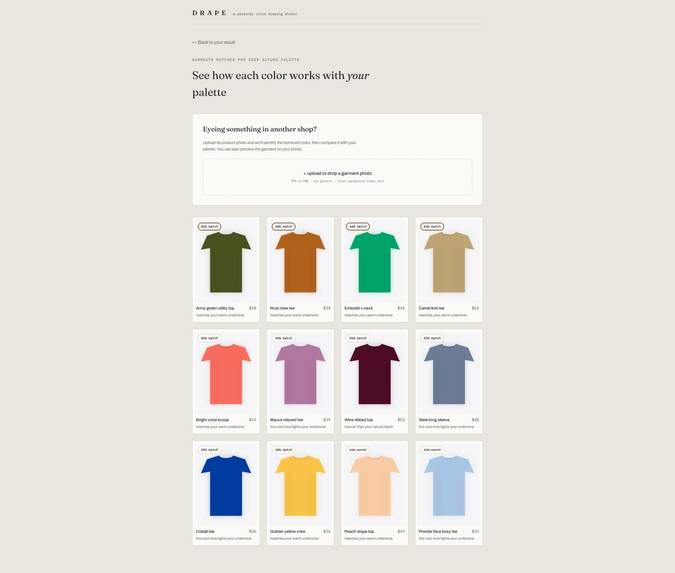
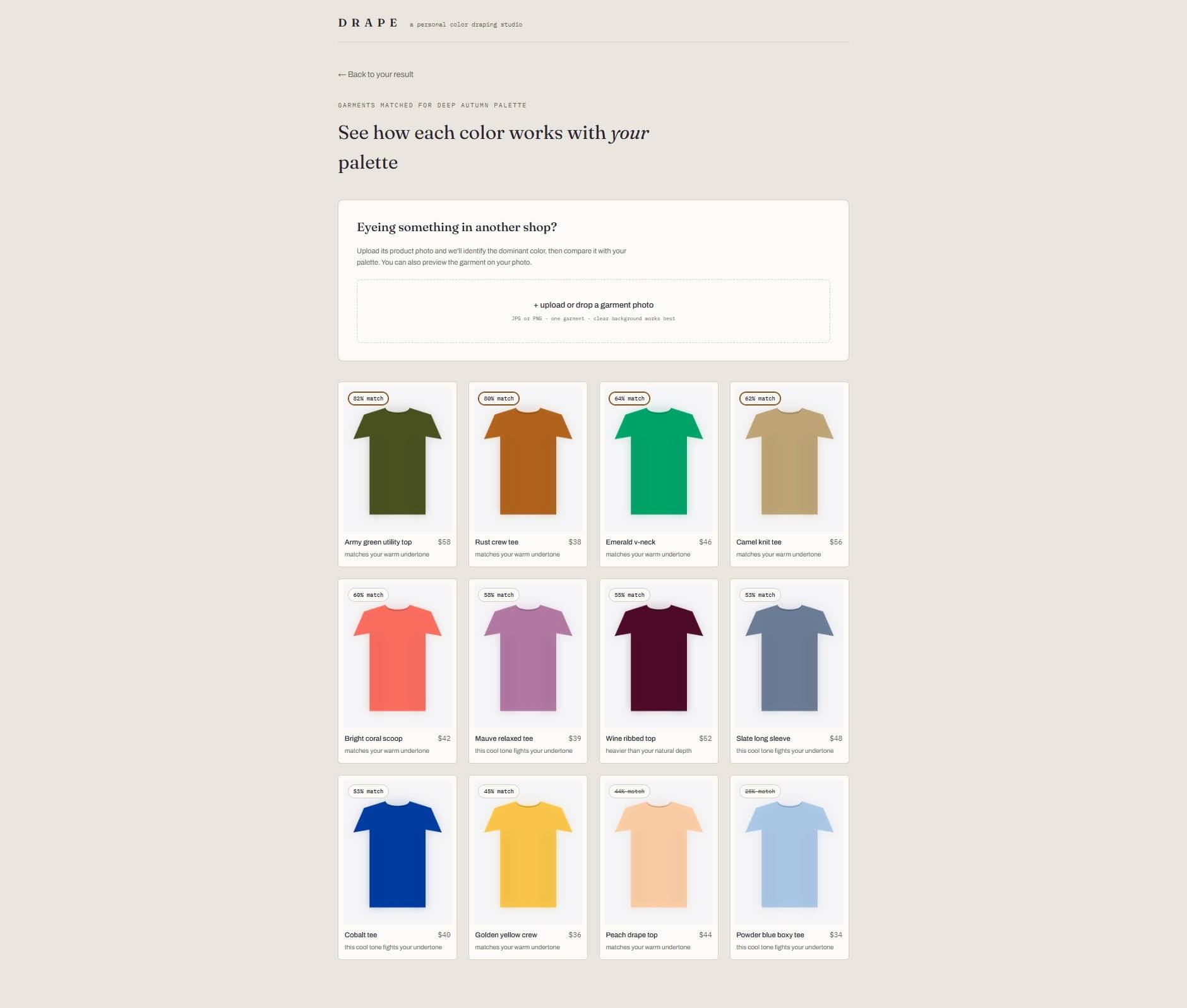
MATCHING GARMENT PAGE
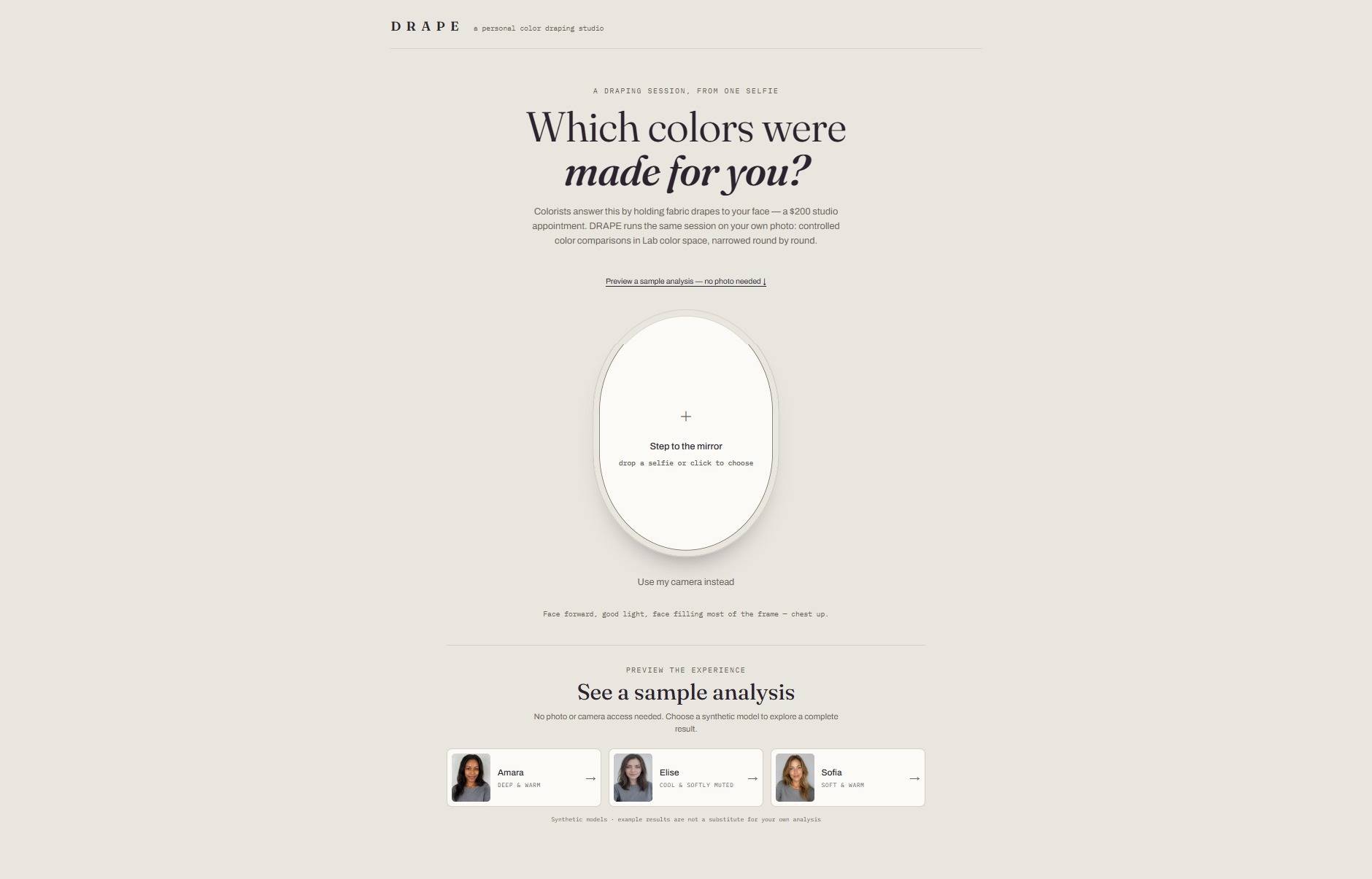
Inspiration
Personal color analysis helps people discover which shades complement their natural features—but it often costs $150–$300, requires a studio appointment, and can involve weeks of waiting. At the same time, online shoppers regularly experience the same frustration: a garment fits and matches the listing, yet somehow looks better on the model than on them. We built DRAPE to make that missing variable—color harmony—visible before checkout.
What it does
DRAPE turns one selfie into a personal color draping studio. It uses YouCam AI Facial Color Tones Analyzer and AI Skin Analysis to read the user’s skin, hair, eyes, eyebrows, lips, redness, and radiance. DRAPE then compares that profile across temperature, depth, and chroma to determine the closest match in the 12-season color system.
Users receive:
- Their closest seasonal palette and confidence level
- Recommended and challenging colors shown visually
- Explainable harmony scores for every shade
- Clothing ranked according to palette compatibility
- A garment checker for product photos from any store
- An optional YouCam AI Clothes VTO preview
- A shareable personal-color card
DRAPE does more than assign a label—it helps users make better wardrobe decisions.
How we built it
DRAPE combines a FastAPI backend with a React and Vite frontend.
YouCam provides the vision layer:
- Facial Color Tones Analyzer extracts measurable facial colors.
- AI Skin Analysis captures temporary skin conditions such as redness and radiance.
- AI Clothes VTO enables personalized garment previews.
We convert the extracted colors into CIELAB color space, where DRAPE can compare temperature, lightness, and chroma more consistently. An adaptive three-round decision process narrows the result from temperature to depth and finally to a specific season.
Every result includes plain-language reasoning, while photo-quality checks, API caching, usage limits, and confidence thresholds keep the experience reliable and honest.
Challenges we ran into
The Facial Color Tones Analyzer returns color values, but not a direct undertone classification. We therefore had to derive temperature using Lab measurements and supporting signals from the user’s facial features.
Generative try-on can also shift the requested garment color. Instead of trusting the input color, DRAPE measures the pixels of the rendered output before scoring it.
Photo quality created another challenge. Lighting, exposure, framing, and color casts can significantly affect an analysis, so we built a local quality gate that checks selfies before spending API units.
We also discovered that closely related seasonal palettes naturally overlap. Rather than presenting false certainty, DRAPE reports confidence and identifies which comparison was closest.
Accomplishments that we're proud of
We created an end-to-end experience that transforms raw facial-color data into something immediately useful for shoppers.
Our classifier was calibrated against 36 seasonal archetypes and achieved:
- 100% temperature accuracy
- 100% four-season family accuracy
- 92% exact 12-season accuracy
DRAPE connects analysis to action: users can understand their palette, evaluate garments, preview clothing, and make a decision within one experience.
What we learned
We learned that color analysis is not simply a classification problem. It is a comparison problem shaped by lighting, skin condition, garment rendering, and uncertainty.
We also learned that AI outputs should be measured rather than blindly trusted. By evaluating the actual rendered pixels, DRAPE turns generative output into evidence for its next decision.
Finally, explainability matters. A season name is interesting, but telling users why a color works—and how that insight applies while shopping—is what makes the result valuable.
What's next for DRAPE
Next, we want to improve DRAPE with:
- Guided camera capture for more consistent selfies
- Larger and more diverse calibration datasets
- Render-drift telemetry for improving color accuracy
- Direct integrations with fashion retailers
- Palette-aware product search and recommendations
- Saved profiles for comparing future purchases
- Expanded support for accessories, makeup, and hair color
Our long-term goal is to make personal color compatibility a standard part of online shopping—so people can ask not only “Will this fit me?”, but also “Was this color made for me?”

Log in or sign up for Devpost to join the conversation.