Inspiration
RepoSense started from a simple observation: modern software repositories are becoming too complex to understand through static tools alone.
While working on different projects, I realized that most repository analysis platforms only provide surface-level insights — file trees, dependency lists, and basic metrics. They rarely understand how different parts of a system actually connect, evolve, and interact together.
I wanted to explore a different approach.
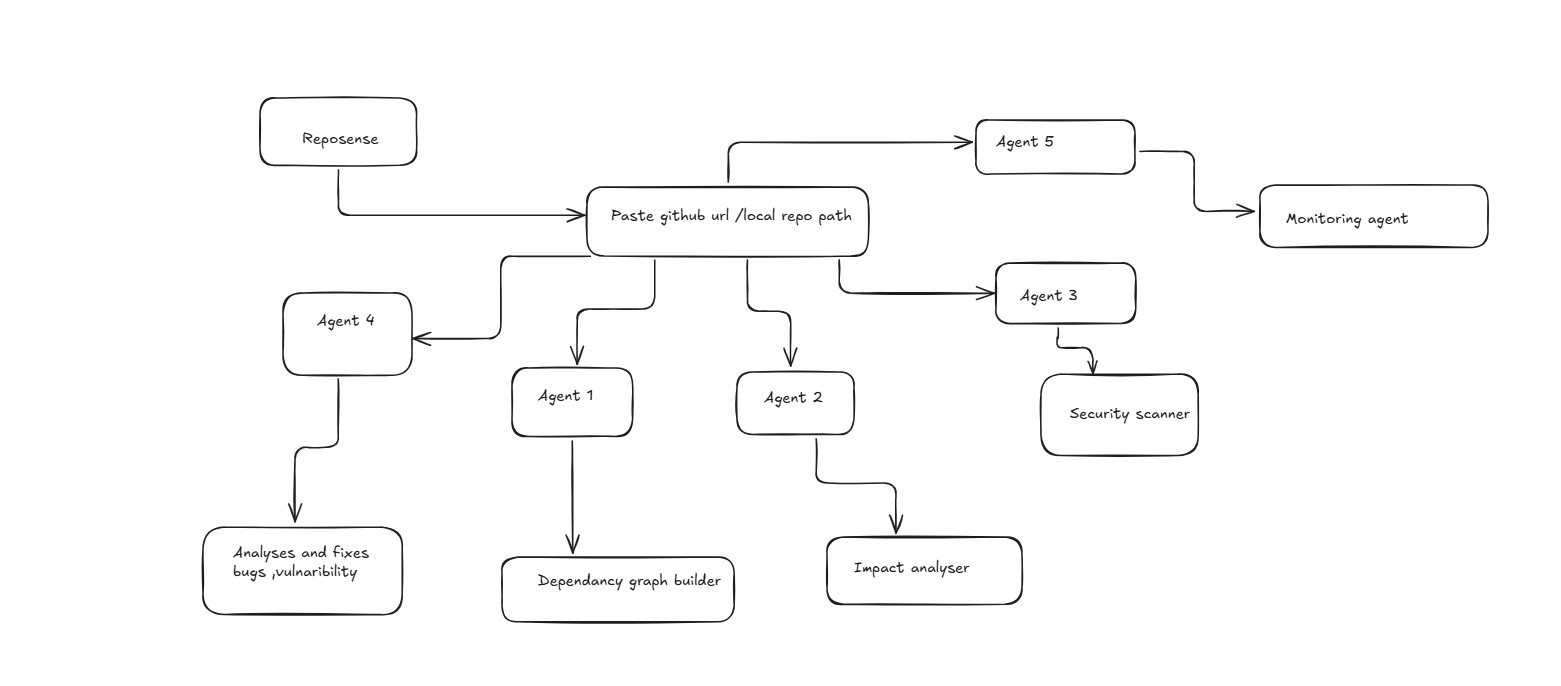
Instead of treating repositories as collections of files, RepoSense treats them as interconnected intelligence graphs where relationships, workflows, dependencies, and architecture patterns can be reasoned about autonomously.
The idea evolved into building a graph-native engineering intelligence platform powered by Jac orchestration and autonomous agent workflows.
RepoSense experiments with:
- graph-based repository understanding
- autonomous engineering reasoning
- multi-agent orchestration
- contextual software analysis
- AI-native developer tooling
One of the most exciting parts of building this project was designing the orchestration flow between agents and transforming repository data into something that could be analyzed more like a living system rather than static code.
This project was also an exploration of how future developer tools may evolve — moving from passive dashboards toward autonomous engineering intelligence systems capable of understanding software architecture contextually.
Beyond the technical implementation, RepoSense helped me think deeply about:
- AI infrastructure design
- graph-native reasoning systems
- developer experience
- orchestration architectures
- intelligent software tooling
RepoSense is still experimental, but it represents my attempt to explore what autonomous repository cognition could look like in the future of software engineering.
Built With
- css
- fastapi
- gemini
- githubapi
- html5
- jac
- javascript
- openai
- python
