-
-
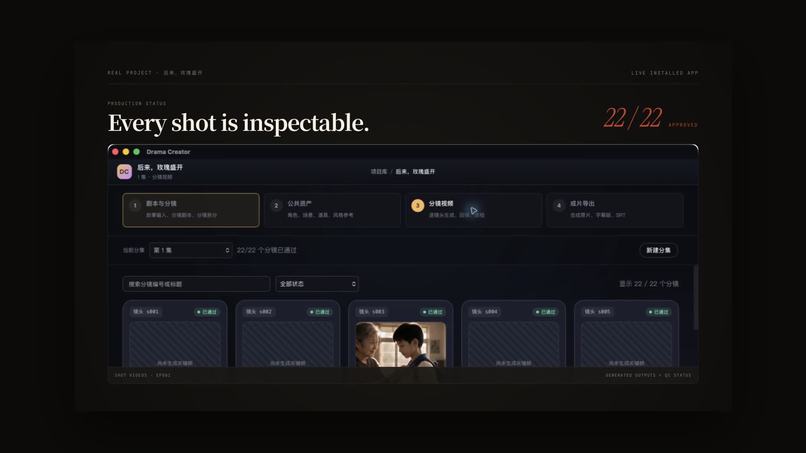
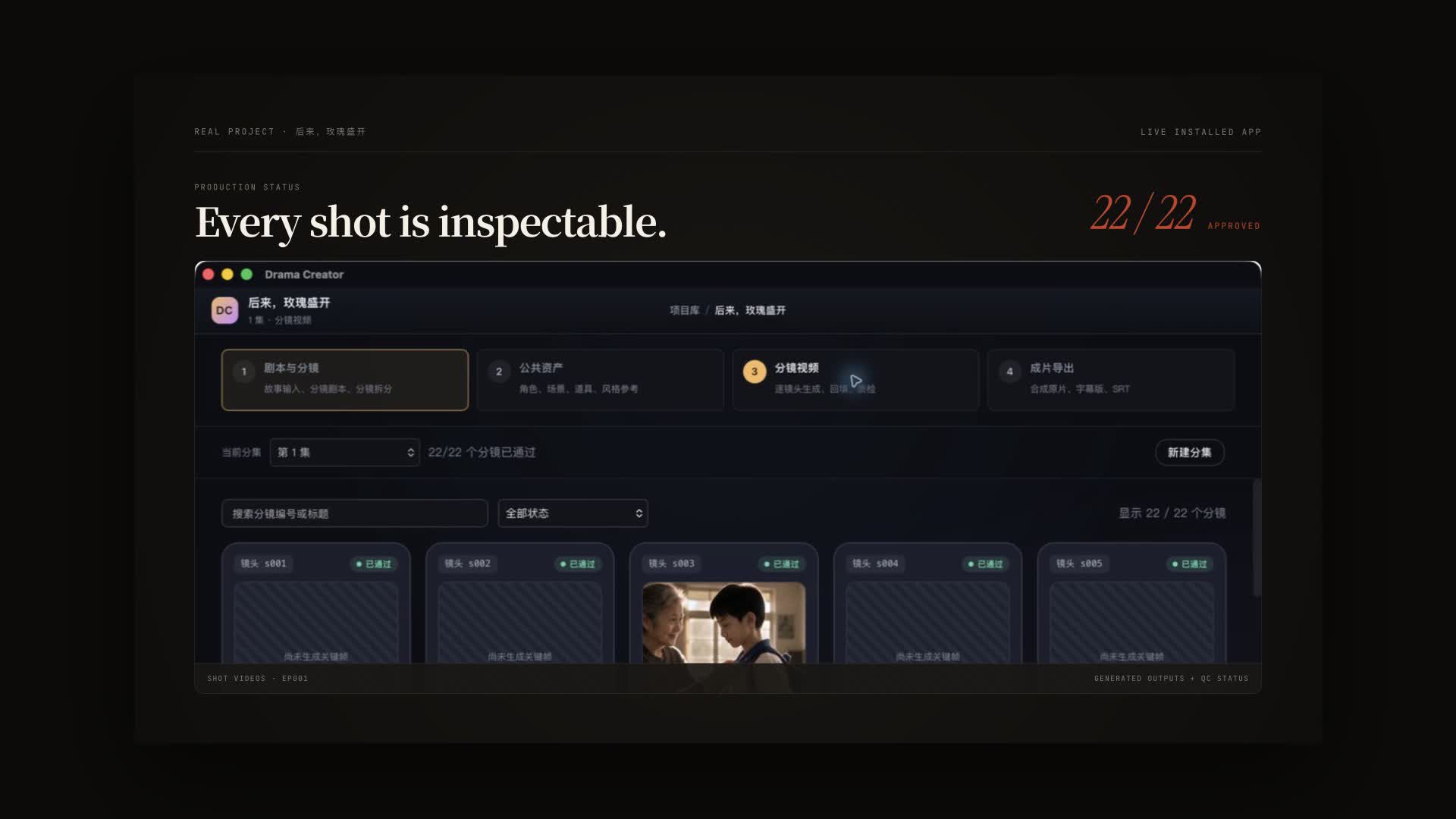
A real 22-shot production, with every shot approved and inspectable.
-
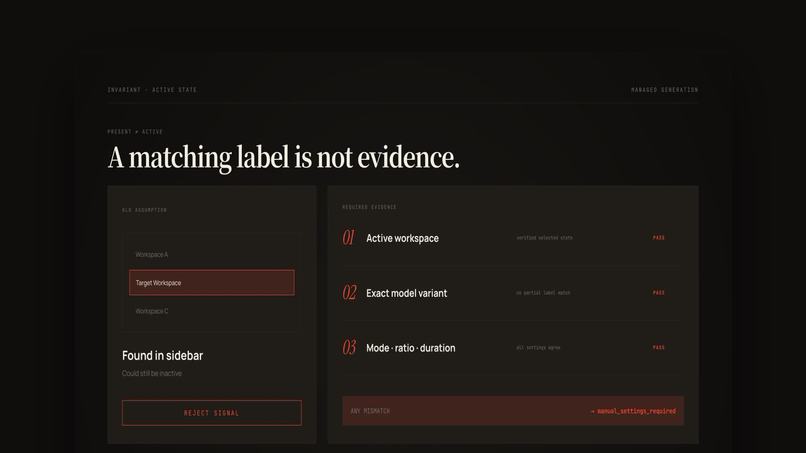
Build Week reliability evidence: exact state checks, upload deduplication, and regression tests.
-
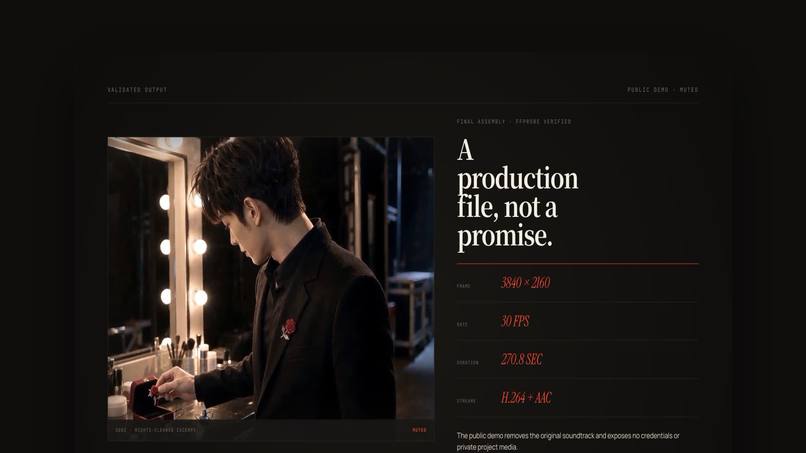
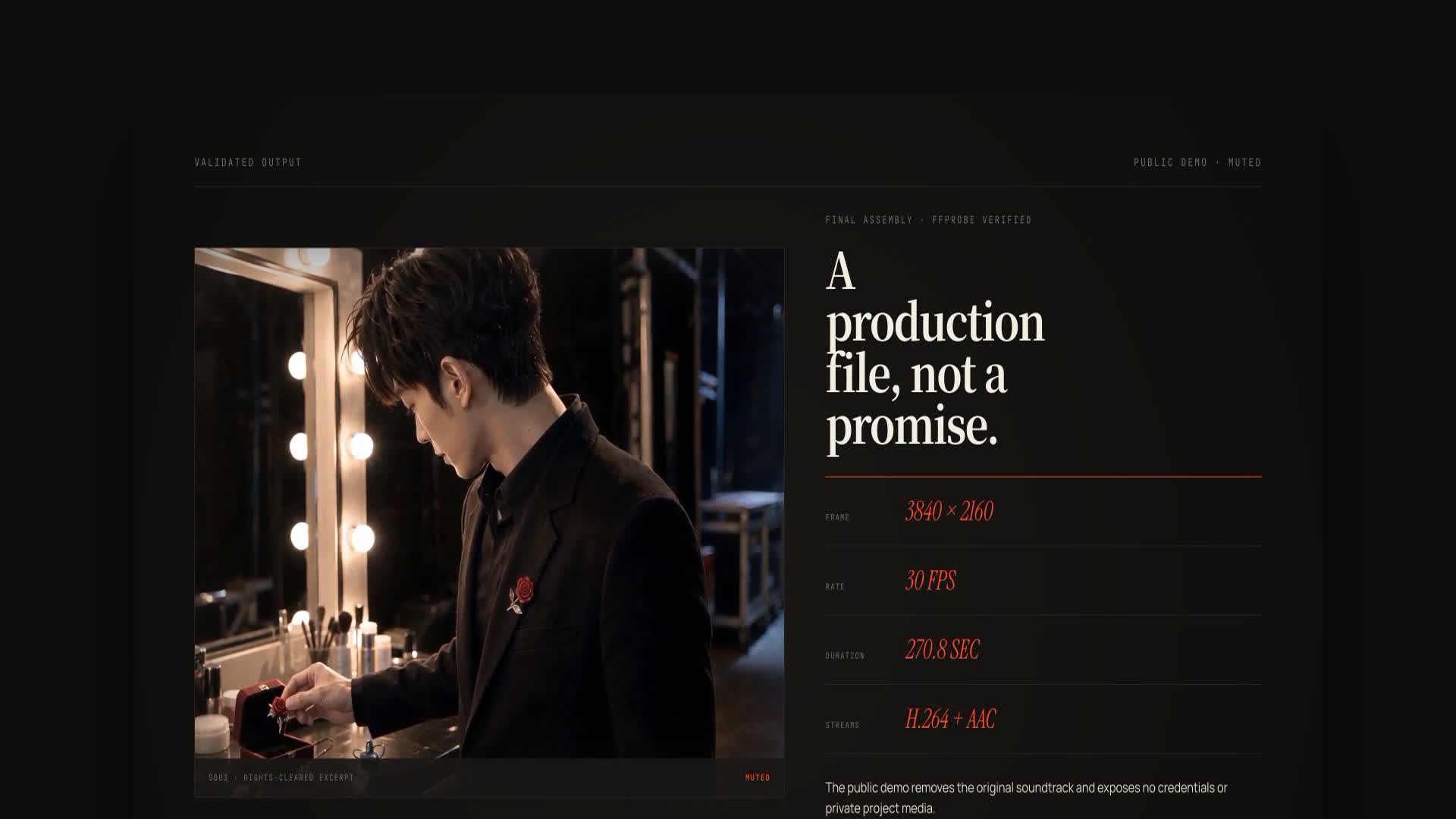
Validated 4K output backed by 236 graph nodes and 405 dependency edges.
-
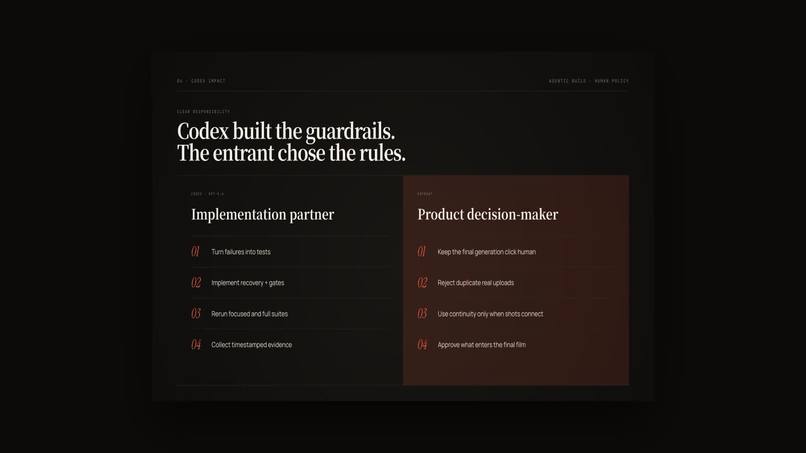
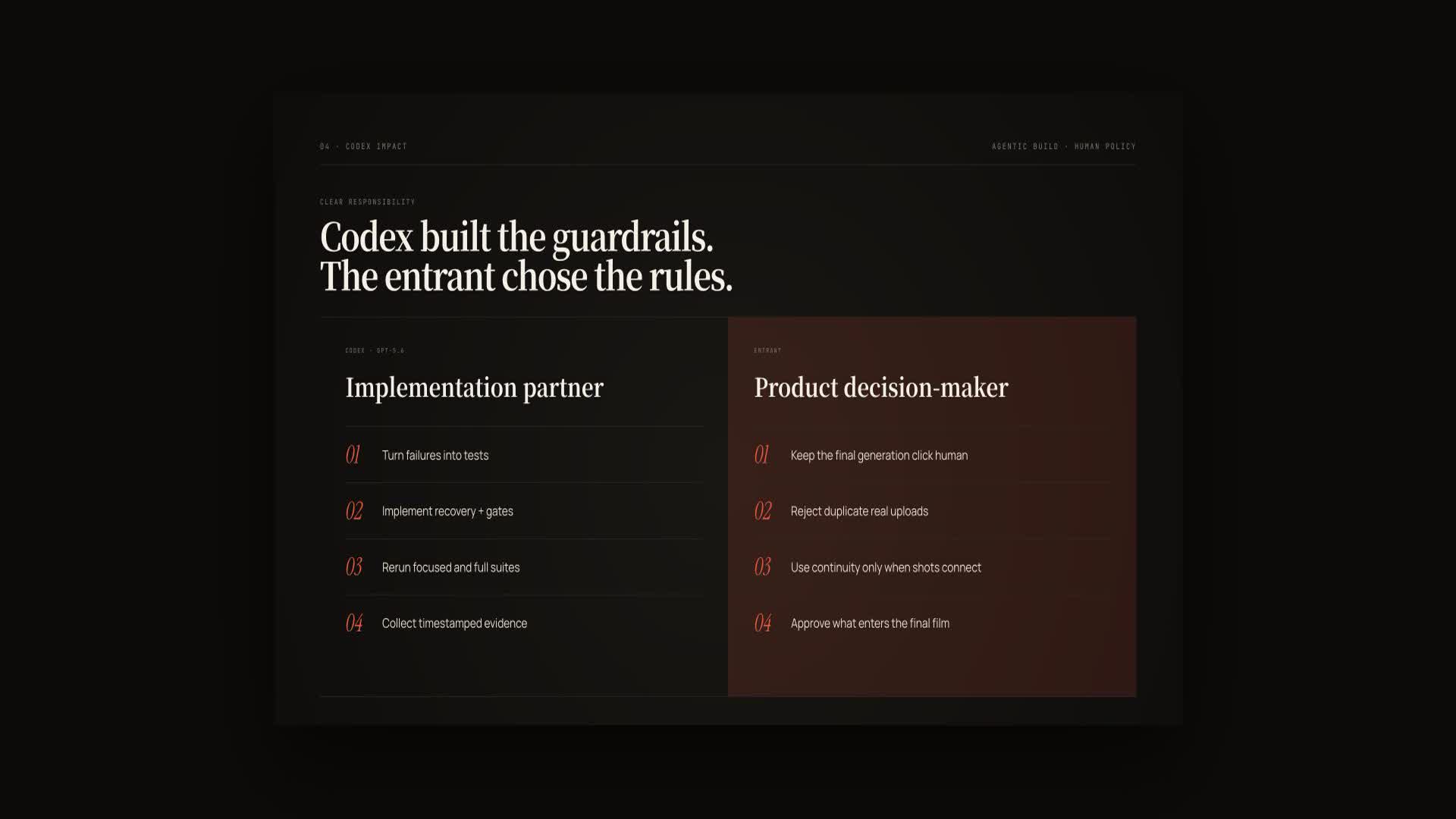
Codex implements tested guardrails; the creator retains the final external submit decision.
Inspiration
One prompt does not make a finished AI film. A usable production needs a story, a storyboard, reusable characters and locations, reference ordering, per-shot versions, quality checks, assembly previews, subtitles, and a final timeline. Independent creators need this structure, but most cannot adopt a heavy studio stack. We built Drama Creator to keep that process coherent, inspectable, and local to the creator's machine.
What it does
Drama Creator organizes production into four connected stages: story and storyboard, public assets, shot videos, and final export. A shot workspace shows its script, references, candidate and approved outputs, dependency links, and QC records as one graph, so creators can see why an output exists instead of only seeing the output.
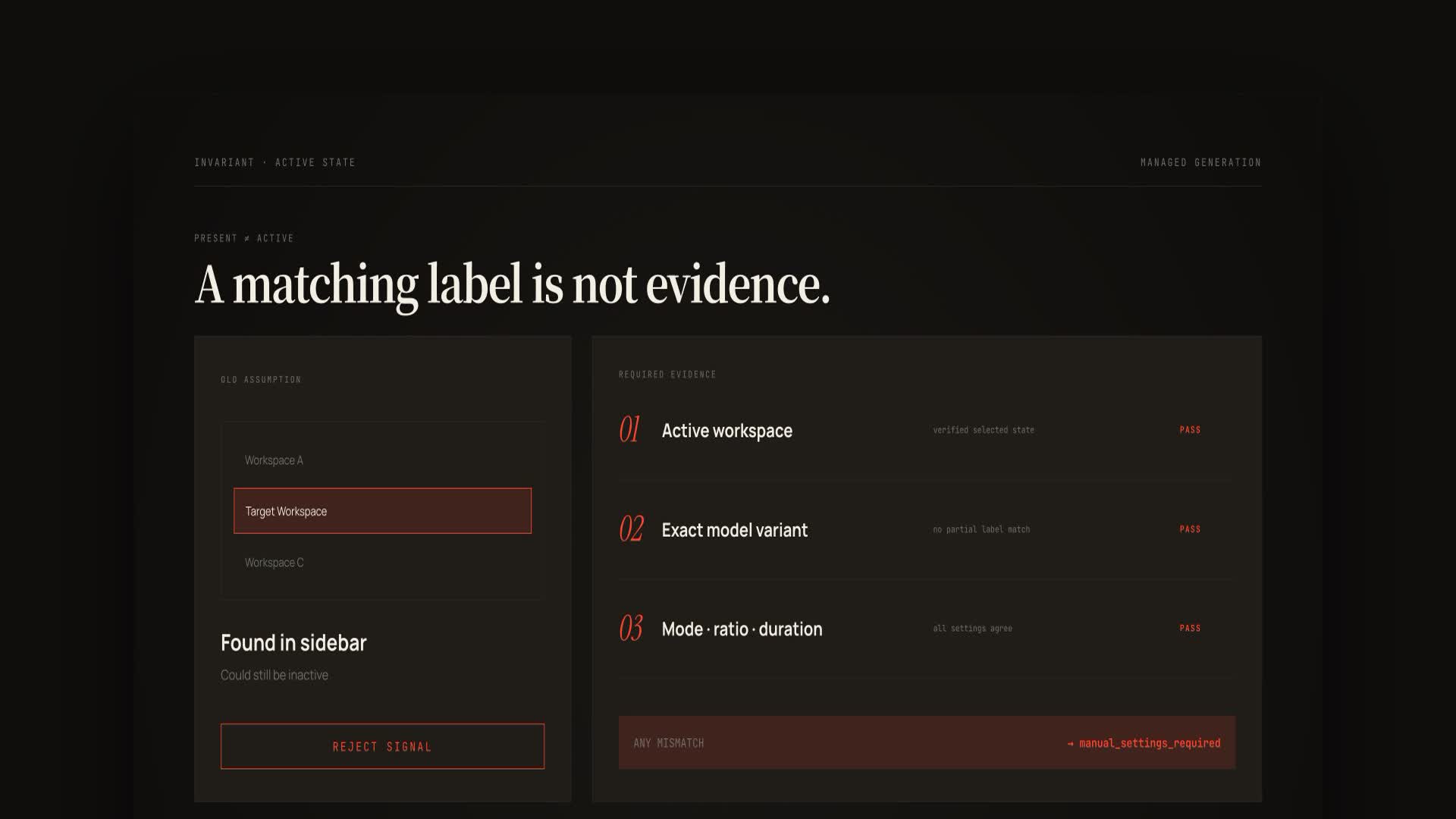
The managed-generation path prepares references and prompts in a creator's own authorized generation account, validates the active workspace and model, waits for uploads to settle, rejects duplicate real uploads, and stops before the final generation click. That final external action remains explicitly human.
Why it matters
Independent creators and small teams must coordinate far more than an individual generated clip: story intent, reusable references, versions, quality evidence, and a final edit. Drama Creator gives that audience one local, inspectable workflow so a 22-shot production can remain traceable from source story to approved output. The Build Week hardening addresses failure modes that otherwise make this workflow unreliable while keeping the final external generation decision with the creator.
What makes it different
Drama Creator treats AI generation as a production dependency graph, not a prompt history. Each shot connects its script, ordered reusable references, generated candidates, approvals, QC records, and assembly state. The combination of local-first provenance, state-verified automation, and an explicit human-controlled submit boundary is the core product idea.
What changed during Build Week
Drama Creator is an existing project. We are asking judges to evaluate only the production-hardening work added after July 13, 2026 at 9:00 AM PT:
- State-aware managed generation. The flow verifies the active workspace and exact model variant rather than trusting a matching label elsewhere on the page.
- Reliable reference handling. It clears prior composer state, waits for uploaded resources, deduplicates repeated references, prefers stable file-input object identifiers, and recovers from stale DOM handles.
- A deliberate human gate. Automation stops at
pre_submit_confirmation; the creator owns the final generation decision. - Fresh same-path assembly previews. Revision-aware media URLs prevent a macOS WebView from replaying a stale cached byte range after a rebuild.
The repository documents the prior/new boundary, timestamps, focused tests, and the primary Codex session used during the event.
How we built it with Codex and GPT-5.6
Codex with GPT-5.6 acted as an implementation and production partner rather than a one-shot code generator. It translated observed production failures into explicit invariants, wrote regression tests before code changes, implemented recovery and safety gates, inspected assembled previews, and converted creator feedback into reusable workflow rules.
The human entrant retained the product decisions: keep the final submit action human, reject duplicate uploads even when prompt wording repeats a reference, use hard cuts for ordinary scene changes, and reserve tail-frame continuity for genuinely continuous shots.
Challenges
The hardest failures were stateful and easy to miss in a toy demo. A page could contain the expected workspace name without that workspace being active; a partial model label could match the wrong variant; a previously valid file input could become stale after the page rerendered; and rebuilding a preview to the same path could still show old bytes in the desktop WebView. We reproduced each failure, turned it into a focused regression, and changed the workflow only after the failing behavior was observable.
Accomplishments
- 22/22 managed-generation regression tests pass.
- 28/28 export and workbench regression tests pass.
- 354/354 repository tests pass.
- The production validation project contains 22 approved shots, 236 graph nodes, and 405 dependency edges.
- Its validated final output is 3840×2160 H.264/AAC at 30 fps and 270.8 seconds.
- The public repository excludes credentials, browser profiles, private production media, and third-party account data.
What we learned
Reliable creative automation is less about producing another prompt and more about proving the state surrounding that prompt. Exact workspace identity, resource identity, model identity, cache revision, and a visible human boundary all matter. Production failures became the most valuable test cases because they exposed assumptions that a clean demo could not.
What's next
Next we plan to make the relationship graph easier to audit across multiple shots, add more model adapters behind the same human-confirmed contract, and package reproducible project fixtures so creators can compare generation and editing policies without sharing private media.
How to test
On macOS, install current Node.js and run:
git clone --branch openai-build-week-2026 https://github.com/jerryOnlyZRJ/drama-creator.git
cd drama-creator
npm ci
npm test
npm run dev
Open http://127.0.0.1:5173/, create a local project, and paste
samples/build-week-story.txt as the source. Third-party generation is optional
and requires the tester's own authorized account; the local editing, import,
QC, and export paths remain inspectable without it.
Built With
- codex
- ffmpeg
- gpt-5.6
- javascript
- macos
- node.js
- playwright
- rust
- tauri
- typescript


Log in or sign up for Devpost to join the conversation.