-
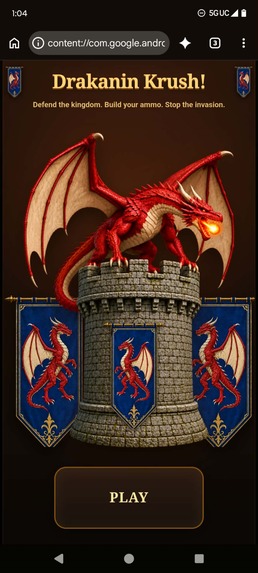
Title page
-
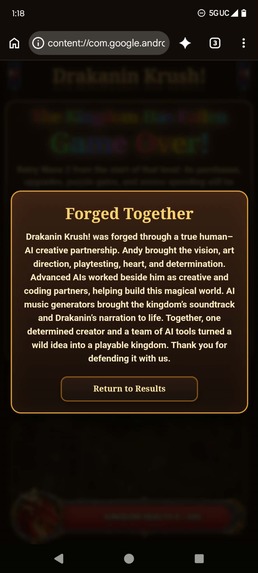
Credits
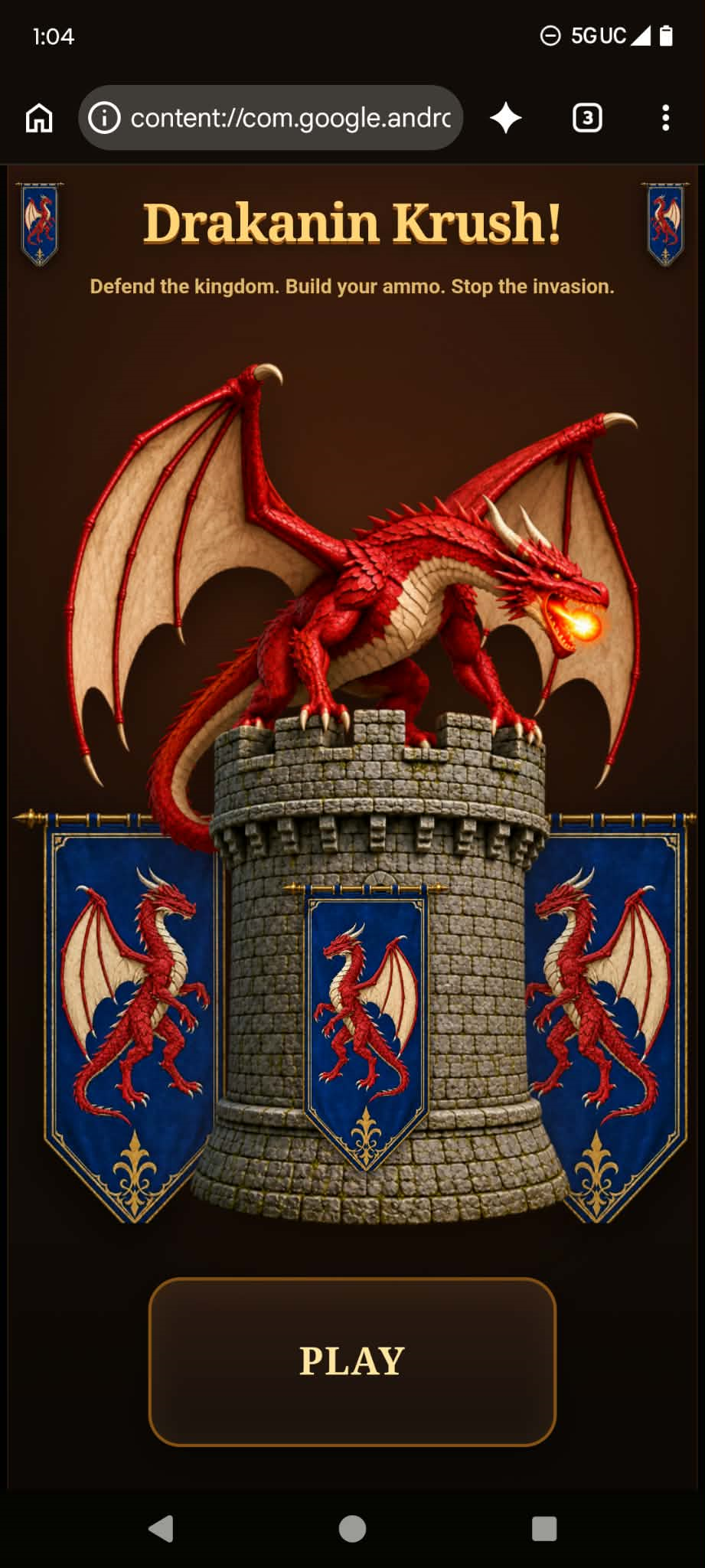
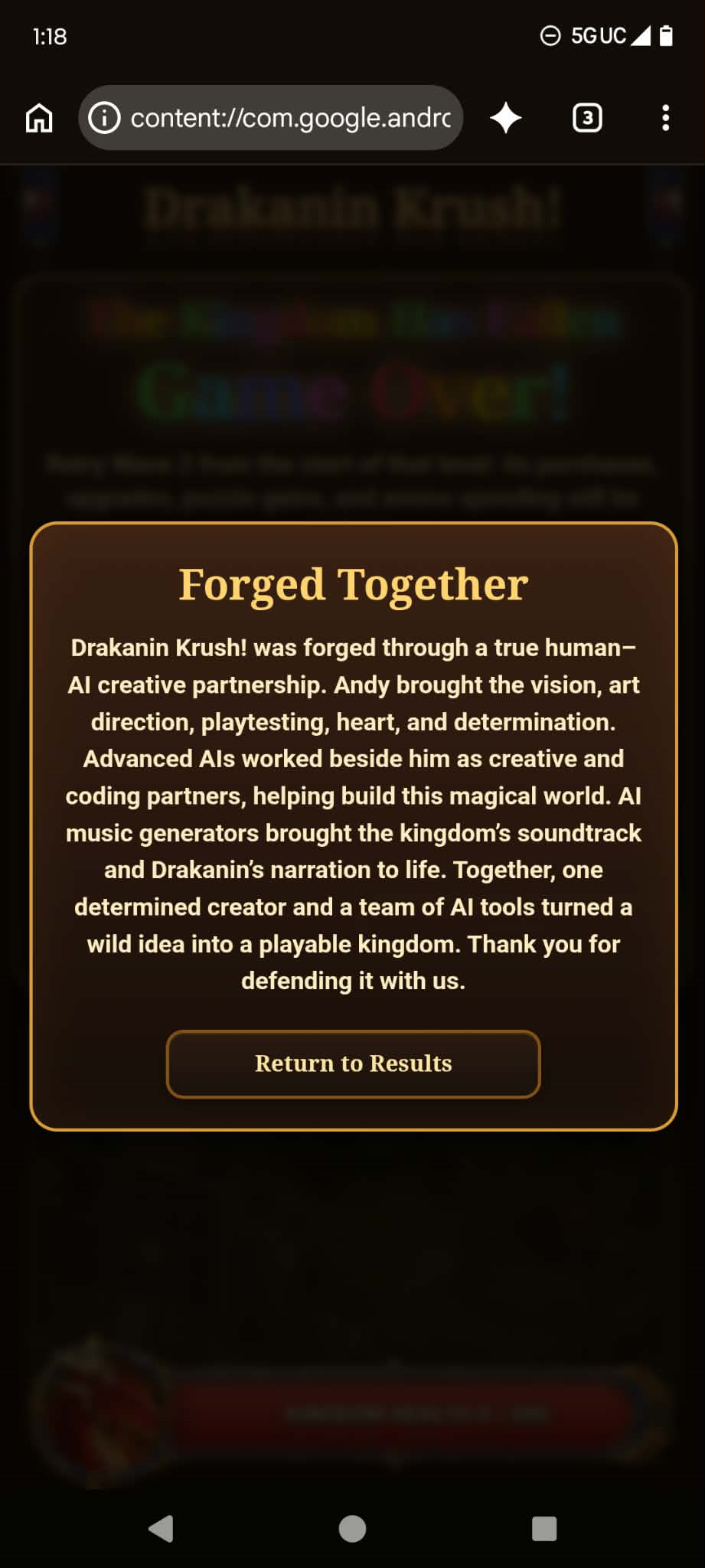
Inspiration
I love AI, dragons, Tetris, Candy Crush, and Kingdom Rush. Drakanin Krush! began with a question: what would happen if I combined the spatial strategy of falling-block puzzles, the satisfaction of creating matches, and the escalating pressure of tower defense inside one magical world?
I wanted the dragon to be more than a mascot or another unit on the battlefield. Drakanin is the hero, a living dragon tower, and the defender of his kingdom. Instead of receiving unlimited attacks on a timer, players must enter a unique puzzle and earn the ammunition Drakanin needs for war. Every successful match directly strengthens the next battle.
The goal was to create two different genres that did not merely sit beside each other, but actually depended on one another.
What it does
Drakanin Krush! is a hybrid puzzle and tower-defense prototype built around one connected gameplay loop.
Players enter a story-driven magical kingdom, place defenses beside a winding enemy path, upgrade their forces, and directly control Drakanin’s attacks. Drakanin can launch fireballs, unleash a flamethrower, or freeze enemies, but each attack consumes ammunition.
That ammunition is forged inside a two-phase 6×6 puzzle.
During the first phase, players rotate and position falling clusters of colored tiles. During the second phase, they swap tiles to create horizontal, vertical, and diagonal matches. Red matches create fireball ammunition, pink matches power the flamethrower, and blue matches create freeze attacks.
The player then returns to the battlefield with the ammunition they earned, expands their defenses, and attempts to survive increasingly dangerous enemy waves.
The puzzle is not a separate minigame. It is the kingdom’s war economy.
How we built it
Our development team was unconventional, but elite.
I served as the creative director, game designer, producer, art director, tester, and final decision-maker. ChatGPT was my primary AI co-creator and development partner throughout the entire 25-session production process. Starting from my creative vision and decisions, ChatGPT helped design and document the game, translate my ideas into precise mechanics, write and revise the prototype, diagnose problems, coordinate detailed iterations, maintain continuity, prevent regressions, and perform quality assurance.
The VS Code AI agents contributed legacy TypeScript and Horizon code from my entry in the previous MHCP competition. That older code served only as source material and a historical foundation. ChatGPT analyzed it, identified the useful concepts, and converted, rebuilt, and greatly expanded those ideas into the standalone HTML, CSS, and JavaScript systems used in Drakanin Krush!
Suno helped create the original music, narration, and sound assets from my creative direction and prompts.
The result was a genuinely collaborative workflow: I supplied the vision, creative judgment, testing, feedback, and final approval, while ChatGPT served as the central AI partner connecting the game design, development, documentation, troubleshooting, and preservation of the project from beginning to end.
The prototype was built as a compact standalone experience using HTML, CSS, and JavaScript, with controls and layouts designed to work on both desktop and mobile devices.
We developed the project through 25 focused production sessions. During each session, I reviewed changes, tested the game on both my computer and phone, identified problems, provided exact corrections, protected stable versions, and approved each feature before moving forward.
One of the most important parts of our process was a dual-document continuity system. We maintained two Markdown files:
- A living game specification containing the complete current design, mechanics, requirements, and rules that every future iteration needed to follow.
- A chronological build log recording what changed, why it changed, what succeeded, what failed, and what still needed testing.
Every development session began by reviewing both documents. Every completed session ended by updating them.
The game specification preserved the current truth of the project, while the build log preserved the history and reasoning behind that truth.
This became our development cheat code. It reduced prompt drift, specification rot, forgotten decisions, contradictory changes, and AI hallucinations to almost zero throughout a long and highly iterative production process.
Keeping the conversations, files, decisions, and testing history inside one dedicated project workspace also allowed the entire team to operate with much stronger continuity and thoroughness from one session to the next.
Challenges we ran into
The greatest challenge was not whether we could build our ideas. It was knowing when to stop, because almost everything we created felt like magic, and every successful feature inspired five more possibilities.
Controlling the scope became essential.
We deliberately limited the prototype to one polished battlefield, one complete puzzle format, a focused collection of defensive towers and dragon attacks, and a complete beginning-to-ending gameplay experience. Features that did not strengthen the central puzzle-to-ammunition-to-battle loop were saved for the future instead of being allowed to delay the finished prototype.
Another major challenge was combining two genres without making either side feel unnecessary. The puzzle needed to be satisfying on its own, but its matches also needed to matter during battle. The tower-defense side needed to provide enough pressure that every piece of ammunition felt valuable, without making the player feel powerless.
We also had to create readable touch controls for a mobile screen, balance ammunition rewards against enemy health, build clear tower-placement rules, maintain smooth camera and audio transitions, prevent regressions, and keep the final package within the submission requirements.
We solved these challenges through detailed iterations, real-device testing, clear acceptance criteria, careful version preservation, and a willingness to improve working systems without constantly rebuilding them from the beginning.
Accomplishments that we're proud of
We are most proud that Drakanin Krush! is not simply a tower-defense game with a puzzle attached to it.
The two systems genuinely depend on one another. Puzzle decisions determine the player’s battle resources, while the pressure of the battlefield gives every puzzle decision meaning. Matching tiles is not only a way to earn points. It creates the fireballs, flames, and freezing attacks needed to defend the kingdom.
We are also proud of how much complete game experience we fit into one prototype.
The game includes a story introduction, tutorial guidance, mobile controls, a two-phase puzzle, tower placement, defensive upgrades, multiple dragon attacks, different enemy types, several escalating waves, a boss encounter, camera transitions, original music and narration, sound effects, saving, an Easter egg, win-and-lose states, and a complete credits sequence acknowledging the human and AI collaboration that brought the project to life.
Completing this experience through 25 documented sessions also proved that a disciplined human-led AI production pipeline can remain coherent across a large number of detailed iterations.
What we learned
The most important lesson was that AI-assisted development becomes far more reliable when it is treated as a real production pipeline instead of a series of disconnected prompts.
Clear documentation, version preservation, explicit instructions, source-of-truth files, decision logs, acceptance criteria, and repeated testing transformed the AI tools from temporary assistants into a coordinated team.
The AI did not replace creative direction. It amplified the direction I supplied.
We learned that the combination of a living game specification and chronological build log was especially powerful. One document explained exactly what the game was supposed to be, while the other explained how and why it became that way. Together, they preserved both the destination and the journey.
I also learned how to divide a large creative vision into manageable sessions, communicate exact visual and mechanical requirements, test one set of changes at a time, identify regressions, and preserve the reasoning behind important decisions.
Most importantly, I learned that I do not need to personally write every line of code before I can direct the creation of an original and complete game. I need a strong vision, a disciplined workflow, persistence, good collaborators, and the ability to recognize when something feels right.
What's next for Drakanin Krush!
The full vision for Drakanin Krush! includes a larger story, additional defensive towers, more dragon attacks, new enemy types, deeper strategic upgrades, and more varied battlefields.
Advanced levels would introduce larger 8×8 and 10×10 puzzle grids, giving players more room to plan complex placements, matches, and cascades. The game would then grow through a focused progression toward level 100, with new challenges and mechanics introduced along the way.
This prototype is also the beginning of a larger Drakanin universe.
I want to use its characters, magical world, visual identity, original music, and gameplay technology as the foundation for future games in different genres—all featuring our star, Drakanin.
His story began with one dragon defending his kingdom, one match at a time.


Log in or sign up for Devpost to join the conversation.