-
-
Overview
Inspiration
Large Language Models are becoming increasingly capable, but browser automation is still built around the DOM—a representation designed for browsers, not AI. We wanted to rethink the browser from an AI-first perspective by giving agents a semantic understanding of web pages instead of forcing them to interpret raw HTML and fragile CSS selectors.
What it does
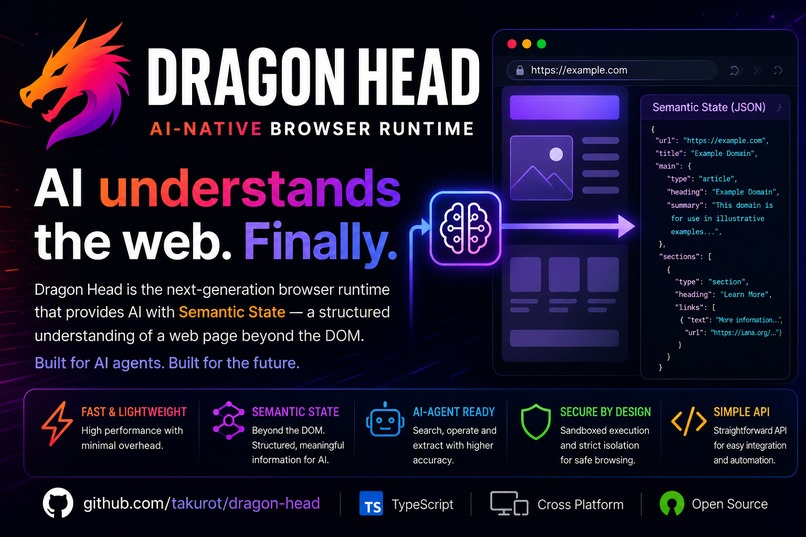
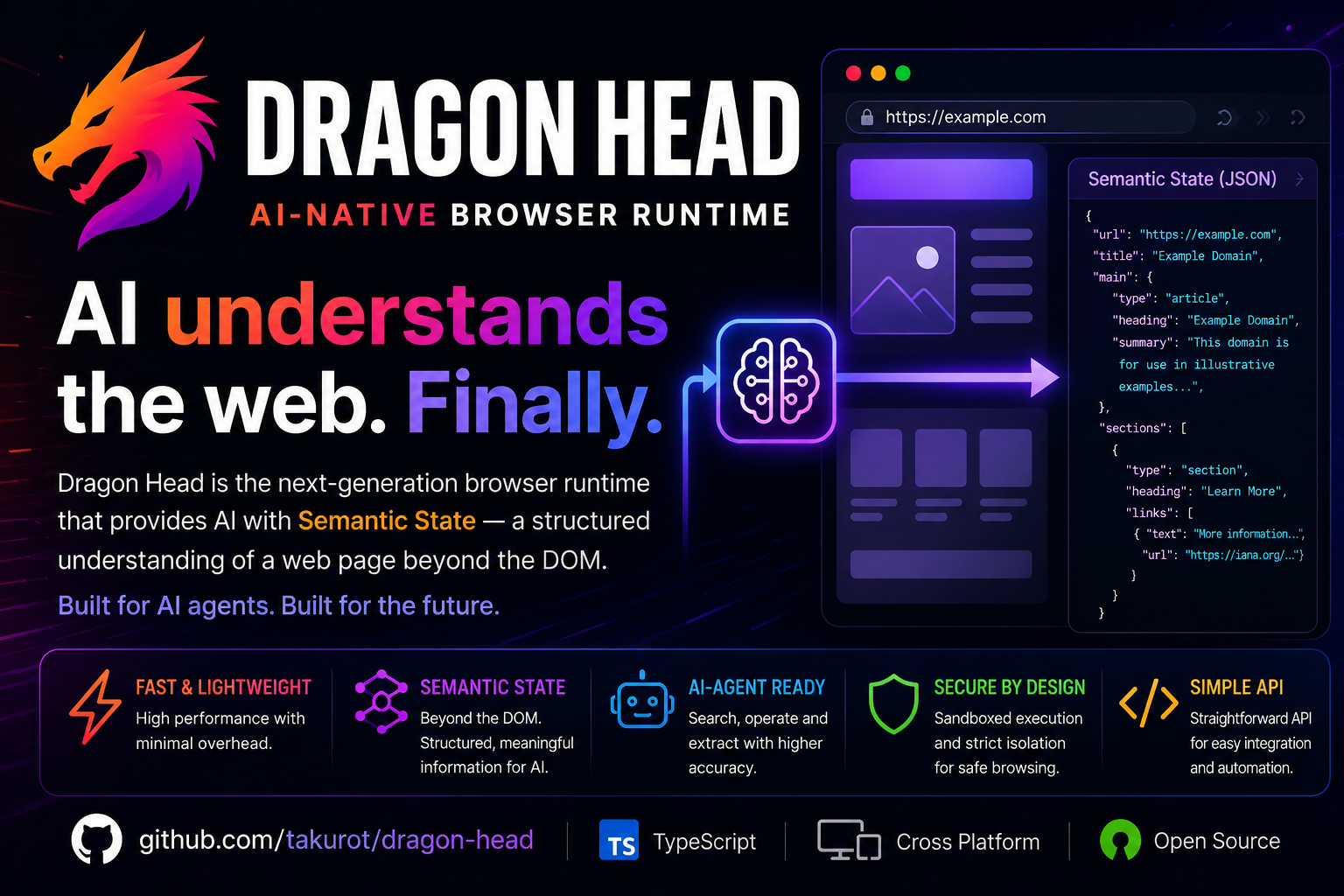
Dragon Head is an AI-native browser runtime that transforms web pages into a structured Semantic State. Instead of interacting with the DOM directly, AI agents operate on meaningful page elements, enabling more reliable web automation, information extraction, and autonomous workflows.
How we built it
We built Dragon Head in TypeScript as a lightweight browser runtime. It analyzes web pages, extracts their semantic structure, and exposes a simple API that AI agents can use to understand and interact with websites. The architecture is designed to be fast, extensible, and compatible with modern LLM-powered applications.
Challenges we ran into
The biggest challenge was determining what information is actually useful for AI. A Semantic State must capture the intent of a page while remaining compact enough to reduce token usage and fast enough for real-time interaction. Balancing completeness, reliability, and performance required multiple iterations.
Accomplishments that we're proud of
- Designed a new Semantic State abstraction beyond the traditional DOM.
- Created an AI-first browser runtime instead of another browser automation library.
- Built a simple developer experience that makes AI-powered browser automation easier and more reliable.
- Open-sourced the project for the AI developer community.
What we learned
Building for AI requires a different mindset than building for humans. Instead of exposing implementation details like HTML, browsers should expose meaning. We learned that structured semantic information makes AI agents simpler, more reliable, and more efficient.
What's next for Dragon Head
Our vision is to make Dragon Head the runtime layer for AI agents on the web.
Next, we plan to:
- Support more complex web applications.
- Improve Semantic State generation and standardization.
- Optimize for lower latency and token efficiency.
- Integrate with popular AI agent frameworks and MCP ecosystems.
- Grow an open ecosystem around AI-native browser development.

Log in or sign up for Devpost to join the conversation.