-
-
DraftLens EDU
Inspiration
As a CAD and visualization educator, I need to give students frequent drawing assignments so they can improve through practice. The barrier is the time required to grade every DXF carefully, identify the exact location of each error, calculate fair deductions, and explain how the student can correct the mistake.
Manual grading can also vary because of workload, fatigue, different grading sessions, and differences between instructors.
DraftLens EDU was created to make CAD assessment more consistent, visible, and educational.
What it does
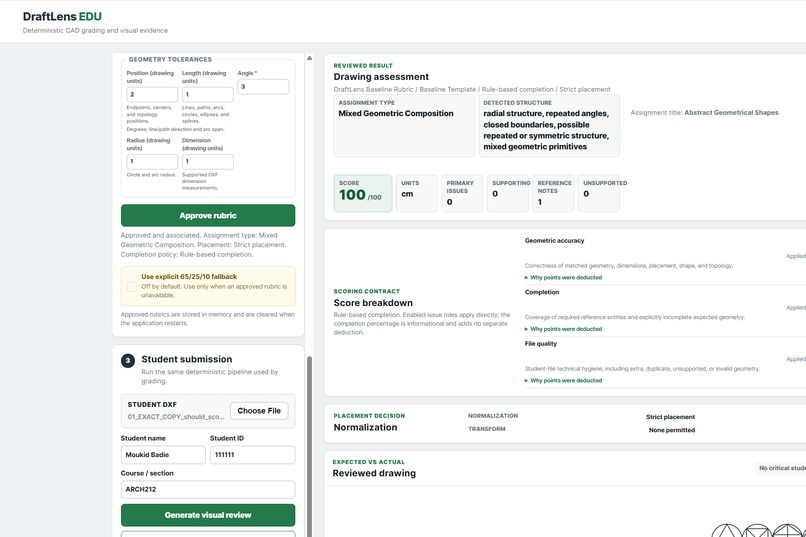
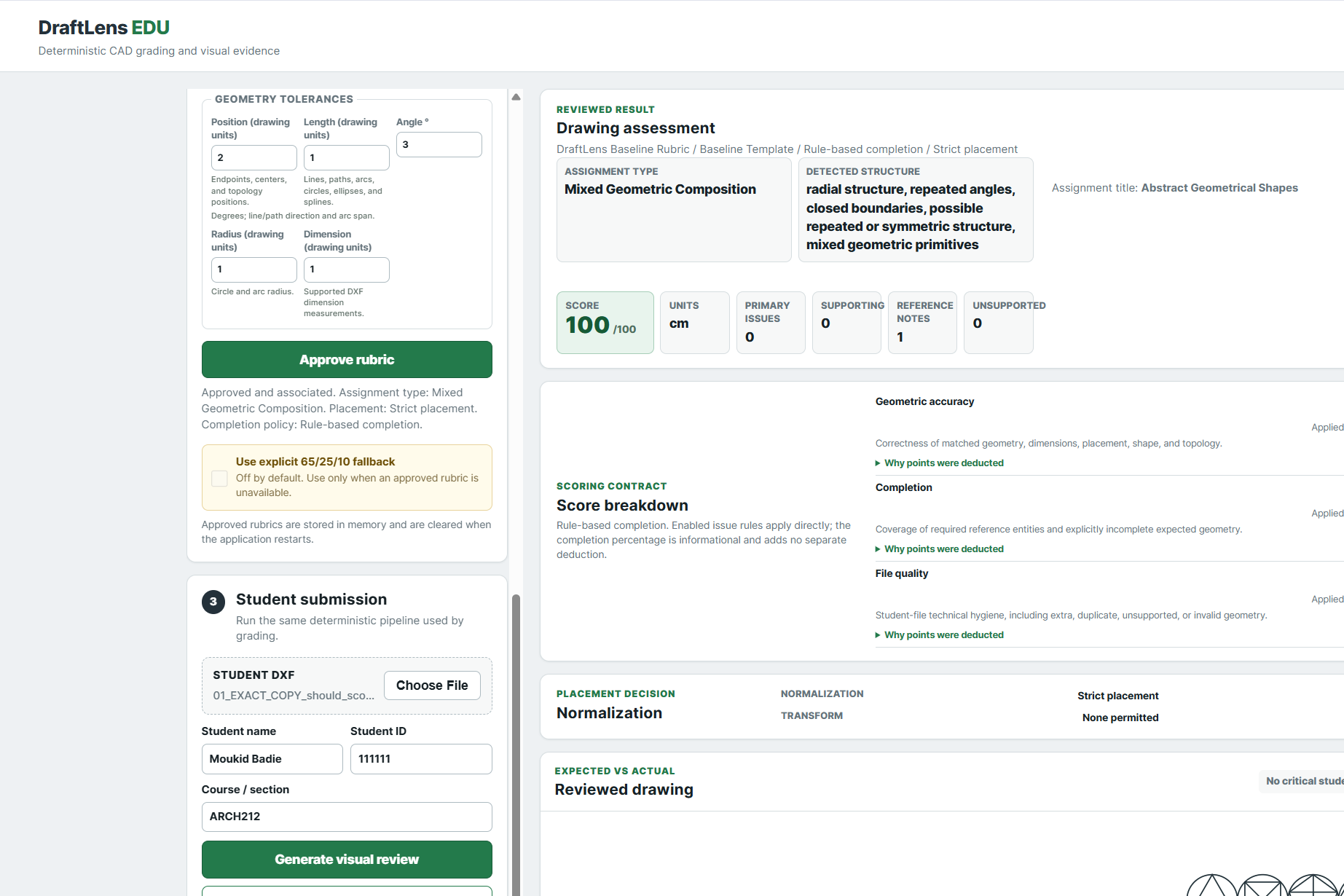
DraftLens EDU compares an instructor-approved reference DXF with a student DXF and produces an explainable visual assessment.
The instructor:
- uploads a reference drawing;
- confirms the assignment title and type;
- reviews and approves the DraftLens Baseline Rubric;
- selects placement and completion policies;
- uploads the student drawing;
- receives a deterministic score, reviewed drawing, detailed findings, correction guidance, and an authoritative PDF report.
DraftLens can identify supported cases of:
- missing geometry;
- extra geometry;
- duplicate entities;
- incorrect position;
- incorrect length;
- incorrect angle;
- incorrect radius;
- endpoint and topology problems;
- complete drawing displacement;
- likely global scale or unit mismatch;
- unrelated or incompatible assignment files.
Each deduction is connected to evidence such as the expected entity, actual entity, measurement, deviation, tolerance, rubric rule, deduction cap, and correction guidance.
The system also includes:
- strict and translation-tolerant placement policies;
- rule-based and proportional completion scoring;
- primary and supporting finding separation;
- causal scoring to reduce double deductions;
- Student-only inspection mode;
- coherent-correspondence compatibility protection;
- authoritative vector PDF reports;
- explicit instructor override for suspicious or incompatible submissions.
How we built it
DraftLens EDU uses:
- Python and FastAPI for the application and API;
- ezdxf for DXF parsing;
- Shapely for geometric operations;
- deterministic geometry normalization and matching;
- reference-aware topology analysis;
- causal issue classification;
- rule and category deduction caps;
- JavaScript, HTML, CSS, and SVG for the review interface;
- ReportLab for vector PDF reports;
- pytest for controlled regression testing.
GPT-5.6 was used to convert classroom experience into explicit product requirements, challenge early architectural decisions, define grading and fairness rules, identify double-deduction risks, evaluate manual test results, and define acceptance criteria.
Codex was used to inspect and restructure the repository, implement the deterministic grading pipeline, generate controlled DXF fixtures, diagnose matching and scoring defects, optimize dense drawings, build the user interface and PDF reporting workflow, and run the automated regression suite.
GPT-5.6 helped determine what should be built and why. Codex helped build, test, diagnose, and correct it.
Challenges
The main challenge was that CAD comparison is not simply checking whether two files contain similar entities.
Repeated geometry can produce valid but incorrect matches. A moved object can create several secondary endpoint gaps. A completely translated drawing may be geometrically correct but violate the instructor's placement policy. An unrelated drawing may contain generic lines and circles that appear superficially similar.
DraftLens therefore needed:
- coherent spatial correspondence;
- causal issue classification;
- reference-aware topology;
- compatibility gating;
- scale diagnostics;
- instructor-controlled placement policies;
- explicit score reconciliation.
Another major challenge was performance. A dense 1,942-entity geometric reference initially produced an impractical number of topology comparisons. A spatial indexing strategy reduced the analysis to approximately one second while preserving deterministic results.
Accomplishments
The final competition release includes:
- deterministic DXF grading;
- visible and traceable deductions;
- correction-command guidance;
- compatibility protection against wrong files;
- global translation diagnosis;
- scale mismatch diagnosis;
- Student-only inspection;
- compact large-finding summaries;
- authoritative multi-page vector PDF reports;
- controlled sample datasets;
- 304 automated tests passing with zero failures, skips, xfails, or xpasses.
The final release also passed Python compilation, JavaScript syntax validation, dependency validation, and Git integrity checks.
What we learned
The most important lesson was that educational grading cannot be reduced to geometric difference alone.
A useful system must understand the relationship between:
- instructor intent;
- assignment compatibility;
- geometric evidence;
- primary causes;
- secondary consequences;
- scoring rules;
- correction guidance.
The project also demonstrated how a non-traditional software developer can use GPT-5.6 and Codex to transform deep domain experience into a tested working product.
What's next
Future development may include:
- reviewed DXF files with dedicated feedback layers;
- native DWG support;
- persistent instructor accounts and databases;
- batch grading and class analytics;
- LMS and Excel integration;
- plagiarism and similarity detection;
- Arabic and English feedback;
- rubric libraries;
- learning-outcome guidance;
- extension to 3D modelling, rendering, visualization, and other CG disciplines.
Built With
- codex
- css
- ezdxf
- fastapi
- html
- javascript
- openai
- pillow
- pypdf
- pytest
- python
- reportlab
- shapely
- svg


Log in or sign up for Devpost to join the conversation.