Inspiration
Cloud9's Category 2 brief asks for a coaching tool that cuts spreadsheet chaos and supports Fearless Draft: when a champion is used in one game, it is gone for both teams for the rest of the series. Coaching staffs already know this pain. Pick and ban notes live in sheets, comfort picks shrink as a series goes long, and a plan written for game 1 can collide with game 2.
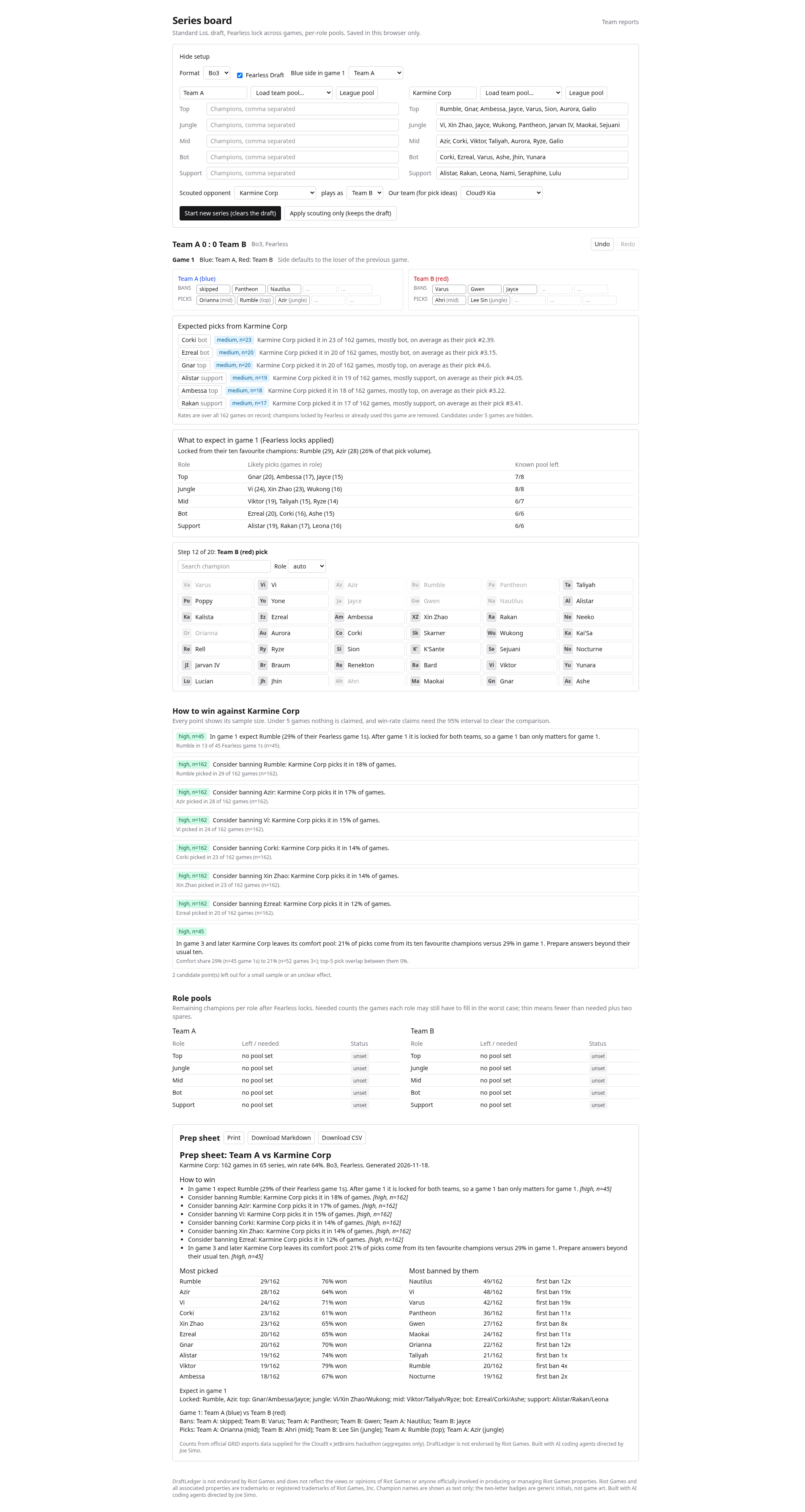
DraftLedger started from that brief and from the official GRID starter data for this hackathon. The idea was not a new prediction model. It was a series board a coach can actually run before a match: tendencies with sample sizes, a twenty-step draft with reasons, the Fearless lock applied the moment game 1 ends, and a prep sheet to take into the booth.
What it does
DraftLedger is a Fearless Draft preparation tool for League of Legends coaching staffs.
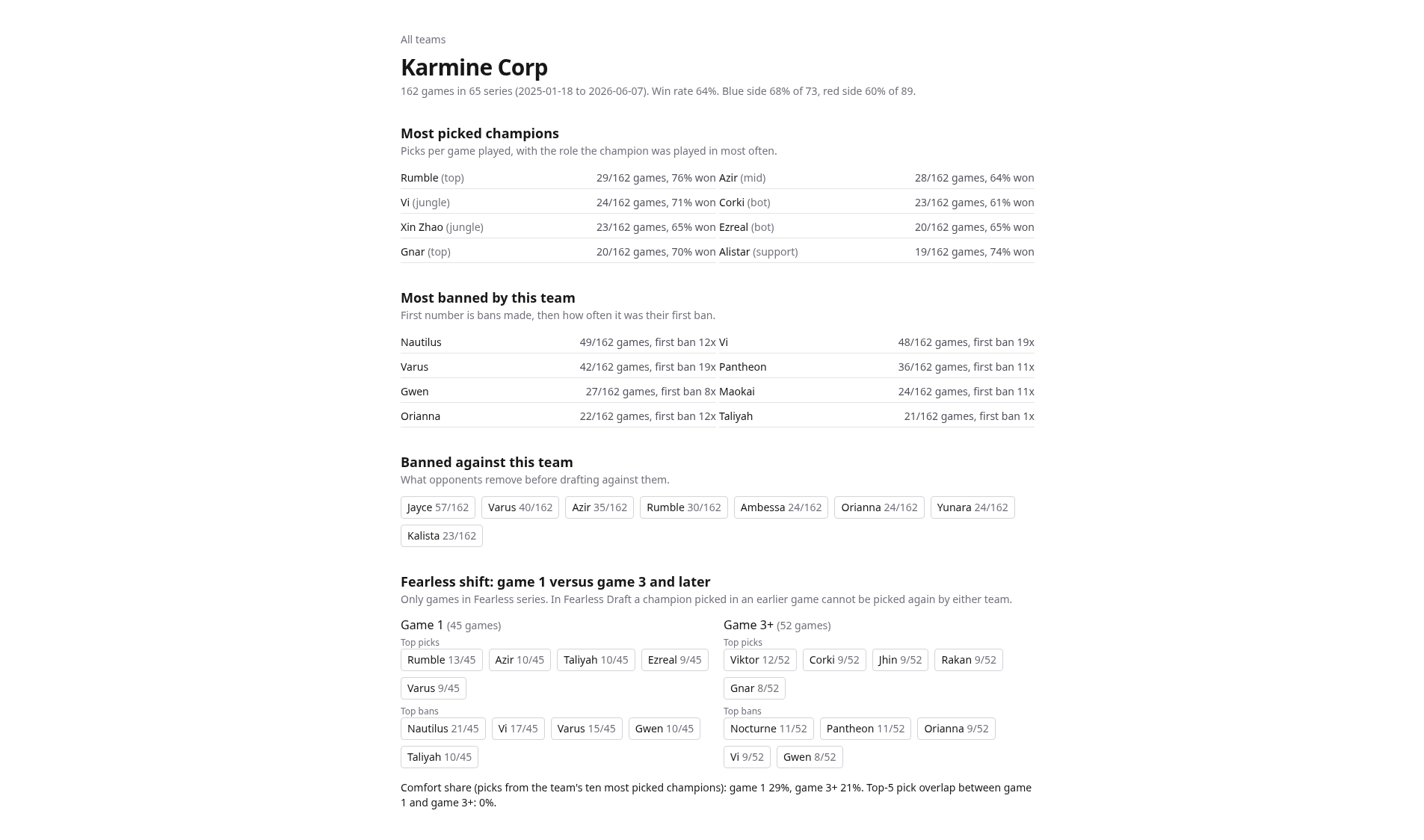
- Team pages list pick and ban tendencies from official GRID counts, with n on every figure, and a Fearless shift view (how drafting changes from game 1 to game 2 to games 3 and later, including comfort-pick share).
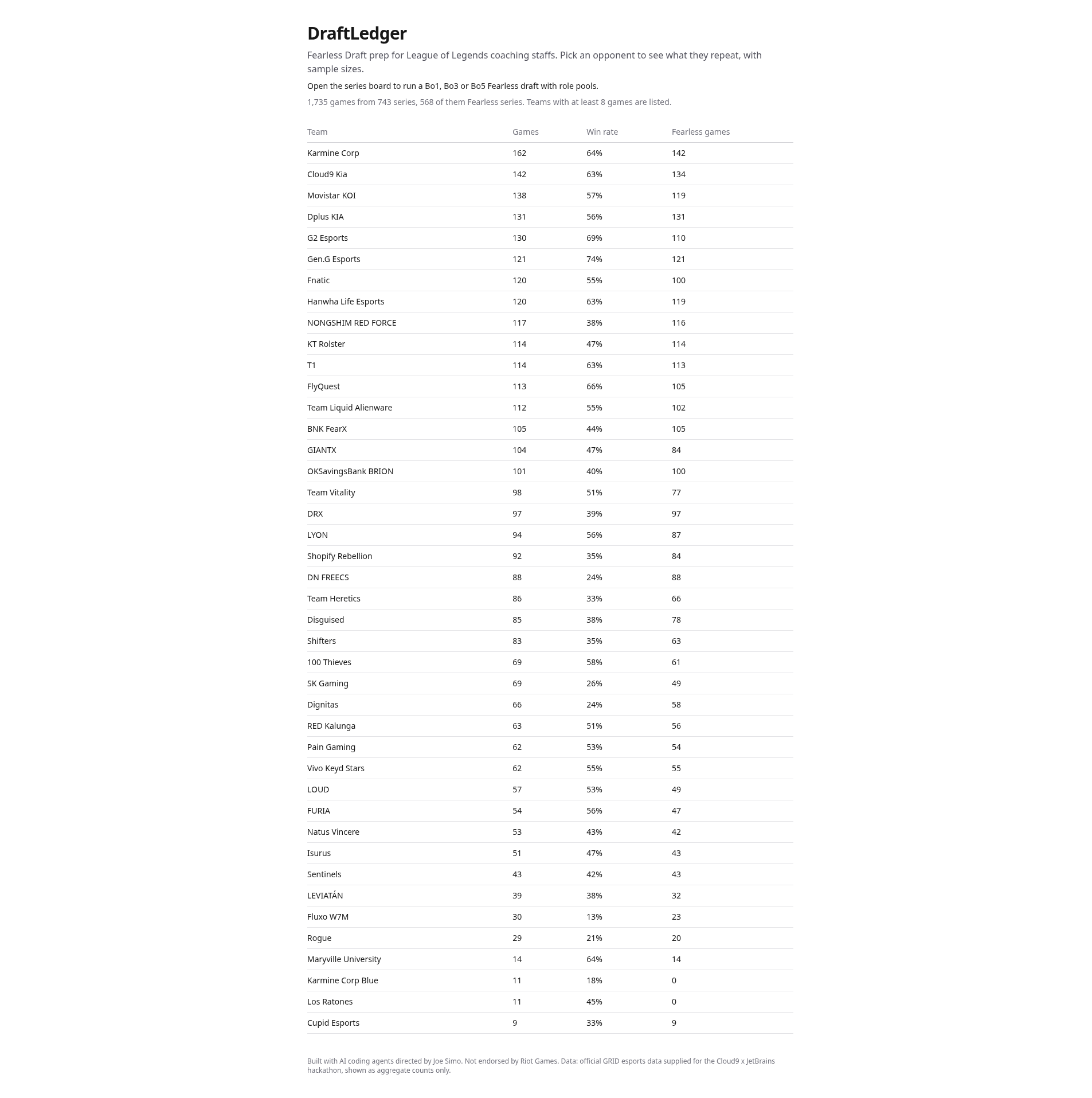
- The series board runs Bo1, Bo3, or Bo5, standard or Fearless. You name the scouted opponent and your own team. Pools are filled from the data.
- A draft is twenty standard ban and pick steps. Suggestions show what the opponent usually does at this step, with a reason and a sample size. Keyboard input is supported (search with /, Enter to take the first match, undo, and a planned move).
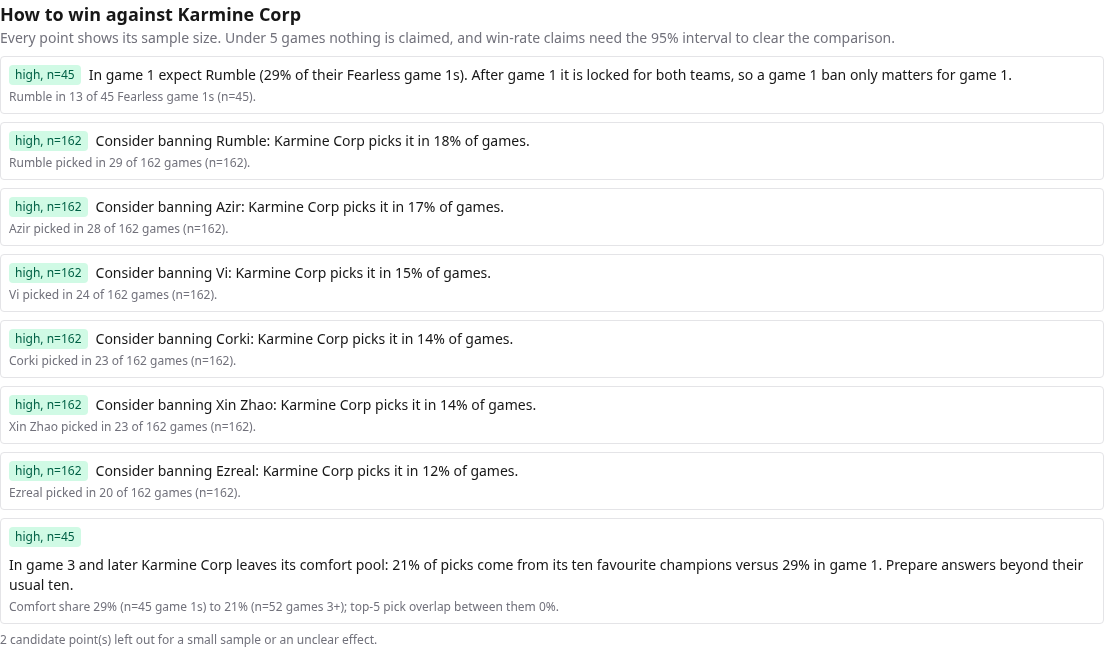
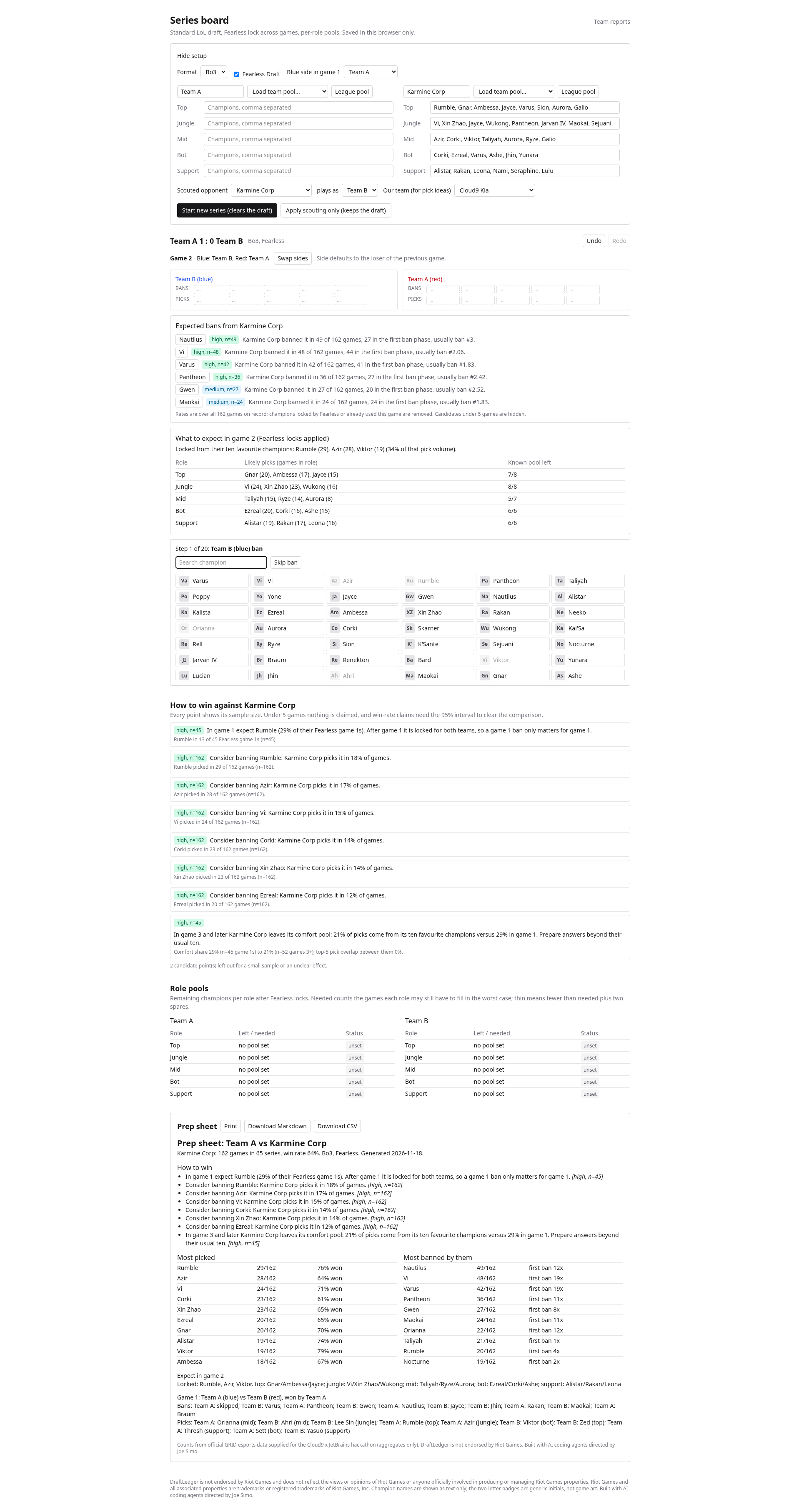
- After game 1, used champions are locked. They are disabled in the picker, removed from the advice, and each role's remaining pool warns when it runs thin. How-to-win notes switch to the next game.
- Per-game plans and a series forecast flag a champion that an earlier game will use up, so the conflict shows up before the draft, not during it.
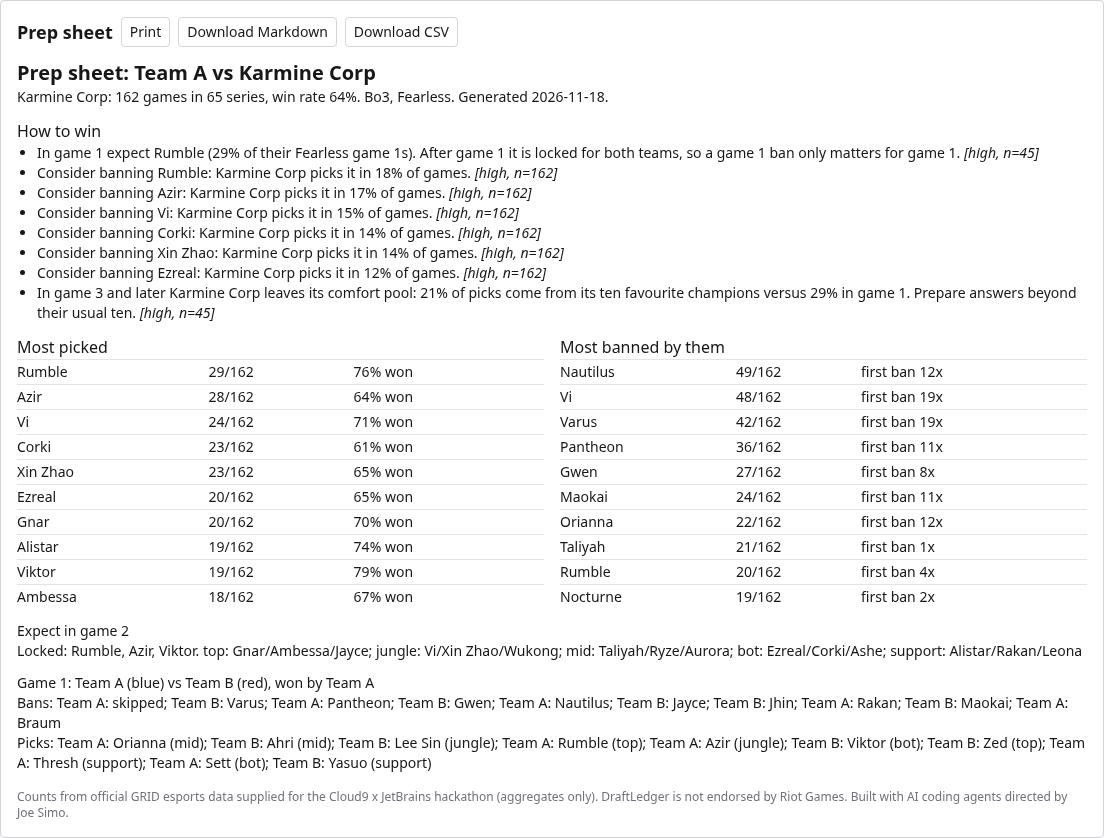
- The board is saved in the browser and restored on reload. A prep sheet exports to print, Markdown, or CSV.
- A methodology page states how roles are inferred, how Fearless is detected, and where the numbers should not be trusted.
Champion names are shown as text only. There is no Riot art and no call to the Riot API. Counts come from official GRID data supplied for this hackathon, stored as aggregates only.
How I built it
The app is a Next.js static site in TypeScript. Licensed GRID files stay outside the repository. A small pipeline turns them into committed aggregates (per-team pick, ban, and win counts, plus champion role frequencies) under public/data/. The board itself is a pure TypeScript reducer with tests, so Fearless locks, undo, and persistence are straightforward to check.
JetBrains tools
The required JetBrains tool is IntelliJ IDEA 2026.3 (build IU-263.7307.200). It was used in three ways, all documented in jetbrains/README.md:
- The command-line inspector (jetbrains/run-inspections.sh) with the committed profile in .idea/. Raw JSON and the IDE log are saved per run under jetbrains/inspections/. Real findings were fixed. False positives were suppressed with a comment that says why. Repeated reruns after the fixes list no findings.
- A GUI session on Nov 18, 2026: the project was opened in the IDE and Code | Inspect Code was run. Screenshots are qa/ide-01.png and qa/ide-02.png.
- The headless formatter, used early on the scaffold.
No JetBrains account or paid license was required for these inspections. JavaScript, TypeScript, HTML, and CSS inspections are part of the free tier.
AI Coding Agent Junie was opened in that same IDE session and given a real task (a share-draft URL on /board, with tests). Junie Lite was overloaded and the run failed. No files were edited by Junie. That attempt is recorded honestly in jetbrains/junie/session-01.md and AI_SHOWCASE.md. It is not claimed as successful tool use. JetBrains Air was not used.
AI use
Joe Simo defined the problem, the scope of each milestone, and the design rules (commit locally, no licensed data in git, aggregates only, champion names as text, no Riot art). AI coding agents wrote the code, tests, and documents, ran the commands, and committed locally. Joe reviewed the results in a browser, found bugs, and decided what to fix next. He also ran the IntelliJ IDEA GUI session. The narration on the demo video is a synthetic voice (Piper text-to-speech). Joe Simo's face and voice do not appear. No AI model runs inside DraftLedger, and no user or GRID data is sent to an AI service.
A longer account, including bugs the human caught, is in AI_SHOWCASE.md.
Challenges I ran into
Roles are not in the GRID draft events. An early version labeled roles from roster order, which matched a champion's usual role only about 54% of the time, so the app infers roles and states that on the methodology page. Browser QA later found leftover labels when a role dropdown stuck; that was a UI bug, not the inference, and it was fixed with tests.
Advice in game 2 once still recommended banning a champion that was already locked, and still talked about game 1. Insights and the prep sheet now take the live board state.
Two prototypes were built in parallel for the same event. One entry was kept (DraftLedger) and the useful parts of the other were ported, rather than shipping two.
Riot's developer policies were treated as a hard constraint: names only, no art, legal notices in the footer, no Riot API. Because the app never calls that API, there is no Riot Developer Portal registration. If organizers later require a registered product, that step would need the entrant's Riot account.
Junie Lite was not available to complete a feature during the build window. The submission relies on IntelliJ IDEA inspections as the JetBrains tool evidence, and does not pretend Junie wrote any of the code.
Accomplishments that I'm proud of
A complete Fearless Bo3 path runs on the public demo: load counts, set up the series, draft twenty steps from explained suggestions, lock game 1 into game 2, restore after a reload, and export a prep sheet. Every coaching claim shows its sample size, and low samples are held back. The methodology is on the site, not only in the repo. The IntelliJ inspection loop is committed and repeatable.
What I learned
Descriptive counts with honest n are more useful to a coach than a confident number with no denominator. Fearless Draft is a state machine: if the lock is not applied to the advice as well as the picker, the tool lies. Agents need a human in the browser. Claims about tools (including the IDE) have to be checked against what is actually in the repository.
What's next for DraftLedger
- Retry Junie on a real DraftLedger change and commit the evidence, if the service is available before the January 12, 2027 deadline.
- Richer macro context for draft insights, if the allowed data supports it, still with sample-size guards.
- Optional shareable series links, which was the Junie prompt that did not complete.
Built With
- fearless-draft
- github
- grid
- intellij-idea
- league-of-legends
- next.js
- typescript
