-
-
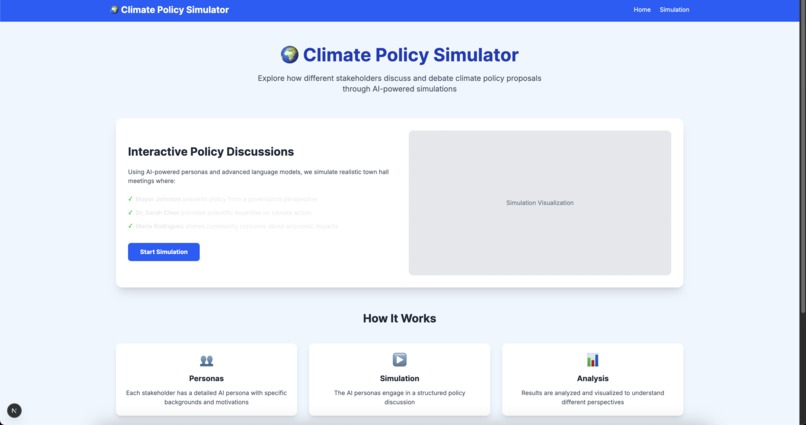
Home Page
-
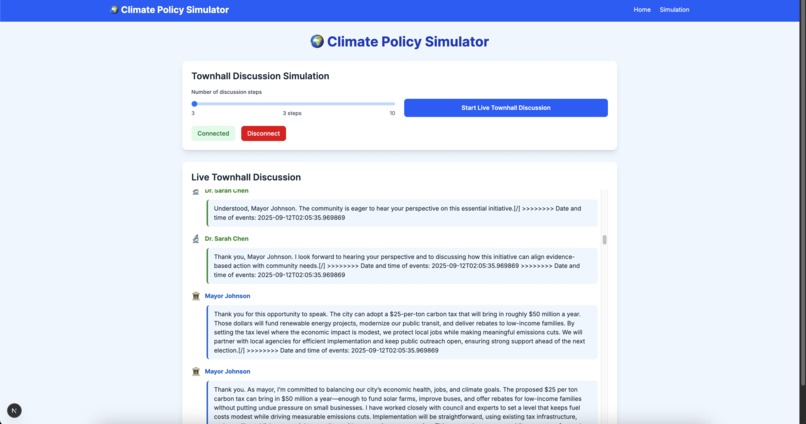
Live Discussion by AI Personas
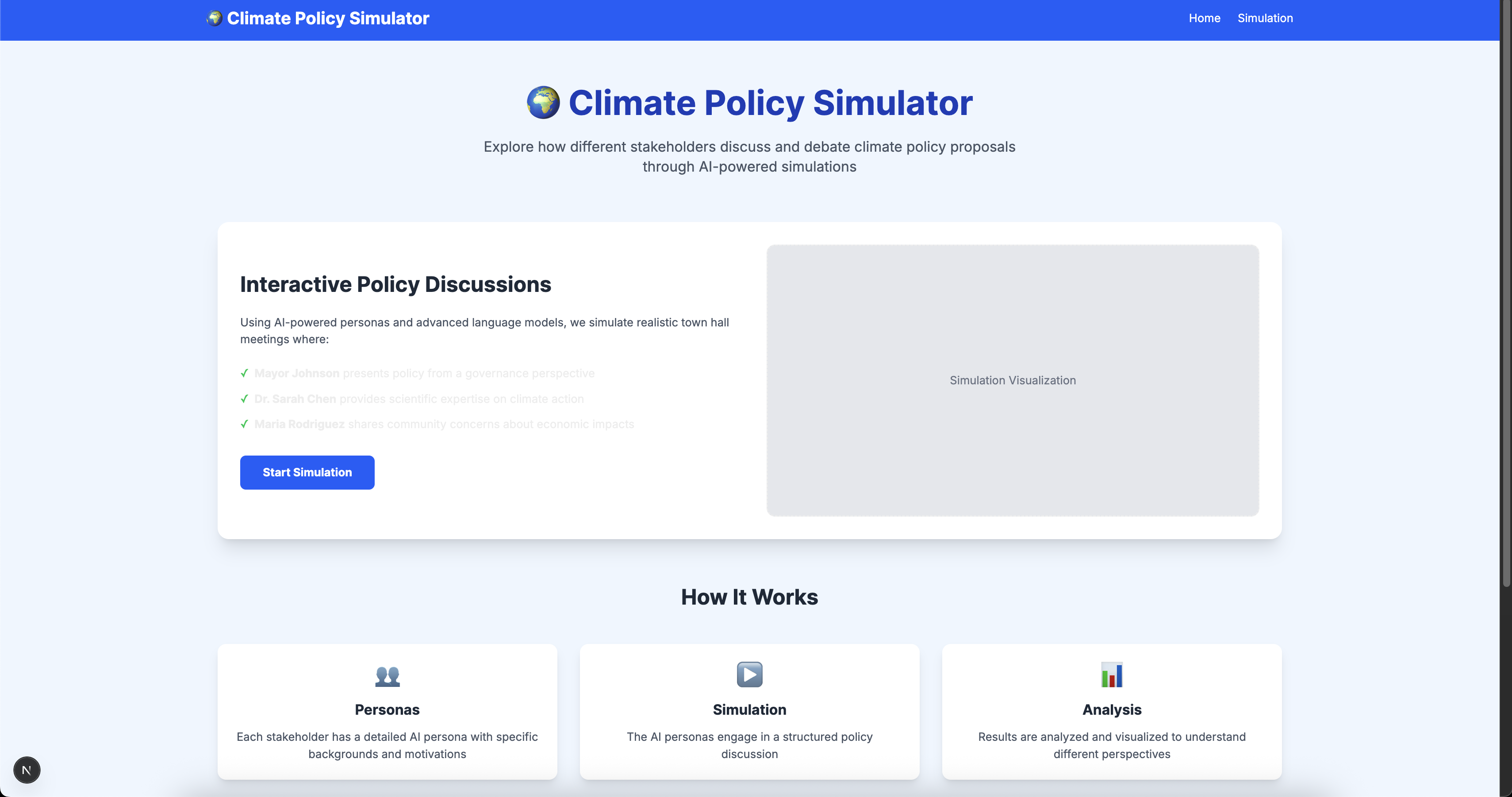
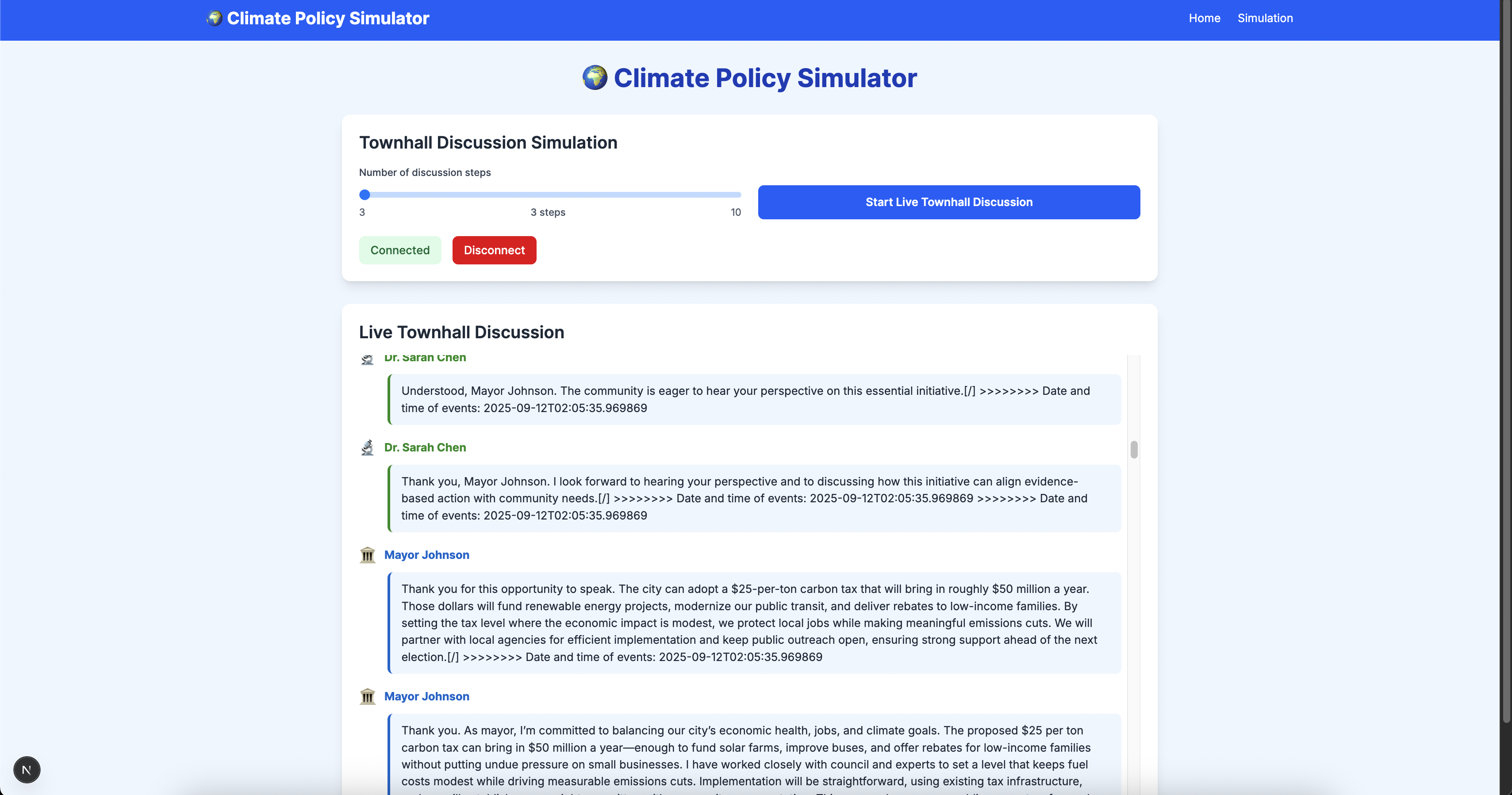
🌍 Climate Policy Simulator
🔥 Inspiration
Our project was inspired by the urgent need for better policy-making tools in the face of climate change. We recognized that effective climate policies require understanding diverse perspectives — from policymakers and scientists to community members. Traditional policy discussions often lack real-time engagement and fail to capture the complexity of stakeholder interactions.
We wanted to create a platform that could simulate these complex discussions using AI, allowing for more informed and inclusive policy design.
🤖 What It Does
The Climate Policy Simulator uses AI personas to model a town hall meeting discussing a carbon tax proposal. Our system creates three distinct personas:
- 👨💼 Mayor Johnson (policy maker)
- 👩🔬 Dr. Sarah Chen (climate scientist)
- 👩 Maria Rodriguez (community resident)
These personas engage in a structured discussion, with a real-time conversation display showing their interactions as they happen. Users can adjust the number of discussion steps and watch the AI personas debate policy trade-offs, providing insights into how different stakeholders might respond to climate initiatives.
🛠️ How We Built It
Our technical implementation combines several key components:
AI Framework:
Used theTinyTroupelibrary withgpt-ossmodels via Langchain GROQ for persona creation and simulation.Real-time Display:
Implemented WebSocket communication between a FastAPI backend and Next.js frontend for live conversation streaming.Alternative Solution:
Created a JSON-based polling mechanism to ensure conversation updates even in challenging network conditions.Multiple Interfaces:
Developed command-line, Streamlit, and web interfaces to cater to different user preferences.Analysis Tools:
Built visualization dashboards to analyze stakeholder positions and policy outcomes.
🧩 Challenges We Faced
Real-time Streaming:
Initially, all conversation messages were displayed at once after simulation completion. We restructured the simulation to capture and stream messages live.Token Counting Error:
Encountered issues with token counting in thetinytroupelibrary for thegpt-oss-20bmodel. We implemented workarounds to suppress error messages while maintaining functionality.WebSocket Communication:
Ensured reliable real-time communication between backend and frontend by handling connection states and error conditions carefully.Message Extraction:
Parsing conversation data from AI-generated text required robust pattern matching to correctly identify speakers and their messages.
📚 What We Learned
Multi-agent AI Potential:
We saw how effectively AI personas can simulate complex human interactions and policy debates when given detailed backgrounds and motivations.Real-time UI Design:
Learned the importance of providing immediate feedback in simulation interfaces to maintain user engagement and understanding.Open Source Models:
Gained valuable experience working with open-source AI models for complex reasoning tasks — showing their viability for policy applications.Modular Architecture:
Reinforced the value of modular design for complex systems, allowing us to add new interfaces and features without disrupting core functionality.
🏆 Accomplishments We're Proud Of
✅ Real-time Conversation Display
Successfully implemented live streaming of AI persona interactions, creating an engaging user experience.✅ Multiple Interface Support
Created three different interfaces: CLI, Streamlit, and Web, making the tool accessible to a wide audience.✅ Robust Persona Design
Developed detailed, realistic personas with distinct perspectives that produce meaningful policy discussions.✅ Hackathon Innovation
Demonstrated an unexpected application ofgpt-ossmodels in the policy domain, showing their versatility beyond traditional use cases.
🚀 Future Directions
We envision expanding the simulator to:
- 🌱 Support additional policy domains beyond climate change
- 📊 Integrate more sophisticated analysis tools for policy impact prediction
- 🧑🤝🧑 Add support for larger group discussions with more personas
- 🧑💻 Implement user interaction capabilities to allow humans to participate in the simulations
- 📱 Develop mobile interfaces for broader accessibility

Log in or sign up for Devpost to join the conversation.