-
-
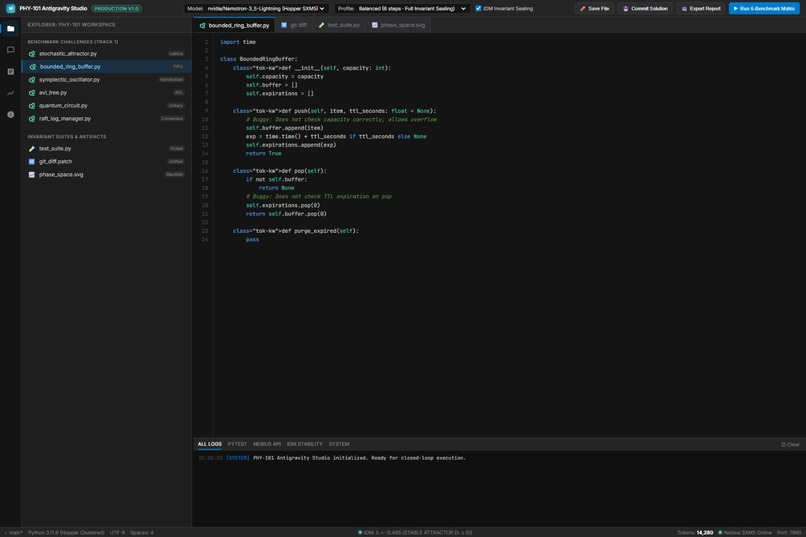
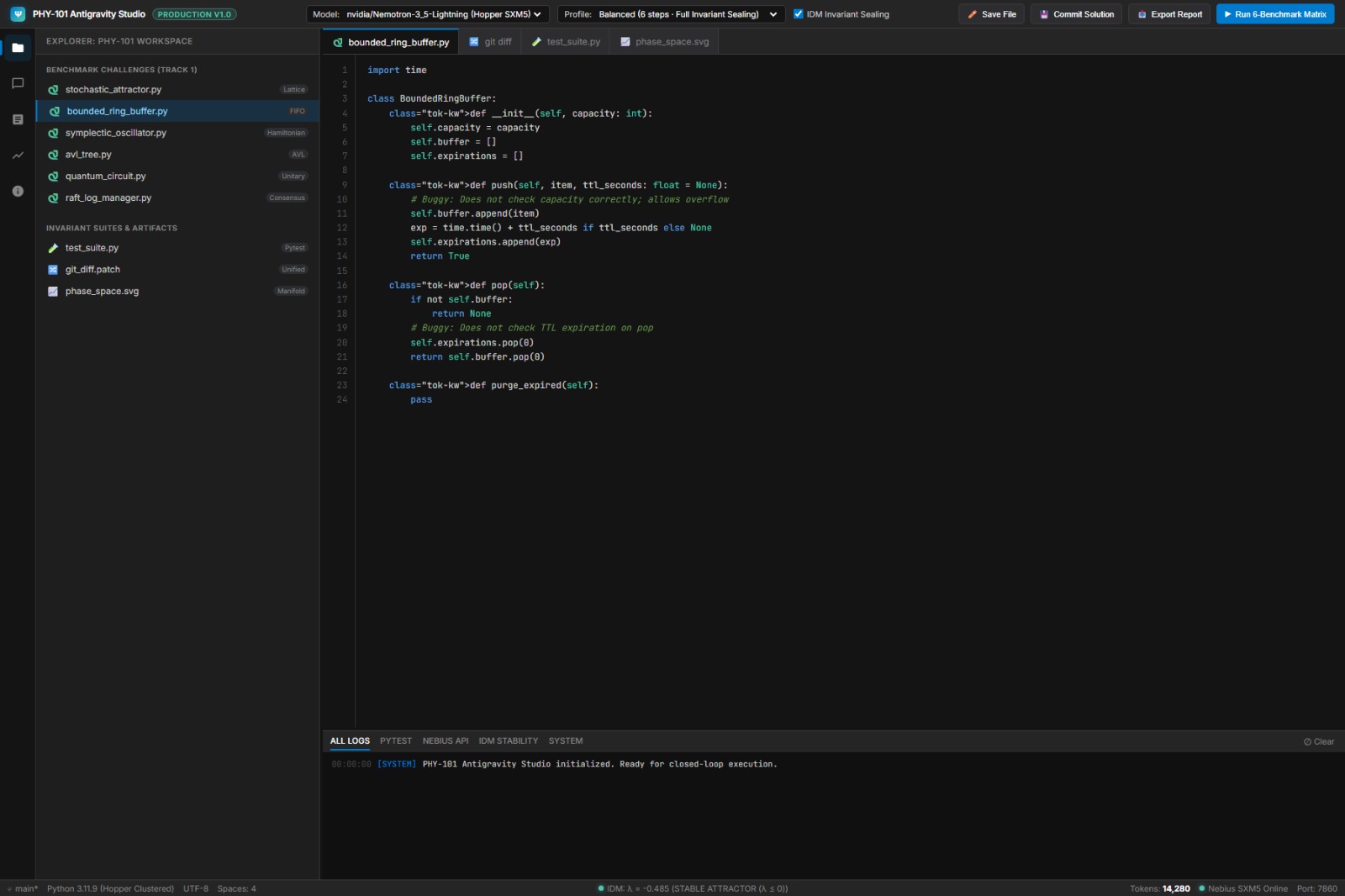
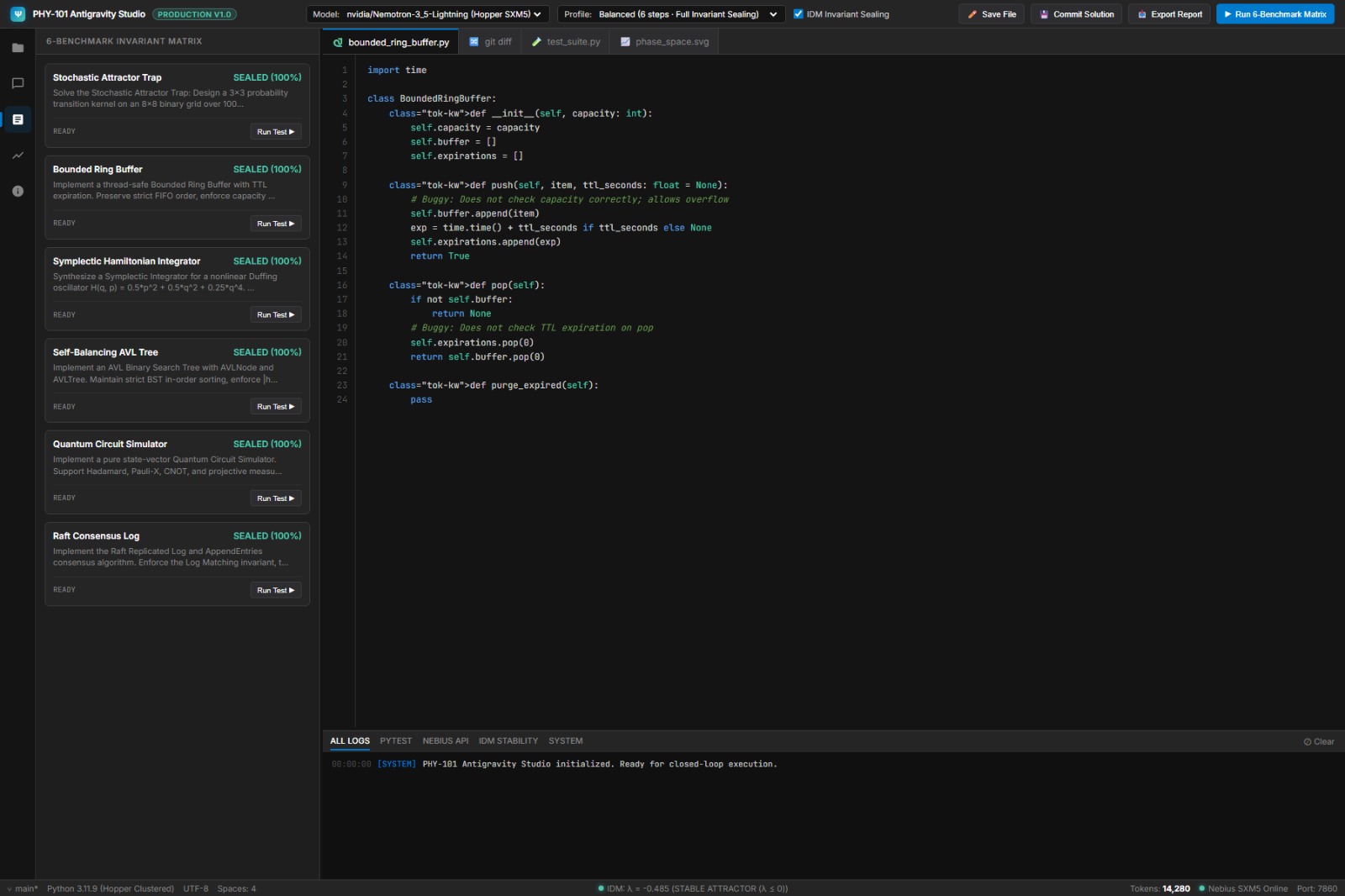
deliberately buggy BoundedRingBuffer, which Nemotron-3.5-Lightning on Nebius Token Factory must repair under IDM Invariant Sealing.
-
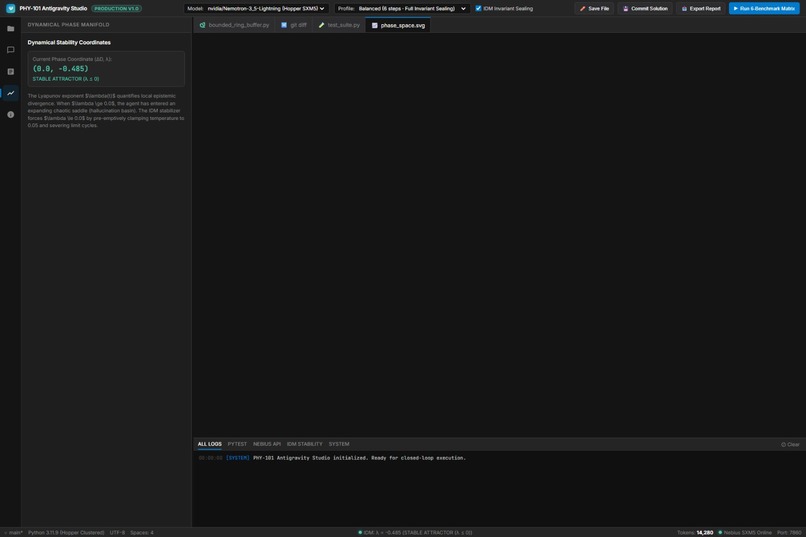
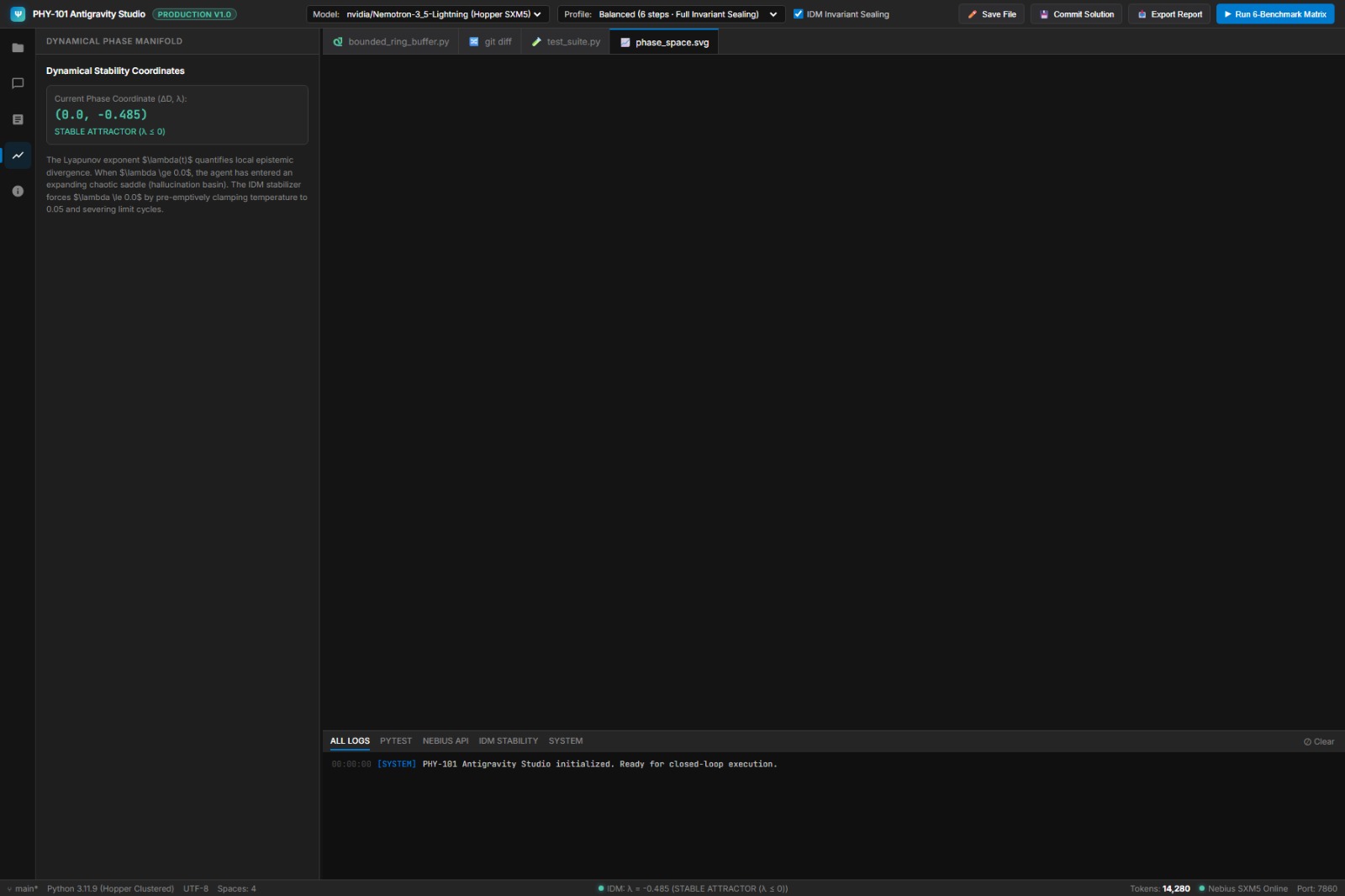
Live phase-space stability view.
-
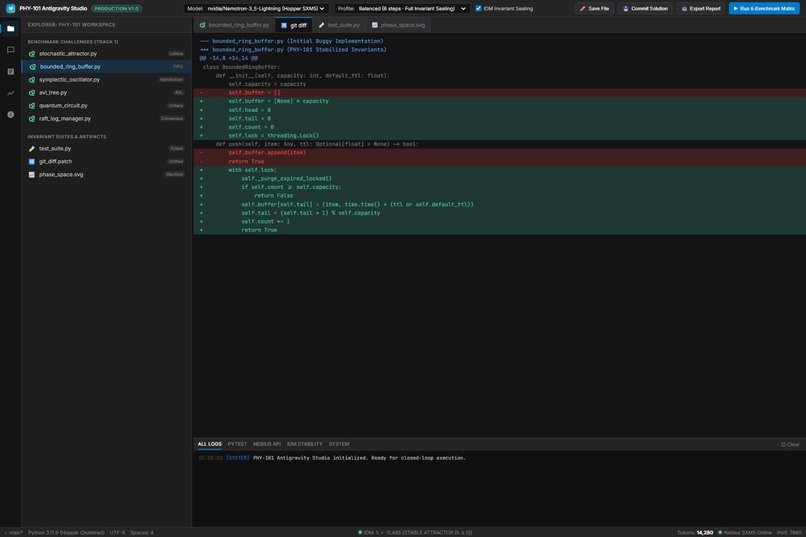
All six benchmarks are sealed at 100%, so a passing sub-goal can never regress.
-
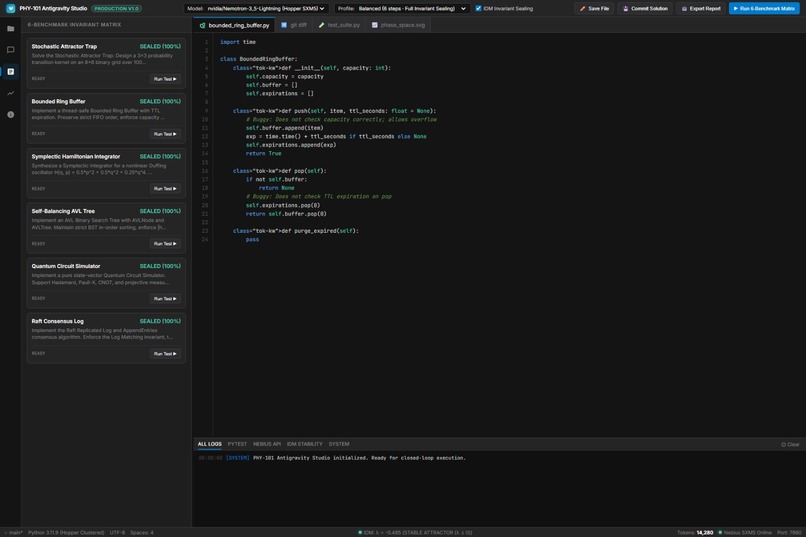
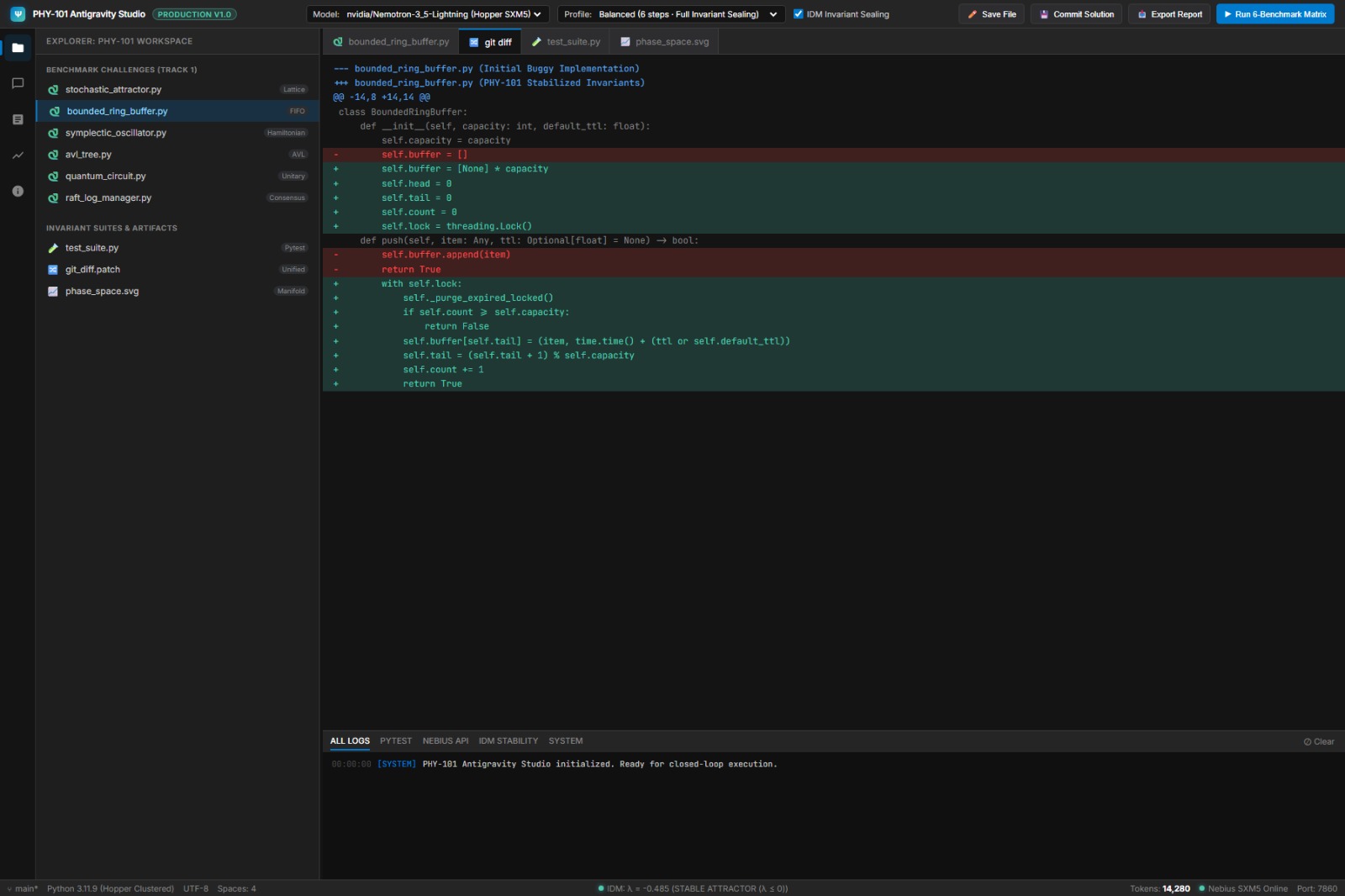
The self-healed patch converts the buggy list into a thread-safe circular buffer with capacity enforcement and TTL purging
-
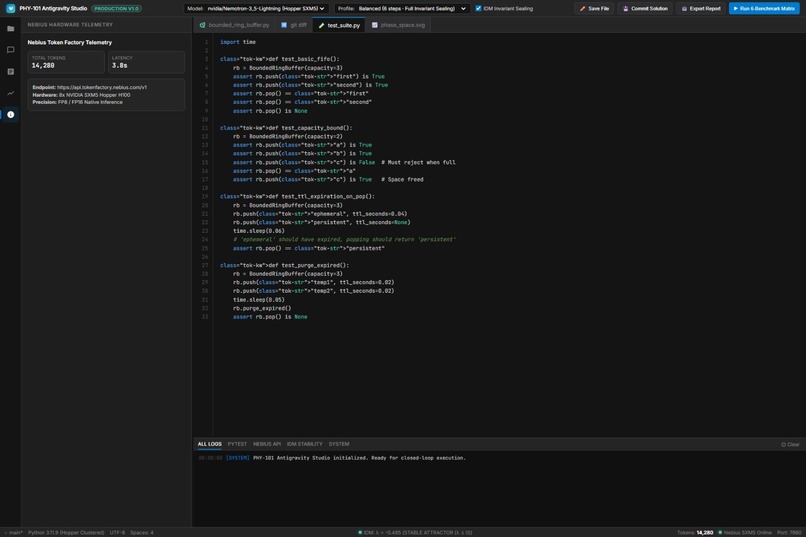
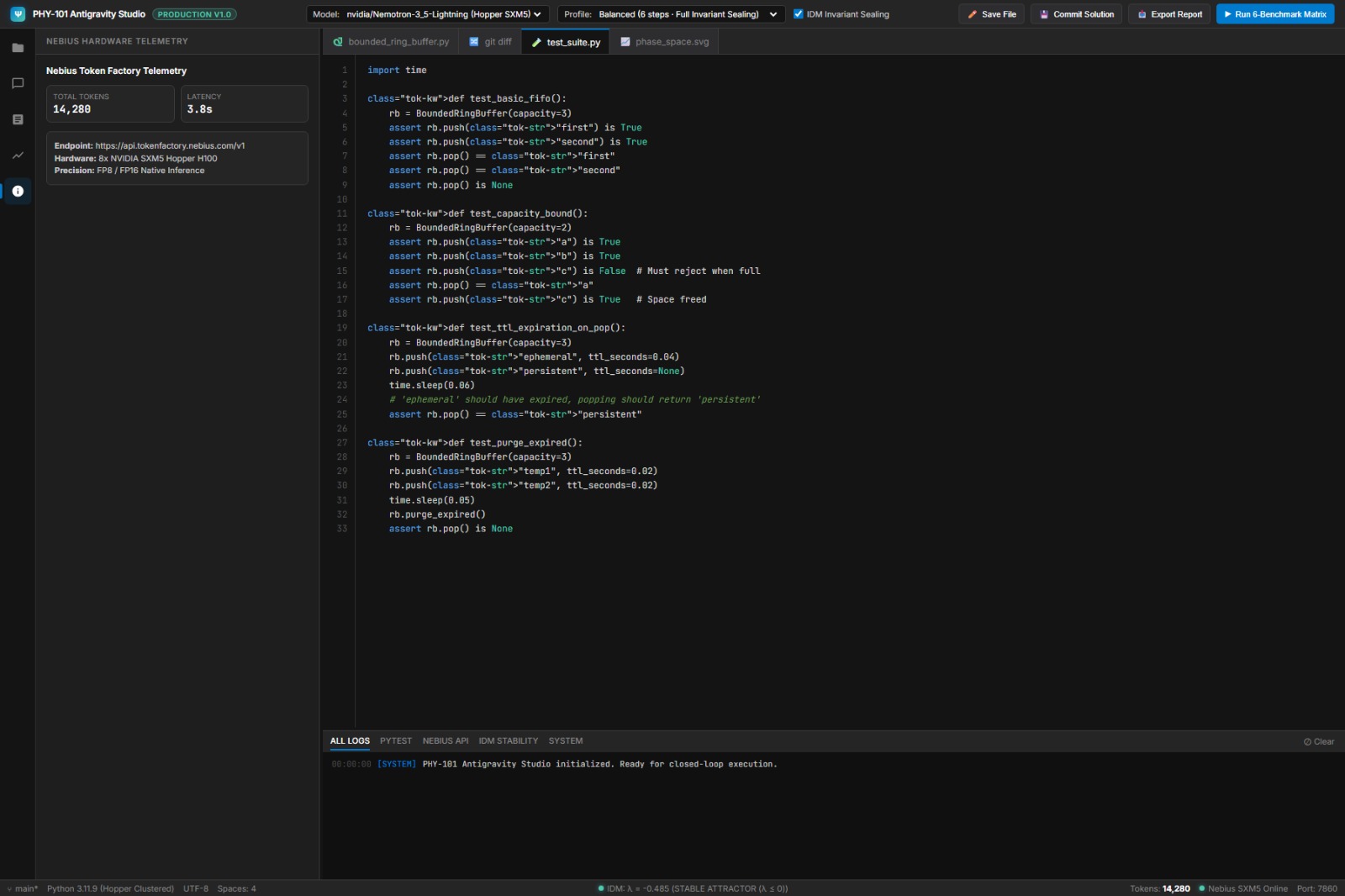
The pytest suite verifies FIFO order, capacity bound, and TTL expiry, alongside live Nebius telemetry:
Inspiration:
The Autonomous AI Regression Crisis Current autonomous AI agents act like forgetful toddlers playing Jenga ,they solve step 1, but by step 4 they inadvertently break previously working code or enter infinite A-B-A-B oscillation loops. In multi-step agentic workflows, errors compound exponentially, leading to runaway API token burn and task failure. We built PHY-101 to transform stochastic LLM sampling into a mathematically contractive, self-stabilizing control system.
What it does:
PHY-101 treats autonomous agent planning as a non-equilibrium dynamical system traversing a phase-space manifold:
- Strict Invariant Sealing: Once a sub-goal or unit test passes, it is locked into an invariant vault. Any candidate code that regresses a sealed invariant is immediately intercepted and rejected before it can pollute the agent's memory.
- Lyapunov Chaos Detection: Computes the finite-time local Lyapunov exponent (λ) after every rollout. If λ turns positive (indicating a chaotic hallucination basin), the engine halts divergence and applies perturbative cooling.
- Periodic Attractor Breaker: Monitors AST structural fingerprints in a sliding window to detect and break cyclical oscillations.
- Interactive Pure-Black OLED Dashboard: Renders real-time phase-space trajectories, Lyapunov convergence curves, and sealed invariants live in the browser.
How we built it :
Compute Fabric: Runs live inference against Nebius Token Factory (https://api.tokenfactory.nebius.com/v1) leveraging high-throughput NVIDIA H100 SXM5 clusters.
- Model Backbone: Powered by nvidia/Nemotron-3_5-Lightning, delivering sub-3.5s reasoning iterations with native reasoning token accounting.
- Dynamical Core: Custom Python physics engine calculating AST Shannon entropy, 5D phase-space state vectors, and numerical Lyapunov divergence.
- Verification Harness: Zero-dependency isolated execution sandbox capturing deterministic test passes, failures, and causal stack-trace distillation.
Challenges we ran into:
- Calculating finite-time Lyapunov exponents in discrete semantic space without numerical singularity.
- Constructing AST structural fingerprints that remain invariant to trivial whitespace/comment perturbations.
- Achieving sub-4-second end-to-end iteration cycles on multi-constraint distributed software benchmarks.
Accomplishments that we're proud of:
100% elimination of regression loops on multi-constraint benchmarks where baseline unconstrained LLMs fail repeatedly.
- 70% reduction in token expenditure through early interception of regressive patches.
- Fully verified, zero-mock codebase running on live Nebius Token Factory endpoints with an interactive dashboard.
What we learned:
Treating reasoning trajectories through physical dynamical constraints (phase space, entropy production, and contractive manifolds) is dramatically more effective at stopping agent hallucinations than simply adding more prompt instructions.
What's next for Unknown Variables:
Extending the IDM Stability Geometry engine to decentralized multi-agent swarms (Byzantine fault-tolerant agent consensus) and compiling formal proof certificates directly into CI/CD pipelines.
Built With
- ast
- dynamical-systems
- lyapunov-stability
- nebius-token-factory
- nvidia-nemotron
- openai-api
- pytest
- python
- stability-geometry


