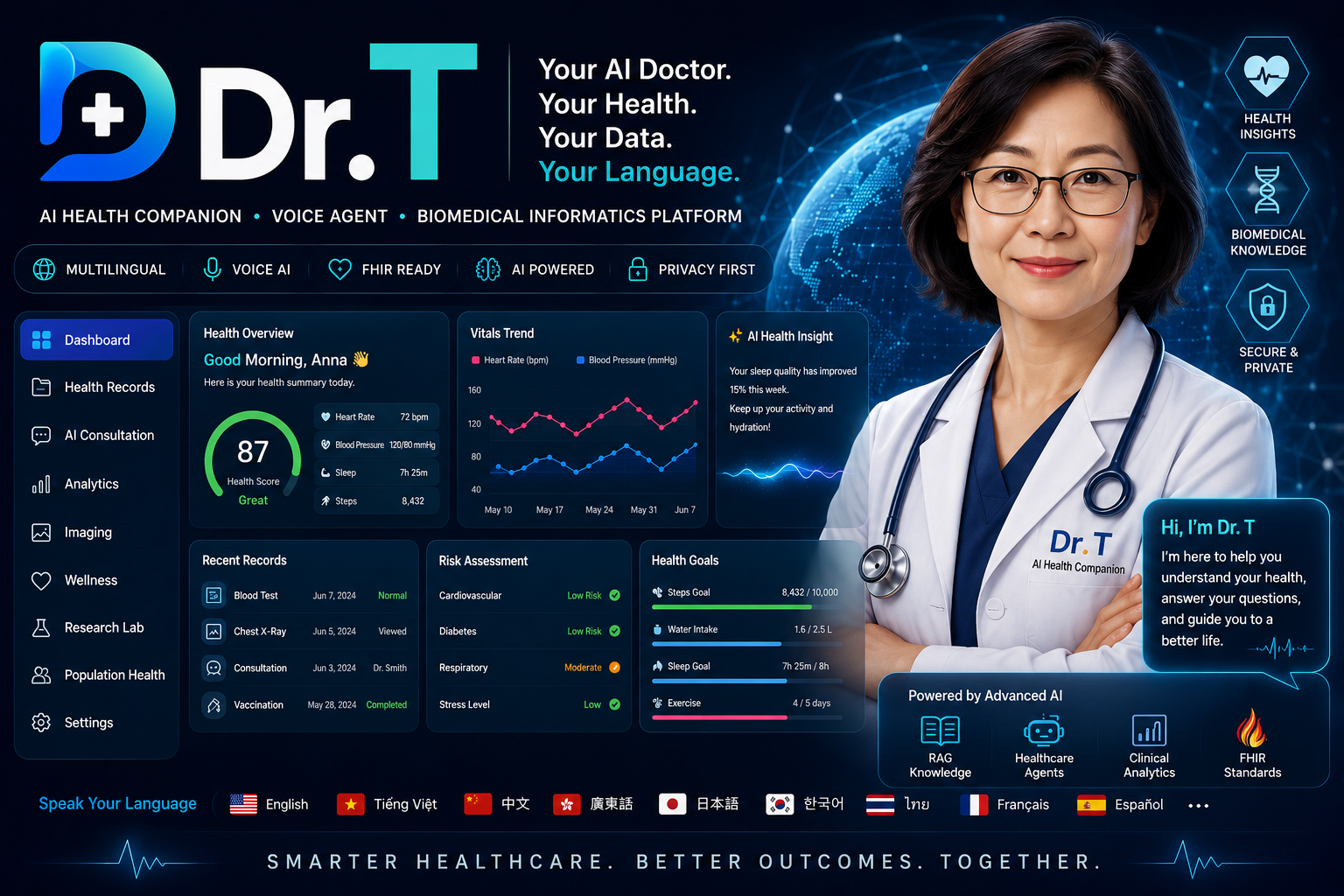
Inspiration The genesis of Dr. T came from studying the massive cognitive load, administrative strain, and emotional burnout experienced by hospital staff and patients worldwide. We realized that clinical systems are built for billing rather than humans, while consumer medical chat tools frequently hallucinate, offering unreliable guidance. That is the pain. And Dr. T is also a real life figure helping her patients through the treatment process with Wits, Wisdom, and especially Kindness.
We set out to engineer an intellectual companion—a Socratic digital peer that doesn't just hand out immediate answers, but walks clinicians and patients through thorough, evidence-based reasoning. This conversational layer is directly bounded with rigorous, standardized clinical schemas, creating a safe, empathetic, and functional workspace.
⚙️ What it does Dr. T is a robust, full-stack Clinical Informatics suite organized into four key operational layers:
The Hub (Voice Node): A multilingual, vocal counseling interface supporting diverse, customizable companion personalities (Empathetic, Socratic, Intellectual, Blunt) with interruption-aware synthesis.
HL7 FHIR Interoperability Suite: An interactive, client-side processor designed to validate, serialize, import, and export standard Patient, Observation, Condition, Encounter, and Procedure schemas mapped directly to global LOINC and SNOMED CT indices.
AI Clinical Document SOAP Compiler: A transformer-driven model helper that takes raw speech or patient notes and transforms them into standard Clinical SOAP Notes and downloadable hospital discharge summaries.
MIMIC-IV High-Fidelity ICU Console: A quantitative dashboard that predicts critical care trends, patient mortality, readmission rates, and Length-of-Stay (LOS) metrics through coefficient regression equations.
Interactive Celebration Canopy: Integrated through a specialized micro-interaction framework (the BirthdayCelebrator), the platform celebrates its continuous development with a real-time particle emission engine, reacting delightfully with bursts of emojis and sparkles when clicked, and maintaining constant, ambient, gradient-mapped visual energy.
🛠️ How we built it We architected the system on a full-stack runtime engineered for peak local and remote performance:
Frontend: Built with React 18, TypeScript, and Vite, styled with highly crafted Tailwind CSS. Fluid, physics-based UI micro-interactions are managed globally with Framer Motion (motion/react).
Backend Proxy: A lightweight Node.js/Express proxy server securely channeling and rate-limiting medical database calls.
AI & Clinical Scanners: Powered by the modern Google Gemini API (@google/genai SDK) to digest scientific abstracts, execute real-time RAG over guidelines, and perform structured medical imaging analyses.
Particle Physics Canvas: Standard CSS animation keyframes and state transition vectors were combined inside a responsive React component to create the beautiful, zero-lag, ambient-emitting celebration badge.
🚧 Challenges we ran into Strict FHIR Validation: HL7 JSON clinical resources have highly nested, complex, and typed fields. Coding client-side schemas that validate accurately without crashing required crafting bulletproof TypeScript union types and deep-comparisons interfaces.
Biostatistical Alignment: Simulating realistic epidemiological data models (specifically mimicking the MIMIC-IV clinical dataset) required mapping complex logic equations into React states, matching interactive slider ranges seamlessly with line graphs and predictive outcomes in real time.
Ambient Animation Performance: Spawning multiple independent HTML element particles (balloons, cakes, and stars) during celebration bursts had the potential to degrade performance on mobile or lower-end machines. We addressed this by implementing strict garbage-collection lifecycles that unmount expired particles and leverage hardware-accelerated CSS keyframe transforms.
🏆 Accomplishments that we're proud of Perfect Clinical Integration: The seamless transition of voice discussions directly into structured FHIR records and downloadable clinical reports.
Zero-Lag UI Execution: Maintaining smooth 60fps responsiveness across ICU analytics graphs, 3D structure tabs, and complex imaging modules.
The "Birthday Celebrator" Interface: Creating a visually stunning, premium-grade header badge (featuring the message: "Everyday is a Birthday to Dr. T - Many happy returns! Version 29370"). It provides an instantly playful, high-fidelity element of delight within a professional biomedical dashboard.
📚 What we learned User Experience Matters in Clinical Tech: A medical tool does not need to feel sterile, cold, or intimidating. Injecting warm, gradient-rich colors, ambient glows, and interactive physical bursts can materially elevate the user's emotional state, reducing system-use friction and stress.
Guarding LLM Contexts: Keeping AI interactions bound to structured system controls (like the FHIR schema validator or regression calculators) is the absolute best defense against runtime hallucinations, guaranteeing predictable system safety.
🔮 What's next for Dr. T Live SMART on FHIR Handshakes: Moving beyond static schemas to establish direct, authenticated OAuth2 integrations with hospital portals like Epic, Cerner, and Athenahealth.
Real-Time DICOM Ingestion: Upgrading the imaging module to parse actual raw DICOM diagnostic radiography files directly in the browser using custom WebGL renderers.
Wearable Telemetry Streaming: Integrating direct API triggers for live Apple HealthKit and Fitbit feeds, feeding patient biometric logs into the clinical predictive engine in real time.
Built With
- all

Log in or sign up for Devpost to join the conversation.