-
-
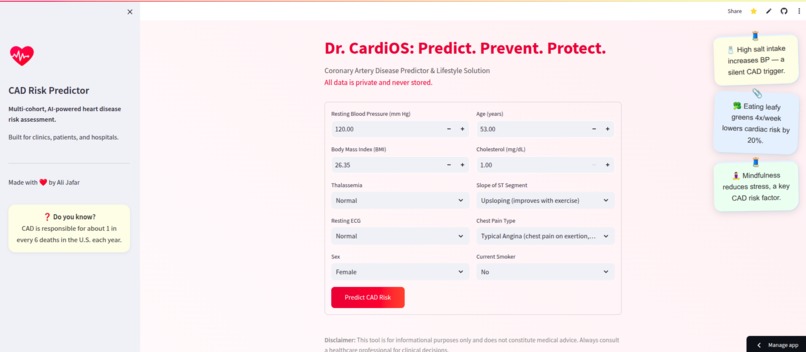
Dr. CardiOS App

🩺 Project Story: Dr. CardiOS – Predict. Prevent. Protect.
💡 Inspiration
Every 36 seconds, someone dies from heart disease in the U.S. — many without prior symptoms. What struck us most was that Coronary Artery Disease (CAD) often remains silent until a catastrophic event. We realized that with the right use of machine learning, we could empower individuals to assess their risk before they become patients.
Inspired by tools like diabetes risk calculators, but seeing no easily accessible equivalent for CAD, we created Dr. CardiOS: a preventive AI assistant that doesn’t just detect risk, but also guides users toward a heart-healthier life with actionable lifestyle changes.
🧠 What We Learned
- How to merge multiple clinical datasets with inconsistent schema and missing values.
- The importance of feature harmonization when combining medical records from different countries.
- How to build machine learning pipelines for classification and recommendation systems.
- Streamlit and Lottie animations to build an intuitive and engaging frontend UI.
- How to create an integrated ML web app with model serving, predictions, and health tips all in one place.
🔨 How We Built It
🗂️ Data Sources
We merged multiple real-world CAD datasets including:
- UCI Heart Disease datasets (Cleveland, Hungarian, Switzerland, Long Beach)
- Z-Alizadeh Sani dataset (Iran)
- Cardiovascular Disease dataset (Kaggle, 70k+ rows)
- Diet Recommendation dataset curated and mapped to risk levels
🧪 ML Models
We trained two key models:
- CAD Risk Classifier (
XGBoost, 82% F1 score) - Diet Recommendation Engine using classification based on lab features and lifestyle inputs.
We used Scikit-learn Pipelines and saved them as .pkl for seamless integration into the app.
🌐 App Interface
We built the app using:
Streamlitfor frontendPlotlyfor risk gaugestreamlit-lottiefor animations- Custom side-fact component for health tips and encouragement
The app structure follows an organized architecture with
/src,/data,/models, and/docsfolders for maintainability.
🧗 Challenges We Faced
- Dataset integration was difficult due to varying column names, scales, and missing values.
- Some datasets lacked labels or had binary instead of multi-class targets.
- The diet dataset had to be manually cleaned and matched to health scores — a time-intensive but rewarding process.
- Streamlit deployment errors (missing dependencies) taught us the importance of having a complete and clean
requirements.txt.
📈 Impact & Future Goals
We envision Dr. CardiOS becoming an educational and screening tool in:
- Community health centers
- College campuses
- Remote clinics in developing regions
In the future, we want to integrate:
- Wearable device data
- Symptom-based triage using LLMs
- Local language support and speech-based interaction
"The best cure is early prevention. Dr. CardiOS gives people that power — before it’s too late."


Log in or sign up for Devpost to join the conversation.