Inspiration
Data pipelines fail quietly. A column gets renamed in a source system, a sync goes stale, rows disappear — and the dashboards downstream are wrong long before anyone notices. The usual "fix" is a human paging through logs at 2am. We wanted an agent that does the watching, the diagnosis, and the repair — but one a data team can actually trust near production, because it never changes a pipeline without explicit human approval.
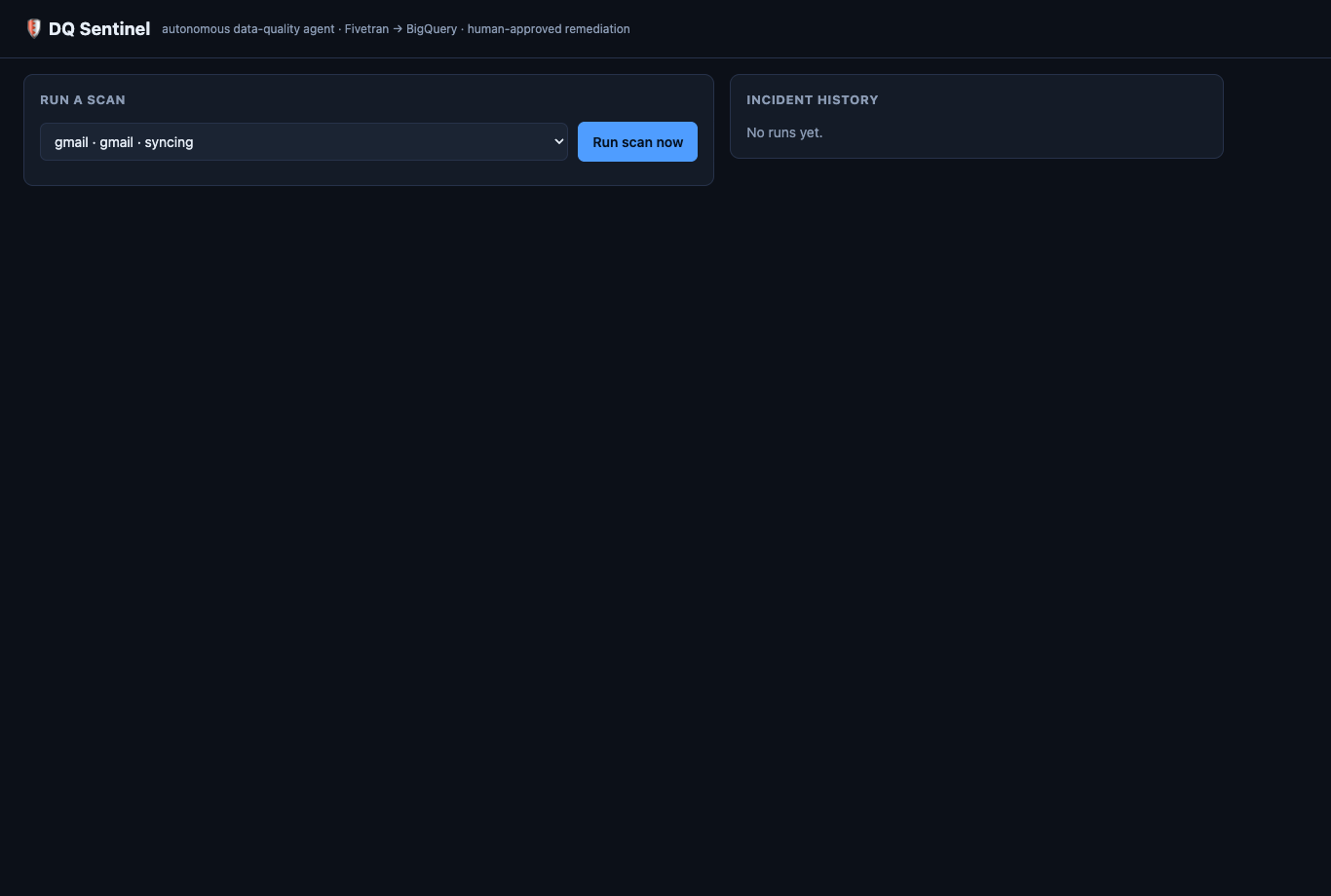
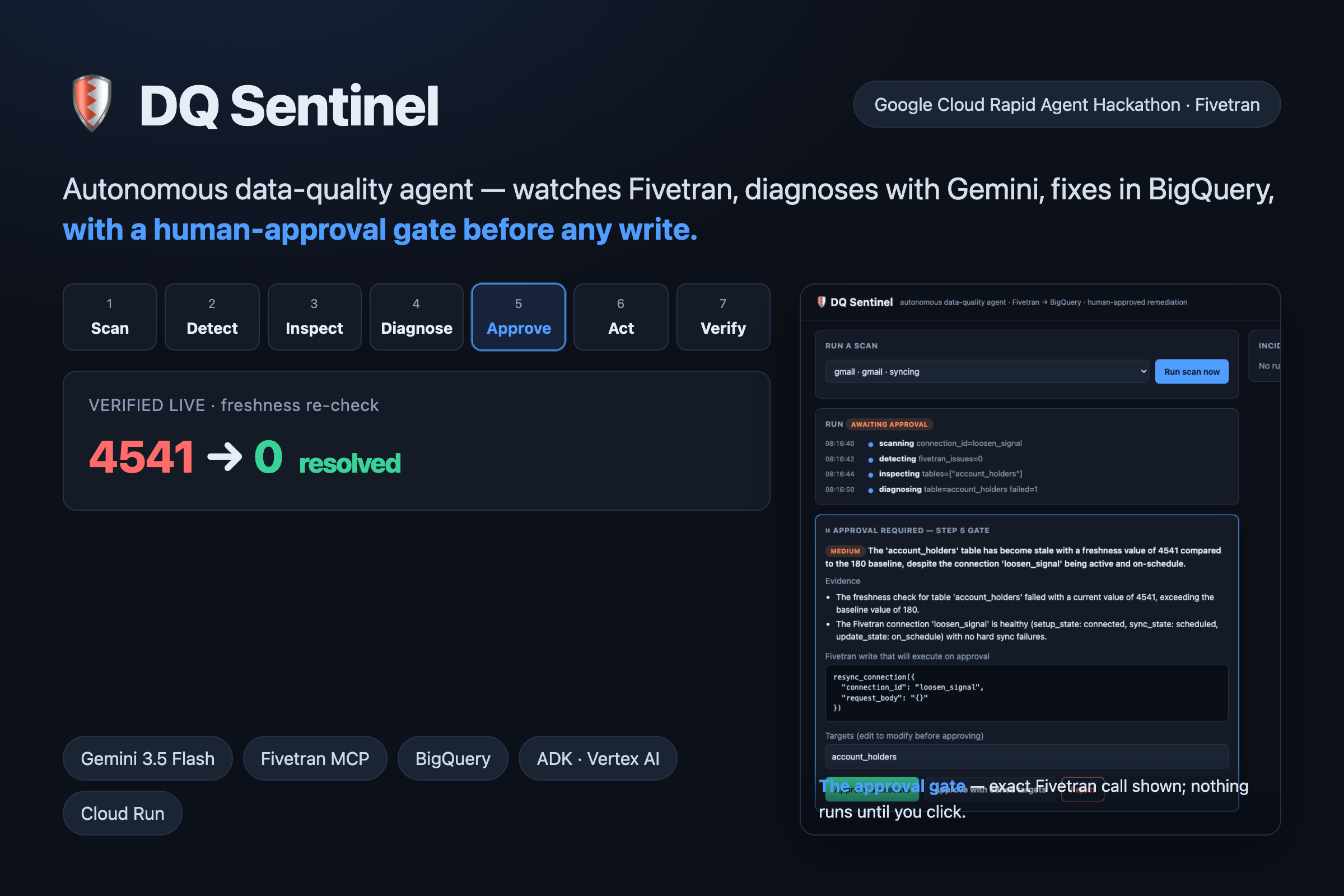
## What it does DQ Sentinel is an autonomous data-quality agent for Fivetran → BigQuery. It runs a fixed 7-step loop:
- Scan — lists Fivetran connections and their status via the Fivetran MCP server.
- Detect — flags sync failures, schema drift, and staleness.
- Inspect — runs parameterized BigQuery checks (row count, null rate, freshness, schema) against a rolling baseline.
- Diagnose — Gemini 3.5 Flash correlates the signals into a ranked root cause and a typed remediation proposal.
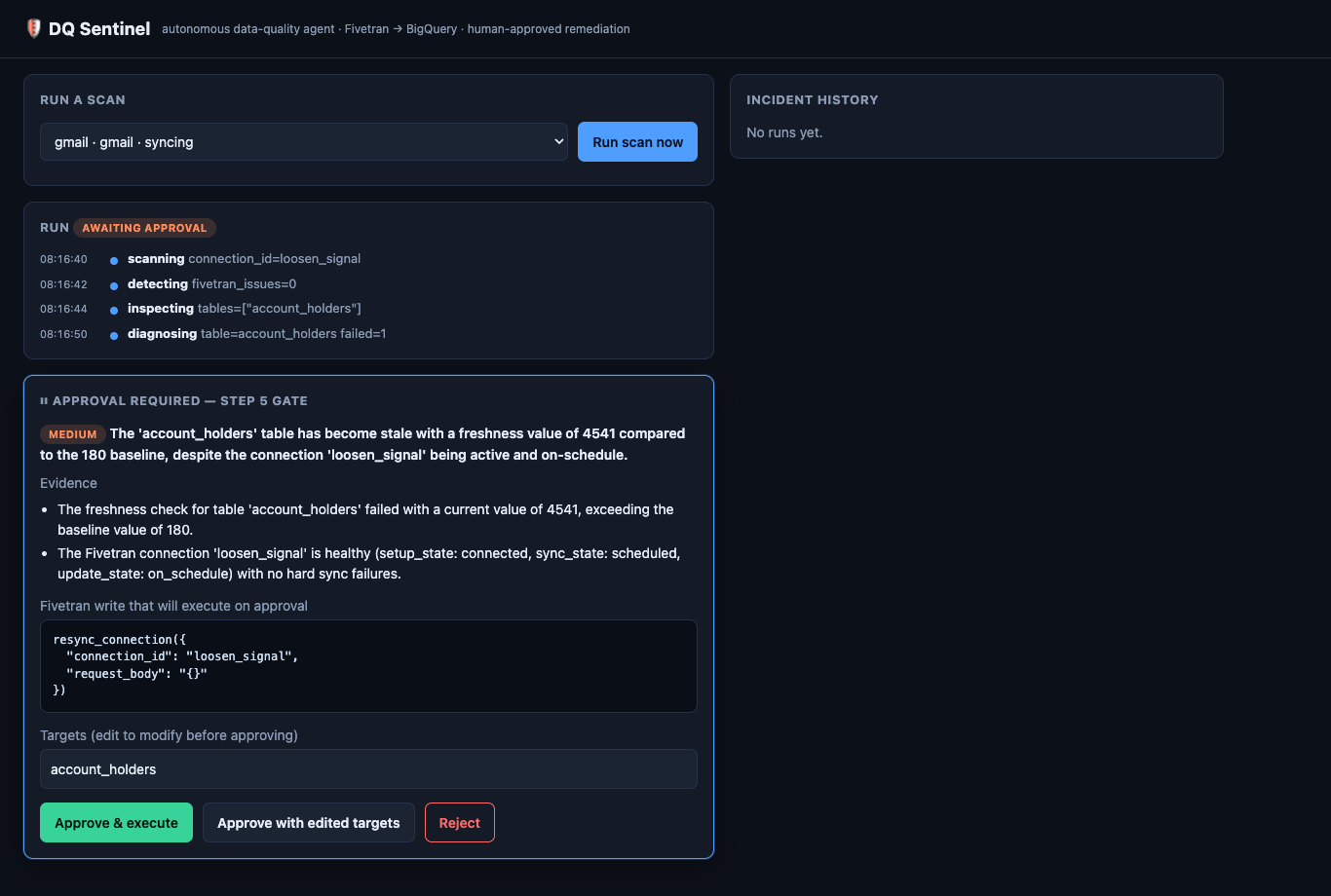
- Approve — a hard, structural human gate: it shows the exact Fivetran tool call it wants to run, with arguments, and waits.
- Act — on approval, executes exactly one Fivetran write (sync / resync / reload schema).
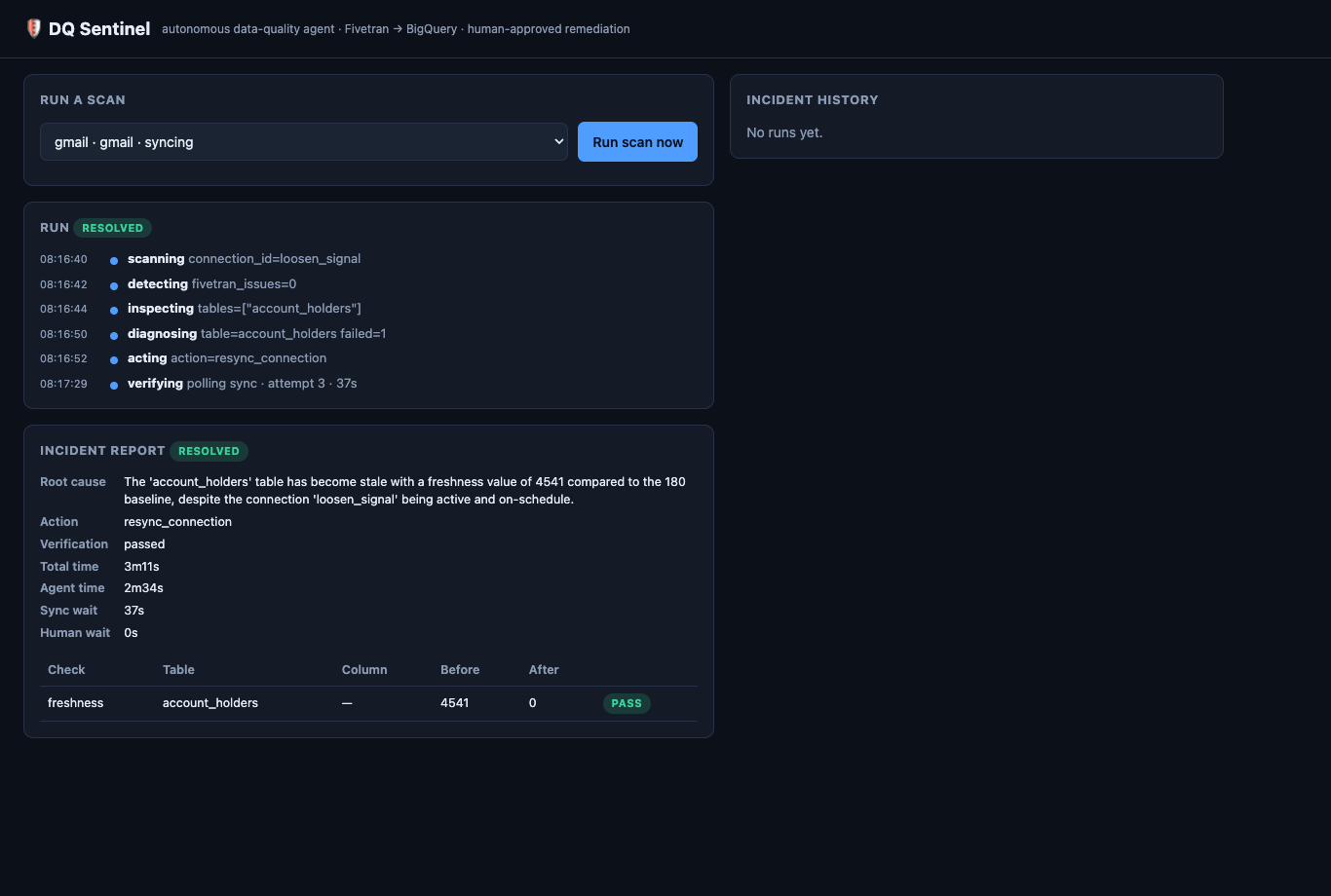
- Verify — polls until the sync completes, re-runs the checks that failed, and emits an incident report with before/after metrics and time-to-resolution.
## How we built it
- Agent: Google ADK (the code-first arm of Agent Builder), deployed on Cloud Run.
- LLM: Gemini 3.5 Flash on Vertex AI. The
diagnosis step gives the model exactly one tool —
propose_remediation— whose typed parameters are the diagnosis schema, so there is no brittle JSON parsing. - Pipelines: the official
fivetran/fivetran-mcpserver over stdio. Read tools are exposed to the model; the four write tools are invoked only by application code. - Data: BigQuery via the Python client. Every
check is a templated query; table and column names are
validated against an allowlist +
INFORMATION_SCHEMA— no free-form SQL ever reaches BigQuery. - Web: FastAPI + a thin polling UI. The approval
gate is bridged to the HTTP request lifecycle with an
asyncio.Future: a run is a detached task, theapprovalcallback parks on a Future, and a POST resolves it — so no request thread is held across the human wait or the multi-minute verify poll. - Demo data: Google Sheets → Fivetran → BigQuery, so issues can be staged deliberately.
## Challenges we ran into
- Reconciling a long agent loop with the web request
lifecycle — the loop awaits a human mid-flight,
then polls Fivetran for minutes. Solved with a
detached-task +
asyncio.Futurebridge, so no request thread is held across either wait. - Fivetran semantics:
get_connection_statereturns HTTP 405 on the live API (we pollget_connection_detailsinstead), and a normal sync of an unchanged Google Sheet doesn't rewrite_fivetran_synced— only a full resync does — which the diagnosis now reflects. - Cloud Run footguns: background CPU must stay
allocated (
--no-cpu-throttling) or the detached task silently freezes; and the Google Front End intercepts a bare/healthz, so the health route lives at/api/health.
## Accomplishments that we're proud of
- A structural approval gate: the diagnosis model has zero Fivetran write tools in scope — it physically cannot sync, resync, or reload. The write runs in separate code only after the approval Future resolves, and the UI shows the precise MCP call first. It survives prompt injection and model drift because the capability simply isn't there.
- A full RESOLVED loop proven live, end-to-end: a stale connector (freshness 4541 min) → Gemini diagnosed → approved → real Fivetran resync → re-check 4541 → 0 → resolved, in ~3 min (agent time 2m34s, sync wait 37s).
- 57 automated checks green (loop 26 · gate bridge 15 · HTTP 16); the gate held under a 23-agent adversarial review with 0 blockers.
## What we learned
- For an agent that touches production, a structural guardrail (the tool isn't in scope) beats a prompt-based one ("please don't") — it's verifiable and can't drift.
- Real connectors have surprising semantics (a no-op sync doesn't refresh timestamps; a "get state" endpoint that 405s) — grounding the LLM's diagnosis in the actual behavior matters more than a clean abstraction.
- Bridging a long-running, human-in-the-loop agent to
a stateless web platform is the real engineering: the
asyncio.Futuregate + the Cloud Run CPU/health gotchas were where the time went.
## What's next for DQ Sentinel Firestore-backed incident history, a richer DQ dashboard, duplicate and distribution-shift checks, and scheduled (not just manual) triggers.
Built With
- bigquery
- cloud-run
- fastapi
- fivetran
- gemini
- google-adk
- mcp
- vertex-ai

Log in or sign up for Devpost to join the conversation.