-
-
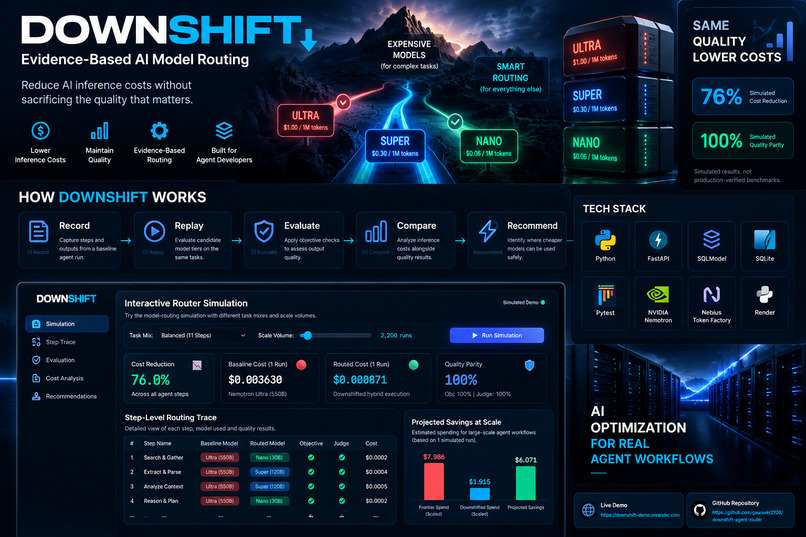
Downshift helps AI developers reduce inference costs through evidence-based model routing while prioritizing output quality.
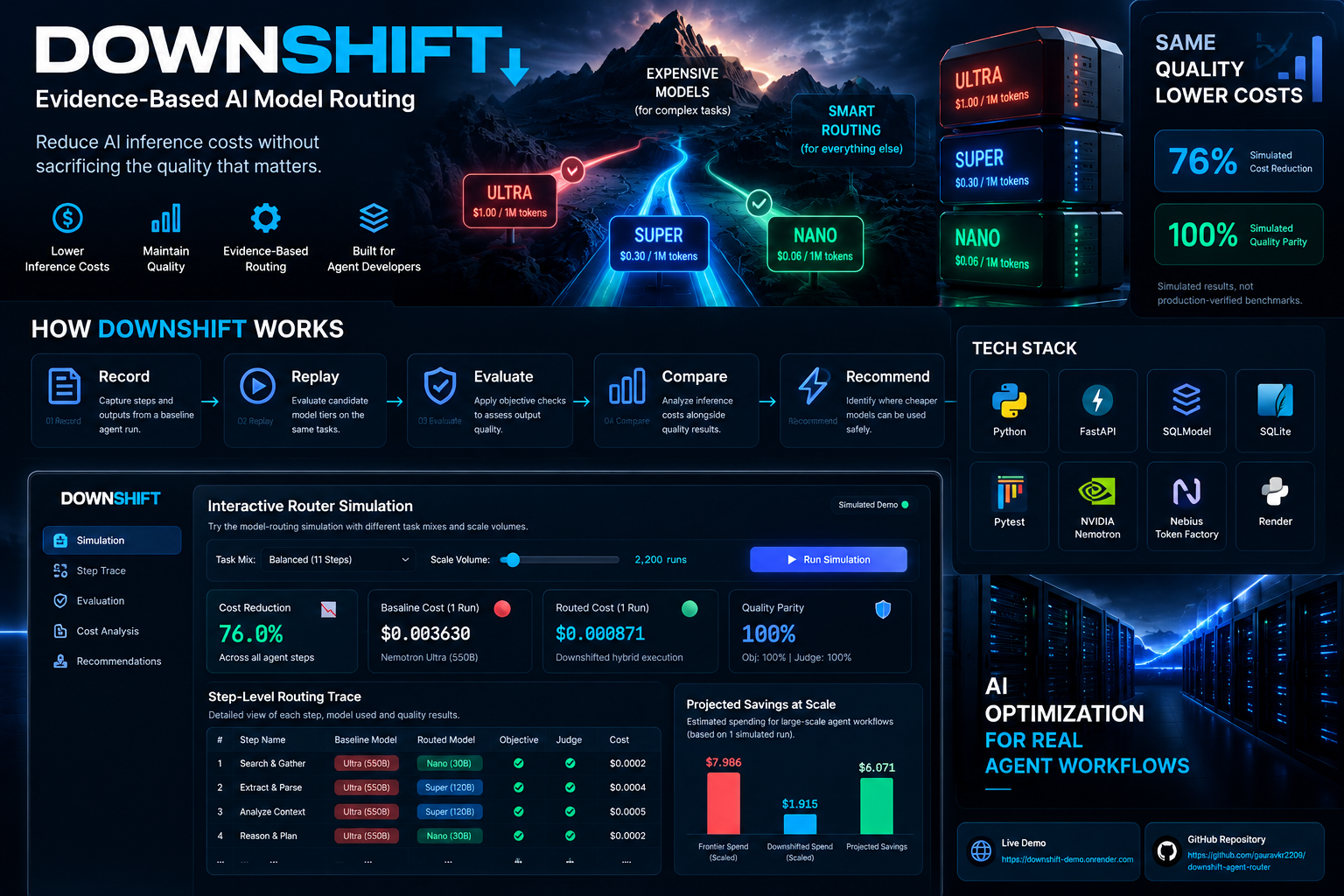
Downshift — Evidence-Based AI Model Routing
Intelligence is expensive. Waste shouldn't be inevitable.
Inspiration
AI agents are becoming capable of researching, reasoning, analyzing data, and completing complex tasks. However, not every step in an agent workflow needs the most powerful and expensive AI model.
A simple classification or extraction task may not need the same model as a difficult reasoning problem. Using a premium model for every step can increase inference costs unnecessarily.
We built Downshift around a simple question: Can we identify which agent tasks can use cheaper AI models while maintaining acceptable output quality?
Instead of relying on guesswork, Downshift explores an evidence-based approach to model routing.
What it does
Downshift is an AI model-routing and evaluation system designed for developers building AI agents.
Its workflow focuses on five stages:
- Record: Capture the steps and outputs of a baseline agent run.
- Replay: Evaluate candidate model tiers against recorded tasks.
- Evaluate: Apply objective checks to assess whether candidate outputs meet task requirements.
- Compare: Analyze estimated inference costs alongside quality results.
- Recommend: Identify opportunities to route suitable tasks to lower-cost models while preserving quality requirements.
The goal is to make model selection a measurable engineering decision rather than a blind trade-off between cost and capability.
How we built it
Downshift is built with Python and uses a modular architecture for agent execution, replay evaluation, cost estimation, and routing recommendations.
The project includes structured execution records, database-backed models for runs and evaluations, configurable model pricing, automated tests, and a web interface for exploring routing simulations.
The public demonstration is deployed on Render, while the source code is available on GitHub.
The current public demo uses deterministic mock clients to demonstrate the workflow. Its cost-reduction and quality figures are simulated projections, not verified results from production inference.
Challenges we faced
One of the central challenges is that a cheaper model should not be recommended solely because it costs less. Its output must also satisfy the requirements of the task.
This makes evaluation essential. Downshift incorporates objective checks and replay-based comparisons to help distinguish potentially safe routing opportunities from cases where quality requirements may not be met.
Another challenge is ensuring that simulated results are not confused with real-world performance. We therefore distinguish the current demonstration from production validation and treat reliable evidence as a prerequisite for trustworthy routing recommendations.
What we learned
Building Downshift reinforced an important lesson: AI optimization is not simply about choosing the cheapest model. It requires balancing cost, task complexity, output quality, and the reliability of the evaluation process.
We also learned the importance of reproducible tests, modular architecture, explicit safety controls, and transparent reporting of limitations.
What's next
Our next steps include validating routing recommendations with real model inference, verifying provider pricing, expanding quality evaluation, and testing recommendations across complete agent workflows rather than relying only on isolated steps.
The long-term vision is to give AI developers a practical way to understand where inference costs arise and where model routing may reduce those costs without compromising the quality their applications require.
Project links
- Live demonstration: https://downshift-demo.onrender.com
- Source code: https://github.com/gauravkr2209/downshift-agent-router
Downshift — Intelligence is expensive. Waste shouldn't be inevitable.
Built With
- agentsllmmodel
- evaluationcost
- fastapi
- intelligenceai
- nebius
- nemotronnebiustoken
- optimizationnvidia
- pytest
- pythonartificial
- render
- routingai
- sqlite
- sqlmodel
- tokenfactory

Log in or sign up for Devpost to join the conversation.