Inspiration
As someone with relatives who are susceptible to these types of scams, it's important to me that there are safety nets to better support people at risk of exploitation. I appreciate a cognitive approach to things and applications of AI relating to social interaction, so a project such as this follows my passions in tech.
What it does
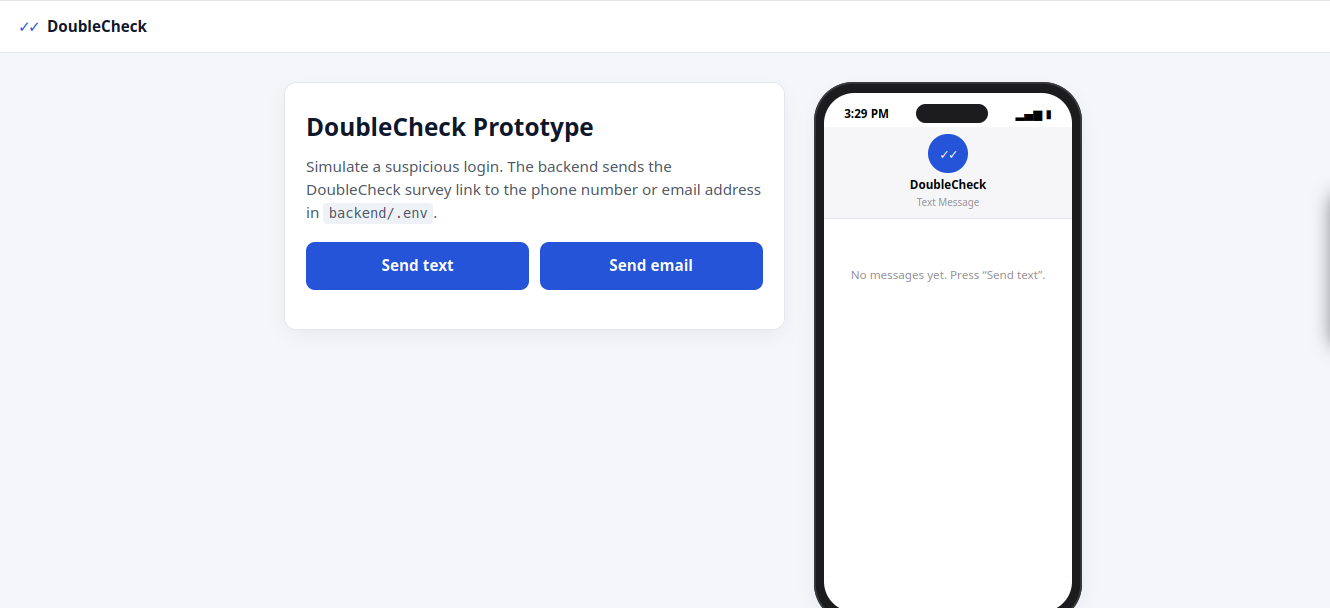
DoubleCheck is an early intervention for high-risk login attempts. A one-time code can easily be read aloud to a scammer over the phone or intercepted through a SIM swap. DoubleCheck replaces that code with an in-app process:
- End the call first. The user has to hang up any active phone call before continuing, which cuts off a scammer who’s coaching them in real time.
- Optional check-in. A short conversation with an AI-powered chatbot screens for signs of fraud, like pressure, urgency, or someone else directing the login.
- Bluetooth verification. If everything looks right, the companion iOS app confirms the login over Bluetooth using a code that changes every 3 seconds, so the user’s phone has to be physically within range of the log-in device.
Note: The live web demo simulates the Bluetooth step; the real check runs through the iOS app.
How we built it
Built in conjunction with Claude Code. Utilizes Typescript + React + Vite for the web app, Swift for the iOS integration. Deployed online with Render.
Challenges we ran into
The initial prototype felt a little clunky and limited -- the slow survey process would provide too much friction for members attempting a valid log-in, so I needed to brainstorm a new approach. Additionally, I didn't have any prior experience with creating apps for iOS, so the set-up was very new.
Accomplishments that we're proud of
Getting Bluetooth verification working on iOS, with a code that rotates every 3 seconds, was a highlight, especially since it was my first iOS app. I’m also proud of shipping a deployed web demo and an app as a solo developer!
What we learned
The biggest lesson was designing for a company’s real business needs. My first version frustrated legitimate members, and my final version is better aligned with what Sound Credit Union actually needs. I still see room to improve, and next time I want to be more ambitious with my ideas. Seeing how other teams approached the same problem was eye-opening. This was my second hackathon and my first solo, and I had a lot of fun. I’d love to do more!
What's next for DoubleCheck
Some implementations that would elevate DoubleCheck:
- Fixing the Bluetooth connection between the iOS app and the web flow, so the full check runs end to end outside the demo
- Using real risk signals, like new devices, unusual locations, or a recent phone number change, to decide when DoubleCheck triggers
Built With
- claude
- express.js
- react
- swift
- typescript
- vite
