-
-
Logo
-
-
Inspiration
The development of Dottie was inspired by research from the American College of Obstetricians and Gynecologists (ACOG), which established the menstrual cycle as a vital sign for adolescent health. In their 2015 Committee Opinion Menstruation in Girls and Adolescents: Using the Menstrual Cycle as a Vital Sign ACOG emphasized that menstrual patterns can serve as an indicator of overall health status in young women. Just as clinicians regularly check vital signs like heart rate, temperature, and blood pressure, the menstrual cycle provides critical insights into hormonal balance and reproductive health. However, unlike other vital signs, menstrual health remains shrouded in stigma and misinformation, particularly for adolescents experiencing their first periods.
The Challenge: Adolescent menstrual health faces three critical barriers:
Knowledge Gap: Many adolescents and caregivers lack clear understanding of what constitutes normal vs. abnormal menstruation.
Communication Barrier: Stigma and embarrassment prevent open discussions about menstrual concerns between adolescents, caregivers, and healthcare providers.
Delayed Care: Without understanding normal parameters, abnormal symptoms often go unreported, leading to delayed diagnosis of underlying conditions like PCOS, endometriosis, or thyroid disorders.
Key Statistics
- Up to 38% of adolescent girls experience menstrual disorders (Adams Hillard, 2014).
- The average delay in diagnosis for endometriosis is 7-10 years, often beginning in adolescence (Diaz et al., 2006).
- 75% of young women report receiving inadequate education about menstrual health (World Health Organization, 2021).
- Only 14% of adolescents consult healthcare providers about menstrual concerns (Society for Adolescent Health and Medicine, 2020).
Dottie emerged from recognizing the gap between this medical understanding and the practical knowledge available to young people and their caregivers. By translating complex medical guidelines into accessible, age-appropriate information, Dottie aims to bridge this knowledge gap and empower adolescents to become advocates for their own health.
What it does
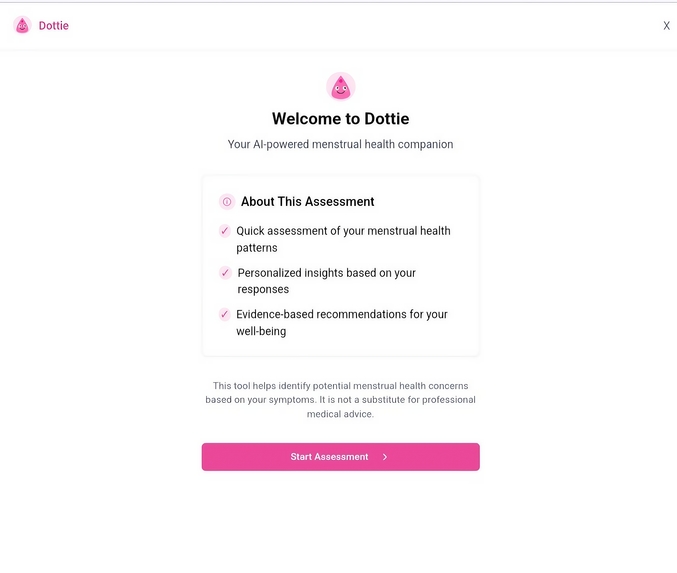
Dottie is an innovative AI-powered digital companion designed to support adolescent girls in understanding and managing their menstrual health. Positioned as a friendly "Period Bestie," the app transforms menstrual health education into an approachable, supportive experience that empowers young women to become advocates for their own well-being.
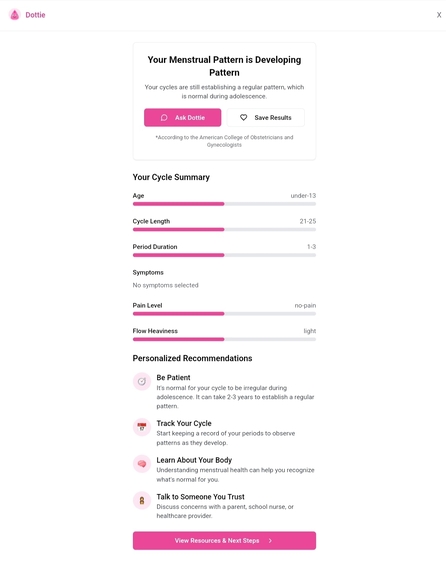
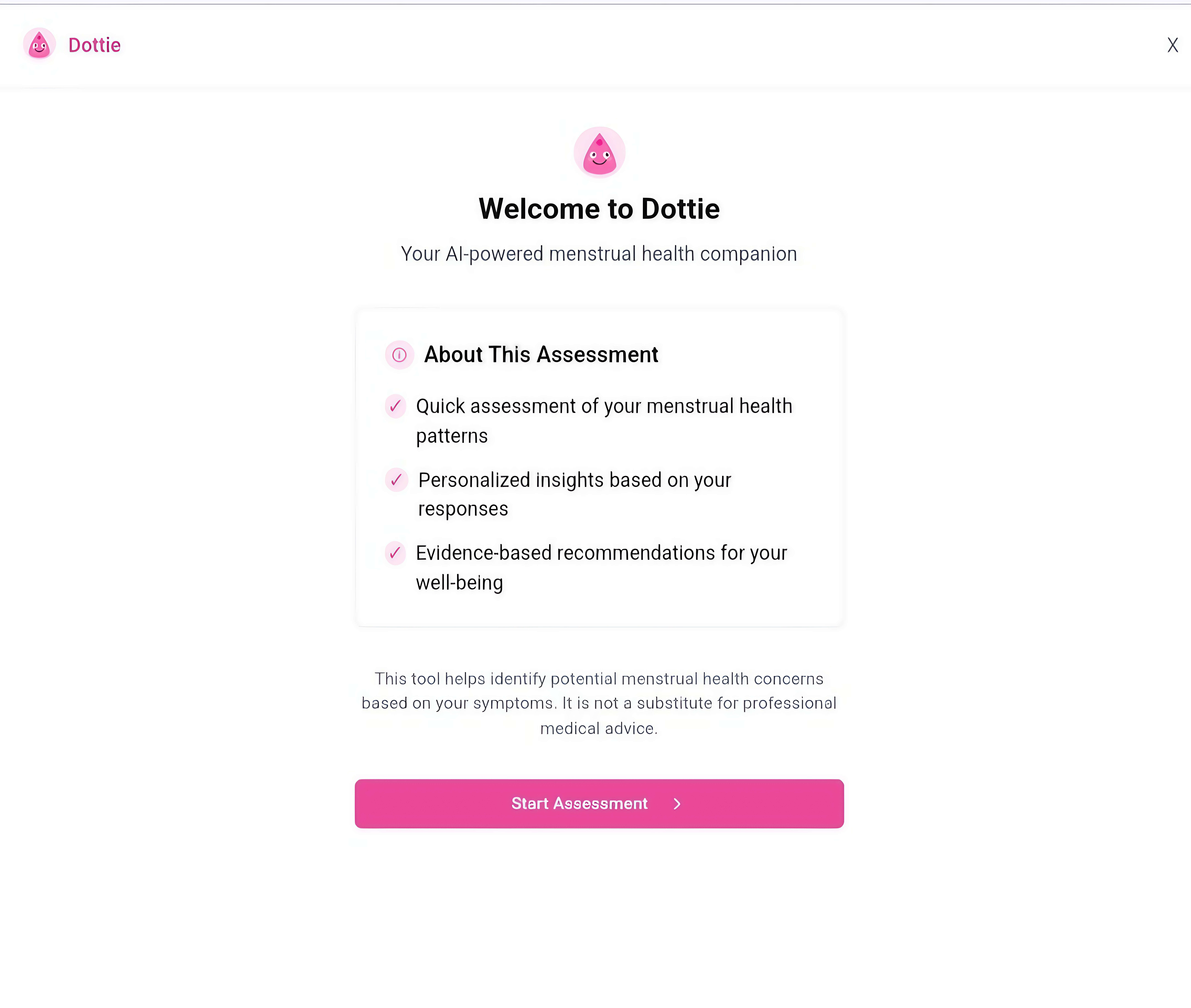
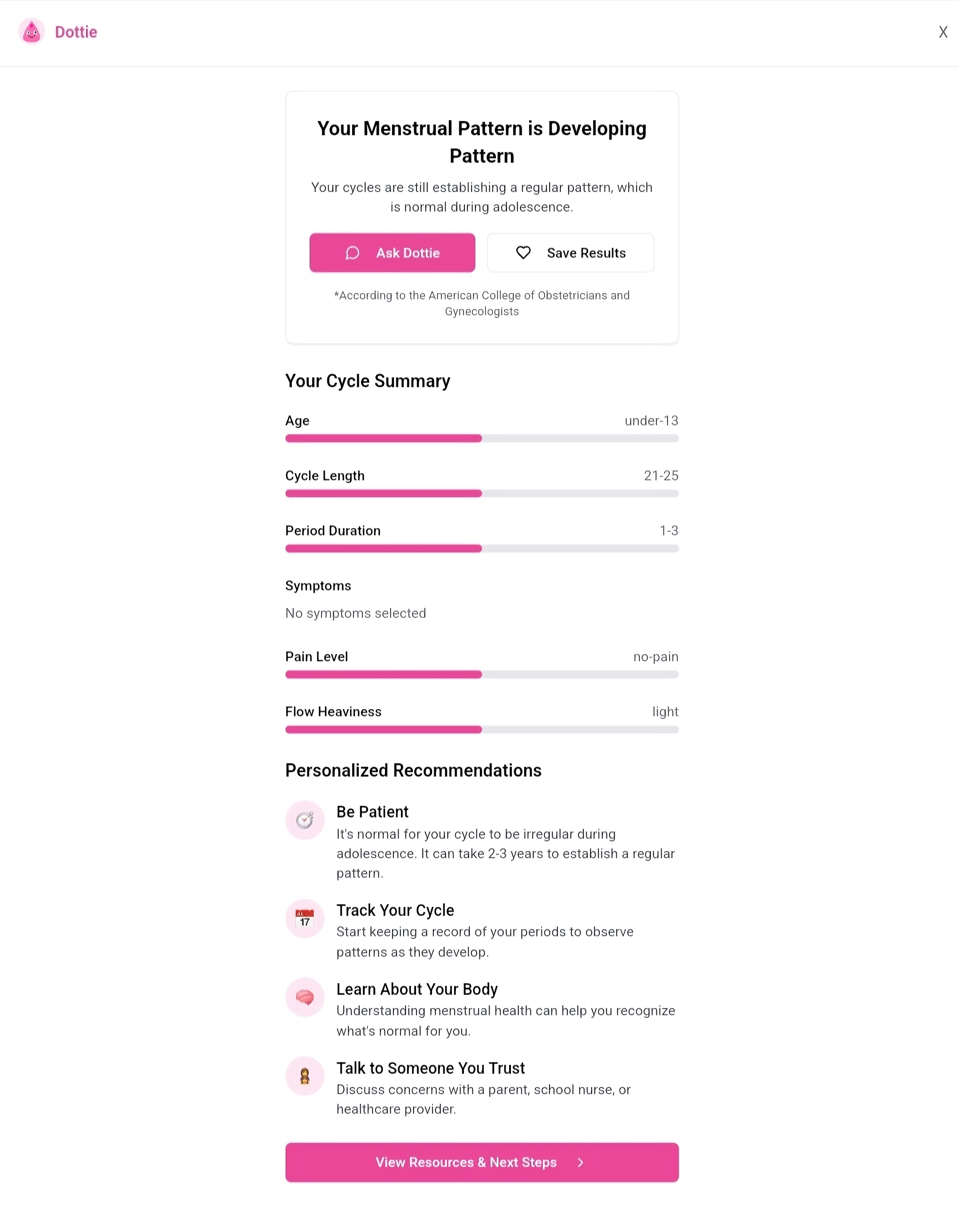
The platform provides a comprehensive approach to menstrual wellness, starting with a quick and intuitive assessment of individual menstrual health patterns. Using advanced AI technology, Dottie generates personalized insights based on users' specific responses. The app offers evidence-based recommendations that help adolescents distinguish between normal and abnormal menstrual experiences, providing clear guidance on when to seek additional medical support.
Key features include symptom tracking, educational content, and a user-friendly interface designed to reduce anxiety and stigma surrounding menstrual health. The app carefully balances scientific accuracy with age-appropriate, conversational language, making complex health information accessible and understandable.
Crucially, Dottie emphasizes that it is not a substitute for professional medical advice. Instead, it serves as a knowledgeable companion that bridges critical information gaps, encourages open communication, and supports young women in developing a positive, informed relationship with their reproductive health.
The platform uses Azure SQL for secure data storage, Azure AI for insights, and Azure Static Web App for smooth deployment and accessibility. You can explore the project and understand the codebase on an abstract level via the following test link: Explore the Dottie project test page.
How we built it
Dottie leverages a modern tech stack with a Node.js/Express.js backend. We implemented a dual-database approach using SQLite for development and Azure SQL for production, with Knex.js as our ORM to maintain a consistent query interface across environments. The architecture was designed for both developer convenience and production readiness.
Challenges we ran into
- Balancing medical accuracy with age-appropriate, accessible language
- Creating a stigma-free interface while maintaining clinical credibility
- Implementing robust privacy controls suitable for adolescent users
- Developing appropriate symptom assessment algorithms based on ACOG guidelines
- Designing culturally responsive content addressing diverse perspectives on menstruation
Accomplishments that we're proud of
- Built a clinically-accurate symptom checker based on established medical guidelines
- Created a privacy-centered design specifically for adolescent users
- Developed a character-based interface that reduces anxiety around menstrual discussions
- Implemented a simple yet effective tracking system with clear visual representations
- Designed conversation starters to improve communication between teens, parents, and doctors
What we learned
- The significant knowledge gap around adolescent menstrual health
- How to effectively translate medical guidelines into conversational AI responses
- The value of a dual-database approach for smoother development workflow
What's next for Dottie: Your Period Bestie
- Completing the frontend user interface with responsive frontend.
- Adding more sophisticated assessment tracking list/detail interface.
- Securing a sturdier test driven development approach through test button validation for all api endpoints.
References
Adams Hillard, P. J. (2014). Menstruation in adolescents: What's normal? The Medscape Journal of Medicine, 16(10), 1-14.
American College of Obstetricians and Gynecologists. (2015). Menstruation in girls and adolescents: Using the menstrual cycle as a vital sign. Committee Opinion No. 651. Obstetrics & Gynecology, 126(6), e143-e146.
Diaz, A., Laufer, M. R., & Breech, L. L. (2006). Menstruation in girls and adolescents: Using the menstrual cycle as a vital sign. Pediatrics, 118(5), 2245-2250.
Society for Adolescent Health and Medicine. (2020). Sexual and reproductive health care: A position paper of the Society for Adolescent Health and Medicine. Journal of Adolescent Health, 68(6), 1080-1086.
World Health Organization. (2021). WHO guideline on self-care interventions for health and well-being. Geneva: World Health Organization.
Built With
- azure
- azure-app-services
- express.js
- knex
- node.js
- playwright
- react
- sqlite
- supertest
- vite
- vitest


Log in or sign up for Devpost to join the conversation.