-
-

DotSage Logo
-
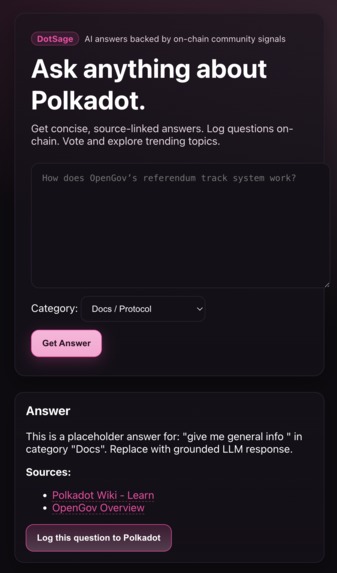
App Screenshot
-
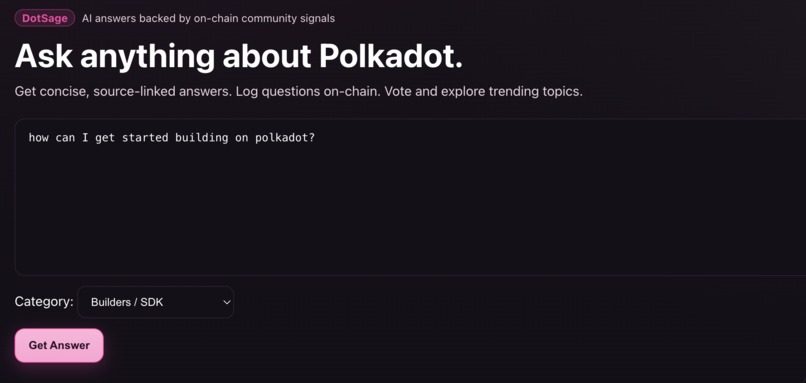
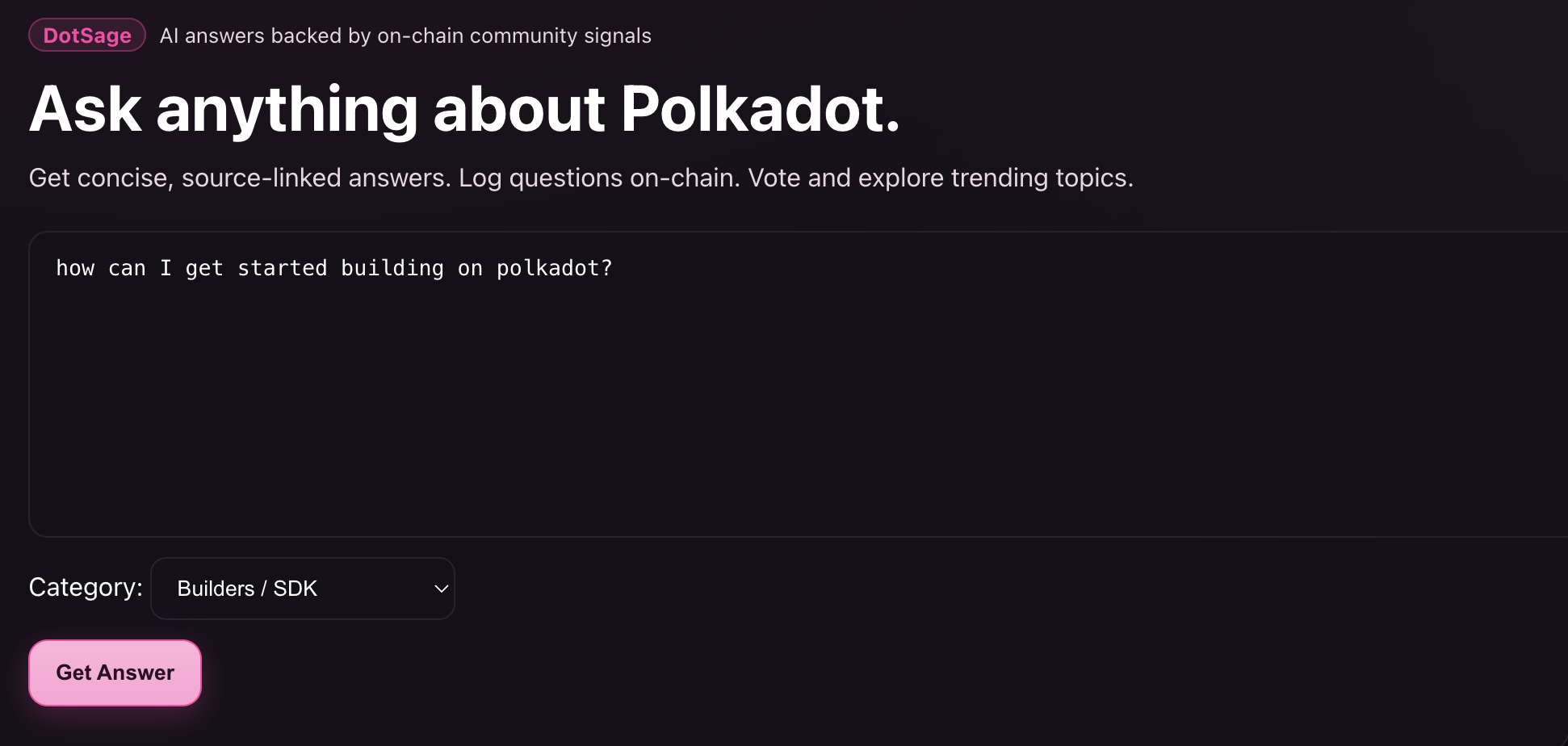
Example Question - App Screenshot
-
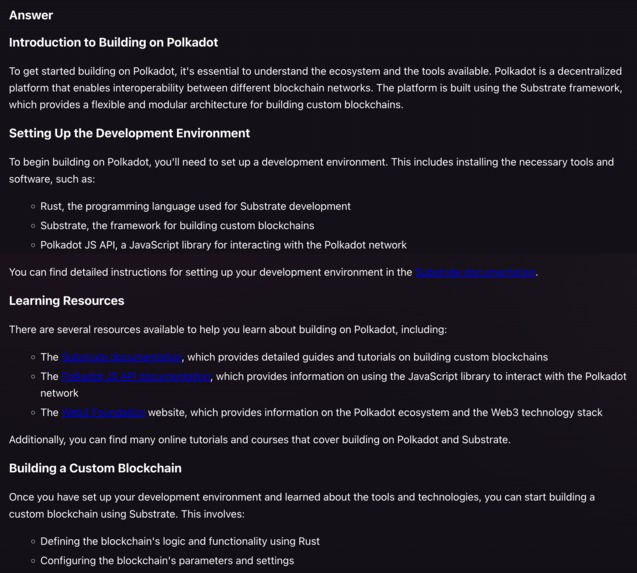
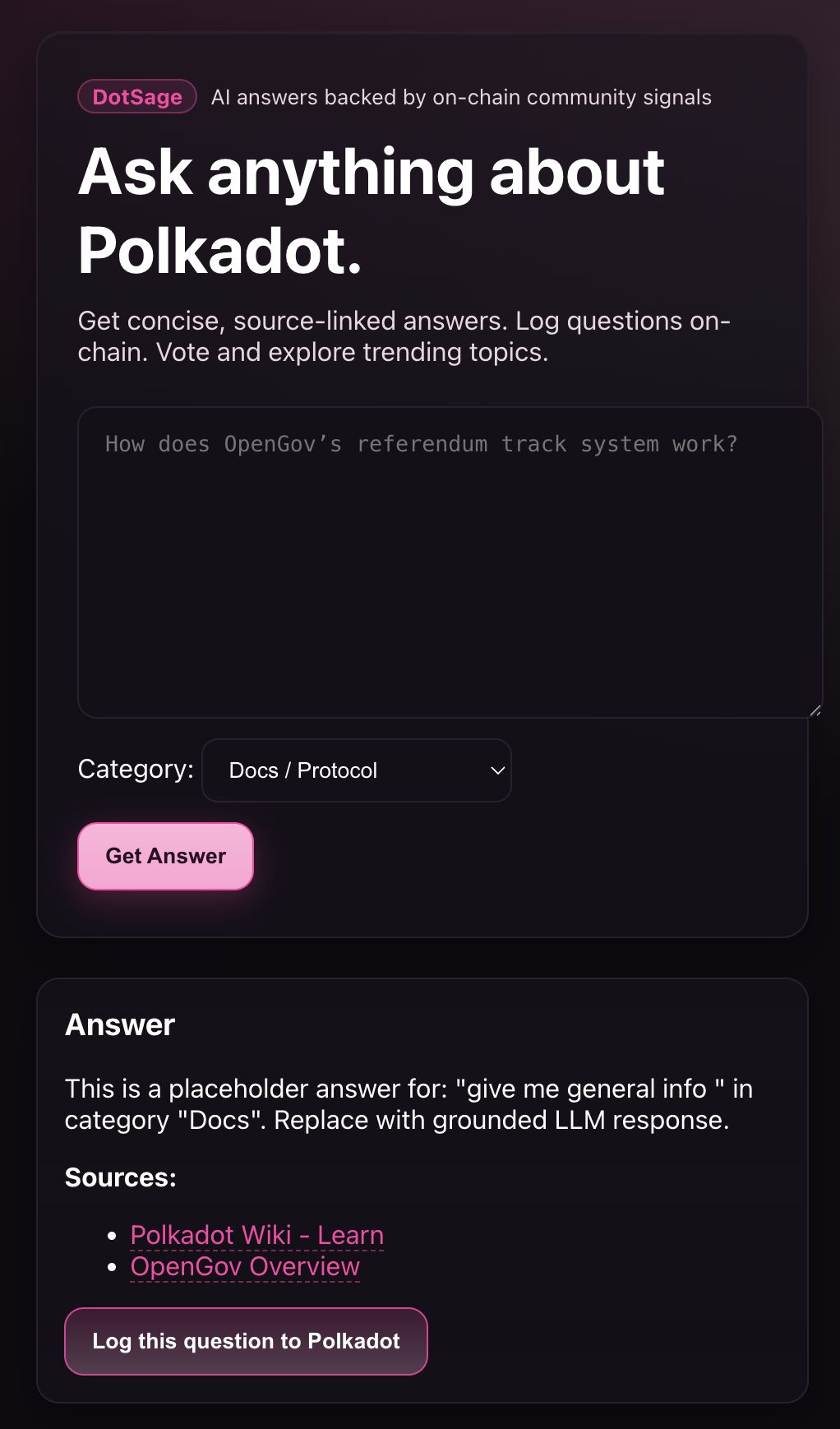
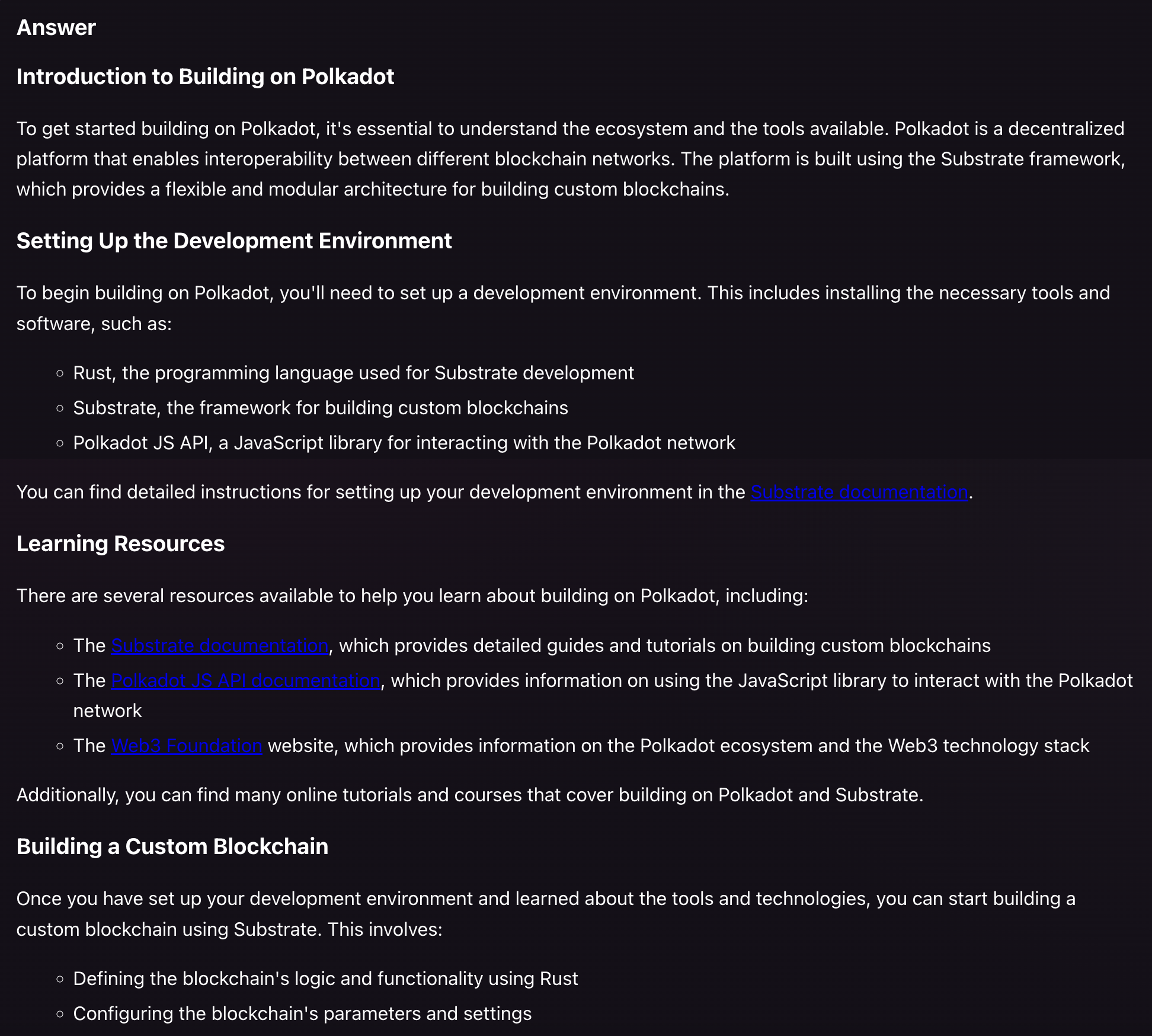
Example Answer - App Screenshot
-
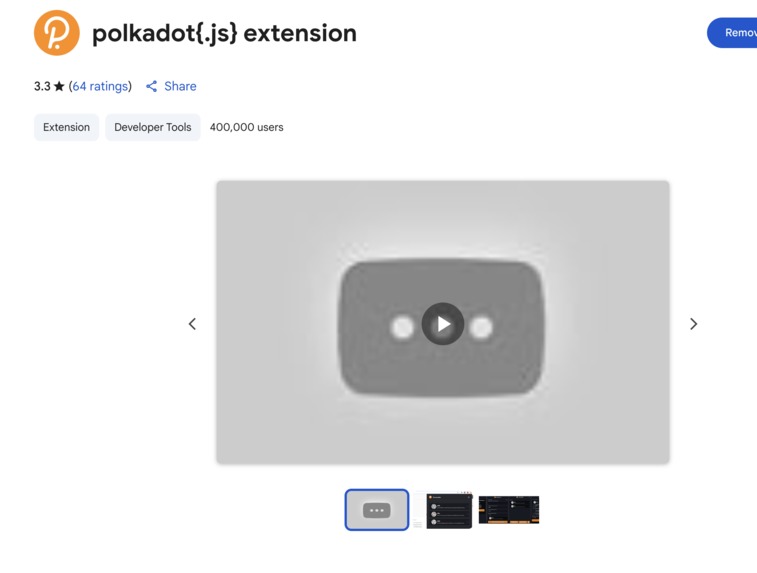
polkadot.js extension
-
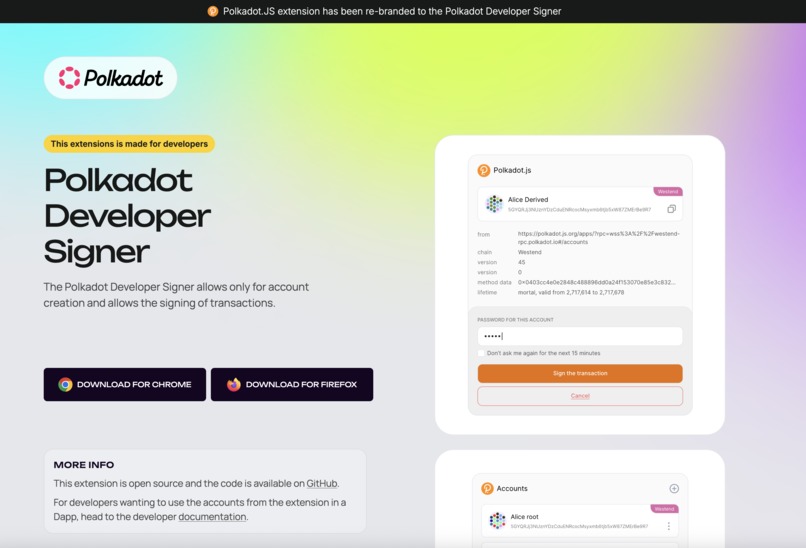
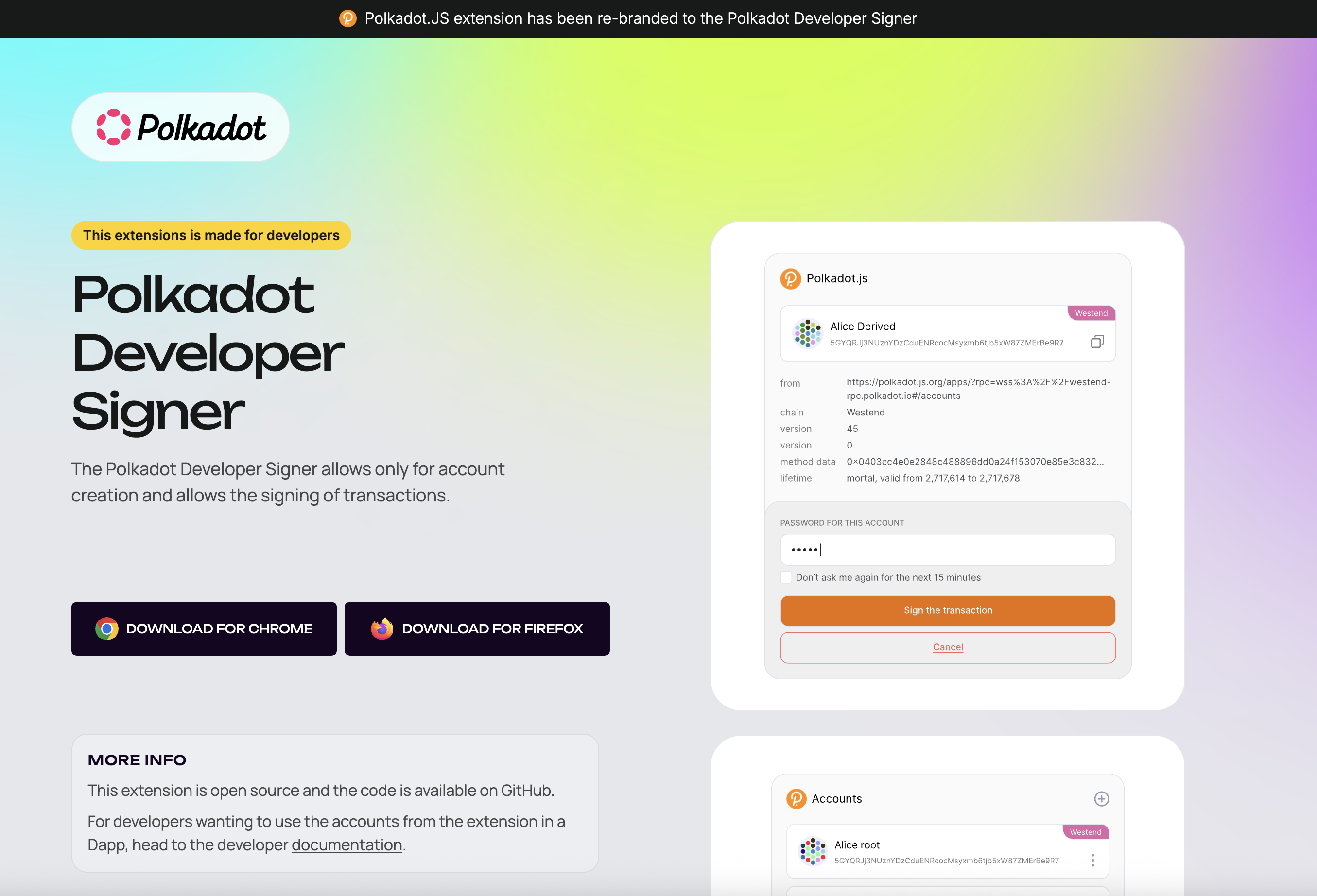
Polkadot Developer Signer (New Polkadot.JS)
-
Other Polkadot Wallets(Talisman)

Inspiration
Polkadot has some of the best tech in Web3, but a brutal learning curve. New users and builders constantly bounce off the docs, X threads, and forum links. We wanted a way to make Polkadot feel like it has a built-in teacher, without centralizing that knowledge.
What it does
DotSage lets anyone ask natural language questions about Polkadot and get AI-generated answers grounded in official docs and ecosystem resources. Each logged question is stored on-chain via an ink! smart contract, and the community can vote on which questions and answers are the most helpful. Over time, this builds an on-chain knowledge map of what the Polkadot community actually struggles with.
How we built it
Frontend: Next.js + React with wallet connection via Polkadot.js extension.
Smart contract: ink! contract deployed on a Polkadot SDK-based chain, storing questions, categories, timestamps, and vote counts.
Backend: Node/TypeScript service that pulls relevant doc snippets and calls an LLM to generate answers.
On-chain integration: @polkadot/api and @polkadot/api-contract for reading/writing contract state from the dApp.
Challenges we ran into
Designing a contract that stores useful data without bloating on-chain state.
Mapping AI answers to traceable documentation sources.
Making the UX dead simple while still exposing Polkadot-native features.
Accomplishments that we're proud of
End-to-end working demo: ask, answer, log, vote, and view trending questions on-chain.
Built a reusable pattern for “AI + on-chain feedback loops” that other ecosystems could copy.
Showcased Polkadot smart contracts, governance concepts, and dev tooling in a single experience.
What we learned
DotSage wasn’t just built for Polkadot users — it was shaped by their real questions. Every step of development mirrored the exact confusion points we saw across the community.
1. “What even is Polkadot 2.0 and how does Elastic Scaling work?”
This led us to build:
A Polkadot-docs-aware AI explainer mode Doc-grounded answer generation Automatic citation extraction for transparency
2. “Where can I learn how to deploy an ink! smart contract?”
We built: Builder Mode / Polkadot Copilot Code snippet generation Quick links to ink!, Polkadot SDK, and Pallet docs A searchable list of “frequently-asked builder questions” pulled from on-chain logs
3. “Why is OpenGov so complicated?”
We added: A structured governance category Answer templates for referendum tracks, delegations, submission process, and voting logic The ability to log governance questions on-chain so the community can see trending confusions
4. “How do parachains actually communicate?”
This inspired: A dedicated XCMP/XCM category A “compare chains” answer format On-chain tags so users can filter all XCM questions from the entire corpus
5. “Which parachain should I build on?”
We added: Polkadot ecosystem knowledge baked into the model context Chain comparison summaries Copilot suggestions for substrate templates, contract chains, and use-case matching
6. “Where do I start as a complete beginner?”
We realized we needed: A Beginner Mode with simplified language Step-by-step explainers Smart-context answers that detect noob-level questions
7. “Can someone explain this in simple terms?”
We added: Tone control (simple → intermediate → expert) Quick analogies (e.g., “Polkadot is a high-speed internet hub; parachains are apps on it”) A toggle to re-explain answers at different difficulty levels
8. “Is my question already answered somewhere?”
This forced us to build: On-chain metadata indexing Recent questions feed “Similar Questions” detection using semantic clustering How Questions Shaped the Actual Product
Here’s what DotSage now ships with, directly because of the community’s confusion patterns:
AI Q&A engine grounded in Polkadot docs On-chain question logging via ink! On-chain voting for answer quality Trending Questions dashboard Builder Copilot Mode Beginner Mode with simplified explanations Governance knowledge lane Semantic question search Topic heatmaps and analytics
This transforms random questions into a permanent, transparent knowledge map the community can build on.
What's next for DotSage
Integrate more tightly with Polkadot OpenGov: allow questions to be linked to referenda and governance tracks, and show relevant OpenGov activity for each topic.
Expose an API so wallets, explorers, and edtech dApps can surface trending questions.
Fine-tune models on Polkadot-specific content and add multi-language support.
Everything DotSage became came from listening. Every question logged on-chain is another signal about how to make Polkadot easier, clearer, and more accessible for everyone.
Built With
- cargo
- document-embedding-retrieval
- github
- groq
- ink!
- nextjs
- node.js
- openai
- pnpm
- polkadot.js
- polkadot/api
- polkadot/api-contract
- polkadotsdk
- react
- tailwindcss
- typescript


Log in or sign up for Devpost to join the conversation.