-
-
Dossier: Everything you need to explain what you built, generated from your projects in minutes
-
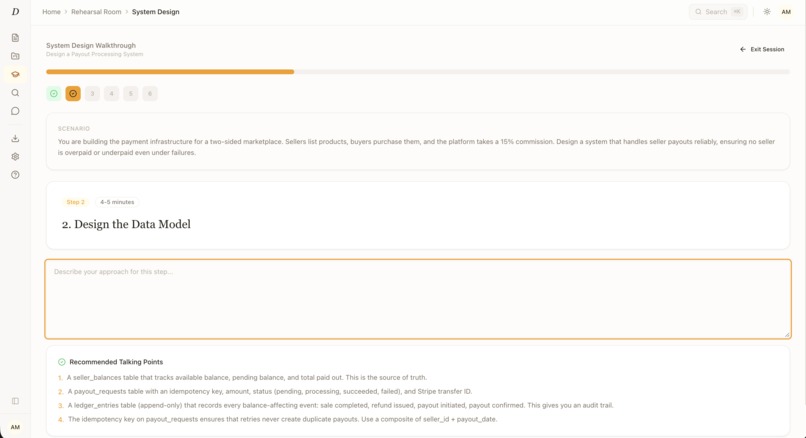
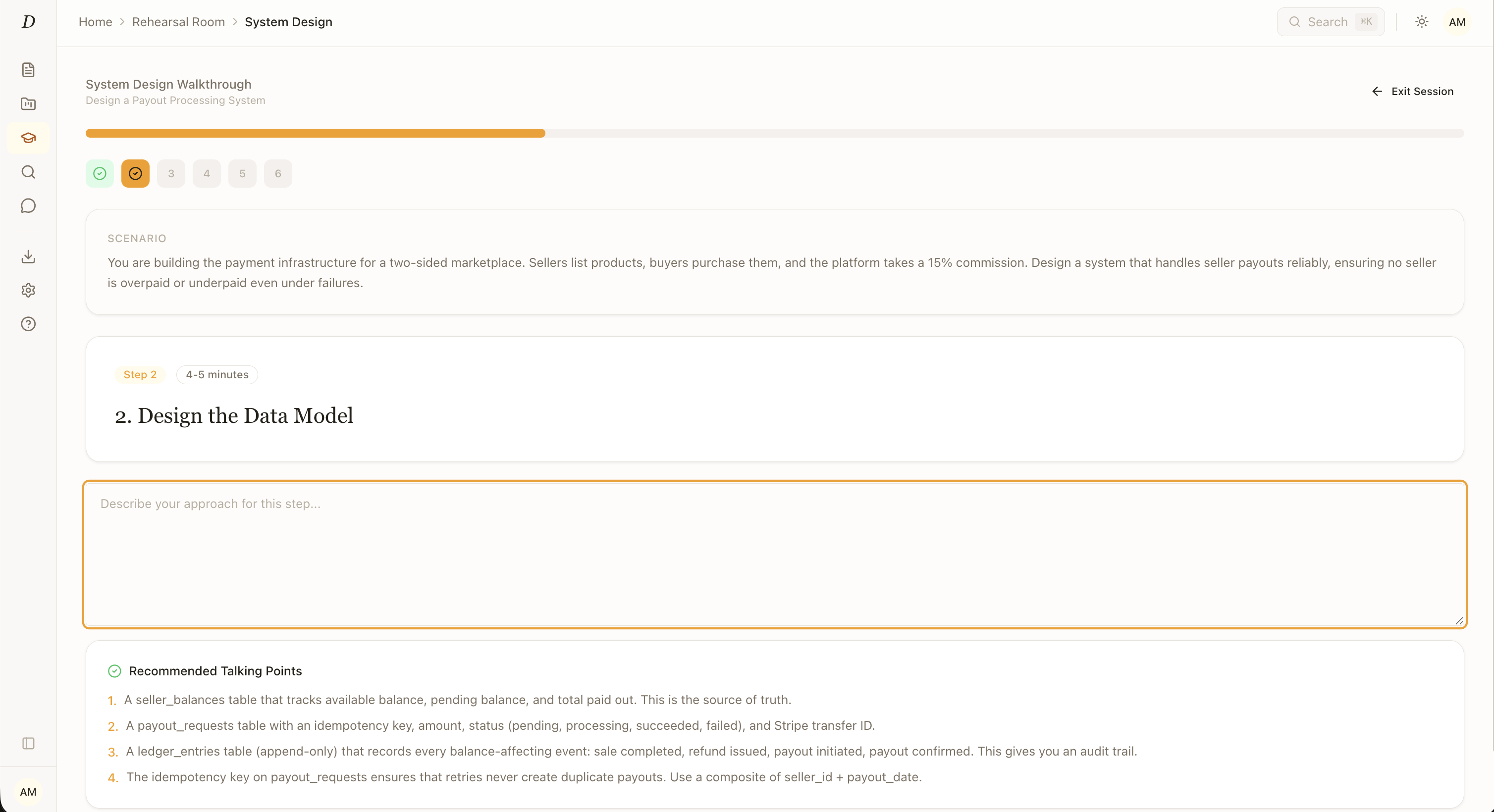
Sample System Design Practice Question
-
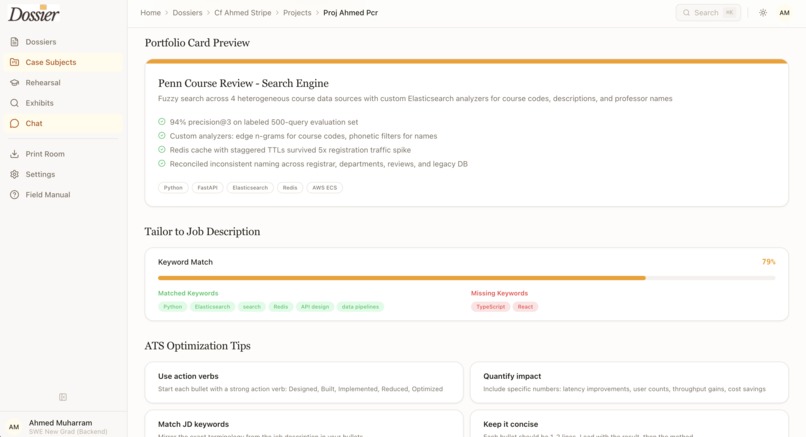
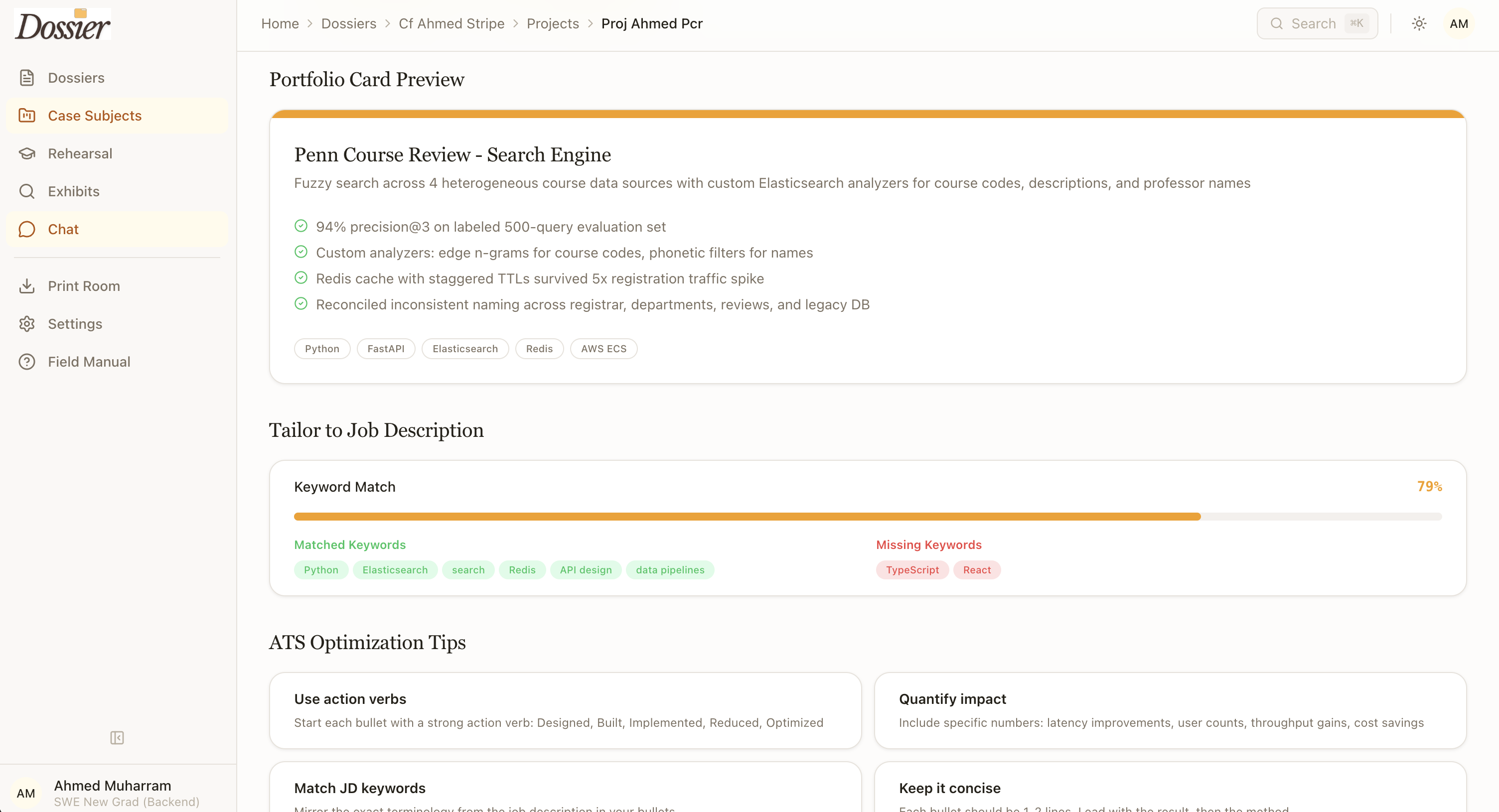
Sample Project Portfolio Card
-
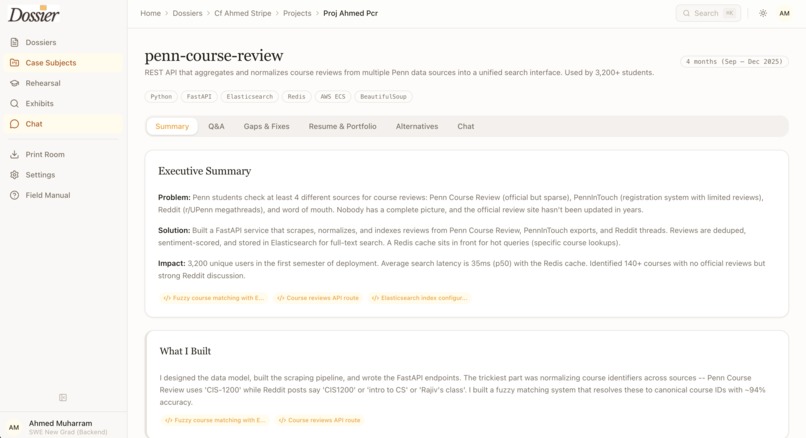
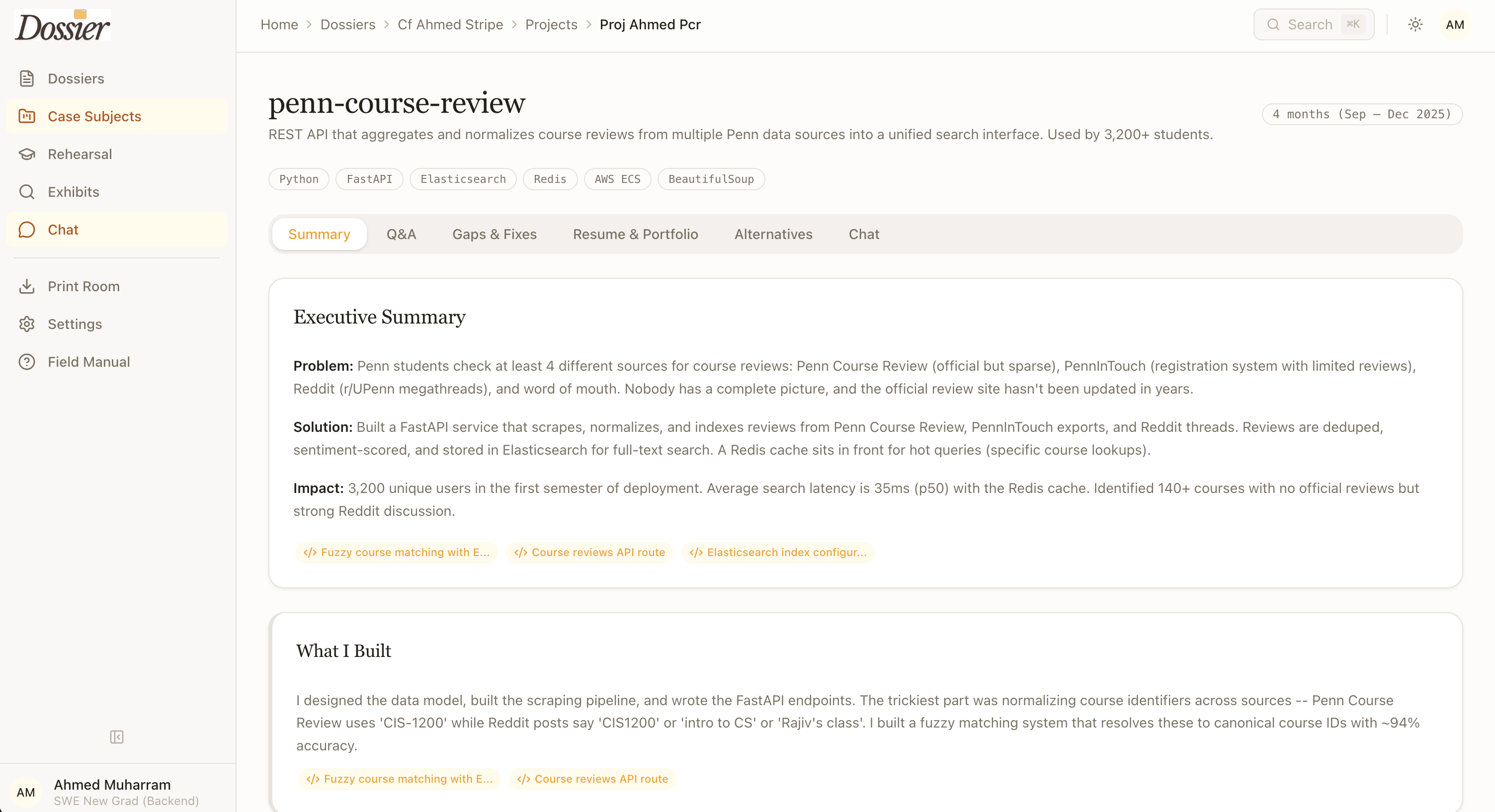
Sample Project Summary
Inspiration
Interviews are noisy, and even strong candidates don’t perform consistently. In our research, 75% of 33,000+ interviewees had inconsistent performance between interviews, and it’s completely normal to forget the minute details of projects you built months, or even years, ago. At the same time, "important" interviews are expensive in time: candidates told us they spend 10 to 15 hours preparing per interview, and that a meaningful chunk of an interview cycle turns into re-reading old code, digging through notes, and trying to reconstruct tradeoffs on the fly.
Dossier started from a simple question: what if your projects came with a reusable, backed-by-code "case file" you could review before every round, so you never have to re-index your own work under pressure?
What it does
Dossier turns your existing project artifacts into a single Interview Prep Brief: everything you need to explain what you built, generated from your projects in minutes.
Through Dossier, you can:
- Generate project summaries and crisp talking points across your projects
- Get resume points that are grounded in what’s actually in your work
- Practice rapid-fire questions, project deep dives, and system design Q&A tailored to the project you select
- See "growth plan" suggestions like project gaps & fixes, scalability concerns, and technology alternatives (so you can strengthen the work later when you get the time to and not just describe it)
- Use a proof-first mindset: the goal isn’t to just sound fluent, it’s to stay accurate and have proof when interviewers ask "why?" and "what tradeoff did you make?"
How we approached it
Instead of starting with "what can we generate?", we started by asking in our user surveys what breaks in real interviews:
- The users who feel this most are actively interviewing right now: a CS student applying with a few meaningful repos, needing to explain system design choices fast.
- Their baseline today is scattered notes, re-reading code, and sometimes copy/pasting into chatbots. This is effective for smaller project only sometimes, and is very hard to repeat consistently.
- We storyboarded the end-to-end journey around the "aha moment": turning one project into a clean story, then let the user drill into details and practice follow-ups.
Challenges we ran into
- Competing with "just paste into ChatGPT." Many candidates already do this; we had to make the value proposition sharper. We don't just generate "answers," but provide consistency, proof, lower cognitive load, and leaner outputs through reliable product.
- Pricing expectations are spiky. People binge prep before onsites and then stop, which makes yearly subscriptions harder to justify.
- Feature density. Early feedback on the demo was that it looks polished, but some pages can feel condensed and the UI can be overwhelming if everything is shown at once.
Accomplishments we’re proud of
- A clear, user-first positioning: "Everything you need to explain what you built."
- A cohesive, realistic UI demo that communicates the experience end-to-end (and got feedback like "more polished than expected").
- A concrete, testable business model: first project covered, then paid tiers (annual plans) aligned with interview-cycle behavior.
- A practical go-to-market story focused on where candidates actually are: communities, campus clubs, career services, referrals, and "sample Dossiers" as a hook.
What we learned
- Candidates don’t only need "more content", they need a repeatable structure (60-second pitch, 5-minute deep dive, tradeoffs) and a way to rehearse it.
- The real hook is defensibility: "Don’t just summarize, but also show file paths + commits." Proof links make people trust the output and reduce bluffing.
- Pricing needs to match reality: usage is bursty; "tokens" language can confuse; users want predictable, simple spending.
- A polished experience matters early: even before full implementation, a high-quality demo and a free trial make the concept concrete and reveal what feels confusing vs. what feels essential.
What’s next for Dossier
- Pilot with real repos: generate the first fully evidence-linked case files and measure outcomes like time saved and confidence/consistency under follow-up questions.
- Scope to the core wedge: the "project story + proof + practice" loop (pitch → deep dive → system design pivots → rapid-fire) before expanding feature breadth.
- Make proof feel instant: tighten the "claim to evidence" experience so every important line can be defended quickly (especially for system design and tradeoff questions).
- Refine pricing and packaging: keep the free "aha moment," then charge in a way that matches interview-cycle bursts and stays simple to understand.

Log in or sign up for Devpost to join the conversation.