-
-
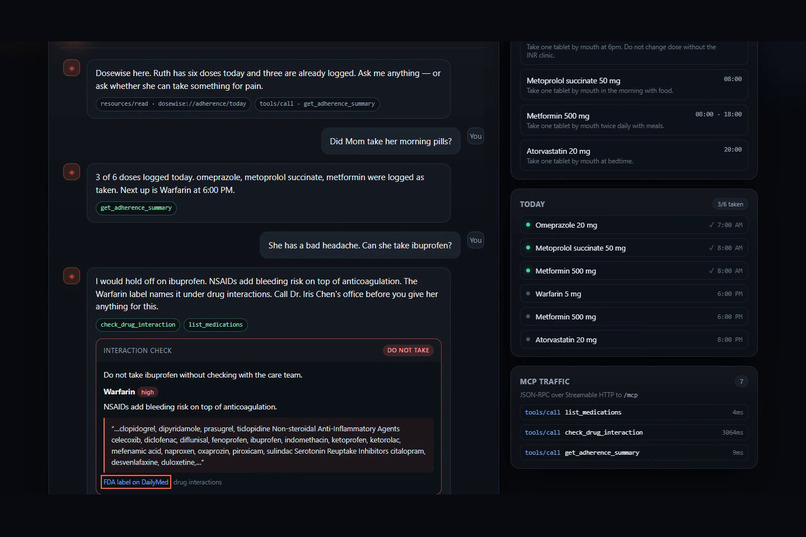
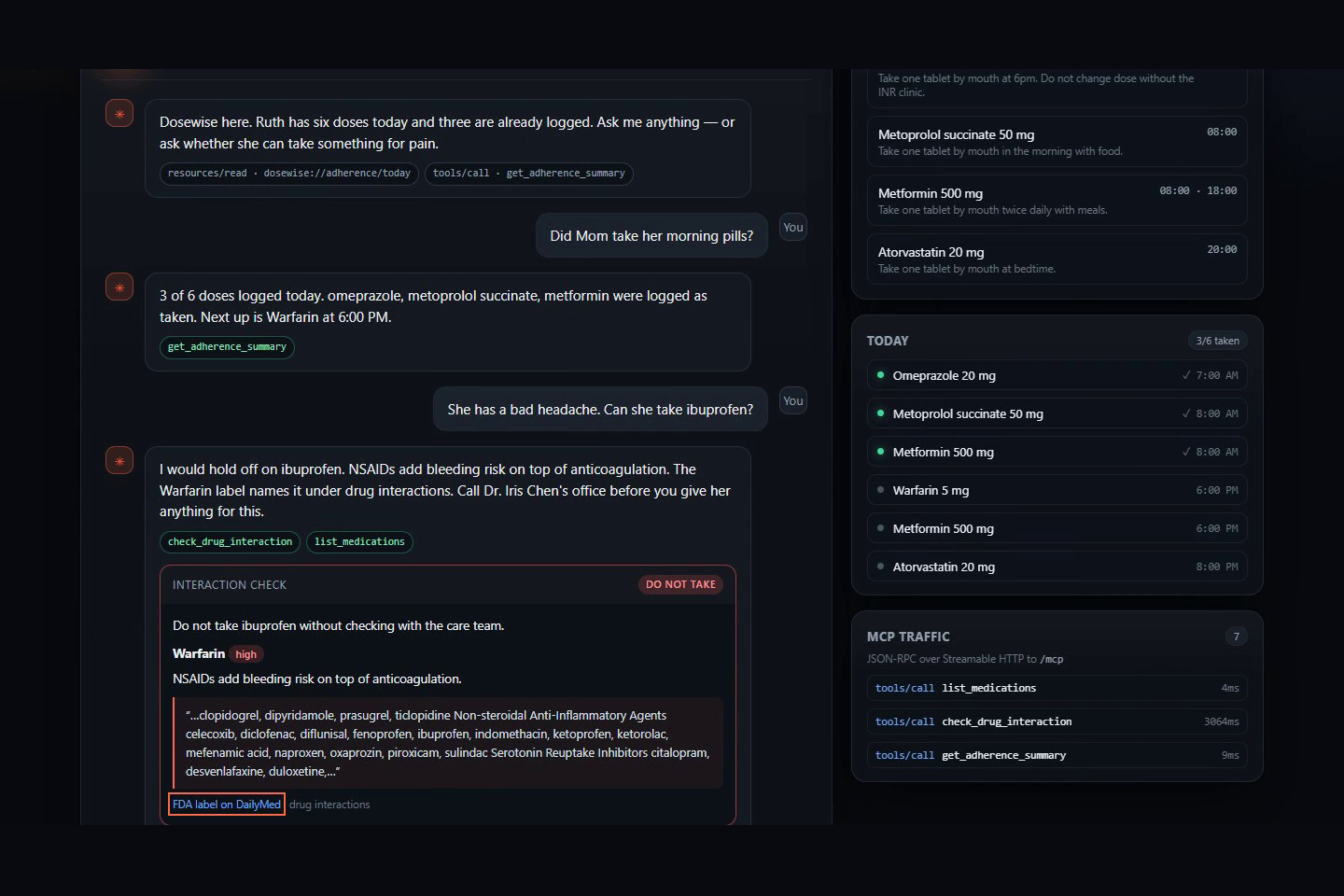
the ibuprofen safety card with the quoted label + DailyMed link
-
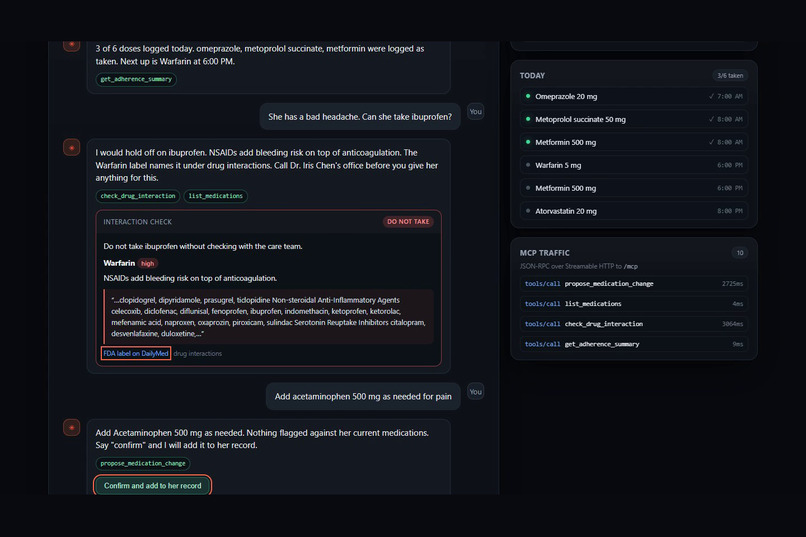
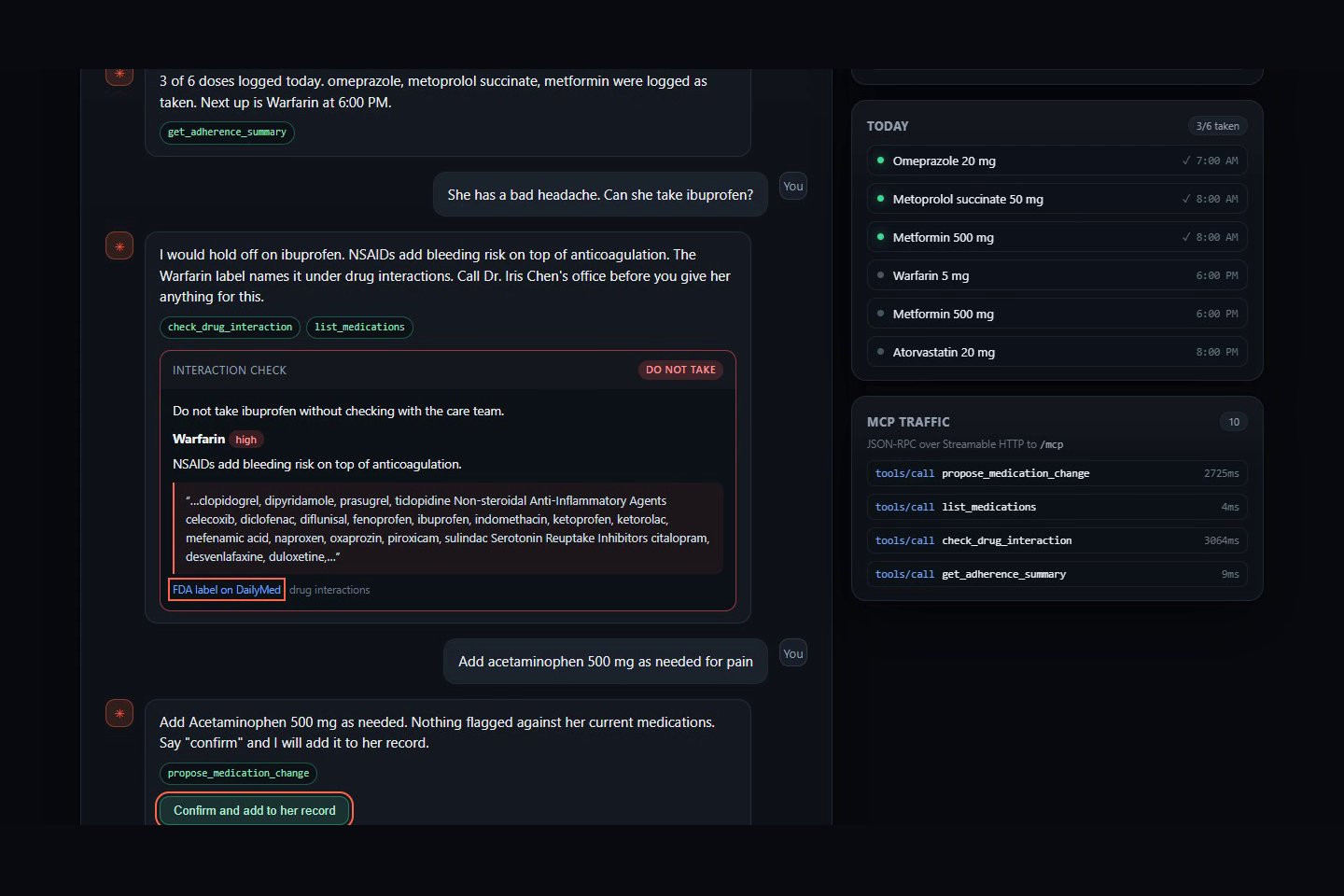
the propose → confirm → applied moment
Inspiration
My mother-in-law keeps five medications on her kitchen counter. She knows what each one is for; what she does not know is which over-the-counter painkiller is safe with her blood thinner. When she asks, the answer is usually a phone call to a doctor's office that closed at five.
Forty million Americans are that phone call now. They are not clinicians. They are daughters and sons standing in a kitchen at nine at night, holding a bottle, deciding. The information they need is public, it is in the FDA label, and the context is already written down somewhere. The two are just never in the same place at the moment of the question.
Alexa+ is the right surface for this because the question is spoken and the moment is short. The MCP server is the right architecture because medication data should live with the family, not with an assistant vendor.
What it does
Dosewise is a self-hosted MCP server (Streamable HTTP, MCP spec 2026-07-28) that owns one household's medication record and answers spoken questions about it.
Ask "Did Mom take her morning pills?" and it reports what was logged, what is due, and what is next.
Ask "Can she take ibuprofen for her headache?" and it:
- normalises ibuprofen through RxNorm to the ingredient (so "Advil" and "Motrin" work too),
- pulls the two most recent openFDA labels for each of her five medications,
- finds the sentence in the warfarin label that names ibuprofen, inside a flattened drug table, and quotes it with the section name, the label's effective date, and a DailyMed link,
- returns a verdict of
avoid,caution,no_known_interaction, orunverified, and names the prescriber to call.
If the label is unreachable, the verdict is unverified, never "safe". If a label sentence only points at another section, or explicitly says the two drugs do not interact, it is filtered out rather than shown as a warning.
Changing the record takes two steps because a model must not approve its own proposal: propose_medication_change mints a single-use, caregiver-bound, 10-minute token, and apply_medication_change requires it. Replay fails. Another token holder cannot redeem it.
It ships with a browser-based Alexa+ experience simulator: microphone, spoken answers, a safety card with the quoted label, a live dose timeline, and a panel showing the actual JSON-RPC traffic behind every answer. Two bearer tokens ship with the demo: a caregiver with read/write/notify, and a read-only display token whose write attempts are refused by the tool handlers themselves.
How we built it
- MCP TypeScript SDK v2 (
@modelcontextprotocol/server,/client,/node,/express): the server is acreateMcpHandler(factory)handler mounted on Express viatoNodeHandler, with a freshMcpServerper HTTP request, bearer auth resolved intoAuthInfo, and scopes checked inside every tool handler. - 9 tools, 5 resources, 2 prompts, each tool with a zod input schema, a zod
outputSchema, and MCP annotations (readOnlyHint,destructiveHint,openWorldHint). Tools returnstructuredContentso a host can render a safety card without parsing prose. - Evidence pipeline in TypeScript: RxNorm normalisation, openFDA label fetch (2 labels, 6-hour cache, boot-time prewarm), section-priority sentence extraction with table-aware windowing, severity heuristics, curated high-risk pairs, allergy families, verdict.
- Persistence: one JSON file with serialised mutations and write-then-rename atomicity. No native build step, and the demo state is inspectable.
- Agent: an Amazon Bedrock Converse tool loop when AWS credentials exist; otherwise a deterministic planner that calls the same MCP tools over the same HTTP transport. The UI labels which one answered.
- Simulator: vanilla HTML/CSS/JS, no build step, Web Speech API for voice.
- Tests: 9 unit tests (quote extraction, severity, adherence, confirmation TTL/scope/replay, store concurrency) plus
npm run smoke, which boots the real server and drives it with a real MCPClientoverStreamableHTTPClientTransport.
Challenges we ran into
- The RxNav interaction endpoint is retired (404). There is no free structured interaction API left, so the answer had to come from label text. That turned out better, the user gets the sentence a pharmacist would read, but it meant building and testing the extraction pipeline.
- Label text is a table dump. One "sentence" in a warfarin label is 400 characters of drug names. Naive matching produced a false high-severity warning for omeprazole + clarithromycin (a boilerplate cross-reference) and a false moderate warning for metformin + ibuprofen (a sentence saying they do not interact). Both are now filtered, with tests.
- openFDA has no field selection. Five medications times five labels is about 3 MB and an 8.7-second answer. Fixed with
limit=2, caching, and prewarming. - Elicitation throws on the current protocol era, so the human-in-the-loop step had to be protocol-neutral two-phase confirmation instead.
- Time-dependent demos are not reproducible, so the server has a
DEMO_CLOCKseam and the seeded dose log is relative to it.
The full list, with severity and "what would have removed it", is in the friction log.
Accomplishments that we're proud of
- The safety answer is verifiable: quote, section, effective date, DailyMed link, all on screen.
unverifiedis a first-class verdict. A network failure cannot be rendered as reassurance.- The scope demo is real: the read-only token is refused inside the tool, not by hiding a button.
- Replay-proof confirmations bound to the caregiver who proposed the change, with tests for expiry, cross-client redemption, action substitution, and replay.
- Every answer is auditable: the traffic panel shows the
tools/calland its latency next to the sentence that was spoken. - It runs with
npm install && npm start. No cloud account, no database, no API keys.
What we learned
- Grounding is a data engineering problem before it is a prompting problem. Most of the work was extraction, filtering, and deciding what "I don't know" looks like.
- For a voice product, latency is a correctness issue. A 9-second answer is a broken answer.
- "Not found" and "found nothing wrong" must be different states. Collapsing them is how a safety tool becomes dangerous.
- MCP is a genuinely good fit for Alexa+ because the tool contract is the product: the same server works from the simulator, from a desktop MCP host, and from a Bedrock agent loop with no changes.
What's next for Dosewise
- Real caregiver notifications (SMS/voice) behind the existing outbox, with delivery receipts.
- An OAuth resource server in front of the same
AuthInfocontract, so a household can be multi-user. - Pharmacist-reviewed expansion of the curated pairs, and a second evidence source for interactions that labels undersell.
- Refill and INR scheduling, which is the other half of the caregiver's day.
- A small on-device speech path so the medication list never leaves the house.
Product feedback and friction log
Every API and SDK used is reviewed in docs/PRODUCT_FEEDBACK.md: the MCP TypeScript SDK v2, the MCP spec, RxNorm/RxNav, openFDA, DailyMed, Amazon Bedrock Converse (including an explicit note that it was not exercised without credentials), and the Web Speech API.
The friction log has 12 entries with severity and what would have removed each one.
Not medical advice
Dana, Ruth and the prescribers are fictional. The labels are real. Dosewise does not diagnose, dose, or change a prescription without an explicit caregiver confirmation.
Built With
- amazon-bedrock
- css3
- dailymed
- express.js
- github
- html5
- javascript
- model-context-protocol
- node.js
- npm
- openfda
- rxnorm
- typescript
- web-speech-api
- zod

Log in or sign up for Devpost to join the conversation.