Inspiration
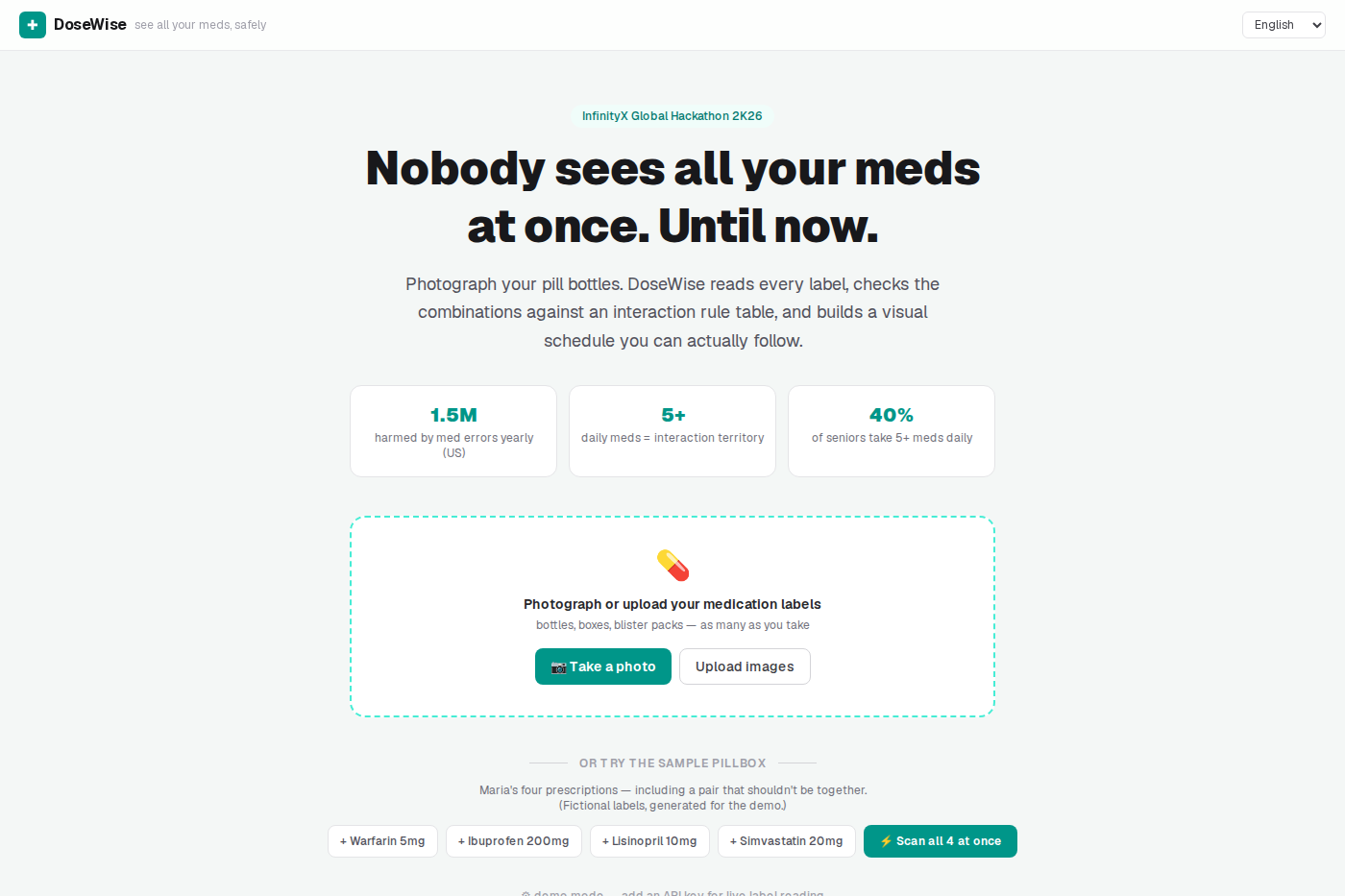
One and a half million people are harmed by medication errors every year in the US alone, and roughly 40% of seniors take five or more medications daily. The classic failure mode isn't exotic — nobody ever sees all the meds at once, so a blood thinner plus an innocent over-the-counter painkiller slips through.
We looked at the incumbents and found the space wide open: Medisafe — the market leader — capped its free tier at two medications this year and was caught sharing users' health data with pharma advertisers. MyTherapy has reminders but no interaction checking. Apple Health can scan a label, but it's iOS-only and its interaction warnings are US-only. Drugs.com's checker is comprehensive but demands you type everything in, in jargon. And CareZone — which pioneered photo-scanning pill bottles — was acquired by Walmart and shut down, taking the best idea in the category with it.
So we rebuilt photo-first medication safety: zero typing, zero accounts, zero data leaving the device.
What it does
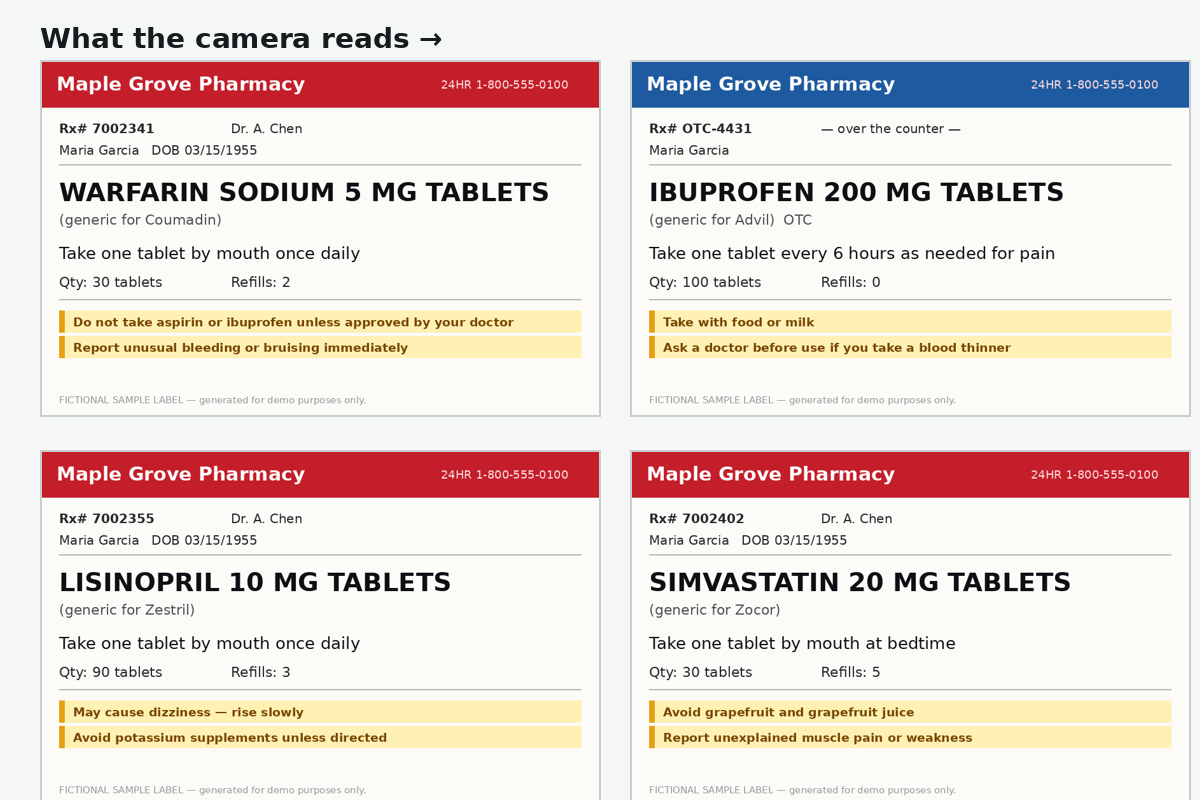
- Photograph or upload your medication labels — bottles, boxes, blister packs.
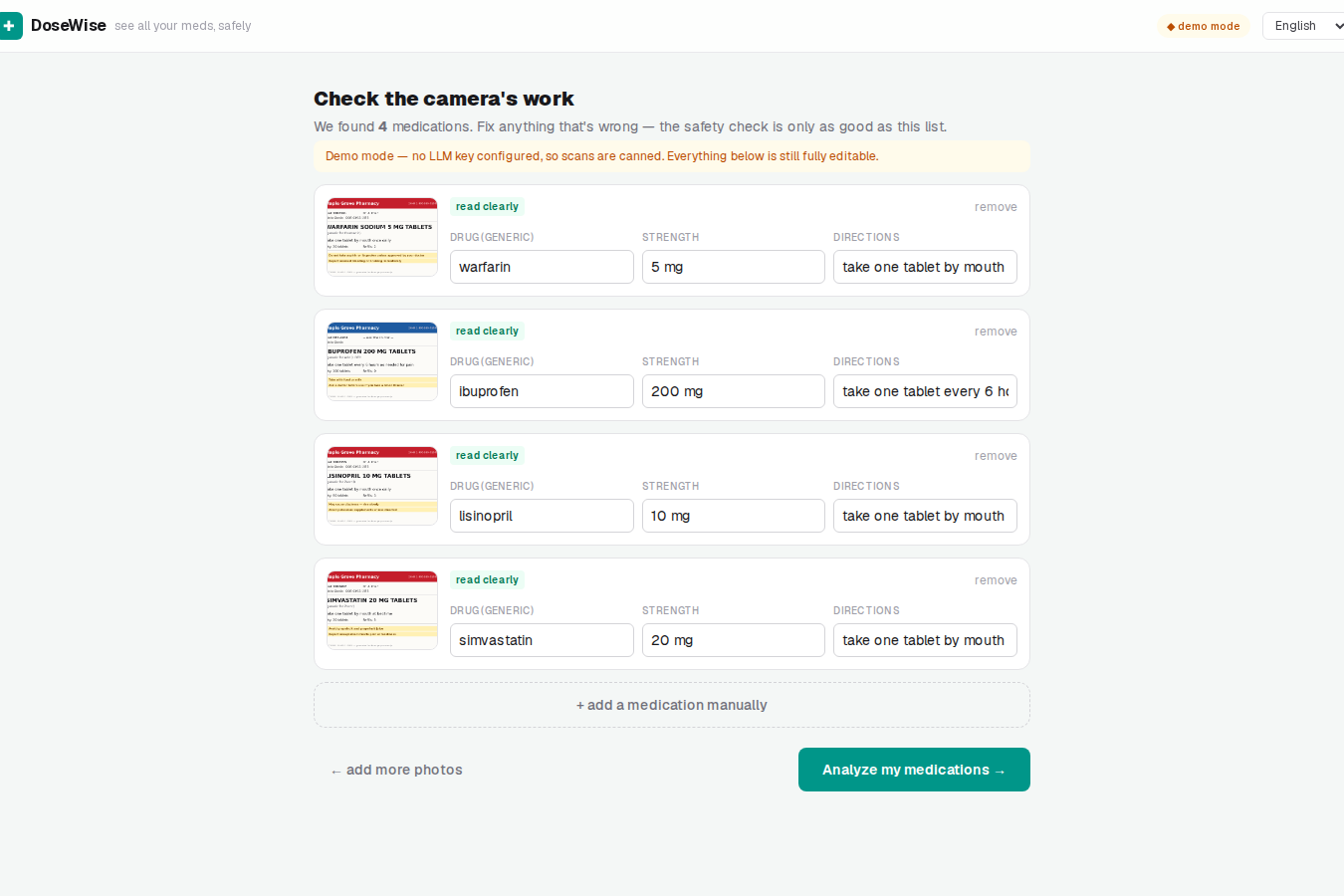
- A vision-language model reads every label — drug name, strength, directions, quantity — and shows you its work so you can fix anything it got wrong.
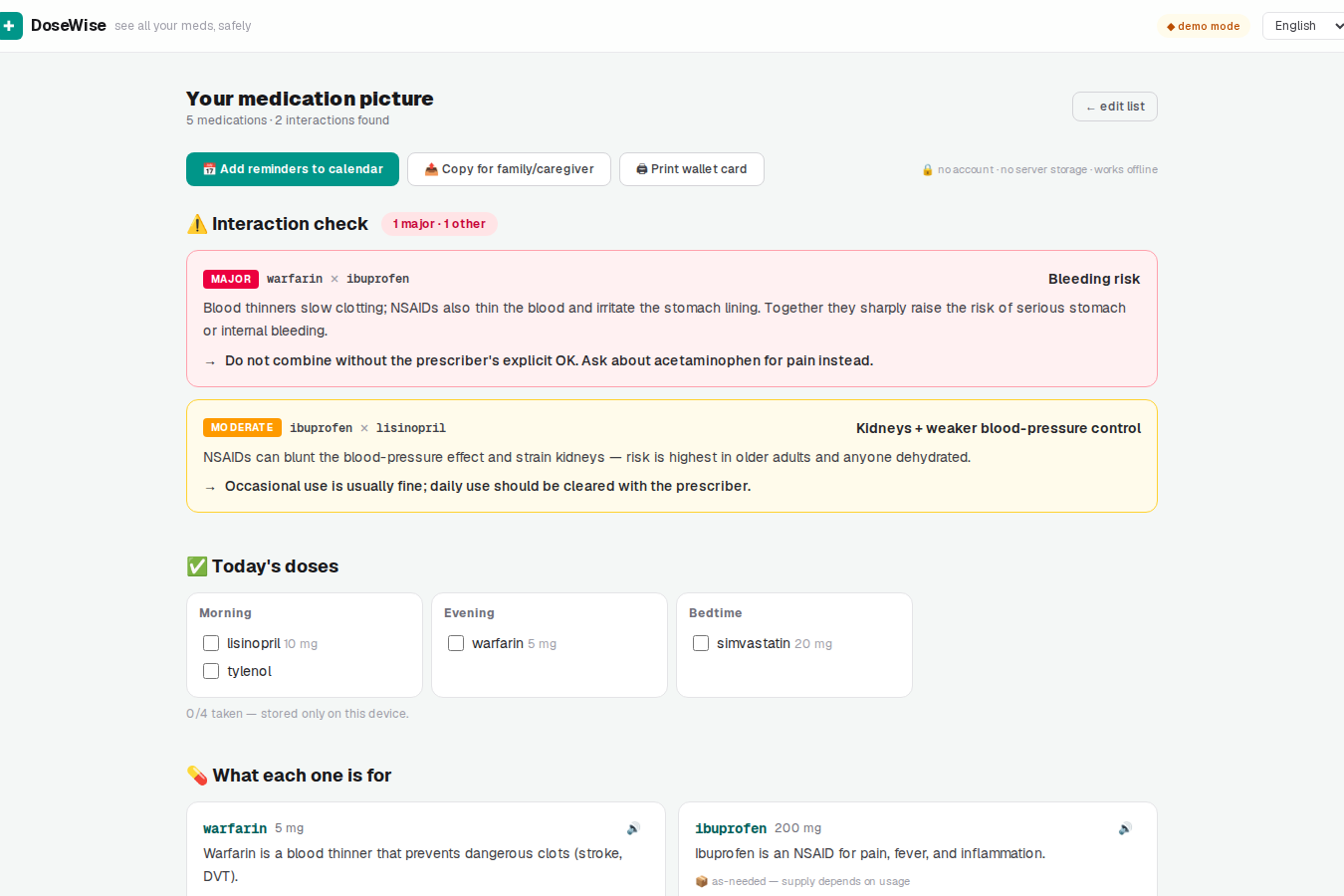
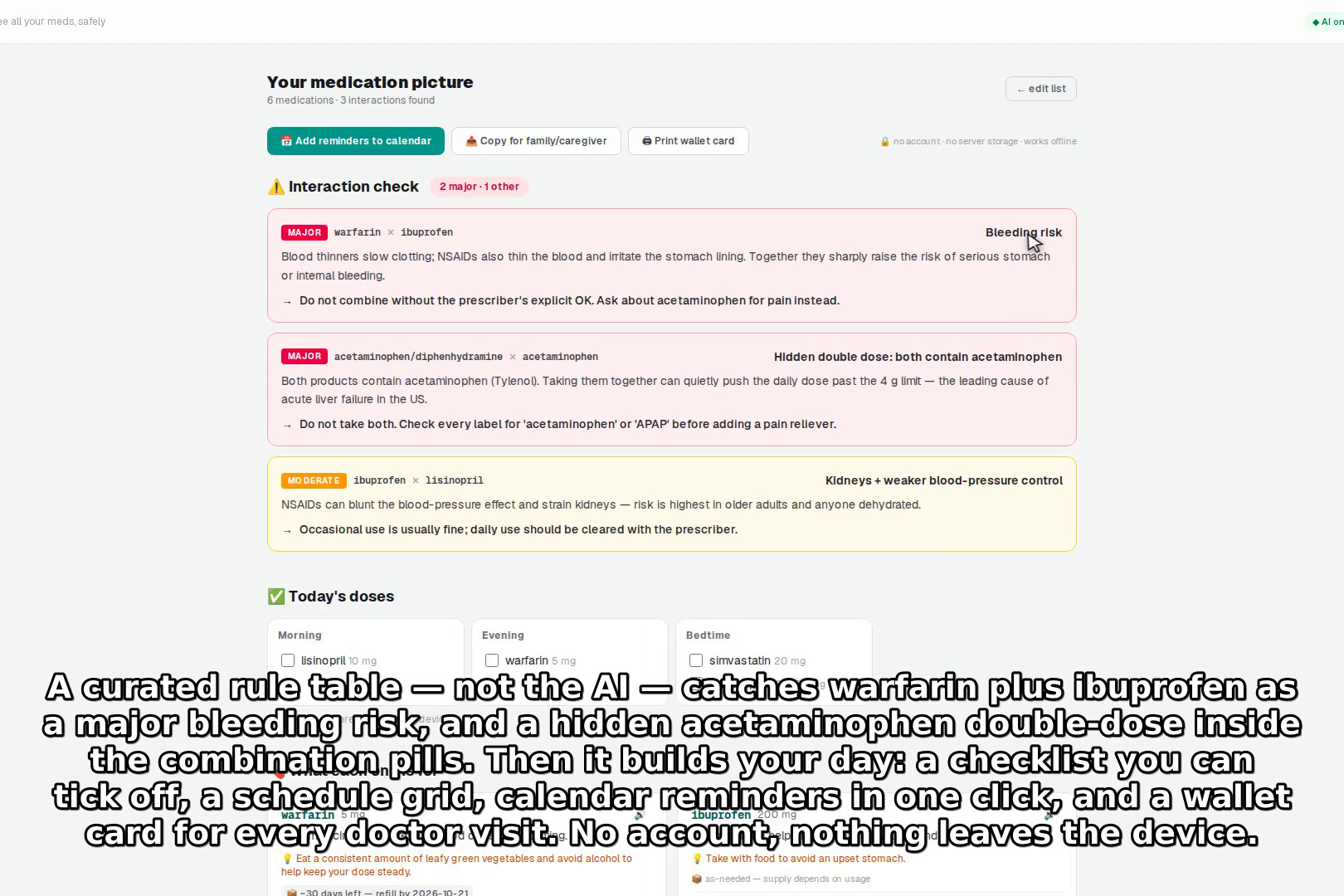
- A deterministic interaction engine — a curated, auditable rule table, never the LLM — flags dangerous combinations in plain language: warfarin × ibuprofen (bleeding risk), ACE inhibitors × potassium (dangerous potassium buildup), opioids × sedatives (respiratory depression), and hidden ingredient double-doses — Norco or Tylenol PM quietly contain acetaminophen, and stacking them with plain Tylenol is a leading cause of acute liver failure.
- A visual schedule lays out morning / noon / evening / bedtime / as-needed with the actual bottle photos, food flags, and drug-specific timing (statins at bedtime, thyroid meds on an empty stomach).
- Make it stick: a today's-doses checklist with streaks, one-click .ics calendar export, refill countdowns, a printable wallet card, and a plain-text summary to send to family or a caregiver.
- Multilingual plain-language explanations ("what is this one even for?") in six languages, with read-aloud for low-vision users.
DoseWise is an organization aid, not medical advice — every screen says so, and every warning carries a confirm-with-your-pharmacist path.
How we built it
- Next.js 16 + TypeScript + Tailwind v4 — single codebase, deployed two ways.
- Vision reading: label photos go to
Qwen3-VLthrough an OpenAI-compatible endpoint (image_urlpayloads), returning strict JSON per label, all images in parallel. - Deterministic safety core: a ~40-drug knowledge table (classes, brand-name aliases, combination-product ingredients) feeds a curated class-pair interaction rule table plus an ingredient-level duplication pass. Safety warnings are auditable code — the LLM can never originate one.
- Sig parser: free-text directions ("every 6 hours as needed", "at bedtime") map to schedule slots with drug-specific timing overrides; label quantity ÷ daily frequency yields refill countdowns.
- Provider resilience: custom user-agent (the endpoint fronts Cloudflare), cold-start retries, model fallback chains,
<think>-block stripping,!-flood filtering — and when no key exists at all, a fully working offline path with canned scans. - Two deployment modes: server API routes in development, and a static export for GitHub Pages where the entire engine runs in the browser — plus a BYOK settings panel that calls the model endpoint directly (it's CORS-open) for judges who want to try live reading with their own key.
- Everything else is free-tier friendly: synthetic pharmacy labels rendered with Pillow (zero PHI), an
.icsgenerator for calendar reminders, Web Speech API for read-aloud, localStorage for the med list and adherence streaks, and a Playwright suite (scripts/e2e.ts, 24 checks) that drives the real browser end-to-end against both builds. - The narrated demo video was produced with a local headless pipeline: Playwright capture → edge-tts voiceover → ffmpeg assembly.
Challenges we ran into
- Vision models are nondeterministic. The same label occasionally came back with an empty drug name on one run and perfect on the next. We added a nudge-retry in the scan path — and leaned into the design: the confirm screen always shows low-confidence reads for a human to fix. The human-in-the-loop step turned out to be the trust story, not a workaround.
- Cold starts. Free-tier GPU endpoints sleep; first calls took 75s. Retries plus model fallbacks plus a canned-offline path keep the demo alive even when upstream isn't.
- Static hosting constraint. GitHub Pages runs no server code, so the whole pipeline had to run client-side — which accidentally gave us our best feature: a deployment where no health data ever touches a server.
- Hidden ingredients. Name-matching misses the real killer — combination products. Modeling
contains(Percocet → oxycodone + acetaminophen) caught a major double-dose in our test pillbox that class-level rules alone would have missed.
Accomplishments that we're proud of
- Ingredient-level interaction detection that catches what name-match checkers miss — Norco + Tylenol = a quiet 4g acetaminophen overdose risk.
- The hybrid architecture itself: AI reads messy pixels, deterministic code makes safety claims. Every warning traces to an auditable rule.
- Genuinely zero-friction: no account, no install, no server — the live demo works offline-mode out of the box, and the whole flow was verified with 24 automated browser checks.
- It respects people: free for unlimited meds, no ads, nothing to harvest — the opposite of the market leader's playbook.
What we learned
- In safety-critical products, "the model said so" is not an answer — a rule table that a pharmacist could audit beats a bigger model.
- Human-in-the-loop UI isn't a patch for AI fallibility; done well, it is the product.
- The best features came from constraints: no budget → BYOK + offline mode → a stronger privacy story than every incumbent.
What's next for DoseWise
- Barcode/NDC lookup via openFDA for exact identification when labels are worn
- Caregiver links — read-only med-list sharing without accounts
- Pill identification for loose/unlabeled pills (imprint + shape + color)
- Validated rule coverage — scale the interaction table against RxNorm/openFDA label data, with pharmacist review
- PWA install for proper background dose reminders
Built With
- github
- next.js
- python
- qwen
- react
- tailwindcss
- typescript

Log in or sign up for Devpost to join the conversation.