Inspiration
We kept noticing how often your genes decide whether a drug is safe — most importantly in oncology, which we all cared about. The DPYD gene, for example, makes the enzyme that breaks down the chemotherapy drug 5-fluorouracil. If you inherit a variant that weakens that enzyme, the drug never clears and builds up to toxic levels, so the same dose that cures one patient can land another in the hospital.
And it isn't just cancer. For most everyday drugs, it comes down to the liver's cytochrome P450 enzymes, and the genes behind them vary widely from person to person. Slow metabolizers can't clear a drug, so it climbs to dangerous levels; ultrarapid metabolizers burn through it before it can work. One person's right dose is another's overdose, and another's waste of time.
Hospitals already act on this with genetic panels and pharmacist-applied CPIC guidelines, but the millions of people sitting on a 23andMe, Ancestry, or other customer DNA file had no private way to ask what their results meant for a medication. That's the gap we built DoseDNA for.
What it does
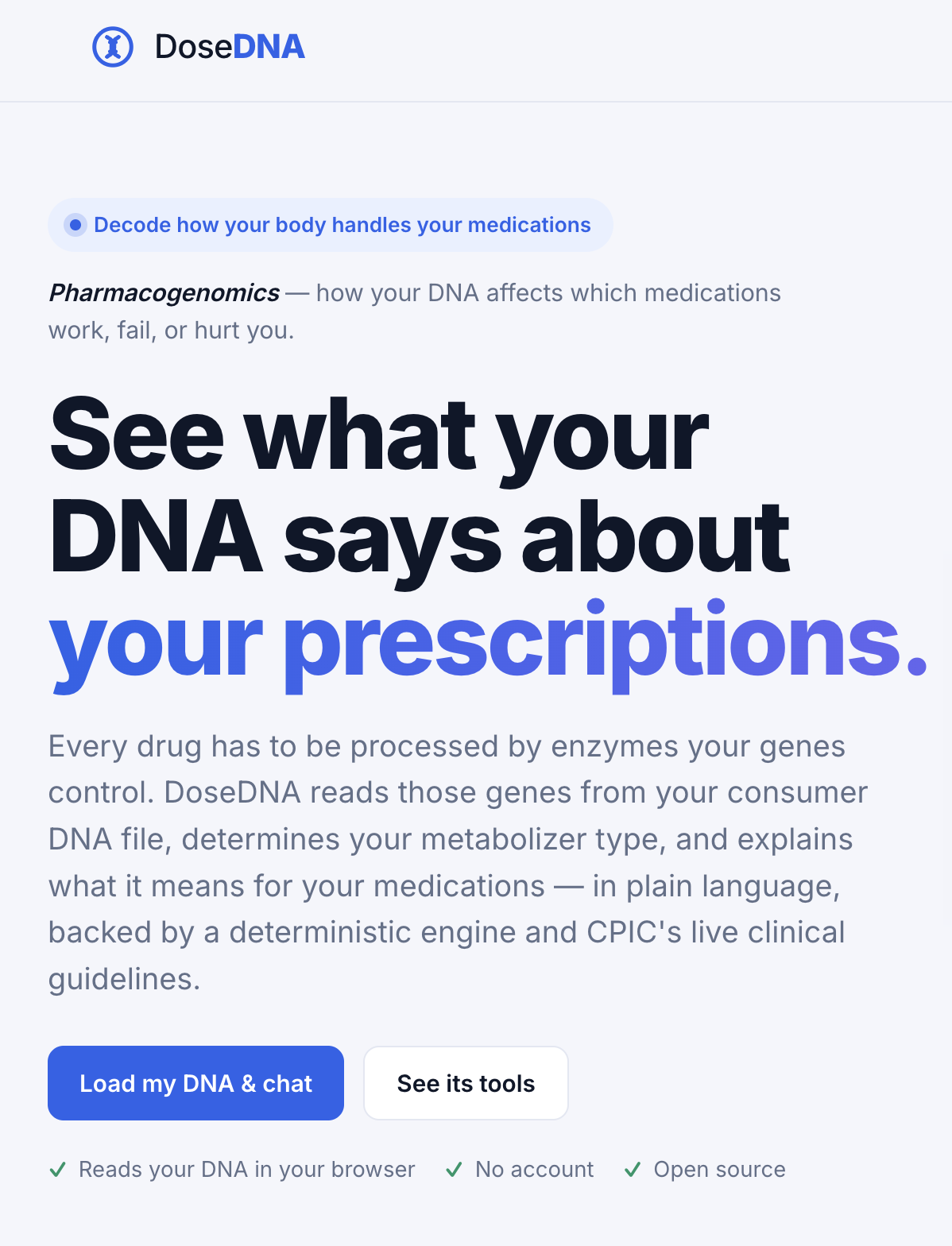
You drop in your raw 23andMe or Ancestry file and ask plain-language questions like "I was prescribed clopidogrel — what should I know?" DoseDNA reads your DNA, works out how you'd process that drug, and explains what it means in clear terms. The whole thing runs in your browser, so your genome never leaves your device. And when your data can't actually answer the question — which happens more often than you'd think — it tells you so instead of guessing.
How we built it
DoseDNA is built on CPIC, the standard that hospitals and health providers reference. Its engine reads your raw DNA file and works through it step by step: which variants you carry, what they mean for how you process a drug, and what the guidance is. Because it follows fixed rules, the medical reasoning runs entirely on your own device (no API key, no model), and the answer is always computed, never guessed. A language layer (Claude Opus 4.8) sits on top only to put that verified answer into plain words, but it can't invent any of the medicine itself.
Challenges we ran into
The first challenge was simply being a team that had never met! We only came together at the start of the event, so we had to quickly adapt to each other's work styles and abilities. We managed it by splitting the work by piece — one of us on the CPIC engine and data, another on the interface, another on the validation tests.
The next was getting it clinically right, because in pharmacogenomics, a wrong answer is worse than no answer at all. Our mentor's bar was that validation had to trace back to real patient data — not our own memory, and not the model's training. So we anchored every test to a landmark trial — CYP2C19 poor metabolizers on clopidogrel (TAILOR-PCI, 2020), or SLCO1B1 and statin-induced myopathy (SEARCH, 2008) — and checked that our answer carried the exact concept each paper proved, while catching falsely reassuring phrases like "standard dose is fine."
Accomplishments that we're proud of
We're proud that the medicine is never made up — every answer comes from a CPIC clinical table, and the AI only phrases what the engine has already verified. As well, we're proud that the genome never leaves the device, so privacy is built into the architecture rather than promised in a policy. And honestly, we're proud that we shipped something this careful as a team that had only just met!
What we learned
We were honestly surprised by how much you can build in a single weekend. We also finally understood why a single variant can flip a drug's effect: with an ordinary, already-active drug, a slow metabolizer overdoses because they can't clear it; but with a prodrug, the same person gets no effect because the drug never activates. Whether the body needs to clear the drug or switch it on is the hinge on which everything turns.
What's next for DoseDNA
Right now, we cover a focused set of genes and drugs to prove the idea works; the natural next step is broadening that to more gene–drug pairs and supporting more file formats. We'd also want a real pharmacist and clinician review of the guidance before anyone relies on it. Longer term, we see the same rigorous engine living in two places: helping individuals understand their own results, and giving clinicians a faster, trustworthy tool — moving "genotype before treatment" from something only hospitals do toward something everyone can reach.
Built With
- claude
- fastapi
- github
- html
- javascript
- node.js
- python
- uvicorn


Log in or sign up for Devpost to join the conversation.